Tag Archives: Parenting

New study: children of same-sex couples do less well than those of married couples

The Public Discourse reports on a new study out of Canada.

Excerpt:

A new academic study based on the Canadian census suggests that a married mom and dad matter for children. Children of same-sex coupled households do not fare as well.

There is a new and significant piece of evidence in the social science debate about gay parenting and the unique contributions that mothers and fathers make to their children’s flourishing. A study published last week in the journal Review of the Economics of the Household—analyzing data from a very large, population-based sample—reveals that the children of gay and lesbian couples are only about 65 percent as likely to have graduated from high school as the children of married, opposite-sex couples. And gender matters, too: girls are more apt to struggle than boys, with daughters of gay parents displaying dramatically low graduation rates.

Unlike US-based studies, this one evaluates a 20 percent sample of the Canadian census, where same-sex couples have had access to all taxation and government benefits since 1997 and to marriage since 2005.

While in the US Census same-sex households have to be guessed at based on the gender and number of self-reported heads-of-household, young adults in the Canadian census were asked, “Are you the child of a male or female same-sex married or common law couple?” While study author and economist Douglas Allen noted that very many children in Canada who live with a gay or lesbian parent are actually living with a single mother—a finding consonant with that detected in the 2012 New Family Structures Study—he was able to isolate and analyze hundreds of children living with a gay or lesbian couple (either married or in a “common law” relationship akin to cohabitation).

So the study is able to compare—side by side—the young-adult children of same-sex couples and opposite-sex couples, as well as children growing up in single-parent homes and other types of households. Three key findings stood out to Allen:

children of married opposite-sex families have a high graduation rate compared to the others; children of lesbian families have a very low graduation rate compared to the others; and the other four types [common law, gay, single mother, single father] are similar to each other and lie in between the married/lesbian extremes.

Employing regression models and series of control variables, Allen concludes that the substandard performance cannot be attributed to lower school attendance or the more modest education of gay or lesbian parents. Indeed, same-sex parents were characterized by higher levels of education, and their children were more likely to be enrolled in school than even those of married, opposite-sex couples. And yet their children are notably more likely to lag in finishing their own schooling.

[…]The truly unique aspect of Allen’s study, however, may be its ability to distinguish gender-specific effects of same-sex households on children. He writes:

the particular gender mix of a same-sex household has a dramatic difference in the association with child graduation. Consider the case of girls. . . . Regardless of the controls and whether or not girls are currently living in a gay or lesbian household, the odds of graduating from high school are considerably lower than any other household type. Indeed, girls living in gay households are only 15 percent as likely to graduate compared to girls from opposite sex married homes.

Thus although the children of same-sex couples fare worse overall, the disparity is unequally shared, but is instead based on the combination of the gender of child and gender of parents. Boys fare better—that is, they’re more likely to have finished high school—in gay households than in lesbian households. For girls, the opposite is true. Thus the study undermines not only claims about “no differences” but also assertions that moms and dads are interchangeable. They’re not.

With a little digging, I found the abstract of the study:

Almost all studies of same-sex parenting have concluded there is “no difference” in a range of outcome measures for children who live in a household with same-sex parents compared to children living with married opposite-sex parents. Recently, some work based on the US census has suggested otherwise, but those studies have considerable drawbacks. Here, a 20% sample of the 2006 Canada census is used to identify self-reported children living with same-sex parents, and to examine the association of household type with children’s high school graduation rates. This large random sample allows for control of parental marital status, distinguishes between gay and lesbian families, and is large enough to evaluate differences in gender between parents and children. Children living with gay and lesbian families in 2006 were about 65 % as likely to graduate compared to children living in opposite sex marriage families. Daughters of same-sex parents do considerably worse than sons.

The author of the study is a professor of economics at Simon Fraser University in British Columbia. His PhD in economics is from the University of Washington.

Related posts

How early can you start to teach children about Christian apologetics?

Here’s a post from a new blog called Beyond Teachable Moments, which offers best practices for Christian parents who want to prepare their children for a world that doesn’t always support Christian convictions – and that’s putting it mildly. In this post, the author explains how she is able to prepare her two boys for a pretty common objection to Christianity.

The challenge:

I think all kids, and adults, have a curiosity about where the Bible came from, how it was put together, and how it was passed down.  That is why my husband and I wanted to teach our kids some of the basics about this topic early on in their lives.  We have found our kids to be really receptive to this material.

[…]Do these differences in the gospel accounts mean that the disciples made up the story about Jesus, or that they are at least unreliable eyewitnesses, as some conclude?  If the eyewitnesses to the gospel accounts can’t get their story straight, should we believe their testimony at all?

So the mom planned out an activity to teach her kids to defend against this objection: (how old do you think kids have to be for this to work?)

The gist of this activity is to set up a scenario where your kids act as eyewitnesses to an event, and then help them to discover that they each will remember and report on different aspects of that event.

There are many ways to do this activity.  I chose to create my own scenario, which I detail below.  You could alternatively have your kids, or one child and a different adult, watch a video clip together on YouTube or on a DVD.  Just make sure to watch the clip on your own in advance so you that have the details straight in your own head first.  Then ask similar pointed questions to the ones listed in the activity outlined below.

I arranged for our kids to meet me in the living room at an appointed time.  I told them that I had something special to show them.  I didn’t give them any further preparation.

Then I dressed up in a strange and elaborate costume.  I put on various pieces of my kid’s dress up costumes (a hat, a mask, ponytails in my hair, a cape, a shirt with a picture on it, gloves, a scarf, and various things sticking out of my front and back pockets, and I had a stuffed animal tucked in somewhere to boot).

At the appointed time, I came into the room where my kids were seated and announced with a strange accent:  “Welcome everyone.  I am Mommy the Magnificent and I have a magic show to perform for you!”

I then explained how I was going to make something disappear in my magic hat.  I put a small toy in my hat; I waved a fancy cloth over top of it that I had taken out of one of my pockets, turned around a bunch of times (mainly so they could see the back of my costume), and said some magic sounding words.  I did some fancy dancing moves and made the toy disappear (by concealing it in my hand).  I then bowed and left the room.

The kids were amused, but also confused.

I told the kids to stay where they were, and quickly took off all of my costume and hid it out of sight.  I re-entered the room where my kids were bouncing off the walls, re-gathered them onto the couch and told them that that they were just eyewitnesses to what I had performed for them.

Then I asked: What is an eyewitness?  (Answer: Someone who sees something with their own eyes.  As they also heard something, our kids coined the term ‘earwitness’ as well!)

I told them that I was going to interview each of them to find out what they saw in my performance.  I took them one by one into a different room where our conversation could not be overheard by their brother, and interviewed them individually.  I told the one waiting to be interviewed to think hard about what he had just seen in preparation for his interview.

Click through to read how the kids responded. I don’t have any kids of my own, but I am reading this blog to see how it’s done. Each post is showing a completely new creative technique for teaching apologetics to these two young boys. If you have any techniques like this, post an example in the comments.

Do you think that it is worth it to have a stay-at-home mom doing these sorts of activities with kids? Do you think that a government-run daycare would do similar activities? What sort of policies should a liberty-minded government enact in order to free up mothers to stay home and nurture their children like this? Which political party do you think is pushing for those policies? Which party is trying to make it harder for moms to stay home and do these sorts of activities?

Women earned more doctoral and Master’s degrees than men in 2012

Women now earning majority of graduate degrees

From the American Enterprise Institute Ideas blog.

Excerpt:

The Council of Graduate Schools (CGS) released its annual report recently on U.S. graduate school enrollment and degrees for 2012, and here are some of the more interesting findings in this year’s report:

1. For the fourth year in a row, women in 2012 earned a majority of doctoral degrees. Of the 67,220 doctoral degrees awarded in 2012 at U.S. universities, women earned 34,761 of those degrees and 52.2% of the total, compared to 31,830 degrees awarded to men who earned 47.8% of the total (see top chart above).

[…]2. By field of study, women earning doctoral degrees in 2012 outnumbered men in 7 of the 11 graduate fields tracked by the CGS (see top chart above)

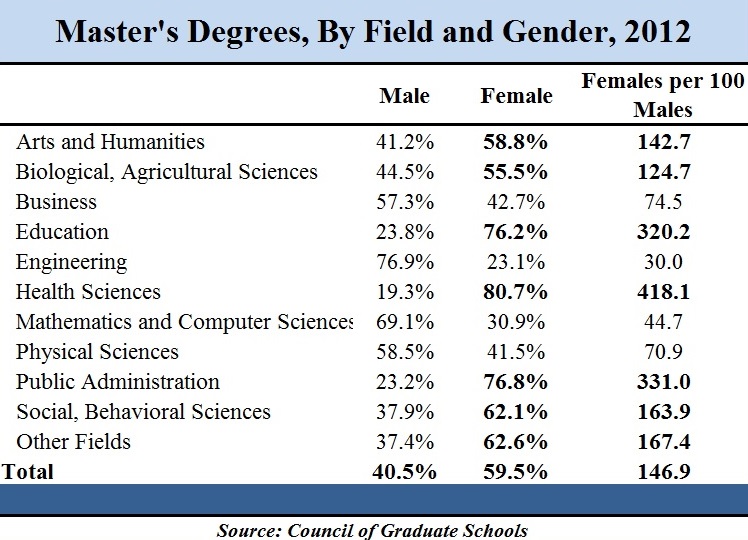
[…]3. The middle chart above shows the gender breakdown for master’s degrees awarded in 2012, and the gender disparity in favor of females is significant – women earned just under 60% of all master’s degrees in 2012, which would also mean that women earned 146.9 master’s degrees last year for every 100 degrees earned by men.

[…]Women represent 58.5% of all graduate students in the U.S., meaning that there are now 141 women enrolled in graduate school for every 100 men.

Click here for the charts.

The author of the post, Dr. Mark Perry, concludes this:

MP: Here’s my prediction – the facts that: a) men are underrepresented in graduate school enrollment overall (100 men were enrolled in 2012 for every 141 women), b) men received fewer master’s (40.5% of the total) and doctoral degrees (47.8% of the total) than women in 2012, and c) men were underrepresented in 7 out of 11 graduate fields of study at both the master’s and doctoral levels last year will get no attention at all from the media, universities and anybody in the higher education industry.

Additionally, there will be no calls for government studies, or increased government funding to address the significant gender disparities in graduate schools, and nobody will refer to the gender graduate school enrollment and degree gaps favoring women as a problem or a “crisis.”  Further, neither President Obama nor Congress will address the gender graduate enrollment and degree gaps by invoking the Title IX gender-equity law, like they have threatened to do for the gender gap in some college math and science programs. And there won’t be any executive orders to address the huge gender disparity in graduate schools by creating a White House Council on Boys and Men like the executive order issued by President Obama in 2009 to create the “White House Council on Women and Girls.”  Finally, despite their stated commitment to “gender equity,” the hundreds of university women’s centers around the country are unlikely to show any concern about the significant gender inequities in graduate school enrollment and degrees, and universities will not be allocating funding to set up men’s centers or create graduate scholarships for men.

Bottom Line: If there is any attention about gender differences in the CGS annual report, it will likely be about the fact that women are a minority in 4 of the 11 fields of graduate study including engineering and computer science (a gender gap which some consider to be a “national crisis”), with calls for greater awareness of female under-representation in STEM graduate fields of study and careers (except for the STEM field of biology, where women areover-represented).  But don’t expect any concern about the fact that men have increasingly become the second sex in higher education.  The concern about gender imbalances will remain extremely selective, and will only focus on cases when women, not men, are underrepresented and in the minority.

Men outnumber women in business, computer science, engineering and physical sciences.

I echo Dr. Perry’s point, and want to add this. In traditional Christianity, men are responsible for providing for their families. One of the ways that we men prepare for this is by getting advanced degrees in STEM-related fields, since these fields are the hardest and also pay the best. So with that in mind, what does it mean for men who want to prepare for this provider role that there is this obvious discrimination against men in graduate schools and doctoral programs? Is anyone going to do anything to change policies and incentives to favor men, like they did when women were under-represented? Of course not. The only thing that will be done is to ignorantly urge men to “man up”, while ignoring the real problems, e.g. – a lack of male teachers, schools that are not geared to male learning styles, and so on.

Related posts