Tag Archives: Feminist

New study: Half of children born last year will see their parents split by age 15

Dina tweeted this post from the UK Daily Mail.

Excerpt:

Children born last year are more likely than any previous generation to see their parents split up, research suggests.

Nearly half will experience family breakdown, according to a report by the Marriage Foundation think tank.

Its researchers estimate that 354,000 out of the 729,674 children born in England and Wales in 2012 will have parents who are separated by the time they reach the age of 15.

The report also suggests that married couples are much more likely to stay together than those who are unmarried.

The vast majority of children whose parents will still be together by their mid-teens will have a mother and father who are married, the report said. Only 5 per cent will have unmarried parents.

Harry Benson, of the Marriage Foundation, said: ‘We continually hear about divorce rates shooting up and causing the exponential rise in family breakdown, but this is demonstrably not the case.

‘The percentage of marriages ending in divorce has actually fallen since 2005 to 42 per cent. For all marriages lasting over ten years, the divorce rate has barely changed since the 1960s.

‘It is the declining rates of marriage which provide the only conceivable explanation of the doubling of family breakdown since the 1980s.

‘Of the teenagers not living with both parents, just 32 per cent of cases involved divorce.’

Last week a report by the  chief inspector of schools Sir Michael Wilshaw linked social problems in Britain to bad parenting. He criticised ‘hollowed-out and fragmented families’ where parents suffer a ‘poverty of accountability’.

Sir Michael said many children were ‘alienated’ from their fathers, and warned of social problems resulting from ‘making excuses’ for bad parents.

‘Some people will tell you that social breakdown is the result of material poverty – it’s more than this,’ he said.

‘These children lack more than money: They lack parents who take responsibility for seeing them raised well. It is this poverty of accountability which costs them.

‘These children suffer because they are not given clear rules or boundaries, have few secure or safe attachments at home, and little understanding of the difference between right and wrong behaviour.’

Findings from the Centre for Social Justice have shown as many as one million children are growing up without a father.

I think that if we really want children to have what they need, then we have to take a very strong position on the tolerance and non-judgmentalism that is so popular among the social left today. Because we are tolerant and non-judgmental, 53 million unborn children are dead. Because we are tolerant and non-judgmental, a record number of children are being raised without their mother or their father (or both). Because we are tolerant and non-judgmental, children are being saddled with the costs of fixing the results of irresponsibility decisions made by adults. Because we are tolerant and non-judgmental, we have run up a $17 trillion dollar debt so that the President can congratulate himself on how generous he is by spending money that other people earned (or will have to earn).

Maybe we need to stop thinking about being liked by our peers and start thinking about doing what’s right for children – born and unborn. A good first step would be to view anyone who espouses moral relativism as an evil, destructive, selfish and foolish person. When a woman brags to you about how she doesn’t judge anyone, you should look at her as someone immoral who cannot see the difference between policies/choices that harm children, and policies/choices that help them. At the very least, you should never marry someone who supports redefining marriage to include no-fault divorce and same-sex marriage. You should never marry someone who supports paying people taxpayer money to have children out of wedlock.

If a person cannot see how natural marriage protects children, then don’t marry them. We need to shame people who don’t protect children. It doesn’t matter what they say to you in order to sound nice. It only matters that they won’t condemn things that are clearly wrong. That makes them a threat to children, and unsuitable for marriage.
Dennis Prager explains what feminism has achieved for women

Dennis Prager has summarized many of my viewpoints on this blog in a tiny, tiny little article. He calls it “Four Legacies of Feminism“.

Read the whole glorious thing and bask in its wisdom!

Full text:

As we approach the 50th anniversary of the publication of Betty Friedan’s feminist magnum opus, The Feminine Mystique, we can have a perspective on feminism that was largely unavailable heretofore.

And that perspective doesn’t make feminism look good. Yes, women have more opportunities to achieve career success; they are now members of most Jewish and Christian clergy; women’s college sports teams are given huge amounts of money; and there are far more women in political positions of power. But the prices paid for these changes — four in particular — have been great, and outweigh the gains for women, let alone for men and for society.

1) The first was the feminist message to young women to have sex just as men do. There is no reason for them to lead a different sexual life than men, they were told. Just as men can have sex with any woman solely for the sake of physical pleasure, so, too, women ought to enjoy sex with any man just for the fun of it. The notion that the nature of women is to hope for at least the possibility of a long-term commitment from a man they sleep with has been dismissed as sexist nonsense.

As a result, vast numbers of young American women had, and continue to have, what are called “hookups”; and for some of them it is quite possible that no psychological or emotional price has been paid. But the majority of women who are promiscuous do pay prices. One is depression. New York Times columnist Ross Douthat recently summarized an academic study on the subject: “A young woman’s likelihood of depression rose steadily as her number of partners climbed and the present stability of her sex life diminished.”

Long before this study, I had learned from women callers to my radio show (an hour each week — the “Male-Female Hour” — is devoted to very honest discussion of sexual and other man-woman issues) that not only did female promiscuity coincide with depression, it also often had lasting effects on women’s ability to enjoy sex. Many married women told me that in order to have a normal sexual relationship with their husband, they had to work through the negative aftereffects of early promiscuity — not trusting men, feeling used, seeing sex as unrelated to love, and disdaining their husband’s sexual overtures. And many said they still couldn’t have a normal sex life with their husband.

2) The second awful legacy of feminism has been the belief among women that they could and should postpone marriage until they developed their careers. Only then should they seriously consider looking for a husband. Thus, the decade or more during which women have the best chance to attract men is spent being preoccupied with developing a career. Again, I cite woman callers to my radio show over the past 20 years who have sadly looked back at what they now, at age 40, regard as 20 wasted years. Sure, these frequently bright and talented women have a fine career. But most women are not programmed to prefer a great career to a great man and a family. They feel they were sold a bill of goods at college and by the media. And they were. It turns out that most women without a man do worse in life than fish without bicycles.

3) The third sad feminist legacy is that so many women — and men — have bought the notion that women should work outside the home that for the first time in American history, and perhaps world history, vast numbers of children are not primarily raised by their mothers or even by an extended family member. Instead they are raised for a significant part of their childhood by nannies and by workers at daycare centers. Whatever feminists may say about their only advocating choices, everyone knows the truth: Feminism regards work outside the home as more elevating, honorable, and personally productive than full-time mothering and making a home.

4) And the fourth awful legacy of feminism has been the demasculinization of men. For all of higher civilization’s recorded history, becoming a man was defined overwhelmingly as taking responsibility for a family. That notion — indeed the notion of masculinity itself — is regarded by feminism as the worst of sins: patriarchy.

Men need a role, or they become, as the title of George Gilder’s classic book on single men describes them: Naked Nomads. In little more than a generation, feminism has obliterated roles. If you wonder why so many men choose not to get married, the answer lies in large part in the contemporary devaluation of the husband and of the father — of men as men, in other words. Most men want to be honored in some way — as a husband, a father, a provider, as an accomplished something; they don’t want merely to be “equal partners” with a wife.

In sum, thanks to feminism, very many women slept with too many men for their own happiness; postponed marriage too long to find the right man to marry; are having hired hands do much of the raising of their children; and find they are dating boy-men because manly men are so rare.

Feminism exemplifies the truth of the saying, “Be careful what you wish for — you may get it.”

I wish I could add something to this, but I can’t because every time I think of something to add, he says it in the next sentence.

If you like this short essay, then this medium essay arguing against feminism authored by Barbara Kay would be nice follow-up.

It might be worth forwarding these articles along to your friends. And I highly recommend books on male-female relationships and roles by George Gilder, especially “Men and Marriage“.

Women earned more doctoral and Master’s degrees than men in 2012

Women now earning majority of graduate degrees

From the American Enterprise Institute Ideas blog.

Excerpt:

The Council of Graduate Schools (CGS) released its annual report recently on U.S. graduate school enrollment and degrees for 2012, and here are some of the more interesting findings in this year’s report:

1. For the fourth year in a row, women in 2012 earned a majority of doctoral degrees. Of the 67,220 doctoral degrees awarded in 2012 at U.S. universities, women earned 34,761 of those degrees and 52.2% of the total, compared to 31,830 degrees awarded to men who earned 47.8% of the total (see top chart above).

[…]2. By field of study, women earning doctoral degrees in 2012 outnumbered men in 7 of the 11 graduate fields tracked by the CGS (see top chart above)

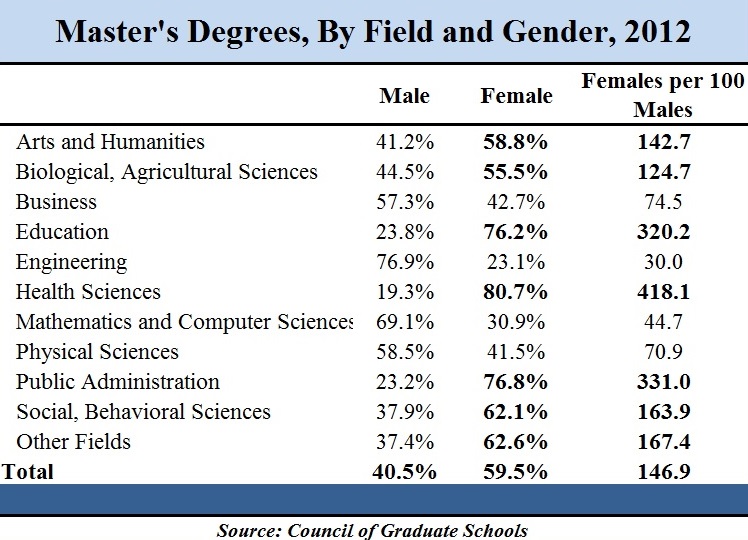
[…]3. The middle chart above shows the gender breakdown for master’s degrees awarded in 2012, and the gender disparity in favor of females is significant – women earned just under 60% of all master’s degrees in 2012, which would also mean that women earned 146.9 master’s degrees last year for every 100 degrees earned by men.

[…]Women represent 58.5% of all graduate students in the U.S., meaning that there are now 141 women enrolled in graduate school for every 100 men.

Click here for the charts.

The author of the post, Dr. Mark Perry, concludes this:

MP: Here’s my prediction – the facts that: a) men are underrepresented in graduate school enrollment overall (100 men were enrolled in 2012 for every 141 women), b) men received fewer master’s (40.5% of the total) and doctoral degrees (47.8% of the total) than women in 2012, and c) men were underrepresented in 7 out of 11 graduate fields of study at both the master’s and doctoral levels last year will get no attention at all from the media, universities and anybody in the higher education industry.

Additionally, there will be no calls for government studies, or increased government funding to address the significant gender disparities in graduate schools, and nobody will refer to the gender graduate school enrollment and degree gaps favoring women as a problem or a “crisis.”  Further, neither President Obama nor Congress will address the gender graduate enrollment and degree gaps by invoking the Title IX gender-equity law, like they have threatened to do for the gender gap in some college math and science programs. And there won’t be any executive orders to address the huge gender disparity in graduate schools by creating a White House Council on Boys and Men like the executive order issued by President Obama in 2009 to create the “White House Council on Women and Girls.”  Finally, despite their stated commitment to “gender equity,” the hundreds of university women’s centers around the country are unlikely to show any concern about the significant gender inequities in graduate school enrollment and degrees, and universities will not be allocating funding to set up men’s centers or create graduate scholarships for men.

Bottom Line: If there is any attention about gender differences in the CGS annual report, it will likely be about the fact that women are a minority in 4 of the 11 fields of graduate study including engineering and computer science (a gender gap which some consider to be a “national crisis”), with calls for greater awareness of female under-representation in STEM graduate fields of study and careers (except for the STEM field of biology, where women areover-represented).  But don’t expect any concern about the fact that men have increasingly become the second sex in higher education.  The concern about gender imbalances will remain extremely selective, and will only focus on cases when women, not men, are underrepresented and in the minority.

Men outnumber women in business, computer science, engineering and physical sciences.

I echo Dr. Perry’s point, and want to add this. In traditional Christianity, men are responsible for providing for their families. One of the ways that we men prepare for this is by getting advanced degrees in STEM-related fields, since these fields are the hardest and also pay the best. So with that in mind, what does it mean for men who want to prepare for this provider role that there is this obvious discrimination against men in graduate schools and doctoral programs? Is anyone going to do anything to change policies and incentives to favor men, like they did when women were under-represented? Of course not. The only thing that will be done is to ignorantly urge men to “man up”, while ignoring the real problems, e.g. – a lack of male teachers, schools that are not geared to male learning styles, and so on.

Related posts