
Tag Archives: Salary

Graduate students with non-STEM degrees increasingly dependent on welfare programs

From the Chronicle of Higher Education.

Excerpt:

Melissa Bruninga-Matteau, a medieval-history Ph.D. and adjunct professor who gets food stamps: “I’ve been able to make enough to live on. Until now.”

“I am not a welfare queen,” says Melissa Bruninga-Matteau.

That’s how she feels compelled to start a conversation about how she, a white woman with a Ph.D. in medieval history and an adjunct professor, came to rely on food stamps and Medicaid. Ms. Bruninga-Matteau, a 43-year-old single mother who teaches two humanities courses at Yavapai College, in Prescott, Ariz., says the stereotype of the people receiving such aid does not reflect reality. Recipients include growing numbers of people like her, the highly educated, whose advanced degrees have not insulated them from financial hardship.

“I find it horrifying that someone who stands in front of college classes and teaches is on welfare,” she says.

Ms. Bruninga-Matteau grew up in an upper-middle class family in Montana that valued hard work and saw educational achievement as the pathway to a successful career and a prosperous life. She entered graduate school at the University of California at Irvine in 2002, idealistic about landing a tenure-track job in her field. She never imagined that she’d end up trying to eke out a living, teaching college for poverty wages, with no benefits or job security.

Ms. Bruninga-Matteau always wanted to teach. She started working as an adjunct in graduate school. This semester she is working 20 hours each week, prepping, teaching, advising, and grading papers for two courses at Yavapai, a community college with campuses in Chino Valley, Clarkdale, Prescott, Prescott Valley, and Sedona. Her take-home pay is $900 a month, of which $750 goes to rent. Each week, she spends $40 on gas to get her to the campus; she lives 43 miles away, where housing is cheaper.

Ms. Bruninga-Matteau does not blame Yavapai College for her situation but rather the “systematic defunding of higher education.” In Arizona last year, Gov. Jan Brewer, a Republican, signed a budget that cut the state’s allocation to Yavapai’s operating budget from $4.3-million to $900,000, which represented a 7.6 percent reduction in the college’s operating budget. The cut led to an 18,000-hour reduction in the use of part-time faculty like Ms. Bruninga-Matteau.

“The media gives us this image that people who are on public assistance are dropouts, on drugs or alcohol, and are irresponsible,” she says. “I’m not irresponsible. I’m highly educated. I have a whole lot of skills besides knowing about medieval history, and I’ve had other jobs. I’ve never made a lot of money, but I’ve been able to make enough to live on. Until now.”

She’s irresponsible, because she expects the people who choose to study rather difficult and unpleasant subjects like nursing and computer science and economics to pay for her lifestyle through taxation and “higher education funding”. I do think it’s important to point out that the main driver of higher tuition is increasing government funding of education, and that this increasing funding of higher education is nothing but corporate welfare.

Excerpt:

The most obvious way that colleges might capture federal student aid is by raising tuition. Research to date has been inconclusive, but Stephanie Riegg Cellini of George Washington University and Claudia Goldin of Harvard have provided compelling new analysis. Cellini and Goldin looked at for-profit colleges, utilizing the key distinction that only some for-profit schools are eligible for federal aid. Riegg and Goldin find that that aid-eligible institutions “charge much higher tuition … across all states, samples, and specifications,” even when controlling for the content and quality of courses. The 75 percent difference in tuition between aid-eligible and ineligible for-profit colleges — an amount comparable to average per-student federal assistance — suggests that “institutions may indeed raise tuition to capture the maximum grant aid available.”

Here are some of the comments that I posted in a Facebook discussion about the CHE story:

I know that some may disagree with me, but this is why people need to focus on STEM fields and stay away from artsy stuff and Ph.Ds in general. We are in a recession. Trade school and STEM degrees only until things improve.

Also, no single motherhood by choice. Get married before you have children, and make sure you vet the husband carefully for his ability to protect, provide, commit and lead on moral and spiritual issues. This woman is not a victim. She chose her life, and the rest of us are paying for it. Nice tattoos by the way – that will really help when she’s looking for a job.

I am actually better at English than computer science, but I find myself with a BS and MS in computer science. We don’t get to do what we like. We do what we have to in order to be effective as Christians. According to the Bible, men have an obligation to not engage in premarital sex, and to marry before having children, and to provide for their families, or they have denied the faith. I would like to have studied English, but the Bible says no way.

I have no problem with people who can make a career out of the arts, like a Robert George or a William Lane Craig. But you can’t just go crazy. And I think men have a lot less freedom than women to choose their major, we have the obligation to be providers and we have to be selected by women based on whether we can fulfill that role (among other roles).

Women have more freedom because they are not saddled with the provider role like men are. However, I think that the times now are different than before. There is more discrimination against conservatives on campus in non-STEM fields and fewer non-STEM jobs in a competitive global economy. The safest fields are things like petroleum engineering, software engineering, etc.

If [people who major in the humanities] can make a living and support a family without relying on government-controlled redistribution of wealth, then I salute and encourage you. If you rely on the government, know that this money is being taken away from those who are doing things they don’t like at all in order to be independent and self-reliant. It is never good to be dependent on government. That money comes from people like me.

In response to an artsy challenger:

I am happy to be scorned by those who make poor choices so long as I can have my money back from them so that I can pursue my dreams. I didn’t see any of these artsy people in the lab at 4 AM completing their operating system class assignments, nor do I see them here working overtime on the weekend in the office. They can say anything and feel anything they want, and write plays and poetry all about their feelings, too. Just give me the money I earned back first. It’s not their money. They have no right to it.

One person asked why I was “always winter, never Christmas”, and I replied:

It is Christmas for the Christians who I send books and DVDs to, as well as for the Christian scholars I support, and the Christian conferences, debates and lectures I underwrite across the world. Unfortunately, every dollar taken from me is a dollar less for that Ph.D tuition of a Christian debater, a dollar less for the flight of that Christian apologetics speaker, a dollar less for that textbook for that Christian biology student, and a dollar less for the flowers being sent to that post-abortive woman who I counseled who is now in law school. I have a need for the money I earn, and when it’s sent to Planned Parenthood to pay for abortions by the government, my plan to serve God suffers. And finally, should I ever get married, I would like my wife to have the option of staying home with the children and even homeschooling them. That costs money. Somehow, I feel that given the choice between my homeschooling wife and the public school unions, the government will choose to give my money to the unions. Just a hunch.

I’m not Santa Claus – I have goals for the money I earn.

I think that people should go into the humanities when they are serious about making a career of it and can get the highest grades. But if they are coasting and only getting Bs and Cs and not paying attention in class, then drop out and go to trade school. Don’t complain later when you can’t find a job. STEM careers pay the most.

Top-earning degrees / college majors

Here’s my previous post on the woman who accumulated $185,000 of student debt studying the humanities and is likewise demanding handouts and claiming not to be responsible.
Liberal feminist Hanna Rosin debunks the 77 percent pay for women myth

In the far-left Slate, of all places.

Excerpt:

The official Bureau of Labor Department statistics show that the median earnings of full-time female workers is 77 percent of the median earnings of full-time male workers. But that is very different than “77 cents on the dollar for doing the same work as men.” The latter gives the impression that a man and a woman standing next to each other doing the same job for the same number of hours get paid different salaries. That’s not at all the case. “Full time” officially means 35 hours, but men work more hours than women. That’s the first problem: We could be comparing men working 40 hours to women working 35.

How to get a more accurate measure? First, instead of comparing annual wages, start by comparing average weekly wages. This is considered a slightly more accurate measure because it eliminates variables like time off during the year or annual bonuses (and yes, men get higher bonuses, but let’s shelve that for a moment in our quest for a pure wage gap number). By this measure, women earn 81 percent of what men earn, although it varies widely by race. African-American women, for example, earn 94 percent of what African-American men earn in a typical week. Then, when you restrict the comparison to men and women working 40 hours a week, the gap narrows to 87 percent.

But we’re still not close to measuring women “doing the same work as men.” For that, we’d have to adjust for many other factors that go into determining salary. Economists Francine Blau and Lawrence Kahn did that in a recent paper, “The Gender Pay Gap.”.”They first accounted for education and experience. That didn’t shift the gap very much, because women generally have at least as much and usually more education than men, and since the 1980s they have been gaining the experience. The fact that men are more likely to be in unions and have their salaries protected accounts for about 4 percent of the gap. The big differences are in occupation and industry. Women congregate in different professions than men do, and the largely male professions tend to be higher-paying. If you account for those differences, and then compare a woman and a man doing the same job, the pay gap narrows to 91 percent. So, you could accurately say in that Obama ad that, “women get paid 91 cents on the dollar for doing the same work as men.”

I believe that the remainder of the gap can be accounted for by looking at other voluntary factors that differentiate men and women.

The Heritage Foundation says that a recent study puts the number at 95 cents per dollar.

Excerpt:

Women are more likely than men to work in industries with more flexible schedules. Women are also more likely to spend time outside the labor force to care for children. These choices have benefits, but they also reduce pay—for both men and women. When economists control for such factors, they find the gender gap largely disappears.

A 2009 study commissioned by the Department of Labor found that after controlling for occupation, experience, and other choices, women earn 95 percent as much as men do. In 2005, June O’Neil, the former director of the Congressional Budget Office, found that “There is no gender gap in wages among men and women with similar family roles.” Different choices—not discrimination—account for different employment and wage outcomes.

A popular article by Carrie Lukas in the Wall Street Journal agrees.

Excerpt:

The Department of Labor’s Time Use survey shows that full-time working women spend an average of 8.01 hours per day on the job, compared to 8.75 hours for full-time working men. One would expect that someone who works 9% more would also earn more. This one fact alone accounts for more than a third of the wage gap.

[…]Recent studies have shown that the wage gap shrinks—or even reverses—when relevant factors are taken into account and comparisons are made between men and women in similar circumstances. In a 2010 study of single, childless urban workers between the ages of 22 and 30, the research firm Reach Advisors found that women earned an average of 8% more than their male counterparts. Given that women are outpacing men in educational attainment, and that our economy is increasingly geared toward knowledge-based jobs, it makes sense that women’s earnings are going up compared to men’s.

When women make different choices about education and labor that are more like what men choose, they earn just as much or more than men. What does it mean that people on the left keep pushing pseudo-science on us to try to punish men and reward women? Why are men so awful that they need to be denigrated like this? And how will men respond to social expectations when they have to face being told that they are “bad”? It seems to me that putting men down is going to lower their level of engagement.

Women earned more doctoral and Master’s degrees than men in 2012

Women now earning majority of graduate degrees

From the American Enterprise Institute Ideas blog.

Excerpt:

The Council of Graduate Schools (CGS) released its annual report recently on U.S. graduate school enrollment and degrees for 2012, and here are some of the more interesting findings in this year’s report:

1. For the fourth year in a row, women in 2012 earned a majority of doctoral degrees. Of the 67,220 doctoral degrees awarded in 2012 at U.S. universities, women earned 34,761 of those degrees and 52.2% of the total, compared to 31,830 degrees awarded to men who earned 47.8% of the total (see top chart above).

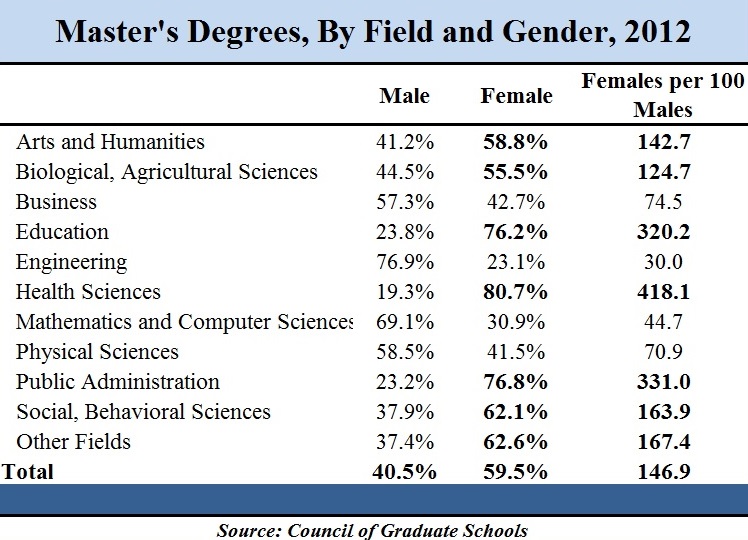
[…]2. By field of study, women earning doctoral degrees in 2012 outnumbered men in 7 of the 11 graduate fields tracked by the CGS (see top chart above)

[…]3. The middle chart above shows the gender breakdown for master’s degrees awarded in 2012, and the gender disparity in favor of females is significant – women earned just under 60% of all master’s degrees in 2012, which would also mean that women earned 146.9 master’s degrees last year for every 100 degrees earned by men.

[…]Women represent 58.5% of all graduate students in the U.S., meaning that there are now 141 women enrolled in graduate school for every 100 men.

Click here for the charts.

The author of the post, Dr. Mark Perry, concludes this:

MP: Here’s my prediction – the facts that: a) men are underrepresented in graduate school enrollment overall (100 men were enrolled in 2012 for every 141 women), b) men received fewer master’s (40.5% of the total) and doctoral degrees (47.8% of the total) than women in 2012, and c) men were underrepresented in 7 out of 11 graduate fields of study at both the master’s and doctoral levels last year will get no attention at all from the media, universities and anybody in the higher education industry.

Additionally, there will be no calls for government studies, or increased government funding to address the significant gender disparities in graduate schools, and nobody will refer to the gender graduate school enrollment and degree gaps favoring women as a problem or a “crisis.”  Further, neither President Obama nor Congress will address the gender graduate enrollment and degree gaps by invoking the Title IX gender-equity law, like they have threatened to do for the gender gap in some college math and science programs. And there won’t be any executive orders to address the huge gender disparity in graduate schools by creating a White House Council on Boys and Men like the executive order issued by President Obama in 2009 to create the “White House Council on Women and Girls.”  Finally, despite their stated commitment to “gender equity,” the hundreds of university women’s centers around the country are unlikely to show any concern about the significant gender inequities in graduate school enrollment and degrees, and universities will not be allocating funding to set up men’s centers or create graduate scholarships for men.

Bottom Line: If there is any attention about gender differences in the CGS annual report, it will likely be about the fact that women are a minority in 4 of the 11 fields of graduate study including engineering and computer science (a gender gap which some consider to be a “national crisis”), with calls for greater awareness of female under-representation in STEM graduate fields of study and careers (except for the STEM field of biology, where women areover-represented).  But don’t expect any concern about the fact that men have increasingly become the second sex in higher education.  The concern about gender imbalances will remain extremely selective, and will only focus on cases when women, not men, are underrepresented and in the minority.

Men outnumber women in business, computer science, engineering and physical sciences.

I echo Dr. Perry’s point, and want to add this. In traditional Christianity, men are responsible for providing for their families. One of the ways that we men prepare for this is by getting advanced degrees in STEM-related fields, since these fields are the hardest and also pay the best. So with that in mind, what does it mean for men who want to prepare for this provider role that there is this obvious discrimination against men in graduate schools and doctoral programs? Is anyone going to do anything to change policies and incentives to favor men, like they did when women were under-represented? Of course not. The only thing that will be done is to ignorantly urge men to “man up”, while ignoring the real problems, e.g. – a lack of male teachers, schools that are not geared to male learning styles, and so on.

Related posts