
Tag Archives: Affirmative Action

UK Supreme Court rules against Christian B&B couple’s conscience rights

Dina sent me this article from the UK Telegraph about a recent Supreme Court decision from the UK.

Excerpt:

The devoutly Christian owners of a Cornish hotel who refused to allow two gay men to take a double room have lost their final appeal to the Supreme Court. It ruled that Peter and Hazelmary Bull had discriminated against the couple, even though they had long operated a rule that unmarried guests had to sleep apart. One of the judges, Lady Hale, said such a case would have been unthinkable less than two decades ago, and it is a measure of how both the law and societal norms have changed that the Bulls should have found themselves in such a predicament.

It is also a pity this matter was not settled amicably when the Bulls made an offer of redress; but campaigners were intent on making an example of them. The aggrieved men, Martyn Hall and Steven Preddy, who were in a civil partnership, were supported by the Equalities and Human Rights Commission (EHRC). The Bulls were perplexed as to why the EHRC should act against them, since their right to exercise their religious beliefs was being set against that of the men not to be discriminated against on the grounds of their sexual orientation.

Dina also sent me this article from the pro-gay Spiked Online.

Excerpt:

[A]s the systematic unequal treatment of gays has ended, so another problem has grown. One pernicious social force has been replaced by another: the willingness of the state to outlaw minority or eccentric views and behaviours. State-backed oppression has yielded to state-backed intolerance.

The Bulls have been hauled before the courts and told they can no longer practise what they preach. To deny a couple the right to make a living in a manner consistent with their Christian values is draconian. The Bulls’ fate is similar to that of Lillian Ladele, an Islington marriage registrar, and Gary McFarlane, a Relate counsellor, who were both sacked after declining to provide their professional services to lesbians and gays. Equality laws did for them all.

The problem here is not, as it appears, merely a slap in the face to Christians. It is a slap in the face to the right of all individuals to act free of state control absent a compelling reason for intervention. As John Stuart Mill put it in On Liberty (1859): ‘The only purpose for which power can be rightfully exercised over any member of a civilised community, against his will, is to prevent harm to others.’

As if to satisfy Mill’s harm principle, the Supreme Court went in search of Preddy and Hall’s ‘harm’. What they found was that when the Bulls’ house rules were explained to Preddy and Hall, they found it ‘upsetting’ and ‘very hurtful’. Even in the touchy-feely twenty-first century, where self-esteem is seen as so important and so fragile, this is pretty lame.

The Supreme Court judge, Lady Hale, may have been aware that this ‘affront to their dignity’, as she put it, was not the sort of harm, in the Mill sense, that should justify the state’s coercive power. She bolstered her argument by linking Preddy and Hall’s hurt feelings to a bigger historical picture. ‘We should not underestimate’, she said, ‘the continuing legacy of those centuries of discrimination, persecution even, which is still going on in many parts of the world’.

Fascism happens when the normal desire for compassion is taken out of the family context and becomes the policy of a powerful feminist welfare state. And that’s when it becomes a threat to the right of individuals to make moral judgments and to exercise religious liberty.

The EHRC, you’ll remember, was a project of the Labour Party of the UK, which is the socialist party in the UK. There is also a communist party called the Liberal Democrats. The striking thing is that many church-attending Christians not only vote for the Labour Party, but they also vote for the Liberal Democrats, which are even more liberal. A lot of this is because British Christians are so far to the left on economic issues that they sort of go along with the assault on their own religious liberty out of ignorance. They vote for bigger and bigger government, and then they are surprised when they actually get it.

The same thing happened in Canada with the Liberal Party and their introduction of Human Rights Commissions and Human Rights Tribunals, which criminalize offending people with free speech. The very Christians that voted for expanding government to reduce poverty were the ones who were then persecuted by the same big government they voted to create. This goes to show why we need to have better economics knowledge among Christians, because many of us are voting for left-wing parties because we think that private, voluntary charity can be replaced with government-controlled redistribution of wealth. Not only does that not work to reduce poverty, but in the end, we lose our liberties, too.

In the UK, you’ll find a lot of Christians who think that rent control is a good thing, that price controls are a good thing, that raising minimum wage is a good thing, that tariffs on imported goods are a good thing – positions which are generally viewed as incorrect by academic economists across the ideological spectrum. That’s why churches need to teach the Christian worldview, including economics. The UK church should be training Christians to undo this ignorant, patriotic confidence that UK Christians have in their welfare state. We all have a lot of work to do to educate ourselves on how the Bible applies to the real world (e.g. – economics), or else we will end up undermining our own liberties.

Additionally, I find it very frustrating that so many churches are so focused on providing emotional comfort and a sense of community to the people in the pews that they neglect to talk about these religious liberty issues. Pastors don’t want to alert ordinary Christians about how dangerous it’s becoming to take unpopular stands on issues like gay rights in public – it’s scary and divisive and drives people away from church. You’re not going to hear them trying to apply the Bible to moral issues or economic issues, etc. from the pulpit, because that spoils the “experience” and “the show” – the comfort and entertainment that people expect from church. We need to do better at helping Christians to be aware of threats to our liberties. They need to be trained to connect their faith to specific laws and policies in the real world.
Women earned more doctoral and Master’s degrees than men in 2012

Women now earning majority of graduate degrees

From the American Enterprise Institute Ideas blog.

Excerpt:

The Council of Graduate Schools (CGS) released its annual report recently on U.S. graduate school enrollment and degrees for 2012, and here are some of the more interesting findings in this year’s report:

1. For the fourth year in a row, women in 2012 earned a majority of doctoral degrees. Of the 67,220 doctoral degrees awarded in 2012 at U.S. universities, women earned 34,761 of those degrees and 52.2% of the total, compared to 31,830 degrees awarded to men who earned 47.8% of the total (see top chart above).

[…]2. By field of study, women earning doctoral degrees in 2012 outnumbered men in 7 of the 11 graduate fields tracked by the CGS (see top chart above)

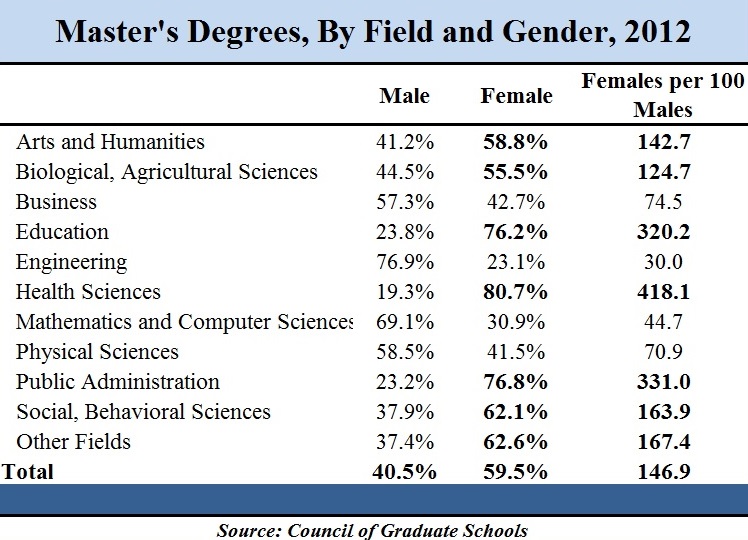
[…]3. The middle chart above shows the gender breakdown for master’s degrees awarded in 2012, and the gender disparity in favor of females is significant – women earned just under 60% of all master’s degrees in 2012, which would also mean that women earned 146.9 master’s degrees last year for every 100 degrees earned by men.

[…]Women represent 58.5% of all graduate students in the U.S., meaning that there are now 141 women enrolled in graduate school for every 100 men.

Click here for the charts.

The author of the post, Dr. Mark Perry, concludes this:

MP: Here’s my prediction – the facts that: a) men are underrepresented in graduate school enrollment overall (100 men were enrolled in 2012 for every 141 women), b) men received fewer master’s (40.5% of the total) and doctoral degrees (47.8% of the total) than women in 2012, and c) men were underrepresented in 7 out of 11 graduate fields of study at both the master’s and doctoral levels last year will get no attention at all from the media, universities and anybody in the higher education industry.

Additionally, there will be no calls for government studies, or increased government funding to address the significant gender disparities in graduate schools, and nobody will refer to the gender graduate school enrollment and degree gaps favoring women as a problem or a “crisis.”  Further, neither President Obama nor Congress will address the gender graduate enrollment and degree gaps by invoking the Title IX gender-equity law, like they have threatened to do for the gender gap in some college math and science programs. And there won’t be any executive orders to address the huge gender disparity in graduate schools by creating a White House Council on Boys and Men like the executive order issued by President Obama in 2009 to create the “White House Council on Women and Girls.”  Finally, despite their stated commitment to “gender equity,” the hundreds of university women’s centers around the country are unlikely to show any concern about the significant gender inequities in graduate school enrollment and degrees, and universities will not be allocating funding to set up men’s centers or create graduate scholarships for men.

Bottom Line: If there is any attention about gender differences in the CGS annual report, it will likely be about the fact that women are a minority in 4 of the 11 fields of graduate study including engineering and computer science (a gender gap which some consider to be a “national crisis”), with calls for greater awareness of female under-representation in STEM graduate fields of study and careers (except for the STEM field of biology, where women areover-represented).  But don’t expect any concern about the fact that men have increasingly become the second sex in higher education.  The concern about gender imbalances will remain extremely selective, and will only focus on cases when women, not men, are underrepresented and in the minority.

Men outnumber women in business, computer science, engineering and physical sciences.

I echo Dr. Perry’s point, and want to add this. In traditional Christianity, men are responsible for providing for their families. One of the ways that we men prepare for this is by getting advanced degrees in STEM-related fields, since these fields are the hardest and also pay the best. So with that in mind, what does it mean for men who want to prepare for this provider role that there is this obvious discrimination against men in graduate schools and doctoral programs? Is anyone going to do anything to change policies and incentives to favor men, like they did when women were under-represented? Of course not. The only thing that will be done is to ignorantly urge men to “man up”, while ignoring the real problems, e.g. – a lack of male teachers, schools that are not geared to male learning styles, and so on.

Related posts

John Hawkins of Right Wing News interviews Dr. Helen Smith about Men On Strike

I thought this interview posted on Right Wing News was a very appropriate thing to post on Fathers Day. The whole thing is worth reading, because it’s stuff that is never discussed much by the people who complain that men aren’t marrying as they used to, under the new changed standard of what marriage is. Well, marriage has changed, and it’s not as attractive to men as it used to be.

Here’s a snip from the interview:

If a man came to you and he said, “Listen, I think marriage is great. There’s no downside to it.” What would you say to him? Not telling him not to do it, but maybe saying, “Have you thought about the other side of this?” What are some of the negatives for men in marriage that are making men less likely to marry?

Well, the first negatives are the legal ones. If man does get divorced, he’s much more likely to pay alimony. For example, about 97 percent of alimony is paid by men, only about 3 percent by women. Men tend to lose with their children more often. Only about 10 percent of men get custody of their children if there’s a divorce. In marriage, …if a man finds out a couple of years down the line that the child isn’t his, the state, in certain states — not most states — a man can be forced to pay for that child even though that child is not his. At the same time, if he wants a vasectomy — now this one is hard because it’s actually not on the books — but if a married man goes to a doctor and wants a vasectomy, most doctors in this country will not perform a vasectomy unless that man gets his wife to sign off.

…If he wants to leave the marriage, a woman can just point her finger and tell her lawyer that a man committed child abuse, domestic abuse — and a lot of times it’s just taken as a given. If a woman wants a restraining order against a man in a marriage, men most often are taken to jail when, you know, the woman calls the police. However, studies actually show that violence in domestic relations is almost 50% from men and 50% from women. If a woman gets angry for any reason, she can simply accuse a man and men are just assumed guilty in our society.

The other thing is psychological reasons. Men’s self-esteem suffers more than women when they don’t see their friends as often and that’s because women tend to congregate a little more. When men lose contact with those friends, their mental and, you know, their psychological health can suffer from that. Men are also generally given the worst part of the house once kids come along. The man is kind of put downstairs to the basement, whether he wants to be there or not. Now sure, a lot of men might enjoy the basement, but they shouldn’t be forced down there.

In my work over the years, I’ve actually seen men who hang around outside or they’ll say, “I don’t mind being outside in the garage,” but the minute they get a divorce they’re right back in that house and wanting the full use of it.

So, I do think that there are a lot of issues that men want to consider when they think about marriage because in our society if you make a mistake and if you’re a man, there’s a lot more at stake. If you’re a woman and you make a mistake, yes, it can be bad, but the state is with you. You probably are going to get your children; you probably are going to get some child support; it’s more than likely you’re not going to be kicked out of your house. There’s even more support for you. There are a lot of organizations to help women; there are almost none to help men.

You know, one way to tell if a woman you like is interested in marriage is to read her an interview like this and then ask her for her feelings. If she is dismissive of the feelings of men, and the changing incentives that men face in this world, then you should really reconsider marriage to her.

By the way, if you’d like a quick re-cap about how feminism has changed marriage, here are a few of the main bullet points that describe what marriage used to mean:

  1. Being the legally and socially recognized head of the household
  2. An expectation of regular sex except in rare cases
  3. Legal rights to children
  4. Lifetime commitment
  5. The presumption of premarital chastity from the wife
  6. Spritual leadership role that is not undermined by forces outside the home
  7. Moral leadership role that is not undermined by forces outside the home
  8. The right to work to earn money and spend it as you see fit

There are more, but those are a few. And you can see, with a little reflection, how different laws and policies have degraded the old definition of marriage and put in place a new feminized definition that takes away the woman’s responsibility to choose a man wisely, to be responsible and self-controlled, to do her part to be accountable to her husband’s leadership, and to avoid choices that destroy the marriage.

Here are some specific things that undermined the 8 points above:

  1. Governmental meddling in the household and imposing values on children in public schools
  2. The normalization of sex-withholding as a way of undermining male leadership
  3. Uneven custody laws and false accusations during custody hearings
  4. No-fault divorce, which encourages women to initiate divorces in order to get the marital home, alimony and child support
  5. Sex education, taxpayer-funded contraceptives, taxpayer-funded abortion, single mother welfare
  6. Public schools teaching things that dogmatically that undermine religion, like Darwinian evolution
  7. Public schools teaching things that dogmatically that undermine morality, like sex education
  8. High tax rates, massive welfare spending which has resulted in inflationary monetary policy

Note: I am chaste and most of this stuff hasn’t really impacted me personally as much as it affects men who have married and had children. I am just being analytical about the way the world is for men.

Very often, women are blissfully unaware of how their own voting undermines men’s willingness and ability to get married and to stay married. Instead of recognizing the motivations and needs and goals of men and changing themselves, they often just resort to insults and blaming. And of course there is a non-stop chorus of male voices who affirm this – even conservatives and Christian leaders do it. The man-up crowd often tells men flat out to lower their standards and let the woman rule regardless of her ability to listen to men, care about men’s goals or care about men’s feelings.