Tag Archives: Male

Women earned more doctoral and Master’s degrees than men in 2012

Women now earning majority of graduate degrees

From the American Enterprise Institute Ideas blog.

Excerpt:

The Council of Graduate Schools (CGS) released its annual report recently on U.S. graduate school enrollment and degrees for 2012, and here are some of the more interesting findings in this year’s report:

1. For the fourth year in a row, women in 2012 earned a majority of doctoral degrees. Of the 67,220 doctoral degrees awarded in 2012 at U.S. universities, women earned 34,761 of those degrees and 52.2% of the total, compared to 31,830 degrees awarded to men who earned 47.8% of the total (see top chart above).

[…]2. By field of study, women earning doctoral degrees in 2012 outnumbered men in 7 of the 11 graduate fields tracked by the CGS (see top chart above)

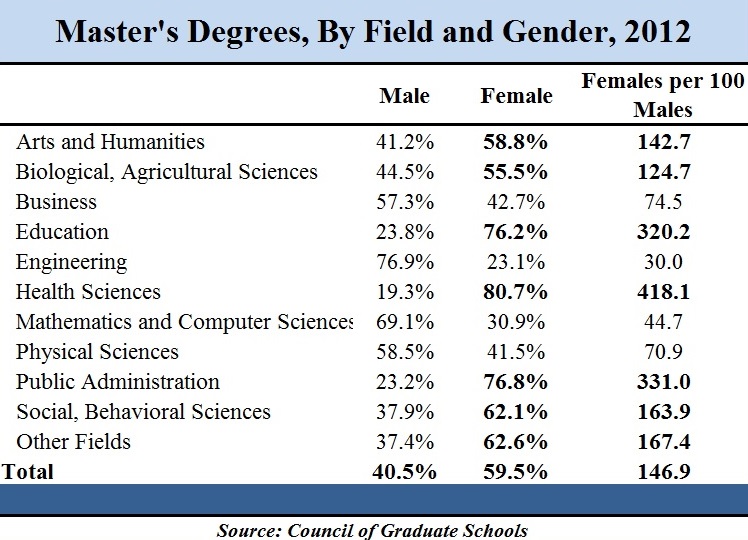
[…]3. The middle chart above shows the gender breakdown for master’s degrees awarded in 2012, and the gender disparity in favor of females is significant – women earned just under 60% of all master’s degrees in 2012, which would also mean that women earned 146.9 master’s degrees last year for every 100 degrees earned by men.

[…]Women represent 58.5% of all graduate students in the U.S., meaning that there are now 141 women enrolled in graduate school for every 100 men.

Click here for the charts.

The author of the post, Dr. Mark Perry, concludes this:

MP: Here’s my prediction – the facts that: a) men are underrepresented in graduate school enrollment overall (100 men were enrolled in 2012 for every 141 women), b) men received fewer master’s (40.5% of the total) and doctoral degrees (47.8% of the total) than women in 2012, and c) men were underrepresented in 7 out of 11 graduate fields of study at both the master’s and doctoral levels last year will get no attention at all from the media, universities and anybody in the higher education industry.

Additionally, there will be no calls for government studies, or increased government funding to address the significant gender disparities in graduate schools, and nobody will refer to the gender graduate school enrollment and degree gaps favoring women as a problem or a “crisis.”  Further, neither President Obama nor Congress will address the gender graduate enrollment and degree gaps by invoking the Title IX gender-equity law, like they have threatened to do for the gender gap in some college math and science programs. And there won’t be any executive orders to address the huge gender disparity in graduate schools by creating a White House Council on Boys and Men like the executive order issued by President Obama in 2009 to create the “White House Council on Women and Girls.”  Finally, despite their stated commitment to “gender equity,” the hundreds of university women’s centers around the country are unlikely to show any concern about the significant gender inequities in graduate school enrollment and degrees, and universities will not be allocating funding to set up men’s centers or create graduate scholarships for men.

Bottom Line: If there is any attention about gender differences in the CGS annual report, it will likely be about the fact that women are a minority in 4 of the 11 fields of graduate study including engineering and computer science (a gender gap which some consider to be a “national crisis”), with calls for greater awareness of female under-representation in STEM graduate fields of study and careers (except for the STEM field of biology, where women areover-represented).  But don’t expect any concern about the fact that men have increasingly become the second sex in higher education.  The concern about gender imbalances will remain extremely selective, and will only focus on cases when women, not men, are underrepresented and in the minority.

Men outnumber women in business, computer science, engineering and physical sciences.

I echo Dr. Perry’s point, and want to add this. In traditional Christianity, men are responsible for providing for their families. One of the ways that we men prepare for this is by getting advanced degrees in STEM-related fields, since these fields are the hardest and also pay the best. So with that in mind, what does it mean for men who want to prepare for this provider role that there is this obvious discrimination against men in graduate schools and doctoral programs? Is anyone going to do anything to change policies and incentives to favor men, like they did when women were under-represented? Of course not. The only thing that will be done is to ignorantly urge men to “man up”, while ignoring the real problems, e.g. – a lack of male teachers, schools that are not geared to male learning styles, and so on.

Related posts

Ryan T. Anderson defends traditional marriage at Boston College

Marriage and family
Marriage and family

The Boston College student newspaper reports. I won’t go over Anderson’s case for traditional marriage, because you all know that from reading my previous posts. I want to highlight what went on at the lecture itself.

Excerpt:

Students sat on the floor, wedged between backpacks and pressed back against the walls. Brightly colored “Support Love” t-shirts were sprinkled liberally throughout the audience in Cushing 001 on Thursday night, as students gathered to hear—and question—Ryan T. Anderson, the William E. Simon Fellow in Religion and a Free Society at the Heritage Foundation.

Titled “A Case Against Gay Marriage,” Anderson’s presentation was arranged by the St. Thomas More Society (STM), a student-run group at Boston College. Rev. Ronald Tacelli, S.J., the group’s faculty advisor and a professor in the philosophy department, introduced Anderson, stating that the event would be more question-and-answer based, as opposed to the panel that had originally been planned. “When I see the size of the crowd, I think it was a better idea,” he said, eliciting laughter.

The large turnout for the talk can be attributed in part to a Facebook event created earlier in the week by BC Students for Sexual Health (BCSSH). The event, formed in opposition to Anderson’s talk after an email about it was sent out to students on the philosophy and theology departments’ listservs, encouraged students to show up wearing Support Love shirts and to participate in the discussion. “This is not the type of programming that fosters an accepting environment for students,” the event description read. “This event is going to have to rely on the audience for any hope of a balancing opinion presence.”

After Tacelli’s introduction, Anderson began by running down a list of things upon which he would not be basing his argument: morality, sexual orientation/homosexuality, religion, tradition. “I think frequently people have an expectation of what they’re going to hear,” he said. “I make a philosophical and policy argument about marriage.”

He then asked a question of the crowd. “From the looks of the t-shirts, this is probably a challenge for most of the audience,” he said. “I want to know what you think marriage is … that’s actually the question that people in favor of redefining marriage refuse to answer. And they refuse to answer that question by hiding behind what I think is a rather sloppy slogan: marriage equality.”

Anderson said that everyone involved in the debate over marriage is ultimately in favor of equality. “We all want the government to treat all real marriages in the same way. The question is, what type of relationship is a marriage?”

Eventually, they had to move to a bigger room and then they continued:

Tacelli interrupted to inform the crowd that BCPD had requested that the event be moved to a larger auditorium, McGuinn 121. The audience left Cushing slightly before 8 p.m., and Anderson resumed his point on government interest in marriage less than 10 minutes later.

[…]Anderson then concluded his talk and commenced nearly an hour of question and answer, with Tacellimoderating.

Nine students asked questions, with many challenging Anderson on various aspects of his argument, to applause from much of the audience. Most questions focused on his central point—that children who were raised by a heterosexual, married couple were better off than those raised by same-sex couples.

And the Q&A was interesting – it shows that even liberal Boston College students could be civil:

“If further studies came out that show these children are fine—they’re healthy, they grow up to be responsible adults and members of society—would you change your mind?” asked one student

Anderson replied that if the studies showed that there was no difference based on family arrangement, then he would not think that government should be in the marriage business. “I don’t think the government should be recognizing consenting adult love if ultimately it doesn’t make a difference one way or another to the common good,” he said. “If the science came back saying, actually, it’s a wash … then yeah, I wouldn’t care what the law or public policy would be about marriage. I would be surprised—and let me say that it wouldn’t change my opinion about what marriage is, that would just be a study of parenting arrangements.”

Brandon Stone, A&S ’14, asked whether, if the end goal was providing the best environment in which to raise children, that would also necessitate defining marriage along economic or class lines.

“The idea here is not that we should only recognize marriages that are socially valuable,” Anderson said. “The idea here is that marriage as an institution is a socially valuable institution, therefore the state tries to promote it. But when the state promotes marriage, it has to promote the truth about marriage. Poor people can get married, right—they can form the reality of that comprehensive unit. So it would be unjust to deny poor people the opportunity if they’re actually capable of forming a marriage.”

Further questions centered around legal rights, such as the transferal of property after death; the specific definitions of  “mothering” and “fathering”; and whether a non-child-producing heterosexual relationship could be considered a marriage.

Post-lecture discussion organized by the campus gay student group:

After Tacelli ended the question and answer period, Alex Taratuta, chair of the GLBTQ Leadership Council (GLC) and A&S ’14, stood up to announce that GLC would be hosting an after-event discussion for any students who wanted to keep talking.

“Going into the event, GLC’s main priority was the mental health and safety of the students,” Taratuta said in an email. “This is one of the reasons that we held a post-event discussion afterwards; we wanted people to have some time to digest the conversation before going back to their dorms … I think it went better than I expected. I knew it would be well attended, but the amount of support from the student body for the GLBTQ community on campus and even the community as a whole, exceeded my expectations.”

Mike Villafranca, co-president of STM and A&S ’14, stopped by the GLC discussion to speak with the students there.

“I was concerned going into tonight’s talk because I knew nothing about Mr. Anderson, and I was worried that the student reaction would be visceral and angry,” Villafranca said later in an email. “Instead of that, I was impressed by the way that the students from GLC and BCSSH reacted to what Mr. Anderson said. It was clear that they came with ideas about what they wanted to ask, but that they listened to what he had to say, and they challenged him in terms of what he said rather than what they came expecting to hear. I’m glad that the Q&A stayed on an intellectual level and didn’t descend into emotional outbursts, which it easily and justifiably could have done.”

I think if you are going to discuss marriage face-to-face with people who are pro-SSM, then it’s probably a good idea to just stick with the Anderson script. I don’t think it’s safe to discuss this issue unless you are careful about who you talk to and how you talk to them. That’s why I am posting about this lecture – to show you how it’s done in hostile environments. We’ve had a whole slew of people from photographers, to sportscasters, to bakers getting into trouble for telling gay peope directly that they disagree with gay marriage. I don’t think you want to take a chance on that approach of “The Bible says…” because it doesn’t work. Ryan Anderson’s approach seems to work a lot better. The people who get hammered are the ones who don’t take the time to study anything except the Bible, who discriminate by appealing to the Bible, and who are not talking to people who have chosen to hear what they have to say – especially in an academic setting where they are there to learn. “The Bible says” ought to be perfectly legitimate in the United States, but thanks to the people in government, it’s not working any more, and we have to adapt.

If you’re going to discuss marriage with a pro-SSM person, then you should do it like Ryan Anderson does it. An academic setting is best. Talking about principles and policies instead of specific people is best. And a secular case for marriage is best. It’s better if your employer won’t be pressured to fire you. It’s best to stick with public policy and secular reasons for marriage, instead of quoting the Bible to non-Christians – that just makes them angry. When you base your position in facts and arguments, they are less likely to get angry because they can disagree with you more easily by arguing against your facts and arguments. Be ready to show  the public, peer-reviewed data that supports your view of marriage. So again, if you insist on doing it, do it like Ryan.

Warning: your comment is probably not going to be approved, so don’t even bother, regardless of what side you’re on.

Related posts

Millionaire gay couple sues Church of England to get gay wedding in a church

Well, that didn’t take long, did it?

The UK Daily Mail reports.

Excerpt:

The first legal challenge to the Church of England’s ban on same-sex marriage was launched today – months before the first gay wedding can take place.

Gay father Barrie Drewitt-Barlow declared: ‘I want to go into my church and marry my husband.’ He added: ‘The only way forward for us now is to make a challenge in the courts against the Church.’

The legal move means an early test for David Cameron’s promise to the CofE and Roman Catholic bishops that no church would be forced to conduct same-sex weddings against the will of its leaders and its faithful.

Ministers set down a ‘quadruple lock’ in the new same sex marriage law – which received Royal Assent last month – which is supposed to protect those churches which oppose gay marriage.

However the guarantees will have to be tested in the courts and gay rights groups have been expecting to bring an early challenge.

How is the suit likely to be resolved?

The article notes that:

[A] succession of past court cases have resulted in defeats for Christians who were in disputes over equality laws, and in particular courts have always found in favour of gays who have challenged Christians.

In recent years notable cases have ended in the sacking of a town hall registrar who refused to conduct civil partnership ceremonies, the sack for a Relate counsellor who said he would not give sex advice to gay couples, and defeat for a couple who declined to let a room in their hotel to a gay couple on the grounds that they were unmarried.

Colin Hart, of the Coalition for Marriage said: ‘The ink’s not even dry on the Bill and churches are already facing litigation. We warned Mr Cameron this would happen, we told him he was making promises that he couldn’t possibly keep.

‘He didn’t listen. He didn’t care. He’s the one who has created this mess. Mr Cameron’s chickens are coming home to roost and it will be ordinary people with a religious belief who yet again fall victim to the totalitarian forces of political correctness.’

Mr Hart added: ‘We now face the real prospect of churches having to choose between stopping conducting weddings, or vicars, and priests defying the law and finding themselves languishing in the dock.’

Yesterday, I blogged about how gay activists are already infringing on religious liberty in the United States. It’s happening here. Isn’t interesting that many people who falsely claim to be Christian nevertheless voted for a President who is in favor of gay marriage? And now we are getting the consequences of gay marriage – the end of religions liberty.