Tag Archives: Marriage

Should government get out of the marriage business?

Dr. Jennifer Roback Morse

Here are three articles by Jennifer Roback Morse posted at The Public Discourse. The articles answer the charge from social liberals and libertarians that government should “get the government out of marriage”.

Here’s the first article which talks about how government will still be involved in marriage, even if we get rid of the traditional definition of marriage, because of the need for dispute resolution in private marriage contracts. She uses no-fault divorce as an example showing how it was sold as a way to get government out of the divorce business. But by making divorce easier by making it require no reason, it increased the number of disputes and the need for more government intervention to resolve these disputes.

Here’s the second article which talks about how the government will have to expand to resolve conflicts over decisions about who counts as a parent and who gets parental rights. With traditional marriage, identifying who the parents are is easy. But with private marriage contracts where the parties are not the biological parents, there is a need for the state to step in and assign parental rights. Again, this will require an expansion of government to resolve the disputes.

Here’s the third article which talks about how marriage is necessary in order to defend the needs and rights of the child at a time when they cannot enter into contracts and be parties to legal disputes.

The third article was my favorite, so here is an excerpt from it:

The fact of childhood dependence raises a whole series of questions. How do we get from a position of helpless dependence and complete self-centeredness, to a position of independence and respect for others? Are our views of the child somehow related to the foundations of a free society? And, to ask a question that may sound like heresy to libertarian ears: Do the needs of children place legitimate demands and limitations on the behavior of adults?

I came to the conclusion that a free society needs adults who can control themselves, and who have consciences. A free society needs people who can use their freedom, without bothering other people too much. We need to respect the rights of others, keep our promises, and restrain ourselves from taking advantage of others.

We learn to do these things inside the family, by being in a relationship with our parents. We can see this by looking at attachment- disordered children and failure-to-thrive children from orphanages and foster care. These children have their material needs met, for food, clothing, and medical care. But they are not held, or loved, or looked at. They simply do not develop properly, without mothers and fathers taking personal care of them. Some of them never develop consciences. But a child without a conscience becomes a real problem: this is exactly the type of child who does whatever he can get away with. A free society can’t handle very many people like that, and still function.

In other words I asked, “Do the needs of society place constraints on how we treat children?” But even this analysis still views the child from society’s perspective. It is about time we look at it from the child’s point of view, and ask a different kind of question. What is owed to the child?

Children are entitled to a relationship with both of their parents. They are entitled to know who they are and where they came from. Therefore children have a legitimate interest in the stability of their parents’ union, since that is ordinarily how kids have relationships with both parents. If Mom and Dad are quarreling, or if they live on opposite sides of the country, the child’s connection with one or both of them is seriously impaired.

But children cannot defend their rights themselves. Nor is it adequate to intervene after the fact, after harm already has been done. Children’s relational and identity rights must be protected proactively.

Marriage is society’s institutional structure for protecting these legitimate rights and interests of children.

I recommend taking a look at all three articles and becoming familiar with the arguments in case you have to explain why marriage matters and why we should not change it. I think it is important to read these articles and to be clear that to be a libertarian doctrine does not protect the right of a child to have a relationship with both his or her parents.  Nor does libertarianism promote the idea that parents ought to stick together for their children. Libertarianism means that adults get to do what they want, and no one speaks for the kids.

The purpose of marriage is to make adults make careful commitments, and restrain their desires and feelings, so that children will have a stable environment with their biological parents nearby. We do make exceptions, but we should not celebrate exceptions and we should not subsidize exceptions. It’s not fair to children to have to grow up without a mother or father just so that adults can pursue fun and thrills.

Can recreational sex turn a selfish, irresponsible man into a marriage-minded provider?

Man helping a woman with proper handgun marksmanship

An article from the American Thinker answers the question that vexes many men. As you read this excerpt below, ask yourself if it is a man or a woman writing this.

First of all, liberal women seem to be having an awful lot of sex these days. They are losing their virginity early, and working their way through as many “alpha males” as possible, but all the while they insist that a stream of recreational-sex relationships is somehow a path to lifelong married love. Can you turn a man who wants nothing more than recreational sex into the perfect husband, simply by invoking the magical power of vagina?

Liberal women think that you can:

On the one hand, liberal women believe wholeheartedly in the idiotic social construct they call, “sexual liberation.”  They pride themselves on losing their virginity, as though that “accomplishment” had ever been above the challenge-scale of an alley cat in heat.

These liberal women I’ve known, having given away their female V-card over and over and over again, all the while scour their host of intimate “trial runs” searching for that mythical, Hollywood-construct, Mr. Right.  This Mr. Right guy, for whom they are searching, is known to them up front as even more sexually-liberated than they, but this little factoid seems not to register in their liberated little heads as they frantically search for the equally mythical family home with the white picket fence, which somehow never gets hit by any of life’s roving tornadoes.  One can almost hear them say in unison, “And they all lived happily ever after.”

I think it’s one of the deepest mysteries of the world why women think that a man who has lots and lots of recreational sex is somehow marriage material. When I think of men who are qualified for marriage, I think of men who have studied hard subjects, gotten marketable skills, worked and worked, saved and saved, and shown that they can be faithful in marriage by exhibiting self-control in the courtship. But liberal women think that all of this reasoning is junk, and you must just jump right into sex to see if the relationship will “work out” or to find out what you “like”. Recreational sex, they insist, is a superior way of finding a husband. Discussing who will do what in an actual marriage and what the actual marriage is for is apparently ineffective.

More:

Evidently, the liberal woman is capable of the most severe form of psychological denial known to humankind.  Certain that one of the men with whom she has copulated without strings will suddenly morph into a faithfully monogamous creature the minute she can convince one of them to say “I do” in front of a few witnesses, the liberal woman marches blindly down the aisle towards near-certain, adulterous doom.  Yet, no amount of honest reason can dissuade liberal women from this self-destructive, moral myopia.

What other term but “morally schizoid” could possibly describe this blatantly contradictory tendency among liberal women?

Having spent their youth casually throwing their own sexual morality to the winds of fairytale “liberation,” these liberal women still steadfastly cling to the faithfully monogamous ideal for that sometime-later moment when they actually do desire all the traditional things — the husband, the kids, the white picket fence — those pesky female-nature embedded longings, which coincidentally ensure the continuation of the human race.

But these liberal women somehow — in perfect schizoid manner — convince themselves that once married, they will be the gratuitous beneficiaries of the monogamous respect they still desire, but have never once demanded or deserved.  Intuitively, women know that strict monogamy provides the only real security for themselves and their own offspring.  Yet, they continue themselves to spurn the demands of monogamy until the very last minute, believing that fidelity springs forth naturally in miraculous profusion among all “married” humans.  Such pure poppycock can only be explained as a mental disorder.

I think women need to ask themselves questions honestly and rationally:

  • can recreational sex make an unemployed man get a job?
  • can recreational sex make a violent man be courteous and respectful?
  • can recreational sex make an atheist turn into a Christian?
  • can recreational sex make a male slut stay faithful?
  • can recreational sex make wastefulness turn into frugality?
  • can recreational sex make laziness turn into diligence?
  • can recreational sex make irresponsibility turn into commitment?

Marriages last because both partners have prepared themselves for self-sacrifice, rational discussions, problem solving and cooperation.

Previously, I provided the male perspective on liberal women’s poor decision-making about men and marriage. Read the article from the American Thinker (written by a woman), then read mine.

Why is it so hard for a working man to provide for a family these days?

Welfare spending
Welfare spending

Here’s my argument which answers the question:

  1. Feminism was behind no-fault divorce.
  2. Making it easier to divorce means that more divorces will occur.
  3. Marital instability causes women to vote for bigger government.
  4. Unmarried women vote mostly for Democrats.

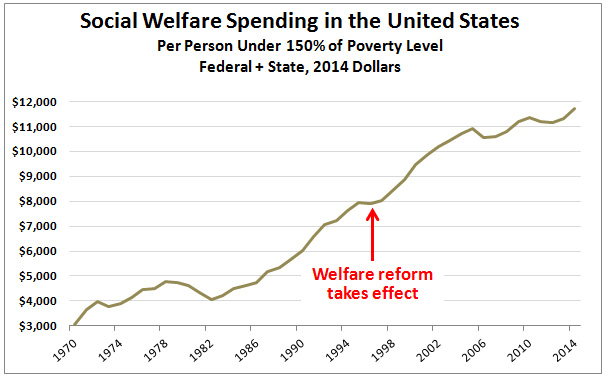
When government spending increases for social programs and welfare, then taxes must be raised to pay for it. When taxes rise, men keep too little of their salaries to hold onto the provider role.

*Please note that I am talking about unmarried (never married, divorced) women throughout this post.

Here’s the evidence for each point.

1. Feminism was behind no-fault divorce, according to this feminist, pro-no-fault-divorce writer.

Excerpt:

Households of 2010 don’t look quite like they did in 1969, when no-fault divorce actually was a controversial topic and these counter-arguments held some weight. The working dad/stay-at-home mom model of the middle class has been replaced by two-parent earner households and a growing number of working mom/stay-at-home dad arrangements. In working poor and impoverished families, the one-parent provider model was never the norm. No-fault divorce seemed scary when it had never before existed, but the truth is that its introduction was long overdue. Feminist groups at the time supported no-fault divorce, as it provided women an escape hatch from desperately unhappy marriages in a society where they were already disadvantaged on almost every level, regardless of their marital status. Imagine an abusive marriage in 1968, when the court-savvy abuser could actually force the victim to stay in the relationship forever. Imagine that now, and you know why domestic violence attorneys are in full support of introducing no-fault divorce to New York. And the judges aren’t the only problem.

Note that the author of this piece thinks that it is not women’s fault that they choose men who they then want to divorce. It’s not the woman’s fault that she is unhappy with the man she courted with and then chose and then made vows to – women need a no-fault escape hatch, and children do fine without fathers.

2. Easier divorces means more divorces.

Abstract:

This paper analyzes a panel of 18 European countries spanning from 1950 to 2003 to examine the extent to which the legal reforms leading to “easier divorce” that took place during the second half of the 20th century have contributed to the increase in divorce rates across Europe. We use a quasi-experimental set-up and exploit the different timing of the reforms in divorce laws across countries. We account for unobserved country-specific factors by introducing country fixed effects, and we include country-specific trends to control for timevarying factors at the country level that may be correlated with divorce rates and divorce laws, such as changing social norms or slow moving demographic trends. We find that the different reforms that “made divorce easier” were followed by significant increases in divorce rates. The effect of no-fault legislation was strong and permanent, while unilateral reforms only had a temporary effect on divorce rates. Overall, we estimate that the legal reforms account for about 20 percent of the increase in divorce rates in Europe between 1960 and 2002.

It seems obvious, but more evidence never hurts. About 70% of divorces are initiated by women, either because they chose to marry the wrong man, or because they are unhappy with the right man.

3. Marital instability causes women to vote for bigger government for security.

Excerpt:

Giving women the right to vote significantly changed American politics from the very beginning. Despite claims to the contrary, the gender gap is not something that has arisen since the 1970s. Suffrage coincided with immediate increases in state government expenditures and revenue, and these effects continued growing as more women took advantage of the franchise. Similar changes occurred at the federal level as female suffrage led to more liberal voting records for the state’s U.S. House and Senate delegations. In the Senate, suffrage changed voting behavior by an amount equal to almost 20 percent of the difference between Republican and Democratic senators. Suffrage also coincided with changes in the probability that prohibition would be enacted and changes in divorce laws.

[…]More work remains to be done on why women vote so differently, but our initial work provides scant evidence that it is due to self-interest arising from their employment by government. The only evidence that we found indicated that the gender gap in part arises from women’s fear that they are being left to raise children on their own (Lott and Kenny 1997). If this result is true, the continued breakdown of the family and higher divorce rates imply growing political conflicts between the sexes. 19

Bigger government must be paid for by higher taxes, of course, which makes it harder for one working man’s income to provide for a family. In fact, feminists wanted men to be displaced as sole-providers. They would prefer that women are “equal” to men, and that means making women get out and work like men. Feminists had every reason to want bigger government and higher taxes to make traditional single-earner families unfeasible financially. They did it for equality.

4. Women are in fact observed to vote for bigger government.

Excerpt:

On Tuesday, the nation made history. It made history in electing the first African American president; it made history in building a bigger margin for the first female Speaker of the House; it made history in delivering the biggest Democratic margin since 1964; it made history in sending a record number of people to the polls and the highest percentage turnout since the 1960 election. Analysts will spend the next few months sifting through the data, trying to figure out what happened and why. Historians will likely spend the next several years and decades studying this election, as well. But one thing is immediately clear. Unmarried women played a pivotal role in making this history and in changing this nation. They delivered a stunning 70 to 29 percent margin to Barack Obama and delivered similarly strong margins in races for Congress and the U.S. Senate. Although unmarried women have voted Democratic consistently since marital status has been was tracked, this election represents the highest margin recorded and a 16-point net gain at the Presidential level from 2004.

In fact, there was a recent (2011) study showing that unmarried women do in fact vote for higher taxes and more government as a substitute for a husband’s provider role.

Abstract:

The last three decades have witnessed the rise of a political gender gap in the United States wherein more women than men favor the Democratic party. We trace this development to the decline in marriage, which we posit has made men richer and women poorer. Data for the United States support this argument. First, there is a strong positive correlation between state divorce prevalence and the political gender gap – higher divorce prevalence reduces support for the Democrats among men but not women. Second, longitudinal data show that following marriage (divorce), women are less (more) likely to support the Democratic party.

What follows from voting Democrat?

Since the Democrats took the House and Senate in 2006, and then the Presidency in 2008, the national debt has more than doubled from about 8 trillion to 20 trillion. A lot of that money was spent in welfare for single mothers, which only makes the women and their fatherless children more dependent on government. Children raised in unmarried home are far less likely to marry themselves, and to be independent of government. Which means that they will vote for bigger government when they start to vote, since they can’t make it through life on their own strength.

If more people vote for Democrats then we will get higher taxes to pay for all the government spending. Higher taxes means that a married man can no longer retain enough of his earnings to support a family. And that means his wife has to work, and that means that his children will learn what the government schools decide they should learn – so that all the children will be equal and think the same (pro-government) thoughts. This should not be controversial, because it is what it is. But if we want to talk about the decline of marriage honestly, then we need to be talking to single women about how they choose men, when they have sex with men, and how they vote at election time. You really can’t have it all.