Tag Archives: Study

Four reasons to think that atheism is inconsistent with scientific progress

Christianity and the progress of science

When people ask me whether the progress of science is more compatible with theism or atheism, I offer the following four basic pieces of scientific evidence that are more compatible with theism than atheism:

  1. the kalam argument from the origin of the universe
  2. the cosmic fine-tuning (habitability) argument
  3. the biological information in the first replicator (origin of life)
  4. the sudden origin of all of the different body plans in the fossil record (Cambrian explosion)

And I point to specific examples of recent discoveries that confirm those four arguments. Here are just a few of them:

  1. An explanation of 3 of the 6 experimental evidences for the Big Bang cosmology (from Physics Forums)
  2. Examples of cosmic fine-tuning to allow the existence of conscious, embodied life (From the New Scientist)
  3. Evidence that functional protein sequences are beyond the reach of chance, (from Doug Axe’s JMB article)
  4. Evidence showing that Ediacaran fauna are not precursors to the Cambrian fossils, (from the journal Nature)

Atheists will typically reply to the recent scientific discoveries that overturned their speculations like this:

  1. Maybe the Big Bang cosmology will be overturned by the Big Crunch/Bounce so that the universe is eternal and has no cause
  2. Maybe there is a multiverse: an infinite number of unobservable, untestable universes which makes our finely-tuned one more probable
  3. Maybe the origin of life could be the result of chance and natural processes
  4. Maybe we will find a seamless chain of fossils that explain how the Cambrian explosion occurred slowly, over a long period time

Ever heard any of these responses?

Below I list some resources to help you to respond to the four responses of atheists to the experimental data.

1) The Big Crunch/Bounce has been disproved theoretically and experimentally.

Theoretically:

Nature 302, 505 – 506 (07 April 1983); doi:10.1038/302505a0

The impossibility of a bouncing universe

ALAN H. GUTH* & MARC SHER†

*Center for Theoretical Physics, Laboratory for Nuclear Science and Department of Physics, Massachusetts Institute of Technology, Cambridge, Massachusetts 02139, USA

†Department of Physics, University of California, Irvine, California 92717, USA

Petrosian1 has recently discussed the possibility that the restoration of symmetry at grand unification in a closed contracting Robertson–Walker universe could slow down and halt the contraction, causing the universe to bounce. He then went on to discuss the possibility that our universe has undergone a series of such bounces. We disagree with this analysis. One of us (M.S.) has already shown2 that if a contracting universe is dominated by radiation, then a bounce is impossible. We will show here two further results: (1) entropy considerations imply that the quantity S (defined in ref. 1 and below), which must decrease by ~1075 to allow the present Universe to bounce, can in fact decrease by no more than a factor of ~2; (2) if the true vacuum state has zero energy density, then a universe which is contracting in its low temperature phase can never complete a phase transition soon enough to cause a bounce.

Experimentally:

The universe is not only expanding, but that expansion appears to be speeding up. And as if that discovery alone weren’t strange enough, it implies that most of the energy in the cosmos is contained in empty space — a concept that Albert Einstein considered but discarded as his “biggest blunder.” The new findings have been recognized as 1998’s top scientific breakthrough by Science magazine.

[…]The flood of findings about the universe’s expansion rate is the result of about 10 years of study, said Saul Perlmutter, team leader of the Supernova Cosmology Project at Lawrence Berkeley National Laboratory.

Perlmutter and others found such a yardstick in a particular kind of exploding star known as a Type 1A supernova. Over the course of several years, the astronomers developed a model to predict how bright such a supernova would appear at any given distance. Astronomers recorded dozens of Type 1A supernovae and anxiously matched them up with redshifts to find out how much the universe’s expansion was slowing down.

To their surprise, the redshift readings indicated that the expansion rate for distant supernovae was lower than the expansion rate for closer supernovae, Perlmutter said. On the largest scale imaginable, the universe’s galaxies appear to be flying away from each other faster and faster as time goes on.

“What we have found is that there is a ‘dark force’ that permeates the universe and that has overcome the force of gravity,” said Nicholas Suntzeff of the Cerro Tololo Inter-American Observatory, who is the co-founder of another group called the High-z Supernova Search Team. “This result is so strange and unexpected that it perhaps is only believable because two independent international groups have found the same effect in their data.”

There has only been one creation of the universe, and the universe will never reverse its expansion, so that it could oscillate eternally. That view is popular, perhaps in part because many people watched videos of Carl Sagan speculating about it in public school classrooms, but all it was was idle naturalistic speculation, (Sagan was a naturalist, and held out hope that science would vindicate naturalism), and has been contradicted by good experimental science. You should be familiar with the 3 evidences for the Big Bang (redshift, light element abundances (helium/hydrogen) and the cosmic microwave background radiation. There are others, (radioactive element abundances, second law of thermodynamics, stellar lifecycle), but those are the big three. Point out how the experimental evidence for the Big Bang has piled up, making the problem even worse for the eternal-universe naturalists.

2) The multiverse has not been tested experimentally, it’s pure speculation.

Speculation:

Multiverse thinking or the belief in the existence of parallel universes is more philosophy or science fiction than science. ”Cosmology must seem odd to scientists in other fields”.

George Ellis, a well-known mathematician and cosmologist, who for instance has written a book with Stephen Hawking, is sceptical of the idea that our universe is just another universe among many others.

A few weeks ago, Ellis, professor emeritus of applied mathematics at the University of Cape Town, reviewed Brian Greene’s book The Hidden Reality: Parallel Universes and the Deep Laws of the Cosmos (Knopf/Allen Lane, 2011) in the journal Nature. He is not at all convinced that the multiverse hypothesis is credible: ”Greene is not presenting aspects of a known reality; he is telling of unproven theoretical possibilities.”

According to professor Ellis, there is no evidence of multiverses, they cannot be tested and they are not science.

Ellis is not the only multiverse sceptic in this universe. A few months ago, science writer John Horgan wrote a column in Scientific American, expressing his doubt in multiverses.

When you get into a debate, you must never ever let the other side get away with asserting something they have no evidence for. Call them on it – point out that they have no evidence, and then hammer them with evidence for your point. Pile up cases of fine-tuning on top of each other and continuously point out that they have no experimental evidence for their speculations. Point out that more evidence we get, the more cases of fine-tuning we find, and the tougher the problem gets for naturalists. There is no evidence for a multiverse, but there is evidence for fine-tuning. TONS OF IT.

3) Naturalistic theories for the origin of life have two problems: can’t make the amino acids in an oxydized atmosphere and can’t make protein and DNA sequences by chance in the time available.

Building blocks:

The oxidation state of Hadean magmas and implications for early Earth’s atmosphere

Dustin Trail, E. Bruce Watson & Nicholas D. Tailby

Nature 480, 79–82 (01 December 2011) doi:10.1038/nature10655

[…]These results suggest that outgassing of Earth’s interior later than ~200?Myr into the history of Solar System formation would not have resulted in a reducing atmosphere.

Functional protein sequences:

J Mol Biol. 2004 Aug 27;341(5):1295-315.

Estimating the prevalence of protein sequences adopting functional enzyme folds.

Axe DD.

The Babraham Institute, Structural Biology Unit, Babraham Research Campus, Cambridge CB2 4AT, UK. doug.axe@bbsrc.ac.uk

Proteins employ a wide variety of folds to perform their biological functions. How are these folds first acquired? An important step toward answering this is to obtain an estimate of the overall prevalence of sequences adopting functional folds.

[…]Starting with a weakly functional sequence carrying this signature, clusters of ten side-chains within the fold are replaced randomly, within the boundaries of the signature, and tested for function. The prevalence of low-level function in four such experiments indicates that roughly one in 10(64) signature-consistent sequences forms a working domain. Combined with the estimated prevalence of plausible hydropathic patterns (for any fold) and of relevant folds for particular functions, this implies the overall prevalence of sequences performing a specific function by any domain-sized fold may be as low as 1 in 10(77), adding to the body of evidence that functional folds require highly extraordinary sequences.

So atheists are in double jeopardy here. They don’t have a way to build the Scrabble letters needed for life, and they don’t have a way to form the Scrabble letters into meaningful words and sentences. Point out that the more research we do, the tougher the problem gets to solve for naturalists, and the more it looks like an effect of intelligence. Write out the calculations for them.

4) The best candidate to explain the sudden origin of the Cambrian era fossils was the Ediacaran fauna, but those are now recognized as not being precursors to the Cambrian fossils.

Science Daily reports on a paper from the peer-reviewed journal Science:

Evidence of the single-celled ancestors of animals, dating from the interval in Earth’s history just before multicellular animals appeared, has been discovered in 570 million-year-old rocks from South China by researchers from the University of Bristol, the Swedish Museum of Natural History, the Paul Scherrer Institut and the Chinese Academy of Geological Sciences.

[…]This X-ray microscopy revealed that the fossils had features that multicellular embryos do not, and this led the researchers to the conclusion that the fossils were neither animals nor embryos but rather the reproductive spore bodies of single-celled ancestors of animals.

Professor Philip Donoghue said: “We were very surprised by our results — we’ve been convinced for so long that these fossils represented the embryos of the earliest animals — much of what has been written about the fossils for the last ten years is flat wrong. Our colleagues are not going to like the result.”

Professor Stefan Bengtson said: “These fossils force us to rethink our ideas of how animals learned to make large bodies out of cells.”

The trend is that there is no evolutionary explanation for the body plans that emerged in the Cambrian era. If you want to make the claim that “evolution did it”, then you have to produce the data today. Not speculations about the future. The data we have today says no to naturalism. The only way to affirm naturalistic explanations for the evidence we have is by faith. But rational people know that we need to minimize our leaps of faith, and go with the simplest and most reasonable explanation – an intelligence is the best explanation responsible for rapid generation of biological information.

Conclusion

I do think it’s important for Christians to focus more on scientific apologetics and to focus their academic careers in scientific fields. So often I look at Christian blogs, and I see way too much G. K. Chesterton, Francis Chan A. W. Tozer, and other untestable, ineffective jibber-jabber. We need to bring the hard science, and stop making excuses about not being able to understand it because it’s too hard. It’s not too hard. Everyone can understand Lee Strobel’s “The Case for a Creator“. That’s more than enough for the average Christian on science apologetics. We all have to do our best to learn what works. You don’t want to be anti-science and pro-speculation like atheists are. I recommend reading Uncommon Descent and Evolution News every day for a start.

Study: children of naturally married couples outperform children of same-sex couples

A family praying and reading the Bible

Whenever I debate a controversial issue, I like to go straight to the studies in order to let the evidence speak for itself. Although it’s difficult to convince someone on the opposite side to change their mind, usually people in the middle will side with the person who has evidence, instead of the person who is crying the loudest and telling anecdotal stories that may or may even not be true.

The Public Discourse reports on a study out of Canada.

Excerpt:

A new academic study based on the Canadian census suggests that a married mom and dad matter for children. Children of same-sex coupled households do not fare as well.

There is a new and significant piece of evidence in the social science debate about gay parenting and the unique contributions that mothers and fathers make to their children’s flourishing. A study published last week in the journal Review of the Economics of the Household—analyzing data from a very large, population-based sample—reveals that the children of gay and lesbian couples are only about 65 percent as likely to have graduated from high school as the children of married, opposite-sex couples. And gender matters, too: girls are more apt to struggle than boys, with daughters of gay parents displaying dramatically low graduation rates.

Unlike US-based studies, this one evaluates a 20 percent sample of the Canadian census, where same-sex couples have had access to all taxation and government benefits since 1997 and to marriage since 2005.

While in the US Census same-sex households have to be guessed at based on the gender and number of self-reported heads-of-household, young adults in the Canadian census were asked, “Are you the child of a male or female same-sex married or common law couple?” While study author and economist Douglas Allen noted that very many children in Canada who live with a gay or lesbian parent are actually living with a single mother—a finding consonant with that detected in the 2012 New Family Structures Study—he was able to isolate and analyze hundreds of children living with a gay or lesbian couple (either married or in a “common law” relationship akin to cohabitation).

So the study is able to compare—side by side—the young-adult children of same-sex couples and opposite-sex couples, as well as children growing up in single-parent homes and other types of households. Three key findings stood out to Allen:

children of married opposite-sex families have a high graduation rate compared to the others; children of lesbian families have a very low graduation rate compared to the others; and the other four types [common law, gay, single mother, single father] are similar to each other and lie in between the married/lesbian extremes.

Employing regression models and series of control variables, Allen concludes that the substandard performance cannot be attributed to lower school attendance or the more modest education of gay or lesbian parents. Indeed, same-sex parents were characterized by higher levels of education, and their children were more likely to be enrolled in school than even those of married, opposite-sex couples. And yet their children are notably more likely to lag in finishing their own schooling.

[…]The truly unique aspect of Allen’s study, however, may be its ability to distinguish gender-specific effects of same-sex households on children. He writes:

the particular gender mix of a same-sex household has a dramatic difference in the association with child graduation. Consider the case of girls. . . . Regardless of the controls and whether or not girls are currently living in a gay or lesbian household, the odds of graduating from high school are considerably lower than any other household type. Indeed, girls living in gay households are only 15 percent as likely to graduate compared to girls from opposite sex married homes.

Thus although the children of same-sex couples fare worse overall, the disparity is unequally shared, but is instead based on the combination of the gender of child and gender of parents. Boys fare better—that is, they’re more likely to have finished high school—in gay households than in lesbian households. For girls, the opposite is true. Thus the study undermines not only claims about “no differences” but also assertions that moms and dads are interchangeable. They’re not.

With a little digging, I found the abstract of the study:

Almost all studies of same-sex parenting have concluded there is “no difference” in a range of outcome measures for children who live in a household with same-sex parents compared to children living with married opposite-sex parents. Recently, some work based on the US census has suggested otherwise, but those studies have considerable drawbacks. Here, a 20% sample of the 2006 Canada census is used to identify self-reported children living with same-sex parents, and to examine the association of household type with children’s high school graduation rates. This large random sample allows for control of parental marital status, distinguishes between gay and lesbian families, and is large enough to evaluate differences in gender between parents and children. Children living with gay and lesbian families in 2006 were about 65 % as likely to graduate compared to children living in opposite sex marriage families. Daughters of same-sex parents do considerably worse than sons.

The author of the study is a professor of economics at Simon Fraser University in British Columbia. His PhD in economics is from the University of Washington. A previous study had shown that gay relationships typically have far more instability (they last for more shorter times). That’s not good for children either. Another study featured in the Atlantic talked about how gay relationships have much higher rates of domestic violence. That’s not good for children either. So we have three reasons to think that normalizing gay relationships as “marriage” would not be good for children.

The reason I am posting this is because I want people to understand why social conservatives like me propose these laws defining and promoting marriage. We do favor natural marriage for the same reason that we oppose no-fault divorce, and for the same reason why we oppose welfare for single mothers (it encourages single motherhood). We don’t want to encourage people to deprive children of their mother or their father. We look at the research, and we decide that children need their mother and father. Given the choice between the needs of the child and restraining the freedom of the adults, we prefer the child’s need for her mother and father. It’s not just arbitrary rules, there is a reason behind the rules.

But children are not commodities. They have certain needs right out of the box. Adults should NOT be thinking about how to duct-tape a child onto any old relationship that doesn’t offer the same safety and stability that opposite sex marriage offers. We should be passing laws to strengthen marriage in order to protect children, not to weaken it. Libertarians don’t want to do that, because they want adults to be free to do as they please, at the expense of children.  Libertarians think that the adults should be able to negotiate private contracts and have no obligations to any children who are present, or who may be present later.

Related posts

Will spending more money on education improve the test scores of students?

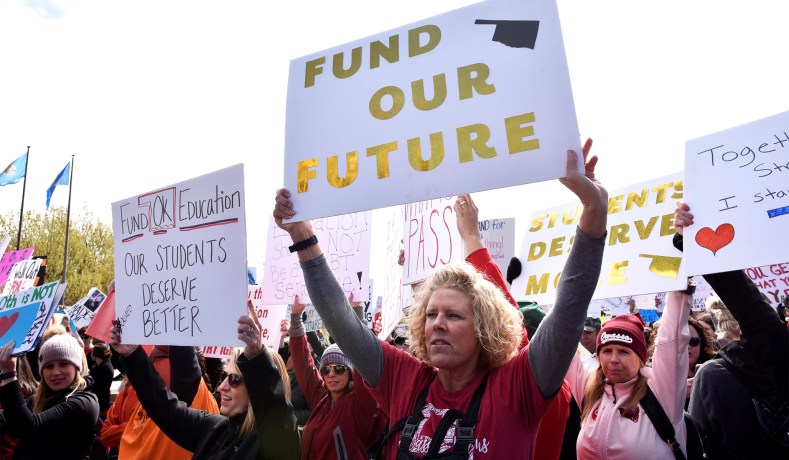
When I want a raise, I work harder, but these teachers hold up signs
When I want a raise, I work harder, but teachers have a different approach

One of my friends has been having a debate with one of his former teachers about whether spending more money on government-run education improves tests scores. He tried posting some evidence, but she just dismissed that by claiming:

  1. If we hadn’t spent more money, then the student test scores would have gone down instead of staying the same.
  2. Most of the money that government spends on education goes to vouchers and private schools, not public schools
  3. Economists at prestigious think tanks like that Cato Institute, the Heritage Foundation, and the American Enterprise Institute cannot be trusted to accurately cite the Bureau of Labor Statistics and the National Center for Education Statistics because of the Koch Brothers
  4. You can’t compare the test scores of American students with the test scores of Asian students who outperform them, (for less government spending), because math is different in Asia compared to America

Let’s look at some data and see if her arguments are correct.

Does more spending mean higher student performance?

National Review reported on data collected in the National Assessment of Educational Progress, which spans all 50 states.

Look:

Comparing educational achievement with per-pupil spending among states also calls into question the value of increasing expenditures. While high-spending Massachusetts had the nation’s highest proficiency scores on the National Assessment of Educational Progress, low-spending Idaho did very well, too. South Dakota ranks 42nd in per-pupil expenditures but eighth in math performance and ninth in reading. The District of Columbia, meanwhile, with the nation’s highest per-pupil expenditures ($15,511 in 2007), scores dead last in achievement.

The student test scores are dead last, but National Review notes that “according to the National Center for Education Statistics, Washington, D.C. was spending an average of $27,460 per pupil in 2014, the most recent year for which data are available.” They are spending the most per-pupil, but their test scores are dead last.

CBS News reported on another recent study confirming this:

Decades of increased taxpayer spending per student in U.S. public schools has not improved student or school outcomes from that education, and a new study finds that throwing money at the system is simply not tied to academic improvements.

The study from the CATO Institute shows that American student performance has remained poor, and has actually declined in mathematics and verbal skills, despite per-student spending tripling nationwide over the same 40-year period.

“The takeaway from this study is that what we’ve done over the past 40 years hasn’t worked,” Andrew Coulson, director of the Center For Educational Freedom at the CATO Institute, told Watchdog.org. “The average performance change nationwide has declined 3 percent in mathematical and verbal skills. Moreover, there’s been no relationship, effectively, between spending and academic outcomes.”

The study, “State Education Trends: Academic Performance and Spending over the Past 40 Years,” analyzed how billions of increased taxpayer dollars, combined with the number of school employees nearly doubling since 1970, to produce stagnant or declining academic results.

“The performance of 17-year-olds has been essentially stagnant across all subjects despite a near tripling of the inflation-adjusted cost of putting a child through the K-12 system,” writes Coulson.

Where did the numbers come from? The Koch Brothers? No:

Data from the U.S. Department of Education incorporating public school costs, number of employees, student enrollment and SAT scores was analyzed to explore the disparity between increased spending and decreasing or stagnant academic results.

Well, at least government-run monopoly schools outperform private private schools, right? No:

[…][P]rivate schools, where students excel over public school peers, …manage to operate at budgets about 34 percent lower than taxpayer-funded schools, US Finance Post reports.

Public schools spend, on average, $11,000 per student, per year.

Coulson noted an Arizona study he conducted which showed that the average per-pupil spending at private schools was only about 66 percent of the cost of public schools.

A more recent state-specific study from 2016 found that this is still the case.

This problem gets even worse when you look at test scores from other countries, where even less is spent on education.

As the Washington Post reported at the end of 2016:

When it comes to math, U.S. high school students are falling further behind their international counterparts, according to results released Tuesday of an ongoing study that compares academic achievement in 73 countries. And the news is not much better in reading and science literacy, where U.S. high schoolers have not gained any ground and continue to trail students in a slew of developed countries around the globe.

In the latest Program for International Student Assessment (PISA) measuring math literacy in 2015, U.S. students ranked 40th in the world. The U.S. average math score of 470 represents the second decline in the past two assessments — down from 482 in 2012 and 488 in 2009. The U.S. score in 2015 was 23 points lower than the average of all of the nations taking part in the survey.

More money is being spent, but the scores are DECREASING.

Now, why is it that increased government spending in the public school monopoly doesn’t improve student performance? Well, one reason is that very little of the money makes it to the classroom.

Where does all the money go?

Let’s look at four places where the money spent on the government-run public school monopoly ends up.

Administration

First, a lot of it gets paid to administrations who implement politically correct programs designed to turn the impressionable young people into little secular socialists.

Here’s a helpful chart from the American Enterprise Institute:

Where does taxpayer money spent on the public school monopoly go?

I guess if a school wants to make things like Planned Parenthood sex education and LGBT indoctrination into priorities, then they would need more administrators.

Pensions

Second, education employees get enormous pensions, which are paid by taxpayers and negotiated by their unions. You would never see pensions this large in the private sector.

This is from the leftist Brookings Institute, from 2014:

This figure shows we now spend nearly $1,100 per student on retirement benefits. The average public school student teacher ratio is 16 to 1. So we are spending about $17,000 per year per teacher in pension contributions.

[…]The National Council on Teacher Quality writes,

In 2014 teacher pension systems had a total of a half trillion dollars in unfunded liabilities—a debt load that climbed more than $100 billion in just the last two years. Across the states, an average of 70 cents of every dollar contributed to state teacher pension systems goes toward paying off the ever-increasing pension debt, not to future teacher benefits (p. iii).

While we are spending a huge amount to fund teacher pensions, most of that spending doesn’t go to attracting the best teachers. It’s paying off past debts.

We can’t hire good teachers, because all the education spending of today is paying for the gold-plated pensions of yesterday.

That was 2014. The numbers are even worse today. Teachers contribute very, very little to their pensions, but the benefits are enormous compared to what the private sector taxpayers get in Social Security. (Which is going to be bankrupt by 2034, as reported by the far-left PBS)

Teacher training

Third, a lot of it is spent on teacher training, because apparently teaching multiplication, Shakespeare or geography changes every year, so the teachers need tens of thousands of dollars in annual training.

The Washington Post reports on a recent study:

A new study of 10,000 teachers found that professional development — the teacher workshops and training that cost taxpayers billions of dollars each year — is largely a waste.

The study released Tuesday by TNTP, a nonprofit organization, found no evidence that any particular approach or amount of professional development consistently helps teachers improve in the classroom.

[…]The school districts that participated in the study spent an average of $18,000 per teacher annually on professional development. Based on that figure, TNTP estimates that the 50 largest school districts spend an estimated $8 billion on teacher development annually. That is far larger than previous estimates.

And teachers spend a good deal of time in training, the study found. The 10,000 teachers surveyed were in training an average of 19 school days a year, or almost 10 percent of a typical school year, according to TNTP.

Maybe if more of the money spent on education were spent directly on hiring teachers, then we would see an improvement. Unfortunately, a lot of the money meant for teachers goes to the teacher unions. How do they spend that money?

Political Contributions

Finally, this is from OpenSecrets.org, concerning political contributions made in the most recent election cycle:

Top Political Contributors in 2016 election cycle

The two largest teacher unions came in at #9 and #11. Most of their donations go to Democrat Party. Democrats believe (against the evidence) that spending more money in the government-run public school monopoly will improve student performance on tests.

So, what’s the solution?

The solution is that we abolish the federal Department of Education, which has done nothing to improve the quality of education for students. We need to push the education of children back down to the state and local levels. We need to empower parents to choose the schools that work best for their children by giving parents vouchers. We need to increase tax-free education savings accounts to help parents with school expenses. We should also give free college tuition to homeschooled students who are admitted to STEM programs at any college or university. We can take the money from the pensions of the union administrators, after we abolish ever single public sector teacher union in the country, and seize all their assets and pensions. If that’s not enough money, then we can seize all the pensions of Department of Education employees – a just punishment for their failure to produce results while still taking taxpayer money.

Finally, we should allow people who already have private sector experience doing things like STEM to become teachers. Let’s face it: the departments that grant Education degrees have the lowest entrance requirements, and produce the least competent adults. People with years of private sector work experience teach better than people with Education degrees. Let’s open up teaching to people who have experience in the private sector doing software engineering, statistics, nursing, etc. and then we’ll have qualified teachers.