Tag Archives: Misandry

Women earned more doctoral and Master’s degrees than men in 2012

Women now earning majority of graduate degrees

From the American Enterprise Institute Ideas blog.

Excerpt:

The Council of Graduate Schools (CGS) released its annual report recently on U.S. graduate school enrollment and degrees for 2012, and here are some of the more interesting findings in this year’s report:

1. For the fourth year in a row, women in 2012 earned a majority of doctoral degrees. Of the 67,220 doctoral degrees awarded in 2012 at U.S. universities, women earned 34,761 of those degrees and 52.2% of the total, compared to 31,830 degrees awarded to men who earned 47.8% of the total (see top chart above).

[…]2. By field of study, women earning doctoral degrees in 2012 outnumbered men in 7 of the 11 graduate fields tracked by the CGS (see top chart above)

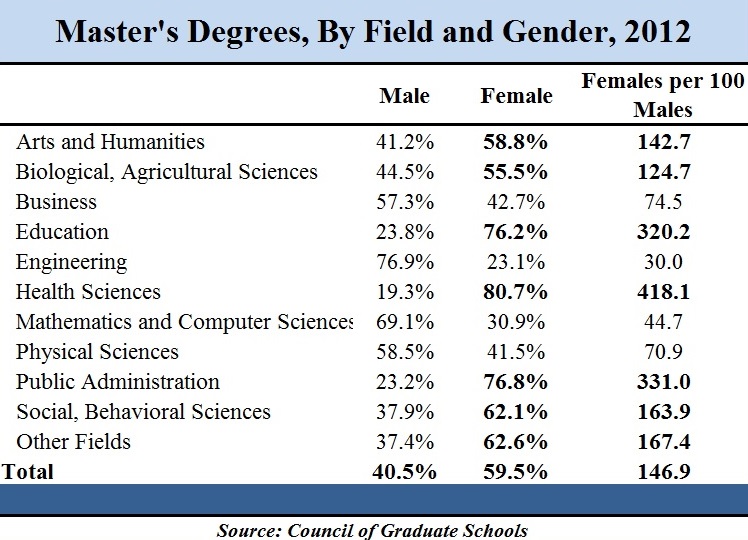
[…]3. The middle chart above shows the gender breakdown for master’s degrees awarded in 2012, and the gender disparity in favor of females is significant – women earned just under 60% of all master’s degrees in 2012, which would also mean that women earned 146.9 master’s degrees last year for every 100 degrees earned by men.

[…]Women represent 58.5% of all graduate students in the U.S., meaning that there are now 141 women enrolled in graduate school for every 100 men.

Click here for the charts.

The author of the post, Dr. Mark Perry, concludes this:

MP: Here’s my prediction – the facts that: a) men are underrepresented in graduate school enrollment overall (100 men were enrolled in 2012 for every 141 women), b) men received fewer master’s (40.5% of the total) and doctoral degrees (47.8% of the total) than women in 2012, and c) men were underrepresented in 7 out of 11 graduate fields of study at both the master’s and doctoral levels last year will get no attention at all from the media, universities and anybody in the higher education industry.

Additionally, there will be no calls for government studies, or increased government funding to address the significant gender disparities in graduate schools, and nobody will refer to the gender graduate school enrollment and degree gaps favoring women as a problem or a “crisis.”  Further, neither President Obama nor Congress will address the gender graduate enrollment and degree gaps by invoking the Title IX gender-equity law, like they have threatened to do for the gender gap in some college math and science programs. And there won’t be any executive orders to address the huge gender disparity in graduate schools by creating a White House Council on Boys and Men like the executive order issued by President Obama in 2009 to create the “White House Council on Women and Girls.”  Finally, despite their stated commitment to “gender equity,” the hundreds of university women’s centers around the country are unlikely to show any concern about the significant gender inequities in graduate school enrollment and degrees, and universities will not be allocating funding to set up men’s centers or create graduate scholarships for men.

Bottom Line: If there is any attention about gender differences in the CGS annual report, it will likely be about the fact that women are a minority in 4 of the 11 fields of graduate study including engineering and computer science (a gender gap which some consider to be a “national crisis”), with calls for greater awareness of female under-representation in STEM graduate fields of study and careers (except for the STEM field of biology, where women areover-represented).  But don’t expect any concern about the fact that men have increasingly become the second sex in higher education.  The concern about gender imbalances will remain extremely selective, and will only focus on cases when women, not men, are underrepresented and in the minority.

Men outnumber women in business, computer science, engineering and physical sciences.

I echo Dr. Perry’s point, and want to add this. In traditional Christianity, men are responsible for providing for their families. One of the ways that we men prepare for this is by getting advanced degrees in STEM-related fields, since these fields are the hardest and also pay the best. So with that in mind, what does it mean for men who want to prepare for this provider role that there is this obvious discrimination against men in graduate schools and doctoral programs? Is anyone going to do anything to change policies and incentives to favor men, like they did when women were under-represented? Of course not. The only thing that will be done is to ignorantly urge men to “man up”, while ignoring the real problems, e.g. – a lack of male teachers, schools that are not geared to male learning styles, and so on.

Related posts

Rasmussen poll finds that men are more pro-life than women

Life News reports on a new poll that confirms the results from the previous Gallup poll, which showed that men are more likely to be pro-life than women.

Take a look:

A new Rasmussen poll out today shows the support for the pro-abortion side is at its lowest level in three years, while support for the pro-life position is at its highest.

Rasmussen asked: “Generally speaking, on the issue of abortion, do you consider yourself pro-choice or pro-life?”

The Rasmussen Reports national telephone survey finds that 46% of Likely U.S. Voters now consider themselves pro-choice, the lowest finding in three years of regular surveying. Forty-three percent (43%) say they are pro-life, matching the highest finding to date. Eleven percent (11%) are undecided.

And now the part that is very interesting:

Fifty percent (50%) of women consider themselves pro-choice, compared to 42% of men. Forty-six percent (46%) of men and 41% of women are pro-life.

Men are also more likely than women to say it is too easy to get an abortion in the United States and that there should be a waiting period. Women are more likely to think it’s too hard to get an abortion. Men are also more likely to feel abortion is morally wrong most of the time.

So, men are pro-life by a margin of 46-42. This is similar to the Gallup poll released in May 2013, that showed that men were pro-life by a margin of 50-42. I think that the first instinct of a man is to protect and provide for the unborn child. Men tend to want to take responsibility for their own decisions. And they are OK with giving up happiness and pleasure in order to sacrifice for the child. Men are more moved to protect things that are weak and vulnerable, even if it means that they will be less free to pursue their own pleasures. That’s how men really are, although that’s often not what women believe about men, and it’s not what is portrayed in the media about men.

In contrast, women are more likely to be pro-abortion, by a huge margin of 50-41. This is similar to the results from the Gallup poll of May 2013, which showed that women were more likely to be pro-abortion by a margin of 47-46.  The split is even large when you notice that women are overwhelmingly more likely to vote for the unrestricted abortion policies of the Democrat party. Exit polls from the last two federal elections have shown that unmarried women in particular vote for Democrats 67% of the time. That number is even higher when you look at young, unmarried women.

Not just unborn children, but born children

Previously, I also documented how polls show that men are far more pro-marriage than women.

Excerpt:

A new national poll points towards a gender gap over same-sex marriage.

According to new numbers released Monday morning from Gallup, 50% of Americans say same-sex marriages should be legal. But break it down by gender, and 56% of women say same-sex couples should be legally allowed to marry, but only 42% of men feel the same way.

So what do we learn from this? We learn that despite massive systemic challenges in the education system and the workplace, that men have nevertheless not given up on the needs of unborn and born children.

I notice that there is a trend among Christian women to try to blame men for abortion and gay marriage, and to try to say that the reason that women have abortions is because of men. But this is false, of course. The reason why women have abortions is because they deliberately prefer men who are bad boys. They are attracted to these men, and these men want premarital sex. They give them the sex in order to be liked by these bad men. They choose the bad men. The good men who are chaste and marriage minded are passed over. You can read about it in the article I blogged about earlier in the week about the hook-up culture, and see a study on the hook-up culture from the Institute of American Values too. And remember that the hook-up culture is praised by feminist leaders. They are the ones who wanted it.

Most women are attracted to bad men. Many cannot resist the attraction and choose the bad men. They are attracted to men who do not try to lead them or judge them on moral or spiritual issues. They go too far with them physically and bond to them and then cannot see their flaws. They eventually have sex with them to try to make them commit. Bad men don’t commit when they are given sex, though. Then the women vote for abortion to get out of it – because they feel that they are victims. Then they blame all men for their own bad choices and claim that the consequences of their actions could not be predicted. They make themselves out to be victims. But the real victims are the children and the good men who are passed over.

None of this would be happening if women thought through what they really wanted – lifelong married love – and then 1) prepared themselves to be wives and mothers and 2) chose chaste men who were prepared to be fathers and husbands. They choose the wrong men. They pass over good men because we are “too strict”. They deprive children of life or fathers. They blame men. It’s that simple. The problem is that we are too scared to tell women that they are wrong about how they choose men.

A recent survey sent to me by Nancy P. even found that men are more interested in marriage and commitment than women. When will we realize where the problem really lies? Blaming men isn’t the answer. We need to teach women to disregard the tingles and the peer pressure and pick the right man for the jobs of husband and father, based on the requirements of the male roles. And that means that we need to roll back feminism, and defeat the idea that man have no roles. Marriage-capable men only turn away from male roles when they see that women are not interested in marriage-minded men.

DOL study finds that after correcting for choices, women are paid 95% of what men are paid

The Heritage Foundation has a post up about it.

Excerpt:

When a questioner at Tuesday’s presidential debate stated that women make only 72 cents for every dollar that men make, both President Obama and Governor Mitt Romney agreed. Not so fast. This figure is highly misleading.

The statistic comes from a Census Bureau report (see figure 2 here) comparing the median earnings of men and women in full-time jobs. However, many factors affect pay—e.g., occupational choice, education, experience, and hours of work. Doctors make more than store clerks, no matter their gender. Employees who work longer hours tend to make more, too.

The Census report ignores all such factors. So it can say nothing about whether men and women with the same level of job performance make the same amount.

Women are more likely than men to work in industries with more flexible schedules. Women are also more likely to spend time outside the labor force to care for children. These choices have benefits, but they also reduce pay—for both men and women. When economists control for such factors, they find the gender gap largely disappears.

2009 study commissioned by the Department of Labor found that after controlling for occupation, experience, and other choices, women earn 95 percent as much as men do. In 2005, June O’Neil, the former director of the Congressional Budget Office, found that “There is no gender gap in wages among men and women with similar family roles.” Different choices—not discrimination—account for different employment and wage outcomes.

For the same reason, the recession has hit men harder than it has women. Since the recession, net employment for men has fallen by over 3 million jobs. Female employment has fallen by less than half that amount. Put another way, the male unemployment rate is currently 0.5 percentage points higher than the female unemployment rate.

Hans Bader from the Competitive Enterprise Institute explains more.

Excerpt: (links removed)

As The Washington Post‘s Glenn Kessler notes, government data shows women work fewer hours than men, which explains much of the apparent pay gap: “since women in general work fewer hours than men in a year, the statistics used by the White House may be less reliable for examining the key focus of the legislation — wage discrimination.” I discuss some other unfounded claims made in support of the Paycheck Fairness Act at this link.

As Steve Tobak noted at CBS News,

Men are far more likely to choose careers that are more dangerous, so they naturally pay more. Top 10 most dangerous jobs (from the U.S. Bureau of Labor Statistics): Fishers, loggers, aircraft pilots, farmers and ranchers, roofers, iron and steel workers, refuse and recyclable material collectors, industrial machinery installation and repair, truck drivers, construction laborers. They’re all male-dominated jobs. . .Men are far more likely to take work in uncomfortable, isolated and undesirable locations that pay more. Men work longer hours than women do. The average fulltime working man works six hours per week or 15 percent longer than the average fulltime working woman.

A popular article by Carrie Lukas in the Wall Street Journal agrees.

Excerpt:

The Department of Labor’s Time Use survey shows that full-time working women spend an average of 8.01 hours per day on the job, compared to 8.75 hours for full-time working men. One would expect that someone who works 9% more would also earn more. This one fact alone accounts for more than a third of the wage gap.

[…]Recent studies have shown that the wage gap shrinks—or even reverses—when relevant factors are taken into account and comparisons are made between men and women in similar circumstances. In a 2010 study of single, childless urban workers between the ages of 22 and 30, the research firm Reach Advisors found that women earned an average of 8% more than their male counterparts. Given that women are outpacing men in educational attainment, and that our economy is increasingly geared toward knowledge-based jobs, it makes sense that women’s earnings are going up compared to men’s.

Moreover, if there is a pay gap, it certainly is not in our major cities, as the leftist New York Times explains.

Excerpt:

Young women in New York and several of the nation’s other largest cities who work full time have forged ahead of men in wages, according to an analysis of recent census data.

The shift has occurred in New York since 2000 and even earlier in Los Angeles, Dallas and a few other cities.

Economists consider it striking because the wage gap between men and women nationally has narrowed more slowly and has even widened in recent years among one part of that group: college-educated women in their 20s. But in New York, young college-educated women’s wages as a percentage of men’s rose slightly between 2000 and 2005.

[…][The study] shows that women of all educational levels from 21 to 30 living in New York City and working full time made 117 percent of men’s wages, and even more in Dallas, 120 percent. Nationwide, that group of women made much less: 89 percent of the average full-time pay for men.

Just why young women at all educational levels in New York and other big cities have fared better than their peers elsewhere is a matter of some debate. But a major reason, experts say, is that women have been graduating from college in larger numbers than men, and that many of those women seem to be gravitating toward major urban areas.

When women make different choices about education and labor that are more like what men choose, they earn just as much or more than men.