
Tag Archives: Mancession

New study: the effects of declining marriage rates and lower salaries for men

First, let’s remember that Obama’s massive trillion dollar stimulus program was designed to help women, not men, even though men had a higher unemployment rate than women when it was enacted.

Christina Hoff Sommers explained it in the Weekly Standard.

Excerpt:

A “man-cession.” That’s what some economists are starting to call it. Of the 5.7 million jobs Americans lost between December 2007 and May 2009, nearly 80 percent had been held by men. Mark Perry, an economist at the University of Michigan, characterizes the recession as a “downturn” for women but a “catastrophe” for men.

Men are bearing the brunt of the current economic crisis because they predominate in manufacturing and construction, the hardest-hit sectors, which have lost more than 3 million jobs since December 2007. Women, by contrast, are a majority in recession-resistant fields such as education and health care, which gained 588,000 jobs during the same period. Rescuing hundreds of thousands of unemployed crane operators, welders, production line managers, and machine setters was never going to be easy. But the concerted opposition of several powerful women’s groups has made it all but impossible. Consider what just happened with the $787 billion American Recovery and Reinvestment Act of 2009.

[…]The National Organization for Women (NOW), the Feminist Majority, the Institute for Women’s Policy Research, and the National Women’s Law Center soon joined the battle against the supposedly sexist bailout of men’s jobs. At the suggestion of a staffer to Speaker of the House Nancy Pelosi, NOW president Kim Gandy canvassed for a female equivalent of the “testosterone-laden ‘shovel-ready’ ” terminology. (“Apron-ready” was broached but rejected.) Christina Romer, the highly regarded economist President Obama chose to chair his Council of Economic Advisers, would later say of her entrance on the political stage, “The very first email I got . . . was from a women’s group saying ‘We don’t want this stimulus package to just create jobs for burly men.’ ”

[…]Our incoming president did what many sensible men do when confronted by a chorus of female complaint: He changed his plan. He added health, education, and other human infrastructure components to the proposal. And he tasked Christina Romer and Jared Bernstein, Joseph Biden’s chief economist, with preparing an extraordinary report that calculated not only the number of jobs the plan would likely create, but the gender composition of the various employment sectors and the division of largess between women and men.

Romer and Bernstein delivered “The Job Impact of the American Recovery and Reinvestment Plan” on January 10. They estimated that “the total number of created jobs likely to go to women is roughly 42 percent.” Lest anyone miss the point, they added that since women had held only 20 percent of the jobs lost in the recession, the stimulus package now “skews job creation somewhat towards women.”

But in the lower quintiles, women can do a lot better for themselves and their children by getting married before having children. The second income makes a big difference. But what if men’s incomes go down, and their unemployment rate goes up?

The left-leaning Atlantic explains how it works.

Excerpt:

The good news, trumpeted in Women’s Work,the latest report from the Pew Economic Mobility Project, is that dramatic increases in women’s labor-force participation have boosted the “financial security and mobility” of millions of families across America since 1970. The bad news is that growing economic opportunities for women have not translated into more family income for poor and working-class families at the lower end of the income ladder.

[…]What accounts for the paradox that women’s income is rising across the board yet family income is falling for the bottom 40 percent of families? Mainly, to paraphrase [feminist] Hanna Rosin, the end of marriage and men in working-class and poor communities across the nation, coupled with the fact that maternal labor-force participation has plateaued since the 1990s. That is, a dramatic retreat from marriage, declines in men’s employment and income, and a leveling off of maternal labor-force participation have all combined to limit the income available to lower-income families, and to offset the increases in women’s income documented in this new report.

[…]One reason that lower-income families are losing economic ground is that gains in women’s income have been offset by declines in marriage among the poor and working class. As the figure below indicates, more than half of these families are headed by just one parent—typically a single mother. Lacking the income of two parents, or the income of a father, these single-parent families are much less likely to reap the benefits of increases in income that have accrued to today’s working women.

[…]Another major factor holding back families financially in the bottom 40 percent are declines in men’s income. Consistent with Rosin’s thesis, which argues that many men in the United States are seeing their economic fortunes erode, the graph below indicates that men’s personal income has fallen across most groups, but particularly among working-class and poor men. So, one more reason that family income has declined for poor and working-class families is that husbands and boyfriends have less dough to put on the table than they once did. This is particularly important because, even today, as the Pew report notes, men’s wage rates in couple-headed families are almost “twice as important as those of their female partners for boosting family income.”

So if you want to help poor women, here are two things that you should do. First, you should help men get better educations so they can get good-paying jobs, even at the low end of the job market. Second, we should be encouraging women to marry in order to get that second income (or only income, if it’s high enough) in order to help make ends meet. Unfortunately, the Democrats are opposed to both.
 

Liberal feminist Hanna Rosin debunks the 77 percent pay for women myth

In the far-left Slate, of all places.

Excerpt:

The official Bureau of Labor Department statistics show that the median earnings of full-time female workers is 77 percent of the median earnings of full-time male workers. But that is very different than “77 cents on the dollar for doing the same work as men.” The latter gives the impression that a man and a woman standing next to each other doing the same job for the same number of hours get paid different salaries. That’s not at all the case. “Full time” officially means 35 hours, but men work more hours than women. That’s the first problem: We could be comparing men working 40 hours to women working 35.

How to get a more accurate measure? First, instead of comparing annual wages, start by comparing average weekly wages. This is considered a slightly more accurate measure because it eliminates variables like time off during the year or annual bonuses (and yes, men get higher bonuses, but let’s shelve that for a moment in our quest for a pure wage gap number). By this measure, women earn 81 percent of what men earn, although it varies widely by race. African-American women, for example, earn 94 percent of what African-American men earn in a typical week. Then, when you restrict the comparison to men and women working 40 hours a week, the gap narrows to 87 percent.

But we’re still not close to measuring women “doing the same work as men.” For that, we’d have to adjust for many other factors that go into determining salary. Economists Francine Blau and Lawrence Kahn did that in a recent paper, “The Gender Pay Gap.”.”They first accounted for education and experience. That didn’t shift the gap very much, because women generally have at least as much and usually more education than men, and since the 1980s they have been gaining the experience. The fact that men are more likely to be in unions and have their salaries protected accounts for about 4 percent of the gap. The big differences are in occupation and industry. Women congregate in different professions than men do, and the largely male professions tend to be higher-paying. If you account for those differences, and then compare a woman and a man doing the same job, the pay gap narrows to 91 percent. So, you could accurately say in that Obama ad that, “women get paid 91 cents on the dollar for doing the same work as men.”

I believe that the remainder of the gap can be accounted for by looking at other voluntary factors that differentiate men and women.

The Heritage Foundation says that a recent study puts the number at 95 cents per dollar.

Excerpt:

Women are more likely than men to work in industries with more flexible schedules. Women are also more likely to spend time outside the labor force to care for children. These choices have benefits, but they also reduce pay—for both men and women. When economists control for such factors, they find the gender gap largely disappears.

A 2009 study commissioned by the Department of Labor found that after controlling for occupation, experience, and other choices, women earn 95 percent as much as men do. In 2005, June O’Neil, the former director of the Congressional Budget Office, found that “There is no gender gap in wages among men and women with similar family roles.” Different choices—not discrimination—account for different employment and wage outcomes.

A popular article by Carrie Lukas in the Wall Street Journal agrees.

Excerpt:

The Department of Labor’s Time Use survey shows that full-time working women spend an average of 8.01 hours per day on the job, compared to 8.75 hours for full-time working men. One would expect that someone who works 9% more would also earn more. This one fact alone accounts for more than a third of the wage gap.

[…]Recent studies have shown that the wage gap shrinks—or even reverses—when relevant factors are taken into account and comparisons are made between men and women in similar circumstances. In a 2010 study of single, childless urban workers between the ages of 22 and 30, the research firm Reach Advisors found that women earned an average of 8% more than their male counterparts. Given that women are outpacing men in educational attainment, and that our economy is increasingly geared toward knowledge-based jobs, it makes sense that women’s earnings are going up compared to men’s.

When women make different choices about education and labor that are more like what men choose, they earn just as much or more than men. What does it mean that people on the left keep pushing pseudo-science on us to try to punish men and reward women? Why are men so awful that they need to be denigrated like this? And how will men respond to social expectations when they have to face being told that they are “bad”? It seems to me that putting men down is going to lower their level of engagement.

Women earned more doctoral and Master’s degrees than men in 2012

Women now earning majority of graduate degrees

From the American Enterprise Institute Ideas blog.

Excerpt:

The Council of Graduate Schools (CGS) released its annual report recently on U.S. graduate school enrollment and degrees for 2012, and here are some of the more interesting findings in this year’s report:

1. For the fourth year in a row, women in 2012 earned a majority of doctoral degrees. Of the 67,220 doctoral degrees awarded in 2012 at U.S. universities, women earned 34,761 of those degrees and 52.2% of the total, compared to 31,830 degrees awarded to men who earned 47.8% of the total (see top chart above).

[…]2. By field of study, women earning doctoral degrees in 2012 outnumbered men in 7 of the 11 graduate fields tracked by the CGS (see top chart above)

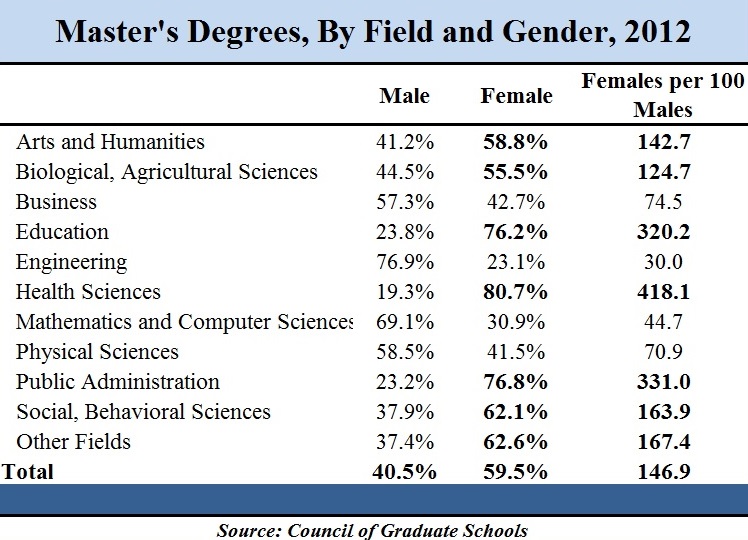
[…]3. The middle chart above shows the gender breakdown for master’s degrees awarded in 2012, and the gender disparity in favor of females is significant – women earned just under 60% of all master’s degrees in 2012, which would also mean that women earned 146.9 master’s degrees last year for every 100 degrees earned by men.

[…]Women represent 58.5% of all graduate students in the U.S., meaning that there are now 141 women enrolled in graduate school for every 100 men.

Click here for the charts.

The author of the post, Dr. Mark Perry, concludes this:

MP: Here’s my prediction – the facts that: a) men are underrepresented in graduate school enrollment overall (100 men were enrolled in 2012 for every 141 women), b) men received fewer master’s (40.5% of the total) and doctoral degrees (47.8% of the total) than women in 2012, and c) men were underrepresented in 7 out of 11 graduate fields of study at both the master’s and doctoral levels last year will get no attention at all from the media, universities and anybody in the higher education industry.

Additionally, there will be no calls for government studies, or increased government funding to address the significant gender disparities in graduate schools, and nobody will refer to the gender graduate school enrollment and degree gaps favoring women as a problem or a “crisis.”  Further, neither President Obama nor Congress will address the gender graduate enrollment and degree gaps by invoking the Title IX gender-equity law, like they have threatened to do for the gender gap in some college math and science programs. And there won’t be any executive orders to address the huge gender disparity in graduate schools by creating a White House Council on Boys and Men like the executive order issued by President Obama in 2009 to create the “White House Council on Women and Girls.”  Finally, despite their stated commitment to “gender equity,” the hundreds of university women’s centers around the country are unlikely to show any concern about the significant gender inequities in graduate school enrollment and degrees, and universities will not be allocating funding to set up men’s centers or create graduate scholarships for men.

Bottom Line: If there is any attention about gender differences in the CGS annual report, it will likely be about the fact that women are a minority in 4 of the 11 fields of graduate study including engineering and computer science (a gender gap which some consider to be a “national crisis”), with calls for greater awareness of female under-representation in STEM graduate fields of study and careers (except for the STEM field of biology, where women areover-represented).  But don’t expect any concern about the fact that men have increasingly become the second sex in higher education.  The concern about gender imbalances will remain extremely selective, and will only focus on cases when women, not men, are underrepresented and in the minority.

Men outnumber women in business, computer science, engineering and physical sciences.

I echo Dr. Perry’s point, and want to add this. In traditional Christianity, men are responsible for providing for their families. One of the ways that we men prepare for this is by getting advanced degrees in STEM-related fields, since these fields are the hardest and also pay the best. So with that in mind, what does it mean for men who want to prepare for this provider role that there is this obvious discrimination against men in graduate schools and doctoral programs? Is anyone going to do anything to change policies and incentives to favor men, like they did when women were under-represented? Of course not. The only thing that will be done is to ignorantly urge men to “man up”, while ignoring the real problems, e.g. – a lack of male teachers, schools that are not geared to male learning styles, and so on.

Related posts