Tag Archives: Household

Dawn Stefanowicz explains her experience being raised by a gay parent

*** WARNING: This post is definitely for grown-ups only! ***

I was listening to a Dr. J podcast on “Why Marriage Matters”, and I heard about a woman named Dawn Stefanowicz, who was raised by her gay father in Toronto.

So, I looked around and found this interview with Dawn posted on MercatorNet. This is mature subject matter.

Intro:

Gay marriage and gay adoption are being fiercely debated in a number of countries. Usually these issues are framed as a human rights issue. But whose rights? Patrick Meagher, MercatorNet’s contributing editor in Canada, recently interviewed a woman who was raised by a homosexual father. She feels that her rights as a child were completely ignored.

Dawn Stefanowicz (www.DawnStefanowicz.com) grew up in Toronto. Now in her 40s, she has written a book, Out From Under: Getting Clear of the Wreckage of a Sexually Disordered Home, to be released later this year. Stefanowicz has now been married for 22 years, is raising a family, and also works as an accountant. She has also testified about same-sex marriage in Washington and Ottawa.

Sample:

MercatorNet: How did you feel about what was going on around you?

Stefanowicz: You become used to it and desensitised. I was told at eight years old not to talk about this but I knew that something was wrong. I was not thinking “this is right or wrong” but I was disturbed by what I was experiencing. I was unhappy, fearful, anxious and confused. I was not allowed to tell my father that his lifestyle upset me. You can be four-years-old and questioning, “Where is Daddy?” You sense women are not valued. You think Daddy doesn’t have time for you or Daddy is too busy to play a game with you. All this is hard because as a child this is the only experience you have.

MercatorNet: How did this affect your relationship with others?

Stefanowicz: I had a hard time concentrating in school on day-to-day subjects and with peers. I felt insecure. I was already stressed out by an early age. I’m now in my 40s. You’re looking at life-long issues. There is a lot of prolonged and unresolved grief in this kind of home environment and with what you witness in the subcultures.

It took me until I was into my 20s and 30s, after making major life choices, to begin to realise how being raised in this environment had affected me. Unfortunately, it was not until my father, his sexual partners and my mother had died, that I was free to speak publicly about my experiences.

And:

MercatorNet: Why do so few children speak out?

Stefanowicz: You’re terrified. Absolutely terrified. Children who open up these family secrets are dependent on parents for everything. You carry the burden that you have to keep secrets. You learn to put on an image publicly of the happy family that is not reality. With same-sex legislation, children are further silenced. They believe there is no safe adult they can go to.

Have you ever considered what effect it has on a child that they have to grow up without their mother or their father? Is that good for them? Is that something that we should be promoting so that there is more of it? It’s a sad thing to tell adults that they cannot do whatever they want, but it’s a sadder thing to harm children just so that adults can do whatever they want. We need to choose to be careful not to harm children by making poor decisions.

Related posts

Government spends $61,194 on welfare for each household below the poverty line

From the Weekly Standard. (With a rant from me below)

Excerpt:

New data compiled by the Republican side of the Senate Budget Committee shows that, last year, the United States spent over $60,000 to support welfare programs per each household that is in poverty. The calculations are based on data from the Census, the Office of Management and Budget, and the Congressional Research Services.

“According to the Census’s American Community Survey, the number of households with incomes below the poverty line in 2011 was 16,807,795,” the Senate Budget Committee notes. “If you divide total federal and state spending by the number of households with incomes below the poverty line, the average spending per household in poverty was $61,194 in 2011.”

This dollar figure is almost three times the amount the average household on poverty lives on per year. “If the spending on these programs were converted into cash, and distributed exclusively to the nation’s households below the poverty line, this cash amount would be over 2.5 times the federal poverty threshold for a family of four, which in 2011 was $22,350 (see table in this link),” the Republicans on the Senate Budget Committee note.

To be clear, not all households living below the poverty line receive $61,194 worth of assistance per year. After all, many above the poverty line also receive benefits from social welfare programs (e.g. pell grants).

How do people become poor anyway, in a rich country like America? Is it someone else’s fault, or is it a result of their own poor decision-making? Let famous black economist Walter Williams – chair of the Department of Economics at the prestigious George Mason University –explain it for us:

Avoiding long-term poverty is not rocket science. First, graduate from high school. Second, get married before you have children, and stay married. Third, work at any kind of job, even one that starts out paying the minimum wage. And, finally, avoid engaging in criminal behavior.

If you graduate from high school today with a B or C average, in most places in our country there’s a low-cost or financially assisted post-high-school education program available to increase your skills.

Most jobs start with wages higher than the minimum wage, which is currently $5.15. A man and his wife, even earning the minimum wage, would earn $21,000 annually. According to the Bureau of Census, in 2003, the poverty threshold for one person was $9,393, for a two-person household it was $12,015, and for a family of four it was $18,810. Taking a minimum-wage job is no great shakes, but it produces an income higher than the Bureau of Census’ poverty threshold. Plus, having a job in the first place increases one’s prospects for a better job.

To augment what Dr. Williams said with a study:

Nearly three out of four poor families with children in America are headed by single parents. When a child’s father is married to his mother, however, the probability of the child’s living in poverty drops by 82 percent.

The collapse of marriage, along with a dramatic rise in births to single women, is the most important cause of childhood poverty but government policy doesn’t reflect that reality, according to a special report released today by The Heritage Foundation.

I had to spend all day Saturday and all day Sunday this weekend working to fix a defect so that I could get back on track on my next project. I am still 4 days behind schedule on that new project. If I can’t catch up, I’ll probably have to cancel my November vacation, and maybe even my December vacation. The massive expenditures on welfare for “the poor” is the reason why I have to come in on Saturday and Sunday to work. I have to  to work to pay for these people, and their enablers in the Democrat party.

Don’t I have a right to pursue my dreams and my marriage plans and my plans to be a public, effective Christian, with the money that I earn through my work? For example, on Saturday, I sent $125 to a young Christian scholar so that he could attend a conference and present a paper on a moral issue that we both care about. The government would never give him money, but they will tax me to pay for contraceptives for everyone else. I am a virgin – I don’t even buy contraceptives for myself! I really have better things to do with my earned income than buying “Obamaphones” for people who spend their entire lives collecting welfare. Don’t I have a right to spend what I earn on my own goals and priorities?

UPDATE: The Manhattan Institute explains how welfare waivers water down the work incentives for welfare.

Related posts

9 reasons why the economy is not moving “forward” under Barack Obama

From the American Enterprise Institute.

Here’s the summary of the list of 9 items:

  1. Unemployment rate
  2. Declining U.S. labor force (structural unemployment/government dependency)
  3. Labor force participation rate
  4. Unemployment/population ratio
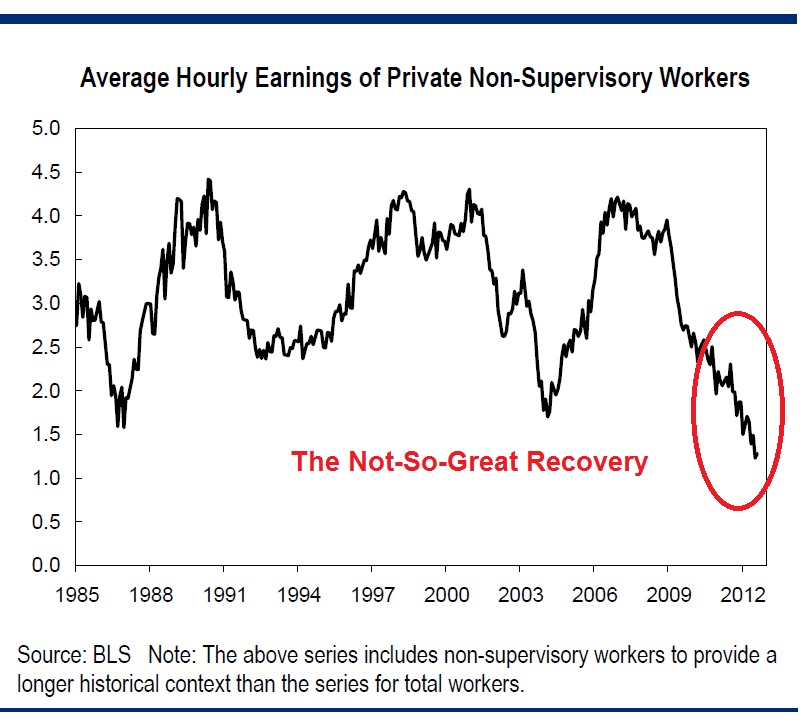
  5. Average hourly earnings of workers
  6. GDP growth
  7. Economic competitiveness
  8. Federal debt crisis
  9. Risk of renewed recession

And here’s the detail of one that I haven’t mentioned much before on this blog:

5. Average hourly earnings were unchanged in the August jobs report, and are up just 1.7% over the past year. Not only does that match the slowest pace on record, but one you account for inflation, wages are flat to down.

The graph:

Average hourly earnings for American workers down under Obama
Average hourly earnings for workers way down under Obama

According to Forbes magazine: (H/T Gateway Pundit)

New income data from the Census Bureau reveal what a great job Barack Obama has done for the middle class as President. During his entire tenure in the oval office, median household income has declined by 7.3%.

In January, 2009, the month he entered office, median household income was $54,983. By June, 2012, it had spiraled down to $50,964. That’s a loss of $4,019 per family, the equivalent of losing a little less than one month’s income a year, every year. And on our current course that is only going to get worse not better…

[…]Three years into the Obama recovery, median family income had declined nearly 5% by June, 2012 as compared to June, 2009. That is nearly twice the decline of 2.6% that occurred during the recession from December, 2007 until June, 2009. As the Wall Street Journal summarized in its August 25-26 weekend edition, “For household income, in other words, the Obama recovery has been worse than the Bush recession.”

[…]Obama has failed the poor as well as the middle class. Last year, the Census Bureau reported more Americans in poverty than ever before in the more than 50 years that Census has been tracking poverty. Now The Huffington Post reports that the poverty rate is on track to rise to the highest level since 1965, before the War on Poverty began. A July 22 story by Hope Yen reports that when the new poverty rates are released in September, “even a 0.1 percentage point increase would put poverty at the highest level since 1965.”

Gateway Pundit adds:

Barack Obama is not just the food stamp president.
A record one in seven Americans is on food stamps today thanks to Barack Obama.

Barack Obama is also the poverty and pain president.
Under Obama, 6.4 million Americans are living below the poverty line and there is a record number of Americans living in deep poverty.

Meanwhile, Moody’s is threatening a credit downgrade:

Moody’s Investors Service said Tuesday that it would probably cut its triple-A rating on U.S. government debt by a notch unless congressional leaders can strike a budget deal in the coming months to bring down the deficit.

“If those negotiations lead to specific policies that produce a stabilization and then downward trend in the ratio of federal debt to GDP over the medium term, the rating will likely be affirmed,” Moody’s said in a press release Tuesday. “If those negotiations fail to produce such policies, however, Moody’s would expect to lower the rating, probably to Aa1.”

The threat comes after one of the other big three ratings firms, Standard & Poor’s, downgraded the U.S. last year following the brawl in Washington over the debt ceiling.

This would be the second credit downgrade – both occurred because of Obama’s Marxist policies of “spreading the wealth around” to punish job creators and their employees.

Are you better off now than you were four years ago?