Tag Archives: Children

Liberal Democrat David Blankenhorn: Protecting marriage protects children

This is an article from 2008 that appeared in the liberal Los Angeles Times. (H/T Dina)

Excerpt:

I’m a liberal Democrat. And I do not favor same-sex marriage. Do those positions sound contradictory? To me, they fit together.

[…]Marriage as a human institution is constantly evolving, and many of its features vary across groups and cultures. But there is one constant. In all societies, marriage shapes the rights and obligations of parenthood. Among us humans, the scholars report, marriage is not primarily a license to have sex. Nor is it primarily a license to receive benefits or social recognition. It is primarily a license to have children.

In this sense, marriage is a gift that society bestows on its next generation. Marriage (and only marriage) unites the three core dimensions of parenthood — biological, social and legal — into one pro-child form: the married couple. Marriage says to a child: The man and the woman whose sexual union made you will also be there to love and raise you. Marriage says to society as a whole: For every child born, there is a recognized mother and a father, accountable to the child and to each other.

[…]Marriage is society’s most pro-child institution. In 2002 — just moments before it became highly unfashionable to say so — a team of researchers from Child Trends, a nonpartisan research center, reported that “family structure clearly matters for children, and the family structure that helps children the most is a family headed by two biological parents in a low-conflict marriage.”

All our scholarly instruments seem to agree: For healthy development, what a child needs more than anything else is the mother and father who together made the child, who love the child and love each other.

For these reasons, children have the right, insofar as society can make it possible, to know and to be cared for by the two parents who brought them into this world. The foundational human rights document in the world today regarding children, the 1989 U.N. Convention on the Rights of the Child, specifically guarantees children this right. The last time I checked, liberals like me were supposed to be in favor of internationally recognized human rights, particularly concerning children, who are typically society’s most voiceless and vulnerable group. Or have I now said something I shouldn’t?

Every child being raised by gay or lesbian couples will be denied his birthright to both parents who made him. Every single one. Moreover, losing that right will not be a consequence of something that at least most of us view as tragic, such as a marriage that didn’t last, or an unexpected pregnancy where the father-to-be has no intention of sticking around. On the contrary, in the case of same-sex marriage and the children of those unions, it will be explained to everyone, including the children, that something wonderful has happened!

I am not a fan of David Blankenhorn at all, but he’s right on this point. This is the argument that motivates most pro-marriage activists, although we have others. I think it’s important for people to see that people who want to preserve the traditional definition of marriage are not anti-gay, they are pro-child. We want children to grow up with mothers and fathers who have every incentive to care for them.
Marriage advice from Christian philosopher William Lane Craig

Here is a question of the week from Dr. Craig on “Marriage Advice”!

Here’s the question:

Dear Dr. Craig,

Marriage is in the foreseeable future, and I would like to ask you for any advice before it happens. Can we avoid any mistakes? Would it be helpful to meet with a pastor for premarital counseling? Are there any helpful tips you could give from a Christian perspective or from your own experience?

Thank you in advance!

Zareen

Here are the main pieces of advice Dr. Craig gives:

  1. Resolve that there will be no divorce
  2. Delay having children
  3. Confront problems honestly
  4. Seek marital counseling
  5. Take steps to build intimacy in your relationship

And here’s the controversial one (#2):

2. Delay having children. The first years of marriage are difficult enough on their own without introducing the complication of children. Once children come, the wife’s attention is necessarily diverted, and huge stresses come upon you both. Spend the first several years of marriage getting to know each other, working through your issues, having fun together, and enjoying that intimate love relationship between just the two of you. Jan and I waited ten years before having our first child Charity, which allowed me the finish graduate school, get our feet on the ground financially, establish some roots, and enjoy and build our love relationship until we were really ready to take on the responsibilities of parenthood. The qualifier here is that if the wife desperately wants children now, then the husband should accede to her wish to become a mother, rather than withhold that from her. Her verdict should be decisive. But if you both can agree to wait, things will probably be much easier.

I wonder if the married readers agree with him about the “waiting at least a year after marriage bafore having children”?

A secular case against legalized abortion

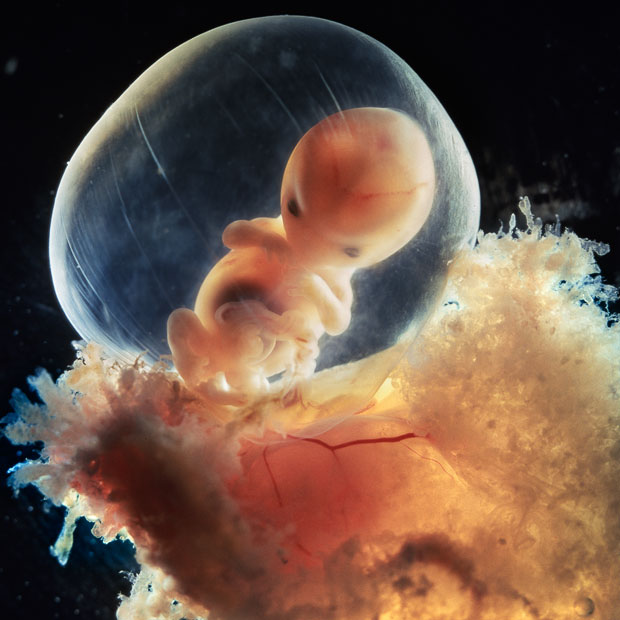
Unborn baby scheming about being only two months old

Note: this post has a twin! Its companion post on a secular case against gay marriage is here.

Now, you may think that the view that the unborn deserve protection during pregnancy is something that you either take on faith or not. But I want to explain how you can make a case for the right to life of the unborn, just by using reason and evidence.

To defend the pro-life position, I think you need to sustain 3 arguments:

  1. The unborn is a living being with human DNA, and is therefore human.
  2. There is no morally-relevant difference between an unborn baby, and one already born.
  3. None of the justifications given for terminating an unborn baby are morally adequate.

Now, the pro-abortion debater may object to point 1, perhaps by claiming that the unborn baby is either not living, or not human, or not distinct from the mother.

Defending point 1: Well, it is pretty obvious that the unborn child is not inanimate matter. It is definitely living and growing through all 9 months of pregnancy. (Click here for a video that shows what a baby looks like through all 9 months of pregnancy). Since it has human DNA, that makes it a human. And its DNA is different from either its mother or father, so it clearly not just a tissue growth of the father or the mother. More on this point at Christian Cadre, here. An unborn child cannot be the woman’s own body, because then the woman would have four arms, four legs, two heads, four eyes and two different DNA signatures. When you have two different human DNA signatures, you have two different humans.

Secondly, the pro-abortion debater may try to identify a characteristic of the unborn that is not yet present or developed while it is still in the womb, and then argue that because the unborn does not have that characteristic, it does not deserve the protection of the law.

Defending point 2: You need to show that the unborn are not different from the already-born in any meaningful way. The main differences between them are: size, level of development, environment and degree of dependence. Once these characteristics are identified, you can explain that none of these differences provide moral justification for terminating a life. For example, babies inside and outside the womb have the same value, because location does not change a human’s intrinsic value. More at Stand to Reason, here.

Additionally, the pro-abortion debater may try to identify a characteristic of the already-born that is not yet present or developed in the unborn, and then argue that because the unborn does not have that characteristic, that it does not deserve protection, (e.g. – sentience). Most of the these objections that you may encounter are refuted in this essay by Francis Beckwith. Usually these objections fall apart because they assume the thing they are trying to prove, namely, that the unborn deserves less protection than the already born.

Finally, the pro-abortion debater may conceded your points 1 and 2, and admit that the unborn is fully human. But they may then try to provide a moral justification for terminating the life of the unborn, regardless.

Defending point 3: I fully grant that it is sometimes justifiable to terminate an innocent human life, if there is a moral justification. Is there such a justification for abortion? One of the best known attempts to justify abortion is Judith Jarvis Thomson’s “violinist” argument. This argument is summarized by Paul Manata, one of the experts over at Triablogue:

Briefly, this argument goes like this: Say a world-famous violinist developed a fatal kidney ailment and the Society of Music Lovers found that only you had the right blood-type to help. So, they therefore have you kidnapped and then attach you to the violinist’s circulatory system so that your kidneys can be used to extract the poison from his. To unplug yourself from the violinist would be to kill him; therefore, pro-lifers would say a person has to stay attached against her will to the violinist for 9 months. Thompson says that it would be morally virtuous to stay plugged-in. But she asks, “Do you have to?” She appeals to our intuitions and answers, “No.”

Manata then goes on to defeat Thomson’s proposal here, with a short, memorable illustration, which I highly recommend that you check out. More info on how to respond to similar arguments is here.

The best book for beginners on the pro-life view is this book:

For those looking for advanced resources, Francis Beckwith, a professor at Baylor University, published the book Defending Life, with Cambridge University Press, 2007.

Learn about the pro-life case

And some posts motivating Christians and conservatives to take abortion seriously: