
Tag Archives: Youth

What helps young men resist peer disapproval?

Tough enough to not care about peer pressure
Tough enough to not care whether you approve of what he’s doing

A post by Nick Peters about young people and apologetics, at the Christian Apologetics Alliance blog.

Excerpt:

Now picture a teenage youth who is a Christian. Is he on the outs with his peers in any way? Well if he’s a good and observant Christian, he’ll be a virgin (since most teenagers in high school aren’t married). Will that lead to any shame to his peers? Yep. Especially since they consider “getting laid” to be a rite of passage and a sign that you are a real man or woman.

So what happens with a boy who’s seventeen and can drive and who is with the guys who are talking about their sexual exploits and the guy has nothing to contribute? If he is asked why he’s not “getting some” he replies that he is a Christian. Is that going to win him any friends? Nope. His “friends” there will most likely mock him for believing in antiquated ideas that science has disproven and tell him he needs to get with the times. Result? The young man is shamed.

Now imagine instead if he’s told the latter part about how his ideas are antiquated and instead, he’s able to make a rational case for the resurrection of Jesus from the dead. Do you think he’ll be able to be shamed the same way? Sure, his friends can still mock him, but he can take the mockery as a sign that they cannot answer his arguments. The young boy has honor then, rather than shame. He might not be sleeping around, but he can hold his head high knowing he can stand up against his peers.

[…]No one wants to be embarrassed, and that includes youth, but if our young people think they can do something that none of their peers can do, it will help them to have that honor that they seek, and there is nothing wrong with seeking honor. Remember the parable where Christ told us to take a lowly position at a banquet so our host would say, “Move up to a better place” and we would be honored? He was saying that that is the proper way to receive honor. Don’t just go out and try to grab it. Let it be given to you.

There are many things that a young person can be ashamed of, but if they’re intellectually unprepared, being a Christian is something that they may be shamed for. In the face of temptation, they need a reason to be obedient rather than just, “The church says so” or “Mom and Dad say so.” Neither of those will be seen as honorable positions. They need to know for themselves why it is that they hold the stance that they do. If they are waiting until marriage, they need to know why. If they believe a man rose from the dead, they need to know why.

That youth are eating this stuff up should tell us something. Youth don’t want to be shamed in the eyes of their contemporaries. They won’t mind holding a different position as long as they can defend that position. If they cannot, then the tide of social pressure could be enough to get them to abandon that and if their emotions and wills start acting against Christianity, it is only a matter of time until the intellect follows.

That excerpt is basically a summary of my life – that’s how I started out as a teen – with apologetics. I’ve been a Christian the whole time in between then and now. I think many parents and churches are wondering how it is that you get a young man to stand up to the culture and peer pressure. The answer is apologetics, and I think integrating Christianity with every other area of knowledge helps as well. Winning arguments over and over is an excellent way to build a suit of armor against temptation and peer pressure.

And in speaking to young people who were raised as Christians then fell away, the common denominator is that they were uncomfortable claiming to be Christians in a secular environment. We have to have a plan to help our young people deal with pluralism and peer pressure. Apologetics is the best answer I can think of.

Study: fathers are important for the development of children’s brains

Fathers and children

The study was reported in the Wall Street Journal.

Excerpt:

Dr. Braun’s group found that at 21 days, the fatherless animals had less dense dendritic spines compared to animals raised by both parents, though they “caught up” by day 90. However, the length of some types of dendrites was significantly shorter in some parts of the brain, even in adulthood, in fatherless animals.

“It just shows that parents are leaving footprints on the brain of their kids,” says Dr. Braun, 54 years old.

The neuronal differences were observed in a part of the brain called the amygdala, which is related to emotional responses and fear, and the orbitofrontal cortex, or OFC, the brain’s decision-making center.

[…]The balance between these two brain parts is critical to normal emotional and cognitive functioning, according to Dr. Braun. If the OFC isn’t active, the amygdala “goes crazy, like a horse without a rider,” she says. In the case of the fatherless pups, there were fewer dendritic spines in the OFC, while the dendrite trees in the amygdala grew more and longer branches.

A preliminary analysis of the degus’ behavior showed that fatherless animals seemed to have a lack of impulse control, Dr. Braun says. And, when they played with siblings, they engaged in more play-fighting or aggressive behavior.

In a separate study in Dr. Braun’s lab conducted by post-doctoral researcher Joerg Bock, degu pups were removed from their caregivers for one hour a day. Just this small amount of stress leads the pups to exhibit more hyperactive behaviors and less focused attention, compared to those who aren’t separated, Dr. Braun says. They also exhibit changes in their brain.

The basic wiring between the brain regions in the degus is the same as in humans, and the nerve cells are identical in their function. “So on that level we can assume that what happens in the animal’s brain when it’s raised in an impoverished environment … should be very similar to what happens in our children’s brain,” Dr. Braun says.

Read the whole thing.

I think this is important because we hear so much today that marriage can be redefined, that having one of each parent doesn’t matter, that live-in boyfriends and stepfathers have the same motivation to care for a woman’s children as the biological father does. We don’t want to make judgments, even if setting boundaries is better for children. A child’s well-being is enormously affected by the woman’s choice of biological father.  You can’t have it both ways – either we are going to judge women who choose men who don’t have the desire to commit to marriage, and do the father role, OR we are going to take things away from children by encouraging women to choose men based on “feelings” instead of abilities. Lowering moral standards and removing moral obligations hurts children. It sounds so nice when we tell women, “you can do whatever you feel like, and just forget about responsibilities, expectations and obligations”, but letting women be guided by their feelings harms children. My stock broker makes me feel uncomfortable because he knows more than I do, and does not respect my opinion. But I pay him to make investment decisions for me. I mustn’t let my pride get in the way of letting him do his job – a job he is more qualified than I am to do. Let him do his job.

Here’s a related question: Are biological fathers or unrelated men more dangerous for children?

This article from the Weekly Standard answers the question.

Excerpt:

A March 1996 study by the Bureau of Justice Statistics contains some interesting findings that indicate just how widespread the problem may be. In a nationally representative survey of state prisoners jailed for assaults against or murders of children, fully one-half of respondents reported the victim was a friend, acquaintance, or relative other than offspring. (All but 3 percent of those who committed violent crimes against children were men.) A close relationship between victim and victimizer is also suggested by the fact that three-quarters of all the crimes occurred in either the perpetrator’s home or the victim’s.

A 1994 paper published in the Journal of Comparative Family Studies looked at 32,000 documented cases of child abuse. Of the victims, only 28 percent lived with both biological parents (far fewer than the 68 percent of all children who live with both parents); 44 percent lived with their mother only (as do 25 percent of all children); and 18 percent lived with their mother and an unrelated adult (double the 9 percent of all children who live with their mother and an unrelated adult).

These findings mirror a 1993 British study by the Family Education Trust, which meticulously explored the relationship between family structure and child abuse. Using data on documented cases of abuse in Britain between 1982 and 1988, the report found a high correlation between child abuse and the marital status of the parents.

Specifically, the British study found that the incidence of abuse was an astounding 33 times higher in homes where the mother was cohabiting with an unrelated boyfriend than in stable nuclear families. Even when the boyfriend was the children’s biological father, the chances of abuse were twice as high.

These findings are consonant with those published a year earlier by Leslie Margolin of the University of Iowa in the journal Child Abuse and Neglect. Prof. Margolin found that boyfriends were 27 times more likely than natural parents to abuse a child. The next-riskiest group, siblings, were only twice as likely as parents to abuse a child.

More recently, a report by Dr. Michael Stiffman presented at the latest meeting of the American Academy of Pediatrics, in October, studied the 175 Missouri children under the age of 5 who were murdered between 1992 and 1994. It found that the risk of a child’s dying at the hands of an adult living in the child’s own household was eight times higher if the adult was biologically unrelated.

The Heritage Foundation’s Patrick Fagan discovered that the number of child-abuse cases appeared to rise in the 1980s along with the general societal acceptance of cohabitation before, or instead of, marriage. That runs counter to the radical-feminist view, which holds that marriage is an oppressive male institution of which violence is an integral feature. If that were true, then child abuse and domestic violence should have decreased along with the rise in cohabitation.

Heritage also found that in the case of very poor children (those in households earning less than $ 15,000 per year), 75 percent lived in a household where the biological father was absent. And 50 percent of adults with less than a high-school education lived in cohabitation arrangements. “This mix — poverty, lack of education, children, and cohabitation — is an incubator for violence,” Fagan says.

Why, then, do we ignore the problem? Fagan has a theory: “It is extremely politically incorrect to suggest that living together might not be the best living arrangement.”

The moral of the story is that it is a lot safer for children if we promote marriage as a way of attaching mothers and fathers to their children. Fathers who have a biological connection to children are a lot less likely to harm them. We should probably be teaching women to choose men who have a certain tenderness towards people they mentor or nurture, as well. These things are not free, you have to persuade women to value the male tendency to want to lead / guide / mentor. A lot of social problems like child poverty, promiscuity and violence cannot be solved by replacing a father with a check from the government. We need to support fathers by empowering them in their traditional roles. Let the men lead. Swallow your feminist instincts, and prefer men who take seriously their role of leading others upward.

Why is it so hard for young people to find a job?

Young people have a sense of entitlement

Bloomberg News discusses the “Professionalism in the Workplace” survey of human resources specialists from York College of Pennsylvania.

Forty-nine percent of [those surveyed] stated that less than half of new employees “exhibit professionalism in their first year.” More than half (53 percent) have noticed “a sense of entitlement” rising among younger workers; almost 45 percent have seen a “worsening of the work ethic,” including “too casual of an attitude toward work” and “not understanding what hard work is.”

Younger workers believe they can multitask and remain productive, the human-resources people told the York researchers. Thirty-eight percent of respondents blamed multitasking for the lack of “focus” among younger workers. The authors of the study explained that the younger generation “believes that it is possible to multi-task effectively” and that using social media, for example, is an efficient way to communicate. In interviews, the applicants check their phones for texts and calls, dress inappropriately and overrate their talents.

“The sad fact is some of these persons probably do not understand what is wrong with this,” the authors note.

Older workers have always complained about younger workers, of course, but there’s a difference: This time they attribute the youthful flaws not to ignorance or waywardness, but to a “sense of entitlement.”

We might forgive 18-year-olds fresh out of high school for lacking employability skills (the manufacturing sector hires many workers lacking undergraduate degrees). But when he or she reaches 23 and has four years of college, employers expect a white-collar worker to recognize basic norms of dress and deportment.

What happened in college, then? The survey by York College’s Center for Professional Excellence assigns colleges part of the blame, observing that letting students miss deadlines without penalty and assigning good grades for middling work only make them form the wrong expectations.

Meanwhile, the UK Daily Mail had the results from a 2013 survey:

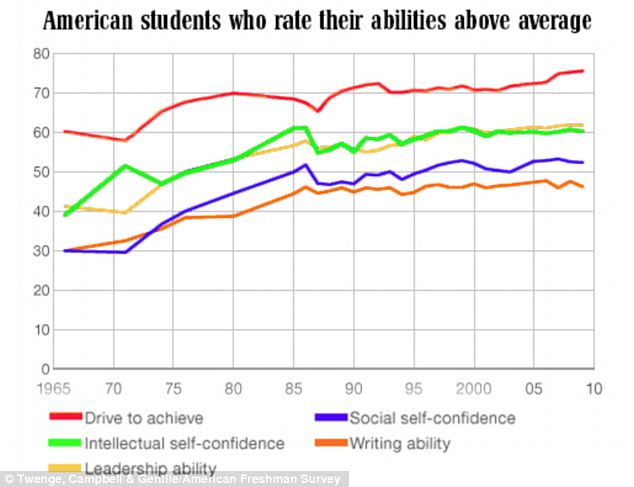
Young people’s unprecedented level of self-infatuation was revealed in a new analysis of the American Freshman Survey, which has been asking students to rate themselves compared to their peers since 1966.

Roughly 9 million young people have taken the survey over the last 47 years.

Psychologist Jean Twenge and her colleagues compiled the data and found that over the last four decades there’s been a dramatic rise in the number of students who describe themselves as being ‘above average’ in the areas of academic ability, drive to achieve, mathematical ability, and self-confidence.

But in appraising the traits that are considered less invidualistic – co-operativeness, understanding others, and spirituality – the numbers either stayed at slightly decreased over the same period.

Researchers also found a disconnect between the student’s opinions of themselves and actual ability.

While students are much more likely to call themselves gifted in writing abilities, objective test scores actually show that their writing abilities are far less than those of their 1960s counterparts.

Also on the decline is the amount of time spent studying, with little more than a third of students saying they study for six or more hours a week compared to almost half of all students claiming the same in the late 1980s.

Though they may work less, the number that said they had a drive to succeed rose sharply.

[…]Twenge is the author of a separate study showing a 30 per cent increase towards narcissism in students since 1979.

‘Our culture used to encourage modesty and humility and not bragging about yourself,’ Twenge told BBC News. ‘It was considered a bad thing to be seen as conceited or full of yourself.’

Just because someone has high self-esteem doesn’t mean they’re a narcissist. Positive self-assessments can not only be harmless but completely true.

However, one in four recent students responded to a questionnaire called the Narcissistic Personality Inventory with results pointing towards narcissistic self-assessments.

Narcissism is defined as excessive self-love or vanity; self-admiration, or being self-centered.

Twenge said that’s a trait that is often negative and destructive, and blames its boom on several trends – including parenting styles, celebrity culture, social media, and easy credit – for allowing people to seem more successful than they really are.

I think what I am seeing is that not only do they work less, but they work at things they “like”, rather than at things that will allow them to provide value to others. So, you’re not going to find a lot of computer programmers or petroleum engineers among young Americans, but you will find a lot of people gravitating to jobs that are easy that make them feel good about themselves, and look good to other people, too.

Obviously, there are policy reasons for youth unemployment being so high, but I think this attitude that young people have is definitely part of it.