Tag Archives: Study

Darwinian apologists absent from conference on evolution research

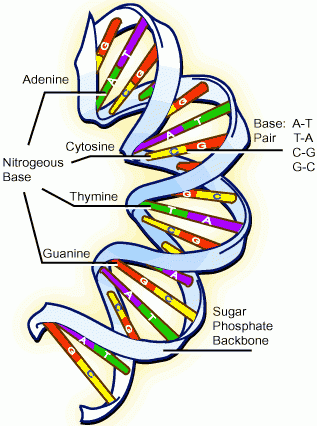
Structure of DNA
Where do you get your information?

Thomas Cudworth explains at Uncommon Descent.

Excerpt:

From June 17 to June 21, 2011, at the University of Oklahoma (Norman) campus, the conference “Evolution 2011” was in session.  It was co-sponsored by three scientific societies – The Society for the Study of Evolution, The Society of Systematic Biologists, and the American Society of Naturalists.  It was billed by its promoters as “the premier annual international conference of evolutionary biologists on the planet.”

That billing may be somewhat hyperbolic, yet two things are clear:  the conference was huge, with an expected turnout of 1400-1500 people; and many of the big names of evolutionary biology were to be there.  Jerry Coyne was to give an address; H. Allen Orr was to chair a session; and Gunter Wagner and Sergey Gavrilets, cutting-edge biologists from the famed 2008 Altenberg conference, were to be there as well.  Hundreds of papers were scheduled, and the research contributors to the various papers and presentations, according to the index for the conference, numbered something like 2,000.

[…]Let’s start with those Darwin defenders who are actively anti-religious or show contempt for religion in their writings and internet remarks.  Conspicuously absent from the list of conference contributors were evolutionary champions Richard Dawkins, P. Z. Myers, Larry Moran, and Eugenie Scott.

Among those who have not attacked religious belief, but have violently bashed ID and/or passionately upheld neo-Darwinian theory, Paul Gross (co-author of Creationism’s Trojan Horse) and plant scientist Arthur Hunt (who has debated ID people live and on the internet) were not listed as contributors to any of the papers.

Among those who were active in the Dover ID trial, as witnesses for the plaintiffs, the no-shows include Kevin Padian, Robert Pennock, and Brian Alters.

Among the prominent Christian Darwinists, i.e., theistic evolutionists/evolutionary creationists, only Ken Miller was going to be there, and not to read a scientific paper, but to issue a cultural manifesto on why evolution matters in America today.  The leading figures of Biologos – Darrel Falk, Dennis Venema, Kathryn Applegate, David Ussery, David Kerk, Denis Lamoureux – who have so often been presented, explicitly or implicitly, as experts on evolutionary biology – produced no papers for this conference.    British scientists Oliver Barclay and Denis Alexander, who have posted several guest columns on Biologos, are not mentioned.  The frequent UD commenter and Quaker TE Allan MacNeill, who has penned hundreds of thousands of words on UD and on his own blogs, apparently couldn’t manage 5,000 or so words for an original research paper for the conference, nor could the belligerent Calvinist TE and almost as prolific anti-ID blogger Steve Matheson.

Here’s why I think this is significant. The people who are the most aware of what intelligent design scholars are publishing in their books and research papers are these Darwinian apologists. They are the ones who know what has to be proven by the Darwinian side in order to counter the research being done by the intelligent design side, e.g. – the protein synthesis papers by Ann Gauger and Doug Axe. So at a major research conference on evolution, you would expect that they would have some research to present to counter the pro-ID research. But there isn’t any.

What I suspect is that the Darwinian side is going to be focused on proving the things that the ID already agrees with as being naturalistic – micro-evolution, adaptation and so forth. That’s what the conference will be about. But the conference will not be about responding to the really hard questions that are required for evolution to be a seamless explanation for all that we see. And that is telling. I see P.Z. Myers writing blog posts that are read by atheists and accepted as true. But what I don’t see is PZ Myers presenting the research to back up his blog posts in a real academic conference. And I especially don’t see PZ Myers agreeing to participate in public debates against pro-ID scholars.

Here are some papers from pro-intelligent design Biologic Institute researchers:

D’Andrea-Winslow L, Novitski AK (2008) Active bleb formation is abated in Lytechinus variegatus red spherule coelomocytes after disruption of acto-myosin contractility. Integrative Zoology 3: 106-113. doi:10.1111/j.1749-4877.2008.00086.x

Axe DD, Dixon BW, Lu P (2008) Stylus: A system for evolutionary experimentation based on a protein/proteome model with non-arbitrary functional constraints. PLoS ONE 3: e2246. doi:10.1371/journal.pone.0002246

Sternberg RV (2008) DNA codes and information: Formal structures and relational causes. Acta Biotheoretica doi:10.1007/s10441-008-9049-6. PMID: 18465197

Gonzalez G (2008) Parent stars of extrasolar planets – IX. Lithium abundances. Monthly Notices of the Royal Astronomical Society, Online Early Articles doi:10.1111/j.1365-2966.2008.13067.x

Duren RW, Marks II RJ, Reynolds PD, Trumbo ML (2007) Real-time neural network inversion on the SRC-6e reconfigurable computer. IEEE Transactions on Neural Networks 18: 889-901. PMID: 17526353

Gonzalez G, Laws C (2007) Parent stars of extrasolar planets VIII. Chemical abundances for 18 elements in 31 stars. Monthly Notices of the Royal Astronomical Society 378: 1141-1152. doi:10.1111/j.1365-2966.2007.11867.x

Gravagne IA, Marks II RJ (2007) Emergent behaviors of protector, refugee and aggressor swarms. IEEE Transactions on Systems, Man and Cybernetics, Part B: Cybernetics 37: 471- 476. PMID: 17416173

Weinschenk JJ, Combs WE, Marks II RJ (2007) On the avoidance of rule explosion in fuzzy inference engines. International Journal of Information Technology and Intelligent Computing 1, #4.

Gonzalez G (2006) Condensation temperatures trends among stars with planets. Monthly Notices of the Royal Astronomical Society: Letters 367: L37-L41. doi:10.1111/j.1745-3933.2005.00136.x

Gonzalez G (2006) The sun’s interior metallicity constrained by neutrinos. Monthly Notices of the Royal Astronomical Society: Letters 370 : L90–L93.
doi:10.1111/j.1745-3933.2006.00197.x

Gonzalez G (2006) The chemical compositions of stars with planets: A review.
Publications of the Astronomical Society of the Pacific 118: 1494-1505 (invited review paper). doi:10.1086/509792

Gonzalez G (2005) Habitable zones in the universe. Origins of Life and Evolution of Biospheres 35: 555-606. doi:10.1007/s11084-005-5010-8

Keller D, Brozik JA (2005) Framework model for DNA polymerases. Biochemistry 44: 6877-6888. PMID: 15865433

Shapiro JA, von Sternberg R (2005) Why repetitive DNA is essential to genome function. Biological Reviews 80: 227-250. Review. PMID: 15921050

von Sternberg R, Shapiro JA (2005) How repeated retroelements format genome function. Cytogenetic and Genome Research 110: 108-116. PMID: 16093662

Axe DD (2004) Estimating the prevalence of protein sequences adopting functional enzyme folds. Journal of Molecular Biology 341: 1295-1315. PMID: 15321723

Lu H, Macosko J, Habel-Rodriguez D, Keller RW, Brozik JA, Keller D (2004) Closing of the fingers domain generates motor forces in the HIV reverse transcriptase. Journal of Biological Chemistry 279: 54529-54532. PMID: 15385563

Keller D, Swigon D, Bustamante C (2003) Relating single-molecule measurements to thermodynamics. Biophysical Journal 84: 733-738. PMID: 12547757

von Sternberg R, Cumberlidge N (2003) Autapomorphies of the endophragmal system in trichodactylid freshwater crabs (Crustacea: Decapoda: Eubrachyura). Journal of Morphology 256: 23-28. PMID: 12616572

Bustamante C, Keller D, Oster G (2001) The physics of molecular motors. Accounts of Chemical Research 34: 412-420. PMID: 11412078

D’Andrea-Winslow L, Strohmeier G, Rossi B, and Hofman P (2001) Identification of a Na/K/2Cl cotransporter (NKCC) in sea urchin coelomocytes: microfilament dependent surface expression mediated by hypotonic shock and cAMP. Journal of Experimental Biology 204: 147-156. PMID: 11104718

Gonzalez G, Brownlee D, Ward P (2001) The Galactic Habitable Zone: Galactic chemical evolution. Icarus 152: 185-200. doi:10.1006/icar.2001.6617

Axe DD (2000) Extreme functional sensitivity to conservative amino acid changes on enzyme exteriors. Journal of Molecular Biology 301: 585-595. PMID: 10966772

von Sternberg R (2000) Genomes and form. The case for teleomorphic recursivity.
Annals of the New York Academy of Sciences 901: 224-236. PMID: 10818573

Wuite GJ, Smith SB, Young M, Keller D, Bustamante C (2000) Single-molecule studies of the effect of template tension on T7 DNA polymerase activity. Nature 404: 103-106. PMID: 10716452

Axe DD, Foster NW, Fersht AR (1998) A search for single substitutions that eliminate enzymatic function in a bacterial ribonuclease. Biochemistry 37: 7157-7166. PMID: 9585527

Axe DD, Foster NW, Fersht AR (1996) Active barnase variants with completely random hydrophobic cores. Proceedings of the National Academy of Sciences USA. 93: 5590-5594. PMID: 8643620

Gauger AK, Goldstein LS (1993) The Drosophila kinesin light chain. Primary structure and interaction with kinesin heavy chain. Journal of Biological Chemistry 268: 13657-13666. PMID: 8514798

So there is plenty there to refute – if there were refutations available.

Should government recognize and legalize same-sex marriage?

Earlier in the week, I posted a case against same-sex marriage that was restricted to non-religious arguments. Here’s an article written by famous Christian apologist J Warner Wallace that does the same thing, but it is  packed with even more evidence than mine!

In his article, he considers the following questions:

  • What is the aim of the same-sex marriage movement?
  • What percentage of people are gay in the United States?
  • What is the role of government?
  • Why should government promote traditional marriage?
  • Are heterosexual and homosexual relationships the same with respect to domestic violence?
  • Are heterosexual and homosexual relationships the same with respect to healthiness?
  • Are heterosexual and homosexual relationships the same with respect to spousal fidelity?
  • Are heterosexual and homosexual relationships the same with respect to stability?
  • Does it matter to children whether their two biological parents raise them or not?

Here’s an excerpt:

It’s clear that that traditional heterosexual two parent family units are far more enduring, monogamous, non-abusive and healthy. On these standards alone, it’s reasonable for us to value and promote traditional two parent marriages as the ‘ideal’ form of family in our culture. But as it turns out, a number of studies confirm that two ‘biological’ parents are actually required if we want to best assure success and well-being in our children.

Many studies come to this conclusion, including studies that are conducted by liberal advocacy groups who also recognize the fact that “children do best when raised by their two married biological parents…” (Mary Parke, “Are Married Parents Really Better for Children?”, Center for Law and Social Policy Policy Brief, May 2003, p.1). This reality is confirmed by a number of additional studies demonstrating that “an extensive body of research tells us that children do best when they grow up with both biological parents…” (Kristin Anderson Moore, et al., “Marriage From a Child’s Perspective: How Does Family Structure Affect Children, and What Can We Do about It?”, Child Trends Research Brief, June 2002, p.1).

We know, for example, that children raised in two biological parent families are far less likely to become sexually active at a young age compared to every other form of family unit, including stepfamilies. (Dawn Upchurch, et al., “Neighborhood and Family Contexts of Adolescent Sexual Activity”, Journal of Marriage and the Family, 61, 1999, 920-930). Children who are not living with both biological parents are 50 to 150% more likely to abuse drugs that kids who are raised in other types of family units, including stepfamilies like those formed in same sex unions. (Substance Abuse and Mental Health Services Administration, “The Relationship Between Family Structure and Adolescent Substance Use”, Rockville, MD, National Clearinghouse for Alcohol and Drug Information, 1996).

In a similar way, studies indicate that “children residing in households with adults unrelated to them were 8 times more likely to die of maltreatment than children in households with 2 biological parents. Risk of maltreatment death was elevated for children residing with step, foster, or adoptive parents.” (Michael Stiffman, et al., “Household Composition and Risk of Fatal Child Maltreatment,” Pediatrics, 109, 2002, pp.615-621). Over and over again, studies confirm the same reality: children do better when raised not only in two parent family units, but in two biological parent family units!

This conclusion is not limited to heterosexual studies. Even those who advocate and support same sex parenting recognize that there are inherent difficulties for children raised n these settings. The homosexual parenting literature continues to recognize this:

“The Lesbian and Gay Parenting Handbook: Creating and Raising Our Families” (April Martin):

“Some children do express an intense longing for the other biological parent, talking about it frequently and emotionally…. Adolescents take particular interest in both their heredity and in gender-specific role models.”

“The Lesbian Parenting Book: A Guide to Creating Families and Raising Children” (D. Merilee Clunis, G. Dorsey Green):

“It is very normal for children to long about and ask for a father…. It is natural to feel defensive when your child longs for a father. We encourage you to remain patient while she asks questions, sorts out information and comes to terms without knowing her father’s identity, or not having her biological father in her life. She needs to do it…. [Artificially Inseminated] children of lesbian parents may grieve never knowing their biological father.”

“Gay Men Choosing Parenthood” (Gerald P. Mallon):

“(The majority of children being raised in gay male households) sometimes verbalized a desire for a mother at one time or another.”

“For Lesbian Parents: Your Guide to Helping Your Family Grow Up Happy, Healthy, and Proud” (Suzanne M. Johnson, Elizabeth O’Connor):

“(Lesbian mothers should ask their daughters) if it’s hard sometimes not having a father. Let her know that you understand that sometimes it is hard.”

Please consider giving this article a read. It is very comprehensive, and cites a huge number of sources. I think that this topic mattered a lot more to the author than it did to me. I grew up in a marriage home and my parents are still married. I only write about the issues of single motherhood, divorce and same-sex marriage because I  have friends in these situations, and because I have read the research. But J Warner Wallace grew up in a single parent home. So he is writing about this topic based on his personal experience.

Further study

For a more academic case against SSM, see this peer-reviewed paper on traditional marriage and same-sex marriage, authored by two guys from Princeton University and one guy from the University of Notredame. One of those guys is the famous Robert P. George. For some simple, practical tips on defending traditional marriage, check out this tip sheet from the National Organization for Marriage.

You can also watch the videos from a formal academic debate on same-sex marriage held at the University of Central Florida, featuring Dr. Michael Brown. Dr. Jennifer Roback Morse also debated same-sex marriage at Columbia University in a formal academic debate. You can see her give a lecture on same-sex marriage at Houston Baptist University here, as well.

Protein binding: by chance or intelligent design?

Dr. Fazale Rana has this interesting post up on protein binding at Reasons to Believe.

Excerpt:

Nobody likes getting the flu. In fact, the influenza virus represents a serious health challenge. For most people it causes a few days of misery, but tragically for others, it takes their lives.

Biomedical researchers are looking for ways to develop therapies against the strains of the influenza virus that avoid destruction by the immune system or fail to respond to antiviral drugs. Recently scientists from the University of Washington and The Scripps Institute made progress toward this end. They designed novel proteins from scratch that bind to the stem region of hemagglutinin, a viral protein that plays a central role in the infection process.1 The hope is that the new proteins will have therapeutic use and also help with diagnosis.

This advance has obvious biomedical importance. It also contributes toward understanding the fundamental nature of protein-protein interactions (PPIs), and with this insight comes powerful new evidence that life stems from a Creator.

Often, in order to carry out their function, proteins must interact and bind in a highly specific manner with other proteins. These PPIs are selective. If the wrong proteins bind to each other, the interaction is of no use to the cell.

A large and varied population of proteins crowds the cell’s interior. Even the simplest bacterium harbors several thousand different types of proteins, along with numerous copies of the other biomolecules inside it. The jam-packed environment complicates things. Proteins are more likely to encounter the “wrong” partners than the ones they are designed to interact with.

Biochemists are currently working to understand the specificity of PPIs and how proteins avoid unintended interactions. As it turns out, protein surfaces are carefully structured to allow strong interactions between protein pairs while minimizing the strength of the unwanted interactions. Recent work by Harvard scientists indicates that the concentration of PPI-participating proteins in the cell is also designed carefully.

In other words, protein structure and concentrations have to be precisely regulated to promote the PPIs critical for life.

The rest of the article talks about all the intricate and cutting-edge engineering and computation done by the scientists to create a situation where the proteins could bind, and then ends with this:

When considering this study, it is remarkable to note how much effort it took to design a protein that binds to a specific location on the hemagglutinin molecule. As biochemists Bryan Der and Brian Kuhlman point out while commenting on this work, the design of these proteins required:

…cutting-edge software developed by ~20 groups worldwide and 100,000 hours of highly parallel computing time. It also involved using a technique known as yeast display to screen candidate proteins and select those with high binding affinities, as well as x-ray crystallography to validate designs.2

If it takes this much work and intellectual input to create a single protein from scratch, is it really reasonable to think that undirected evolutionary processes could accomplish this task routinely?

If you have to involve human intelligence to this degree, then I think that the best explanation is intelligent design.