Tag Archives: Marriage

State of Utah lists 15 consequences to redefining marriage in appellate brief

This is from National Review.

Excerpt:

In an historic opening brief filed yesterday before the U.S. Court of Appeals for the Tenth Circuit, the state of Utah identified at least 15 consequences of redefining marriage to include same-sex couples. You can read the full text, which justifies more fully why each of these reasons are valid.

Here are some of their reasons:

1. “First, as many commentators have observed, because procreation is an inherently gendered affair, redefining marriage in genderless terms would break the critical conceptual link between marriage and procreation. . . . Given the manifest ills of fatherless parenting, the State has a compelling interest in sending a powerful message to women that, whenever possible, marriage to the fathers of their children is very important to the welfare of those children and to society itself.”

5. “Fifth, and most obviously, a genderless definition of marriage would likely increase the number of children being raised by same-sex parents. That could happen because the couple decides to raise together an existing child of one of the partners. Or it could result from the conception of a new child through surrogacy or sperm-donation. Either way, such children will not benefit from the State’s preferred mother-father parenting model; often they will have no way of knowing even the identity of both biological parents. And recent evidence on same-sex parenting, while not conclusive, indicates that same-sex parenting arrangements are less effective than married biological mothers and fathers in producing positive outcomes in the lives of their children.

8. “[The] correlation between genderless marriage and lower birthrates. . . . It is also striking that fertility and birthrates tend to be markedly lower in nations and states that have embraced same-sex marriage.”

12. “Governments would likely be pressured—and perhaps agree—to revoke the tax-exempt status of churches or other non-profit religious organizations that refuse on religious grounds to recognize same-sex marriages or to provide benefits to same-sex couples on the same terms as husband-wife couples.”

13. “Governments would likely be pressured—and perhaps agree—to investigate, prosecute and punish people in wedding-related businesses for refusing on religious conscience grounds to assist with same-sex weddings.”

14. “Government licensing agencies would likely be pressured—and perhaps agree—to investigate and punish counselors for refusing on religious conscience grounds to counsel same-sex married couples on the same terms as heterosexual couples.”

15. “Religion-based conflicts between public schools and parents would likely increase as children are taught about sexuality and marriage in ways that contravene parents’ and students’ deeply held religious beliefs.”

These reasons are all of interest to the state, but what about the other social consequences of redefining marriage?

Ryan T. Anderson wrote about that a while back.

Excerpt:

The Norm of Monogamy. New York University Professor Judith Stacey has expressed hope that redefining marriage would give marriage “varied, creative and adaptive contours,” leading some to “question the dyadic limitations of Western marriage and seek…small group marriages.”[5] In their statement “Beyond Same-Sex Marriage,” more than 300 “LGBT and allied” scholars and advocates call for legal recognition of sexual relationships involving more than two partners.[6]

University of Calgary Professor Elizabeth Brake thinks that justice requires using legal recognition to “denormalize[] heterosexual monogamy as a way of life” and “rectif[y] past discrimination against homosexuals, bisexuals, polygamists, and care networks.” She supports “minimal marriage” in which “individuals can have legal marital relationships with more than one person, reciprocally or asymmetrically, themselves determining the sex and number of parties, the type of relationship involved, and which rights and responsibilities to exchange with each.”[7]

And:

The Norm of Exclusivity. Andrew Sullivan, who has extolled the “spirituality” of “anonymous sex,” also thinks that the “openness” of same-sex unions could enhance the bonds of husbands and wives:

[A]mong gay male relationships, the openness of the contract makes it more likely to survive than many heterosexual bonds.… [T]here is more likely to be greater understanding of the need for extramarital outlets between two men than between a man and a woman.… [S]omething of the gay relationship’s necessary honesty, its flexibility, and its equality could undoubtedly help strengthen and inform many heterosexual bonds.[11]

“Openness” and “flexibility” are Sullivan’s euphemisms for sexual infidelity. Similarly, in a New York Times Magazine profile, gay activist Dan Savage encourages spouses to adopt “a more flexible attitude” about allowing each other to seek sex outside their marriage.[12] The New York Times recently reported on a study finding that exclusivity was not the norm among gay partners: “‘With straight people, it’s called affairs or cheating,’ said Colleen Hoff, the study’s principal investigator, ‘but with gay people it does not have such negative connotations.’”[13]

We really need to think about the consequences of these decisions before we jump into them. The last time we redefined marriage, it was no-fault divorce. That worked out great for selfish adults who wanted to make marriage about their own happiness and feelings, but it didn’t work out well for the children who were impacted.

Can the negative effects of fatherlessness be attributed to other factors, like poverty?

Marriage and family
Marriage and family

Here’s a blog post from the Institute for Family Studies to answer that question.

Introduction:

Growing up without a father—whether that’s due to divorce, a nonmarital birth, or a father’s death—is associated with a host of negative effects. But given that children from low-income families, for instance, are more likely to live apart from their father in the first place, it can be hard to tell to what extent an absent father causes the problems that father absence is associated with, and to what extent other factors related to both family structure and child outcomes (like household income) are to blame.

Researchers Sara McLanahan, Laura Tach, and Daniel Schneider published a paper last year on exactly this problem. They reviewed 47 studies that used a variety of methods designed to uncover the causal effects of father absence, such as lagged dependent variable models, natural experiments, and individual fixed effects models.

Here’s one of the findings:

Labor Force: McLanahan and her colleagues found few studies on how father absence affects children’s employment and income in adulthood. The handful of analyses they did find are not entirely comparable; however, some of their findings were consistent. “Divorce was associated with lower levels of employment” in two studies, and in two other studies there were “higher levels of labor force inactivity among those who experienced divorce in early childhood.” In a fifth study, growing up with stepparents and with a single divorced mother had negative effects on occupational status, while growing up with a single widowed mother was not a disadvantage relative to growing up with stably married parents.

Here is Dr. Robert Rector of the Heritage Foundation to add some more evidence for this view.

He writes:

Census data and the Fragile Families survey show that marriage can be extremely effective in reducing child poverty. But the positive effects of married fathers are not limited to income alone. Children raised by married parents have substantially better life outcomes compared to similar children raised in single-parent homes.

When compared to children in intact married homes, children raised by single parents are more likely to have emotional and behavioral problems; be physically abused; smoke, drink, and use drugs; be aggressive; engage in violent, delinquent, and criminal behavior; have poor school performance; be expelled from school; and drop out of high school.[19] Many of these negative outcomes are associated with the higher poverty rates of single mothers. In many cases, however, the improvements in child well-being that are associated with marriage persist even after adjusting for differences in family income. This indicates that the father brings more to his home than just a paycheck.

The effect of married fathers on child outcomes can be quite pronounced. For example, examination of families with the same race and same parental education shows that, when compared to intact married families, children from single-parent homes are:

  • More than twice as likely to be arrested for a juvenile crime;[20]
  • Twice as likely to be treated for emotional and behavioral problems;[21]
  • Roughly twice as likely to be suspended or expelled from school;[22] and
  • A third more likely to drop out before completing high school.[23]

The effects of being raised in a single-parent home continue into adulthood. Comparing families of the same race and similar incomes, children from broken and single-parent homes are three times more likely to end up in jail by the time they reach age 30 than are children raised in intact married families. [24] Compared to girls raised in similar married families, girls from single-parent homes are more than twice as likely to have a child without being married, thereby repeating the negative cycle for another generation.[25]

Finally, the decline of marriage generates poverty in future generations. Children living in single-parent homes are 50 percent more likely to experience poverty as adults when compared to children from intact married homes. This intergenerational poverty effect persists even after adjusting for the original differences in family income and poverty during childhood.[26]

Yesterday, on the Dennis Prager show, Dennis was discussing this article and this article during the male – female hour. He made the point that children raised by single mothers and divorced mothers don’t have the experience of growing up and seeing their mother love her husband and act like a wife towards him. No government program can provide that. It is important that boys and girls have that experience of seeing a woman love her husband, and seeing a man love his wife. Of seeing them in a committed, stable, purposeful relationship, trying to provide for and raise their children.

Today, a lot of women are watching Hollywood movies and TV shows where men are portrayed in a very negative way, e.g. – Mad Men. These shows are often written by people on the hard left – radical feminists and/or gay activists. A girl growing up in this environment is just not going to have access to a positive view of how men and women get along in a marriage, making them less marry-able. Less safe to marry. That example of man and wife would act as a counter to Hollywood, but too many boys and girls are growing up without it.

So what’s the take-home lesson? The take-home lesson is that we need to be more careful about choosing partners and having children. It’s probably a good idea to be less driven by emotions, peer approval and hormones, and more driven by rational thought and studies. Choose wisely, and test well.

UK survey: nearly 60% of working moms would cut their work hours if they could afford to

Dina tweeted this UK Daily Mail article that made me think about how women vote.

Excerpt:

More than a third of working mothers would like to give up their jobs completely and stay at home with their children, a major Government survey has found.

It showed that millions of mothers of young children who go out to work do so only because they need to work to pay the bills.

The research for the Department for Education found that, far from being anxious to get out of their homes and into employment, the great majority of mothers are only reluctant workers.

Nearly six out of ten of all working mothers would cut down their hours to spend more time with their families if they could afford to, it said.

The yearning among mothers to leave their jobs and look after their children instead is even more pronounced among the highest achieving women, the  survey indicated.

More than two-thirds of those in senior and middle management roles would spend fewer hours in the office and devote more time to their children if they had enough money, it said.

[…]Yesterday’s survey also undermines the claims that prejudice and discrimination against women in male-dominated companies is the reason why women are heavily outnumbered in the boardroom.

Rather, it suggests that many women who could get to the top in business choose instead to put their children before their careers.

The problem is that when government gives people free stuff, people who work have to work more to pay for it. And the strangest thing is that even though women seem to want to stay home with their kids (which is good), when it comes time to vote, they actually vote NOT to stay home with their kids. How? By growing the size of government, which results in higher taxes. To find out what women really think about staying home with their kids, we can look at how they vote. 

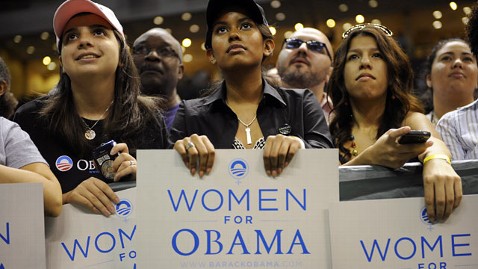
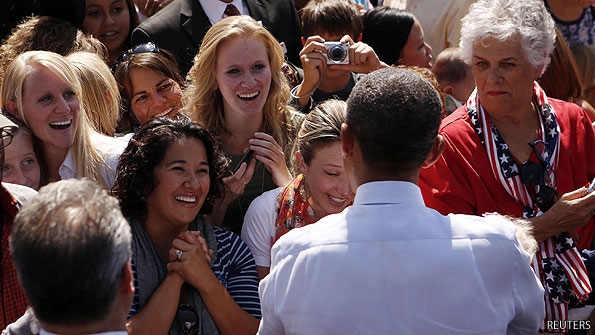
Women voted 55 to 44 for Obama
Women voted 56-44 for more government spending in 2012

CNN reports on how women voted in the 2012 election:

According to CNN’s exit polls, 55% of women and 45% of men voted for Obama and 44% of women and 52% of men voted for Romney. That level of female support for the president made an especially big impact in swing states like Ohio where the gender breakdown mirrored the national figures.

[…]There are some indications that social issues directly impacting women might have helped sway votes in some states.

Tuesday’s early exit polls showed 51% of Missouri voters said they believed abortion should be legal all or most of the time. Of those voters, exit polls showed 76% supported Democratic incumbent Claire McCaskill, who won Tuesday night, while 19% voted for Akin.

Forty-seven percent of Missouri’s voters said abortion should be illegal. Exit polls showed Akin netted 67% of this group’s votes while 27% of people who think abortion should be illegal supported McCaskill.

But much more than social issues, pocketbook economic issues most concerned women voters, exit polling showed.

“Women like all voters felt the economics were most important,” Swers said. “Women tend to be more supportive of government spending… than men are … so they were less responsive to Romney in that way and more responsive to Obama’s message on empathy and helping the middle class.”

Gallup reported that the gender gap in the 2012 election was actually 20 points. That was the largest ever measured in a Presidential election. The actual vote for Obama among women, according to Gallup, was 56-44.

More government means higher taxes
Women are also more pro-abortion more than men

Here is a peer-reviewed research paper that shows the problem that we need to warn women about, so that they vote smarter.

The abstract reads:

This paper examines the growth of government during this century as a result of giving women the right to vote. Using cross‐sectional time‐series data for 1870–1940, we examine state government expenditures and revenue as well as voting by U.S. House and Senate state delegations and the passage of a wide range of different state laws. Suffrage coincided with immediate increases in state government expenditures and revenue and more liberal voting patterns for federal representatives, and these effects continued growing over time as more women took advantage of the franchise. Contrary to many recent suggestions, the gender gap is not something that has arisen since the 1970s, and it helps explain why American government started growing when it did.

When people vote for government to do more for everyone else, then men who work have to pay more in taxes.

Women for bigger government, higher taxes
Women vote for higher taxes, so they have to work more

If women want to stay home with their children more, then they need to vote for their husbands (present or future) to pay less in taxes when they work. That means voting for smaller government, more liberty and more personal responsibility. Until women get to the point of connecting their future plans (marriage and parenting) for their lives with their current voting, this situation is not going to change. Marriages run on money. It’s no good to urge men to “man-up” and then take away their ability to provide by taxing more of their earnings to pay for Sandra Fluke’s birth control pills and abortions. Keep the money in the family, and then you can stay home with the kids more.