
Tag Archives: Marriage

Is cohabitation a better way to prepare for marriage than courting?

Painting: "Courtship", by Edmund Blair Leighton (1888)
Painting: “Courtship”, by Edmund Blair Leighton (1888)

Consider this assessment of cohabitation from the liberal New York Times.

Excerpt:

AT 32, one of my clients (I’ll call her Jennifer) had a lavish wine-country wedding. By then, Jennifer and her boyfriend had lived together for more than four years. The event was attended by the couple’s friends, families and two dogs.

When Jennifer started therapy with me less than a year later, she was looking for a divorce lawyer. “I spent more time planning my wedding than I spent happily married,” she sobbed. Most disheartening to Jennifer was that she’d tried to do everything right. “My parents got married young so, of course, they got divorced. We lived together! How did this happen?”

Cohabitation in the United States has increased by more than 1,500 percent in the past half century. In 1960, about 450,000 unmarried couples lived together. Now the number is more than 7.5 million. The majority of young adults in their 20s will live with a romantic partner at least once, and more than half of all marriages will be preceded by cohabitation. This shift has been attributed to the sexual revolution and the availability of birth control, and in our current economy, sharing the bills makes cohabiting appealing. But when you talk to people in their 20s, you also hear about something else: cohabitation as prophylaxis.

In a nationwide survey conducted in 2001 by the National Marriage Project, then at Rutgers and now at the University of Virginia, nearly half of 20-somethings agreed with the statement, “You would only marry someone if he or she agreed to live together with you first, so that you could find out whether you really get along.” About two-thirds said they believed that moving in together before marriage was a good way to avoid divorce.

That’s a nice idea – wanting protection against divorce. But I think these hopeful attitudes that young people have about cohabitation and the utility / harmlessness of premarital sex, is so much whistling past the graveyard. The fact is that cohabitation does not improve marital stability.

The New York Times author assesses the evidence about cohabitation:

Couples who cohabit before marriage (and especially before an engagement or an otherwise clear commitment) tend to be less satisfied with their marriages — and more likely to divorce — than couples who do not. These negative outcomes are called the cohabitation effect.

Researchers originally attributed the cohabitation effect to selection, or the idea that cohabitors were less conventional about marriage and thus more open to divorce. As cohabitation has become a norm, however, studies have shown that the effect is not entirely explained by individual characteristics like religion, education or politics. Research suggests that at least some of the risks may lie in cohabitation itself.

As Jennifer and I worked to answer her question, “How did this happen?” we talked about how she and her boyfriend went from dating to cohabiting. Her response was consistent with studies reporting that most couples say it “just happened.”

“We were sleeping over at each other’s places all the time,” she said. “We liked to be together, so it was cheaper and more convenient. It was a quick decision but if it didn’t work out there was a quick exit.”

She was talking about what researchers call “sliding, not deciding.” Moving from dating to sleeping over to sleeping over a lot to cohabitation can be a gradual slope, one not marked by rings or ceremonies or sometimes even a conversation. Couples bypass talking about why they want to live together and what it will mean.

Cohabitation is associated with higher risks of divorce because it works to undermine the need for quality communication during courting and the need for commitment that is based on discipline, instead of pleasure. People slide into something that looks like marriage because the sex pulls them in. But they’ve never taken the time to talk about what the relationship is really about, and whether they are intending to commit to the other person for life, and on what terms, and for what reason. Young people find these conversations difficult and scary for a reason – they are not capable of discussing relationships in terms of self-sacrifice, self-control, and self-denial.

The focus on early sex is caused by a focus on wanting to get to pleasure right away. They want relationships to be like a consumer good, where they get their needs met without having to talk about suitability for roles, and acceptance of responsibilities and obligations. In my experience, young people are terrified of the responsibilities, obligations and expectations of a real commitment. They want relationships to be free,easy and fun – where they just get to do whatever they feel like, moment by moment. And somehow, it’s all supposed to work out, without anyone talking seriously about roles and responsibilities and commitment.

But of course that doesn’t work as well as keeping your distance and getting to know each other first. It’s not just compatibility that is important, though – it’s that both people need to prepare for the roles and responsibilities they will have in a marriage, and demonstrate to each other that each is capable of performing those roles.

What’s the answer?

Research has shown that pre-marital chastity produces more stable and higher quality marriages. And that’s because chastity helps people to focus on conversations and obligations instead of the recreational sex which clouds the judgment and glosses over the seriousness of marriage. Premarital sex rushes the relationship to the point where it is harder to break it off because of the sunk costs of sex and the pain of the break-up. Courtship is the time to discuss the things that break up marriages, like finances and division of labor. It is the time to demonstrate self-control and fidelity. Courting doesn’t allow either person to get control of the relationship through sex, so that they can get their needs met without having to care about the other person. When sex is ruled off the table, the only way to have the relationship go on is by serving the other person and showing them that you have what it takes to do the marriage role you’re assigned. That’s hard work, but young people need to accept that and get on with preparing for and practicing their marriage responsibilities.

Why not go back to courting?

If you asked me, I would tell you that courting is protection against a painful break-up as well as protection against a bad marriage. And the aim of courting is to interview the other person so that you can see whether they understand the demands of the marriage and whether they can perform their duties to their spouse and children. In particular, men should investigate whether the woman has prepared (or is willing to prepare now) to perform her roles as wife and mother, and women should investigate whether the man has prepared to perform his roles as protector, provider and moral/spiritual leader (or is willing to prepare now). Courting is not designed to be fun, although it can be fun. It is not meant to make people feel happy, it is mean to prepare them for marriage. And this is because you cannot translate fun and happy into marriage, because marriage is about well-defined roles, self-sacrifice and commitment. Marriage is about following through for the other person, whether you get what you want or not. You’d be surprised how often people give up on courting and show that their real goal for a relationship is not lifelong self-sacrificial love at all, but just using other people for their own happiness while they keep their distance from the responsibilities, obligations and expectations of the marriage covenant.

And that’s why I encourage men to very gently and subtly guide the relationship in a way that will allow both the woman and the man to practice their expected marital duties, see how they feel about their duties and get better at being able to perform them. Men have the most to lose from the divorce courts, if things go south. That’s why it is the man’s the responsibility to detect and reject women who are only interested in fun and thrills.
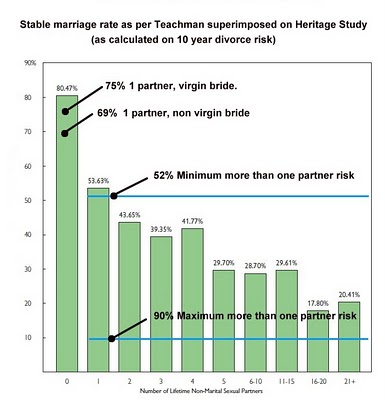

Does more relationship experience lead to better relationship success?

Published in the Journal of Marriage and Family

Marriage expert Brad Wilcox tweeted this article from the Institute for Family Studies.

It says:

In most areas of life, having more experience is good. Want to be great in your chosen field? Sustained experience is essential. Want to be great at a sport? There’s no substitute for practice. And anyone who runs a business can tell you that their best employees are those who have been in the job long enough to have learned how to handle the normal well and the unexpected with wisdom.

While more experience is often beneficial in life, the story looks different when it comes to some types of experience before marriage. For example, in our Before “I Do” report, we surveyed a national longitudinal sample of young adults about their love lives prior to marriage to examine factors associated with future marital quality. We found that having more sexual and cohabiting partners before marriage is associated with lower relationship quality once married. In particular, having only ever lived with or had sex with one’s spouse was associated with higher marital quality. Our findings are consistent with other studies showing that cohabiting with more partners before marriage is associated with greater likelihood of divorce1 and that a higher number of sexual partners before marriage is associated with lower marital quality and greater likelihood of divorce.2 As we noted, what happens in Vegas may not always stay in Vegas. But why?

There are many reasons why having more romantic partners before marriage may put one at higher risk of difficulties in marriage. One of the most important explanations comes under the heading of what some call selection effects. For many people, an elevated risk of difficulties in marriage was present before they had their first relationship experience. Background characteristics such as parental divorce, low education, and economic disadvantage are associated both with having more sexual and cohabiting partners and also with lower marital quality and/or divorce.3So it may not be that having more sexual or cohabiting partners causes further risk because a lot of risk was already in motion. Selection is a big part of how relationships unfold, but is it the whole story? We believe that, in addition to selection, behavior matters and has plausible connections to marital outcomes. We are going to explain four reasons why having more relationship experience before tying the knot might make it harder to succeed in marriage.

Here are the 4 reasons:

  1. More Awareness of Alternatives
  2. Changed Expectations: The Perfect Sexual Lover (in Your Mind)
  3. More Experience Breaking It Off
  4. Babies

I have to quote the one that I’ve personally encountered in my mentoring – number three: more experience breaking it off. I’ve seen this commitmentphobia in two women who had “wild” periods in their past who had broken up with cohabitating boyfriends.

It says:

Cohabitation has characteristics that seem paradoxical. Living with a partner makes it harder to break up than dating, all other things being equal, and often now comes at a time in relationship development where people have not really chosen each other for the future.8 And yet, cohabiting couples frequently break up, and they are more likely than any other time in history not to end up marrying.9

These days, cohabitation has become more a part of the dating scene than a lead-up to marriage. Let’s call the phenomenon cohabidating. In this context, some people are getting a lot of experience at leaving serious relationships (or surviving being left). Just as with our prior point, that does not sound bad in one way—at least insofar as people are breaking off relationships that had no future. But it’s also true that people tend to get good at things they have a lot of experience doing. People can get good at moving out and moving on.

How does that impact marriage? Some people probably so deeply learn that they can survive leaving a relationship when they are unhappy with it that they leave reasonably good marriages that would have given them and their children the best outcomes in life. They bail too quickly.

Obviously, many others leave very poor or even dangerous marriages only after a lot of agonizing and effort. We’re not suggesting divorce is ever easy or that it is not sometimes the best course. But in a day and age when people get so much experience moving out and moving on, we think many may learn to do so too rapidly, and to their detriment.

If you want to get good at relationships, experience may not be the answer. Reading good studies like this, and making decisions that line up with the research is much wiser. As always, never follow your heart. Always follow rational arguments and evidence, and keep connected to a good panel of advisors who have had long-term relationships success. That’s the best way to avoid disaster.

Before you marry, have enough money saved to keep your kids out of public schools

My friend William shared this excellent article from The Federalist, which talks about how public schools, under the influence of Common Core, are exposing children to pornography in order to advance a leftist culture agenda. The article has the stories of several heroic mothers who stood up to the school system and got the pornographic materials removed. Let’s look at one of them, and then I’ll comment on how public school administrators and teachers should be viewed, then I’ll comment on the issue of financing these public schools, then I’ll talk about planning for schooling of your children.

Excerpt:

In 2012, Lebanon, Oregon, mother of two Macey France began studying the nationwide implementation of Common Core. While looking through a document titled “Common Core Appendix B” that contained reading exemplars, Macey found the book, “The Bluest Eye” listed as an example of appropriate assigned literature for eleventh- and twelfth-grade students.*

France, a contributor to the website PolitiChicks, took to her keyboard and typed up a scathing condemnation of the book as not high-school appropriate, including quotes directly from the book, such as:

I am not putting pornographic excerpts from public school books on this blog, duh.

We continue:

As a result, her article “Common Core-Approved Child Pornography” was viewed and shared hundreds of thousands of times and Macey was nominated for a CPAC blogger award for Best Sunlight Post of 2013.

“This is when I first became a ‘target’ for the progressives who support public education and minimize parental rights,” said France, who had a hard time understanding how her well-researched, truthful article could make her the target of the kind of emotional, hateful rhetoric she experienced. It frustrated her to be personally attacked for wanting to protect her kids. It also frustrated her to find many parents who weren’t concerned about their teens reading “The Bluest Eye” because they believed school officials knew more about what was best for their children than they did.

“I was called names, accused of being backwards, racist [Toni Morrison is a black woman], ignorant, a flat-earther, and even received private messages on Facebook telling me how hateful I was,” France said. “I was first introduced to the phrase ‘white privilege.’ At one point, I was called Hitler. I was misunderstood and accused of wanting to ban and burn books [even though] I went out of my way to convey that I am not an advocate for banning literature. I am a huge parental rights advocate. I got the distinct impression I was not supposed to question the manner in which they [educators] related to my kids.”

My problem with public school is not that education school graduates are selecting high brow reading material that is above me. I love Shakespeare and Spenser and Dickens and Austen and other classical writers. The problem I have with public schools is that some of the teachers, and most of the administrators, have this agenda to break down traditional morality and sexualize children at earlier and earlier ages. This is part of the secular progressive agenda – they know that sexualizing children makes them less likely to become conservative, less likely to marry, less likely to have children who are raised by a mom and dad, and who are therefore more resistant to the will of the secular leftist government.

Public schools are leftist indoctrination seminaries

A good example of how this works can be found in the province of Ontario, Canada. There, the Liberal Party government is led by a lesbian woman who left her husband and children to move in with her lover. The Liberal Party decided to re-write the education curriculum so that it would be more in line with their supporters in the Sexual Revolution crowd, e.g. -secularists, LGBT activists, abortion providers, etc. And so, they hired a convicted child pornographer to re-write the curriculum. They didn’t see the public school’s priority as teaching children how to get the skills needed to find jobs that pay. They wanted the public schools to make children non-judgmental about the immoral behaviors of the selfish adults.

It’s very important for parents to understand that people don’t just find themselves in education programs and then in public schools by accident. Sometimes they are in there because they couldn’t find real work in the private sector. Sometimes they are there because they want to indoctrinate your kids with their left-wing ideology. You can’t assume that the people in public schools want to partner with you to pass on prudent and practical Judeo-Christian wisdom to your children. The public school monopoly attracts those who are looking for job security and insulation from the disapproval of their customers. It’s true that some teachers are there to educate students so they have useful skills in order to find good jobs. But in my experience, many of teachers aren’t, and most of the administrators aren’t.

Note: private school teachers and administrators have to compete with other schools, so they are sensitive to meeting the needs of parents. At least you have a choice about where you send your kids, so they have to care what you want for your kids, and how much you are able to pay.

Don’t vote for bigger government if you value quality education

So how do these public schools get their funding? Well, it’s simple. They appeal to voters by saying that the more they spend on public schools, the more children will learn. This actually works on voters who don’t bother to familiarize themselves with the facts:

Education spending has tripled since 1970

The truth is that parents who want children to do well should always vote for smaller government, lower taxes, and the pushing down of decision-making in education policy to the state and local level. We shouldn’t be swayed by “it’s for the children” rhetoric, because throwing more money at the problem only gives us more sexual revolution indoctrination and more gay rights agenda. Most of the new money goes to administrators anyway – not to the teachers in the classrooms. You might think that the public schools are there to help your children to get a job, but that’s not what they public school administrators think they are there for.

Getting married? Make a plan to provide for your kids’ education

One final point. I am finding myself surrounded by male Christian apologists who want to get married, and who are not interested in being providers. They’ve spend their entire 20s in school as students, they’ve taken money from their parents, they’ve never worked a day in their lives, they have outstanding student loans, they have no savings, and yet they all talk to women they like about marriage. My view is that Christian men should not be allowed to talk to women – even to ask them the time of day or for directions – until they have a STEM degree, 2 years of private sector work experience, all debts paid off, a car and some savings. And why not? Well, for reasons like this article on the public schools.

The public schools are what they are, and Christian parents cannot rely on them to educate our kids. If a man is talking about marriage without having taken steps to get a STEM degree, STEM private sector work history, and an investment account that is added to every month, then he has no business talking to a woman about marriage. He has to be able to show her that he is serious about providing the children with homeschooling or a private school education. How parents plan to educate their kids is a major issue in marriage – it affects whether the children will be effective and influential, or not. A woman should not trust the promises of any man who has not taken practical steps in the past to prepare for the needs of his children in the future. She cannot accept intentions and promises that make her feel good, she has to see evidence of his ability to put aside his ambitions in order to provide for her and the children – that is his obligation as a man (1 Tim 5:8). A man who wants marriage should prepare well in advance for it by having a career that will allow him to earn and save so that his wife and children will not be threatened in their worldview more than they can bear. If he has to give up some student stuff and some ministry stuff in order to prepare for husband / father responsibilities, then he should do that – before the wedding day.