Tag Archives: Husband

Should women who get pregnant after premarital sex expect the men to marry them?

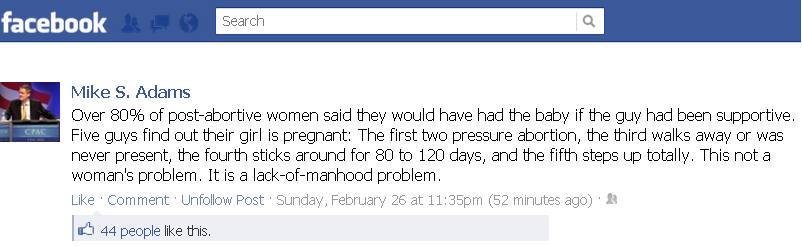
Mike Adams on abortion: click for larger image.

Professor Mike S. Adams is pro-life, but he posted something on Facebook that I must disagree with.

He posted this:

Over 80% of post-abortive women said they would have had the baby if the guy had been supportive. Five guys find out their girl is pregnant: The first two pressure abortion, the third walks away or was never present, the fourth sticks around for 80 to 120 days, and the fifth steps up totally. This not a woman’s problem. It is a lack-of-manhood problem.

Mike has about 5000 friends, and 44 of them liked it. I would think that most of these people would call themselves pro-life conservatives. But I don’t think what he posted promotes the pro-life cause.

I replied to him with this:

Mike I could not disagree more. It’s a woman’s problem unless it is rape, since the woman consents to sex with a man she is not married to. In fact, the cause of abortion is YOUR opinion – namely, the opinion that women should not be obligated to be chaste or to think rationally about who they are having sex with. There is a path to marriage that goes through courtship, and that path has a name: self-control. Stop enabling the poor choices of women, because we have to stop the murder of unborn children.

Many of Mike’s friends supported him. So I wrote this:

Wow. I had no idea that so many of Mike’s friends think that the Bible is a pack of lies when it says that fornication is morally wrong. I guess you guys aren’t Christians then, since you feel so free and easy about revising the Bible when you feel like it.

If fornication is wrong, it’s wrong for women AND men. And you don’t fornicate and then expect happy outcomes from it. There is a word for a person who sins and then expects a good outcome. A FOOL.

Then Mike replied to me:

Sorry Wintery. Where I come from the man leads and is, therefore, responsible.

I replied to that with this:

Mike, I agree with male leading – IF the man is a Christian. But the men that these women chose are not Christians. And you can’t expect men to act morally unless they have a theistic framework that grounds morality.

Women should not be told, by you and others, that they can choose to have sex with immoral men and then expect the immoral men to act morally. That is just enabling abortion by justifying a lack of prudence and wisdom. Instead, we should be holding women accountable to choose men who WILL control themselves.

We should not be supporting the fantasy view of love that says  that recreational sex magically leads men to commit to protect, provide and lead women for life. That view is neither wise nor Biblical. On the contrary, recreational sex leads men to NOT commit. Women have to learn how to select men, to evaluate them for marriage, and to make them prove themselves. We need to tell men AND women that sex before marriage is morally wrong. And we need to be convincing by showing them how recreational sex does not lead to stable marriages, and puts children, unborn and born, in harm’s way. Telling the truth about the danger of premarital sex is the best way to stop the killing of unborn children.

Here’s an example to make the point. We do not blame bears for mauling campers. Bears are bears, and they were bears before the campers showed up in their cave. We ought to blame the camper for choosing to wander off the trail and into the bear’s den in order to PET THE BEAR. Wild bears may eat free food that is offered to them, but they are not going to let you pet them and hug them. Women, like campers, need to be responsible. They need to choose the right man for marriage. They need to exercise self control. They need to make the man prove his ability to commit and support a family BEFORE they have sex with him. No one hires an employee without understanding what job they need done and then making sure that the candidate they choose can do the job. And that’s what we need to tell women.

Obviously, I was a little upset when I wrote that, but I hope it wasn’t too bad.

So what’s the point I was trying to make by being critical of Mike? I think the problem we have today is that men who are pro-life are unwilling to hold women accountable for their own poor decisions about sex and marriage. Basically, conservative and/or Christian men think that women don’t need to think through what choices are most likely to avoid abortion and most likely to achieve marriage. These men give tacit approval to the popular trend of trying to achieve marriage through premarital sex (or cohabitation), when the research shows that these behaviors do not result in long-lasting stable marriages. In fact, sex out of wedlock is a good way to get into a situation where an abortion will occur.

In my view, Mike is inadvertently encouraging women to get into the situations where they will be pressured to abort by reinforcing the idea that there is nothing wrong with their plan to achieve marriage by having premarital sex (or cohabitating), and then expecting men to respond to their pregnancy by MARRYING them. Mike seems to be telling women that it is normal for them to expect that marriage will follow from premarital sex with men who have not been vetted for the roles of provider, protector and leader As if marriage is natural for men who don’t even have jobs and who are surrounded by women willing to have sex with them on the first date. Any man who will have recreational premarital sex with a woman is exactly the kind of person who will not commit to lifelong providing and fidelity – he is having sex before marriage because he wants recreation, without the commitment and self-sacrifice that marriage requires. Rationally speaking, it makes no sense for men to buy the cow, and to keep buying the cow with 40 years of labor, when they can get the milk for free. And that’s what we need to tell women – think with your minds, not with your emotions.

Here is an interesting statistic from Relevant Magazine:

[A] recent study reveals that 88 percent of unmarried young adults (ages 18-29) are having sex. The same study, conducted by The National Campaign to Prevent Teen and Unplanned Pregnancy, reveals the number doesnʼt drop much among Christians. Of those surveyed who self-identify as “evangelical,” 80 percent say they have had sex.

[…]In addition to having premarital sex, an alarming number of unmarried Christians are getting pregnant. Among unmarried evangelical women between the ages of 18 and 29, 30 percent have experienced a pregnancy (a number thatʼs actually 1 percent higher than among those who donʼt claim to be evangelical).

According to the Guttmacher Institute, nearly half of all pregnancies in America are unintended. And of those, 40 percent end in abortion. More than 1 million abortions occur in the United States each year. But perhaps the most disturbing statistic for the Church: 65 percent of the women obtaining abortions identify themselves as either Protestant or Catholic (37 percent Protestant and 28 percent Catholic). Thatʼs 650,000 abortions obtained by Christians every year.

Christian women are not told that premarital sex is wrong by many Christians and conservatives – and out of that refusal by “Christians” and “conservatives” to take a stand, we get 650,000 abortions per year. We need to have more courage to tell women to be more self-controlled and responsible when they choose who to have sex with, and when to have sex. We need to tell women to make good decisions that lead to stable marriages. We need to tell women to study these issues and to support policies that produce strong, moral men who are willing to marry – for example, by reforming education so that our schools produce men who can find jobs, perhaps by having more male teachers in the classroom. We need to tell women to support policies that make marriage more friendly for men, like abolishing no-fault divorce, and promoting shared parenting. Christians in particular need to counteract the views of love and romance that are prevalent in popular culture with a view of relationships built around chastity and love. Although many people today are uncomfortable with moral absolutes and moral judgments, it would be a good be a good idea for women to promote these things, so that the men they are choosing from are more moral.

In the end, I agree with Mike S. Adams in one respect. Abortion may be caused by a lack of manhood problem. Only the lack of manhood doesn’t come from the men that women choose to have premarital sex with. The lack of manhood comes from men who refuse to hold women accountable for their own free foolish decisions that put unborn children in harm’s way. In addition to the abortion problem that results from those foolish decisions, there is also the explosion in out-of-wedlock births to weigh in the balance. Again, the more people tell women that they should expect men who engage in recreational sex to commit to marriage after premarital sex (or cohabitation), the more fatherlessness we get.

Dennis Prager explains what feminism has achieved for women

Dennis Prager has summarized many of my viewpoints on this blog in a tiny, tiny little article. He calls it “Four Legacies of Feminism“.

Read the whole glorious thing and bask in its wisdom!

Full text:

As we approach the 50th anniversary of the publication of Betty Friedan’s feminist magnum opus, The Feminine Mystique, we can have a perspective on feminism that was largely unavailable heretofore.

And that perspective doesn’t make feminism look good. Yes, women have more opportunities to achieve career success; they are now members of most Jewish and Christian clergy; women’s college sports teams are given huge amounts of money; and there are far more women in political positions of power. But the prices paid for these changes — four in particular — have been great, and outweigh the gains for women, let alone for men and for society.

1) The first was the feminist message to young women to have sex just as men do. There is no reason for them to lead a different sexual life than men, they were told. Just as men can have sex with any woman solely for the sake of physical pleasure, so, too, women ought to enjoy sex with any man just for the fun of it. The notion that the nature of women is to hope for at least the possibility of a long-term commitment from a man they sleep with has been dismissed as sexist nonsense.

As a result, vast numbers of young American women had, and continue to have, what are called “hookups”; and for some of them it is quite possible that no psychological or emotional price has been paid. But the majority of women who are promiscuous do pay prices. One is depression. New York Times columnist Ross Douthat recently summarized an academic study on the subject: “A young woman’s likelihood of depression rose steadily as her number of partners climbed and the present stability of her sex life diminished.”

Long before this study, I had learned from women callers to my radio show (an hour each week — the “Male-Female Hour” — is devoted to very honest discussion of sexual and other man-woman issues) that not only did female promiscuity coincide with depression, it also often had lasting effects on women’s ability to enjoy sex. Many married women told me that in order to have a normal sexual relationship with their husband, they had to work through the negative aftereffects of early promiscuity — not trusting men, feeling used, seeing sex as unrelated to love, and disdaining their husband’s sexual overtures. And many said they still couldn’t have a normal sex life with their husband.

2) The second awful legacy of feminism has been the belief among women that they could and should postpone marriage until they developed their careers. Only then should they seriously consider looking for a husband. Thus, the decade or more during which women have the best chance to attract men is spent being preoccupied with developing a career. Again, I cite woman callers to my radio show over the past 20 years who have sadly looked back at what they now, at age 40, regard as 20 wasted years. Sure, these frequently bright and talented women have a fine career. But most women are not programmed to prefer a great career to a great man and a family. They feel they were sold a bill of goods at college and by the media. And they were. It turns out that most women without a man do worse in life than fish without bicycles.

3) The third sad feminist legacy is that so many women — and men — have bought the notion that women should work outside the home that for the first time in American history, and perhaps world history, vast numbers of children are not primarily raised by their mothers or even by an extended family member. Instead they are raised for a significant part of their childhood by nannies and by workers at daycare centers. Whatever feminists may say about their only advocating choices, everyone knows the truth: Feminism regards work outside the home as more elevating, honorable, and personally productive than full-time mothering and making a home.

4) And the fourth awful legacy of feminism has been the demasculinization of men. For all of higher civilization’s recorded history, becoming a man was defined overwhelmingly as taking responsibility for a family. That notion — indeed the notion of masculinity itself — is regarded by feminism as the worst of sins: patriarchy.

Men need a role, or they become, as the title of George Gilder’s classic book on single men describes them: Naked Nomads. In little more than a generation, feminism has obliterated roles. If you wonder why so many men choose not to get married, the answer lies in large part in the contemporary devaluation of the husband and of the father — of men as men, in other words. Most men want to be honored in some way — as a husband, a father, a provider, as an accomplished something; they don’t want merely to be “equal partners” with a wife.

In sum, thanks to feminism, very many women slept with too many men for their own happiness; postponed marriage too long to find the right man to marry; are having hired hands do much of the raising of their children; and find they are dating boy-men because manly men are so rare.

Feminism exemplifies the truth of the saying, “Be careful what you wish for — you may get it.”

I wish I could add something to this, but I can’t because every time I think of something to add, he says it in the next sentence.

If you like this short essay, then this medium essay arguing against feminism authored by Barbara Kay would be nice follow-up.

It might be worth forwarding these articles along to your friends. And I highly recommend books on male-female relationships and roles by George Gilder, especially “Men and Marriage“.

Is cohabitation a better way to prepare for marriage than courting?

Matt from Well Spent Journey sent me this assessment of cohabitation from the liberal New York Times.

Excerpt:

AT 32, one of my clients (I’ll call her Jennifer) had a lavish wine-country wedding. By then, Jennifer and her boyfriend had lived together for more than four years. The event was attended by the couple’s friends, families and two dogs.

When Jennifer started therapy with me less than a year later, she was looking for a divorce lawyer. “I spent more time planning my wedding than I spent happily married,” she sobbed. Most disheartening to Jennifer was that she’d tried to do everything right. “My parents got married young so, of course, they got divorced. We lived together! How did this happen?”

Cohabitation in the United States has increased by more than 1,500 percent in the past half century. In 1960, about 450,000 unmarried couples lived together. Now the number is more than 7.5 million. The majority of young adults in their 20s will live with a romantic partner at least once, and more than half of all marriages will be preceded by cohabitation. This shift has been attributed to the sexual revolution and the availability of birth control, and in our current economy, sharing the bills makes cohabiting appealing. But when you talk to people in their 20s, you also hear about something else: cohabitation as prophylaxis.

In a nationwide survey conducted in 2001 by the National Marriage Project, then at Rutgers and now at the University of Virginia, nearly half of 20-somethings agreed with the statement, “You would only marry someone if he or she agreed to live together with you first, so that you could find out whether you really get along.” About two-thirds said they believed that moving in together before marriage was a good way to avoid divorce.

That’s a nice idea – wanting protection against divorce. But I think these hopeful attitudes that young people have about cohabitation and the utility / harmlessness of premarital sex, is so much whistling past the graveyard. The fact is that cohabitation does not improve marital stability. Young people believe it because they want to believe it. Let’s look at the evidence to see why.

Cohabitation is a bad idea because what it says is that sex is not to be confined to marriage, but it is instead for recreational purposes outside of marriage. If men and women cannot demonstrate that they are capable of self-control prior to marrying by functioning in a relationship based on commitment and not based on pleasure, then they are not qualified for marriage. Cohabitation is associated with higher risks of divorce because it works to undermine the need for quality communication during courting and the need for commitment that is based on discipline, instead of pleasure.

Research has shown that pre-marital chastity produces more stable and higher quality marriages. And that’s because chastity helps people to focus on conversations and obligations instead of the recreational sex which clouds the judgment and glosses over the seriousness of marriage. Premarital sex rushes the relationship to the point where it is harder to break it off because of the sunk costs of sex and the pain of the break-up. Courtship is the time to discuss the things that break up marriages, like finances and division of labor. It is also the time to demonstrate self-control and fidelity.

More:

Couples who cohabit before marriage (and especially before an engagement or an otherwise clear commitment) tend to be less satisfied with their marriages — and more likely to divorce — than couples who do not. These negative outcomes are called the cohabitation effect.

Researchers originally attributed the cohabitation effect to selection, or the idea that cohabitors were less conventional about marriage and thus more open to divorce. As cohabitation has become a norm, however, studies have shown that the effect is not entirely explained by individual characteristics like religion, education or politics. Research suggests that at least some of the risks may lie in cohabitation itself.

As Jennifer and I worked to answer her question, “How did this happen?” we talked about how she and her boyfriend went from dating to cohabiting. Her response was consistent with studies reporting that most couples say it “just happened.”

“We were sleeping over at each other’s places all the time,” she said. “We liked to be together, so it was cheaper and more convenient. It was a quick decision but if it didn’t work out there was a quick exit.”

She was talking about what researchers call “sliding, not deciding.” Moving from dating to sleeping over to sleeping over a lot to cohabitation can be a gradual slope, one not marked by rings or ceremonies or sometimes even a conversation. Couples bypass talking about why they want to live together and what it will mean.

The problem with young people today is that they want marriage as “a blissful state where I will get whatever I want without having to do anything, and where I am free from the consequences of my own selfishness”.  They don’t want marriage as commitment, moral obligations, serving others and self-sacrifice. By avoiding conversations about who will do what, and what needs doing, they can fool themselves by thinking that happy sex and happy drinking and happy dancing will naturally turn into happy marriage. But marriage isn’t about feeling happy, it’s about being a sinful person who now has to learn to love another sinful person and has to train and lead selfish, rebellious children so they are able to serve God and others.

If you asked me, I would tell you that courting is protection against a bad marriage. And the aim of courting is to interview the other person so that you can see whether they understand the demands of the marriage and whether they can perform their duties to their spouse and children. In particular, men should investigate whether the woman has prepared (or is willing to prepare now) to perform her roles as wife and mother, and women should investigate whether the man has prepared to perform his roles as protector, provider and moral/spiritual leader (or is willing to prepare now). Courting is not designed to be fun, although it can be fun. It is not meant to make people feel happy, it is mean to prepare them for marriage. And this is because you cannot translate fun and happy into marriage, because marriage is about well-defined roles, self-sacrifice and commitment. Marriage is about following through for the other person, whether you get what you want or not.

And that’s why I encourage men to very gently and subtly guide the relationship in a way that will allow both the woman and himself to practice their expected marital duties, see how they feel about their duties and get better at being able to perform them.