
Tag Archives: Virginity

New study: virgins have happiest marriages, more sex partners means more unhappiness

Although we live in a culture that is dominated by the thoughts and opinions of secular leftists, science provides useful information for those who want defend Biblical morality. Consider the issue of sexuality and marriage. Secular leftists claim that sex outside of marriage is natural, and produces happiness. Bible believing Christians and Jews say chastity is best. Who is right?

Here is the latest study authored by Dr. Nicholas Wolfinger, a sociologist at the University of Utah. His previous book on relationships was published by Oxford University Press. In his analysis of the data, Wolfinger controlled for divorce rates, religiosity, and socioeconomic status.

Here’s the most important graph:

Study: virgins have the happiest marriages, more partners means less happiness

Other factors that increased marital happiness: having a 4-year college degree (5%), having a salary > 78K (5%), regular church attendance (6%). Notice that women are more dissatisfied with marriage (in general) than men are, and they tend to blame the spouse they freely chose for that unhappiness.

The Federalist also reported on previous research relevant to this study:

Psychologists Galena K. Rhoades and Scott M. Stanley found that women who have had sex with someone other than their husband report statistically significant drops in marital quality over those who don’t. A 2004 study by sociologist Jay Teachman showed that intimate premarital activities such as cohabitation and intercourse increased the rate of marital dissolution by anywhere between 28 and 109 percent, depending on the activity.

Wolfinger also noted in a previous study that only 5% of women were virgins when they married.

Wolfinger noted that a possible explanation for the link between promiscuity and unhappiness is that people look back on their past partners and compare their spouse unfavorably to them. This is especially the case with women. My concern about this is that feminism has taught women to try to increase their social standing by having hook-up sex with attractive bad boys. If those women ever marry, they do it when they are older, less fertile, and less attractive. The husband they eventually “settle” for will (in their minds) always compare unfavorably to the hot bad boys they had sex with when they were younger and prettier. This, I believe, is what leads to their unhappiness with the man they chose to marry.

More partners also means more marital instability

In a previous post, I blogged about several studies linking virginity to marital stability. Couples who don’t have sex before marriage, or even who delayed it, reported better communication, higher satisfaction, better quality sex, and a lower chance of divorce.

Men ought to be aware of this research when they are choosing a spouse. Obviously, you want a virgin, for the increased happiness and increased stability. For marriage-friendly character, you want to avoid women who are promiscuous thrill-seekers. You want to avoid women who run up debt doing easy non-STEM degrees and traveling. You want to avoid women who hook up with hot bad boys aren’t serious about commitment. Women who choose fun and thrills in their teens and 20s are setting a pattern of using sex as a way to get happiness in the moment. Later on, they’ll continue that pattern of seeing relationships as commodities that are designed to make them feel good, moment by moment. They’ll look at marriage as a way to fulfill their needs. They’ll have internalized the view that relationships are not commitments to invest in self-sacrificially. The pattern will be: “if it doesn’t make me feel happy right now, then it should be ended”. Men who aren’t serious about evaluating the character of the women for the marriage enterprise are running the risk of divorce, it’s that simple.

The best way to make sure that you have a clear head when evaluating a woman is to stay sober, and keep her hands off of you. When a man refuses to let a woman cloud his judgment with sex, then she is forced to learn how to love him, help him, and submit to his leadership. Male chastity encourages women who have been influenced by feminism to abandon selfishness, fun-seeking, and thrill-seeking, so that they learn to care for others. Male chastity also helps a man to resist older women who chose bad boys in their teens and 20s and want to get married to a good provider in their 30s. The studies discussed above clearly show that such women are more likely to be unhappy, and their future marriages are more likely to be unstable. Avoid them.
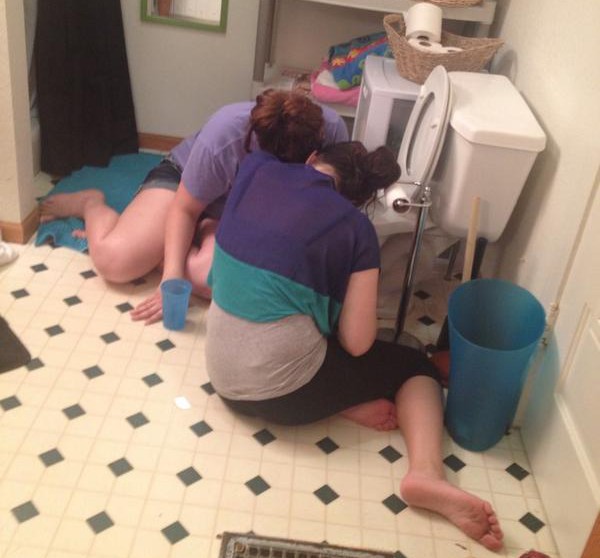

Study: women who lose their virginity in their teens are more likely to divorce

College students puking in toilet

The UK Daily Mail reports on a study that shows that women who lose their virginity as teenagers are more likely to divorce.

Excerpt:

Women who lost their virginity as young teenagers are more likely to divorce – especially if it was unwanted, according to new research.

The University of Iowa study shows that 31 per cent of women who had sex for the first time as teens divorced within five years, and 47 per cent within 10 years.

Among women who delayed sex until adulthood, 15 per cent divorced at five years, compared to 27 per cent at 10 years.

The findings were published in the April issue of the Journal of Marriage and Family.

Author Anthony Paik, associate professor of sociology in the university’s College of Liberal Arts and Sciences, examined the responses of 3,793 married and divorced women to the 2002 National Survey of Family Growth.

The study showed, however, that if a young woman made the choice to lose her virginity as a teenager, there was no direct link to a marital split later in life.

If the sexual act took place before the age of 16 women were shown more likely to divorce, even if it was wanted.

Thirty-one percent of women who lost their virginity during adolescence had premarital sex with multiple partners, compared to 24 per cent of those who waited.

Twenty-nine percent experienced premarital conceptions, versus 15 percent who waited.

One in four women who had sex as a teen had a baby before they were married, compared to only one in ten who waited until adulthood.

Only one per cent of women surveyed said they chose to have sex at age 13 or younger, compared to five per cent at age 14 or 15, and 10 per cent at age 16 or 17.

Forty two per cent reported that their first sexual intercourse before age 18 that was not completely wanted.

Fifty eight per cent of the group waited until age 18 or older to have sex. Of those, 22 per cent said it was unwanted, compared to 21 per cent who said it was wanted.

Researchers concluded sex itself may not increase the probability of divorce, while factors such as a higher number of sexual partners, pregnancy, or out-of-wedlock birth increased the risk for some.

If you want a stable marriage, then you don’t have sex before you’re married. There are tons of virgins out there, and there is a huge difference in the quality of romantic relationships when both parties exercise self-control with physical touching. Don’t let it go too far – you lose some of what love and marriage can be.

Study: fathers are important for the development of children’s brains

Fathers and children

The study was reported in the Wall Street Journal.

Excerpt:

Dr. Braun’s group found that at 21 days, the fatherless animals had less dense dendritic spines compared to animals raised by both parents, though they “caught up” by day 90. However, the length of some types of dendrites was significantly shorter in some parts of the brain, even in adulthood, in fatherless animals.

“It just shows that parents are leaving footprints on the brain of their kids,” says Dr. Braun, 54 years old.

The neuronal differences were observed in a part of the brain called the amygdala, which is related to emotional responses and fear, and the orbitofrontal cortex, or OFC, the brain’s decision-making center.

[…]The balance between these two brain parts is critical to normal emotional and cognitive functioning, according to Dr. Braun. If the OFC isn’t active, the amygdala “goes crazy, like a horse without a rider,” she says. In the case of the fatherless pups, there were fewer dendritic spines in the OFC, while the dendrite trees in the amygdala grew more and longer branches.

A preliminary analysis of the degus’ behavior showed that fatherless animals seemed to have a lack of impulse control, Dr. Braun says. And, when they played with siblings, they engaged in more play-fighting or aggressive behavior.

In a separate study in Dr. Braun’s lab conducted by post-doctoral researcher Joerg Bock, degu pups were removed from their caregivers for one hour a day. Just this small amount of stress leads the pups to exhibit more hyperactive behaviors and less focused attention, compared to those who aren’t separated, Dr. Braun says. They also exhibit changes in their brain.

The basic wiring between the brain regions in the degus is the same as in humans, and the nerve cells are identical in their function. “So on that level we can assume that what happens in the animal’s brain when it’s raised in an impoverished environment … should be very similar to what happens in our children’s brain,” Dr. Braun says.

Read the whole thing.

I think this is important because we hear so much today that marriage can be redefined, that having one of each parent doesn’t matter, that live-in boyfriends and stepfathers have the same motivation to care for a woman’s children as the biological father does. We don’t want to make judgments, even if setting boundaries is better for children. A child’s well-being is enormously affected by the woman’s choice of biological father.  You can’t have it both ways – either we are going to judge women who choose men who don’t have the desire to commit to marriage, and do the father role, OR we are going to take things away from children by encouraging women to choose men based on “feelings” instead of abilities. Lowering moral standards and removing moral obligations hurts children. It sounds so nice when we tell women, “you can do whatever you feel like, and just forget about responsibilities, expectations and obligations”, but letting women be guided by their feelings harms children. My stock broker makes me feel uncomfortable because he knows more than I do, and does not respect my opinion. But I pay him to make investment decisions for me. I mustn’t let my pride get in the way of letting him do his job – a job he is more qualified than I am to do. Let him do his job.

Here’s a related question: Are biological fathers or unrelated men more dangerous for children?

This article from the Weekly Standard answers the question.

Excerpt:

A March 1996 study by the Bureau of Justice Statistics contains some interesting findings that indicate just how widespread the problem may be. In a nationally representative survey of state prisoners jailed for assaults against or murders of children, fully one-half of respondents reported the victim was a friend, acquaintance, or relative other than offspring. (All but 3 percent of those who committed violent crimes against children were men.) A close relationship between victim and victimizer is also suggested by the fact that three-quarters of all the crimes occurred in either the perpetrator’s home or the victim’s.

A 1994 paper published in the Journal of Comparative Family Studies looked at 32,000 documented cases of child abuse. Of the victims, only 28 percent lived with both biological parents (far fewer than the 68 percent of all children who live with both parents); 44 percent lived with their mother only (as do 25 percent of all children); and 18 percent lived with their mother and an unrelated adult (double the 9 percent of all children who live with their mother and an unrelated adult).

These findings mirror a 1993 British study by the Family Education Trust, which meticulously explored the relationship between family structure and child abuse. Using data on documented cases of abuse in Britain between 1982 and 1988, the report found a high correlation between child abuse and the marital status of the parents.

Specifically, the British study found that the incidence of abuse was an astounding 33 times higher in homes where the mother was cohabiting with an unrelated boyfriend than in stable nuclear families. Even when the boyfriend was the children’s biological father, the chances of abuse were twice as high.

These findings are consonant with those published a year earlier by Leslie Margolin of the University of Iowa in the journal Child Abuse and Neglect. Prof. Margolin found that boyfriends were 27 times more likely than natural parents to abuse a child. The next-riskiest group, siblings, were only twice as likely as parents to abuse a child.

More recently, a report by Dr. Michael Stiffman presented at the latest meeting of the American Academy of Pediatrics, in October, studied the 175 Missouri children under the age of 5 who were murdered between 1992 and 1994. It found that the risk of a child’s dying at the hands of an adult living in the child’s own household was eight times higher if the adult was biologically unrelated.

The Heritage Foundation’s Patrick Fagan discovered that the number of child-abuse cases appeared to rise in the 1980s along with the general societal acceptance of cohabitation before, or instead of, marriage. That runs counter to the radical-feminist view, which holds that marriage is an oppressive male institution of which violence is an integral feature. If that were true, then child abuse and domestic violence should have decreased along with the rise in cohabitation.

Heritage also found that in the case of very poor children (those in households earning less than $ 15,000 per year), 75 percent lived in a household where the biological father was absent. And 50 percent of adults with less than a high-school education lived in cohabitation arrangements. “This mix — poverty, lack of education, children, and cohabitation — is an incubator for violence,” Fagan says.

Why, then, do we ignore the problem? Fagan has a theory: “It is extremely politically incorrect to suggest that living together might not be the best living arrangement.”

The moral of the story is that it is a lot safer for children if we promote marriage as a way of attaching mothers and fathers to their children. Fathers who have a biological connection to children are a lot less likely to harm them. We should probably be teaching women to choose men who have a certain tenderness towards people they mentor or nurture, as well. These things are not free, you have to persuade women to value the male tendency to want to lead / guide / mentor. A lot of social problems like child poverty, promiscuity and violence cannot be solved by replacing a father with a check from the government. We need to support fathers by empowering them in their traditional roles. Let the men lead. Swallow your feminist instincts, and prefer men who take seriously their role of leading others upward.