
Tag Archives: UK

How one woman decided to have an abortion… then another… then another

Dina said me this astonishing article from the UK Daily Mail, which shows one case where a woman chose abortion over and over.

Excerpt:

Her first abortion came when she was 17, following a bitterly regretted drunken encounter with a colleague at an office party. 

[…]Her bold decision to speak out about her abortions comes after it was revealed that the NHS spends more than £50  million a year on repeat terminations.

One third of the 189,000 abortions carried out in England and Wales in 2010 involved women who’d had at least one before. In some cases, a staggering seven abortions had previously been carried out on the same woman.

Abortion one:

The first one… was when she… got pregnant when she ended up in bed with a  22-year-old colleague called Brian.

‘Although I knew I could get pregnant, we didn’t use contraception. I just didn’t think it would happen to me…

[…]Michelle visited her GP and found out she was entitled to a free NHS abortion at her local hospital. 

Abortion two:

[S]he met John, 35, an Irish soldier stationed at barracks near her home, and they embarked on a three-week fling. It left her with another unplanned, and unwanted, pregnancy. 

[…]Michelle was once again granted an NHS abortion at nine weeks — this time at a private London clinic, in July 2000.

Abortion three:

Then, a year later, she met her current partner, Paul, at a local pub.

[…]Michelle says she was open about her abortions, and told Paul, 36 — who is an estates manager — that she didn’t want any more children.

[…][I]n July, Michelle was going through a rocky period with Paul when she discovered she was pregnant again.

She says: ‘At the time we were barely speaking, as we were both so stressed out. We hadn’t been intimate for months, but one night relations thawed and we had sex.

‘Until then, we’d been using condoms but this time we didn’t. Although I thought about getting the morning-after pill, I ended up leaving it to chance.’

[…]At nine weeks, Michelle was granted a third NHS abortion, at another London clinic.

Three taxpayer-funded abortions for three pregnancies brought on by this woman’s own free decisions.

In the UK, abortions, IVF and single motherhood are all taxpayer-funded. If women had to pay for their own abortions, their own IVF, their own out-of-wedlock births, then maybe they would not be making decisions like this woman has. When you pay people to do something, you mustn’t be surprised when they do that thing more. Lowering the cost of anything means that more people will buy it. And making it free makes even more people do it.

The first step to ending abortion is that society needs to understand that virtually every woman who has one is at least partly responsible for her own decision-making.  Very often, when it comes to abortion, we seem to place blame on men and assume that women can do no wrong – that they are victims of men. But clearly that is not always true. We seem to have a real problem in this society holding women accountable for making poor decisions. Maybe that needs to change? Pregnancy does not happen by accident – both the man and the woman have to make a choice to have recreational sex when they aren’t ready to welcome a baby into the world. We have to stop looking at people who have recreational sex as victims and expect more from them.
New study: NHS patients are 45 percent more likely to die than US health care patients

Wes sent me this article from the UK Telegraph.

Excerpt:

Patients are 45% more likely to die in NHS hospitals than in US ones, according to figures revealing how badly England’s health service compares with those of other countries.

Previously unpublished data collated by Professor Sir Brian Jarman over more than 10 years found NHS mortality rates were among the worst of those in seven developed countries.

A patient in England was five times as likely to die of pneumonia and twice as likely to die of septicaemia compared to similar patients in the US, the leading country in the study, the data suggested.

The elderly were found to be particularly at risk in English hospitals compared with those in the other countries.

The figures showed that the situation had improved since 2004, when the death rate in English hospitals was 58% higher than that in the best performing country.

But NHS institutions still lagged behind in the most recent data, from 2012, despite reforms of the health service and increased funding.

Of the other six countries studied, only the US was named because of the sensitivity of the data.

Prof Sir Brian, who adjusted the data to take account of differences in the countries’ health services, did not initially release his figures because he was so shocked by them he at first assumed there must be a flaw in his methodology.

There was, however, “no means of denying the results,” he said.

“I expected us to do well and was very surprised when we didn’t,” the Imperial College London medic told Channel 4 News.

“If you go to the States, doctors can talk about problems, nurses can raise problems and listen to patient complaints.

“We have a system whereby for written hospital complaints only one in 375 is actually formally investigated. That is absolutely appalling.”

Previously, I had posted a summary of a book by Scott Atlas, a medical doctor at the Hoover Institute at Stanford University. In that article, he laid out the reasons why the U.S. healthcare system was the best in the world.

Related posts

Women earned more doctoral and Master’s degrees than men in 2012

Women now earning majority of graduate degrees

From the American Enterprise Institute Ideas blog.

Excerpt:

The Council of Graduate Schools (CGS) released its annual report recently on U.S. graduate school enrollment and degrees for 2012, and here are some of the more interesting findings in this year’s report:

1. For the fourth year in a row, women in 2012 earned a majority of doctoral degrees. Of the 67,220 doctoral degrees awarded in 2012 at U.S. universities, women earned 34,761 of those degrees and 52.2% of the total, compared to 31,830 degrees awarded to men who earned 47.8% of the total (see top chart above).

[…]2. By field of study, women earning doctoral degrees in 2012 outnumbered men in 7 of the 11 graduate fields tracked by the CGS (see top chart above)

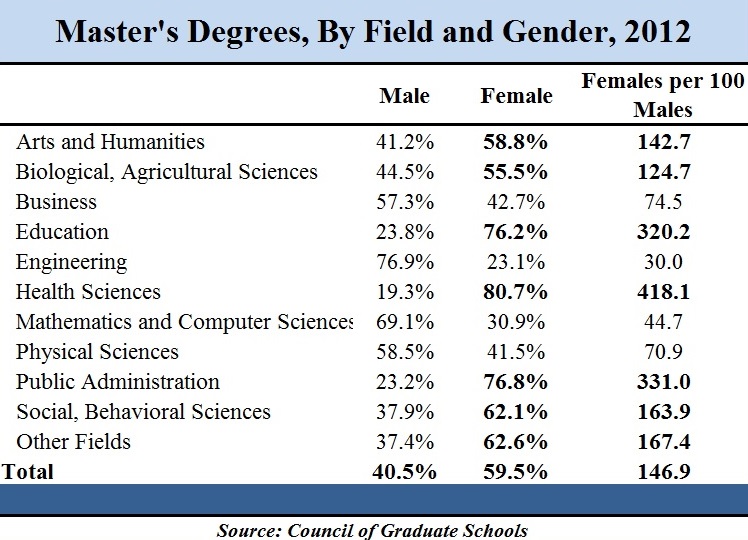
[…]3. The middle chart above shows the gender breakdown for master’s degrees awarded in 2012, and the gender disparity in favor of females is significant – women earned just under 60% of all master’s degrees in 2012, which would also mean that women earned 146.9 master’s degrees last year for every 100 degrees earned by men.

[…]Women represent 58.5% of all graduate students in the U.S., meaning that there are now 141 women enrolled in graduate school for every 100 men.

Click here for the charts.

The author of the post, Dr. Mark Perry, concludes this:

MP: Here’s my prediction – the facts that: a) men are underrepresented in graduate school enrollment overall (100 men were enrolled in 2012 for every 141 women), b) men received fewer master’s (40.5% of the total) and doctoral degrees (47.8% of the total) than women in 2012, and c) men were underrepresented in 7 out of 11 graduate fields of study at both the master’s and doctoral levels last year will get no attention at all from the media, universities and anybody in the higher education industry.

Additionally, there will be no calls for government studies, or increased government funding to address the significant gender disparities in graduate schools, and nobody will refer to the gender graduate school enrollment and degree gaps favoring women as a problem or a “crisis.”  Further, neither President Obama nor Congress will address the gender graduate enrollment and degree gaps by invoking the Title IX gender-equity law, like they have threatened to do for the gender gap in some college math and science programs. And there won’t be any executive orders to address the huge gender disparity in graduate schools by creating a White House Council on Boys and Men like the executive order issued by President Obama in 2009 to create the “White House Council on Women and Girls.”  Finally, despite their stated commitment to “gender equity,” the hundreds of university women’s centers around the country are unlikely to show any concern about the significant gender inequities in graduate school enrollment and degrees, and universities will not be allocating funding to set up men’s centers or create graduate scholarships for men.

Bottom Line: If there is any attention about gender differences in the CGS annual report, it will likely be about the fact that women are a minority in 4 of the 11 fields of graduate study including engineering and computer science (a gender gap which some consider to be a “national crisis”), with calls for greater awareness of female under-representation in STEM graduate fields of study and careers (except for the STEM field of biology, where women areover-represented).  But don’t expect any concern about the fact that men have increasingly become the second sex in higher education.  The concern about gender imbalances will remain extremely selective, and will only focus on cases when women, not men, are underrepresented and in the minority.

Men outnumber women in business, computer science, engineering and physical sciences.

I echo Dr. Perry’s point, and want to add this. In traditional Christianity, men are responsible for providing for their families. One of the ways that we men prepare for this is by getting advanced degrees in STEM-related fields, since these fields are the hardest and also pay the best. So with that in mind, what does it mean for men who want to prepare for this provider role that there is this obvious discrimination against men in graduate schools and doctoral programs? Is anyone going to do anything to change policies and incentives to favor men, like they did when women were under-represented? Of course not. The only thing that will be done is to ignorantly urge men to “man up”, while ignoring the real problems, e.g. – a lack of male teachers, schools that are not geared to male learning styles, and so on.

Related posts