
Tag Archives: Marriage

New study: the majority (69%) of divorces are initiated by women

Is it OK to tell women they are wrong?
Is this “I’ll do what I want” attitude compatible with life-long married love?

This new report from Live Science gives us some numbers about who initiates divorces most frequently.

It says:

Women are more likely than men to initiate divorce in the United States, but they are no more likely than men to initiate breakups in a dating relationship, a new study finds.

“The breakups of nonmarital heterosexual relationships in the U.S. are quite gender-neutral and fairly egalitarian,” study author Michael Rosenfeld, an associate professor of sociology at Stanford University, said in a statement. “This was a surprise because the only prior research that had been done on who wanted the breakup was research on marital divorces.”

Previous research had found that women are more likely to initiate divorce, at least in the United States, Europe and Australia. In the new study, Rosenfeld compared divorces to nonmarital breakups, in an effort to understand the driving forces behind each type of breakup.

To investigate, he looked at data from the 2009 to 2015 waves of How Couples Meet and Stay Together, a nationally representative survey spearheaded by Rosenfeld and his colleagues. The new study includes 2,262 adults, ages 19 to 64, who reported having opposite-sex partners in 2009. By 2015, 371 of the participants had broken up or gotten divorced.

Women initiated 69 percent of the 92 divorces, Rosenfeld found. But there was no statistically significant difference between women and men when it came to nonmarital breakups, regardless of whether they were living together, he said.

The Ruth Institute reports on a few studies:

Female unions seem to have the highest divorce rates, followed by male unions, followed by opposite sex unions.

“For Sweden, the divorce risk for partnerships of men is 50% higher than the risk for heterosexual marriages, and that the divorce risk for female partnerships is nearly double that for men.”

“For Norway, divorce risks are 77% higher in lesbian partnerships than in those of gay men.”  (The Norwegian data did not include a comparison with opposite sex couples.)

In California, the data is collected a little differently. The study looks at couples who describe themselves as partners, whether same sex or opposite sex. The study asks the question, how likely is it that these couples live in the same household five years later. Male couples were only 30% as likely, while female couples were less that 25% as likely, as heterosexual married couples, to be residing in the same household for five years.

It really seems as if there is something about women in particular that causes them to be unable to keep to commitments in their actions, despite what they might say with their words.

So I am seeing a couple of problems in young, unmarried women that might explain this.

Feminism is bad

First, there is the feminism. Feminism was the driving force behind no-fault divorce. Today, young unmarried women are being taught to view marriage as stifling to their freedom. So if they do get married, they are often resolved that marriage should not affect their freedom in any way. That is just not the way marriage works, though – both spouses need to be equally ready to have their freedom infringed upon by things that HAVE TO GET DONE. Lots of things that have to get done will not be fun, thrilling or amusing – and that’s why it’s good to be prepared to do them before you marry.

My friend Dina says that she only knows one happily married couple from among her friends. The most frequent case she sees is wife is working in order to pay for big house, two cars, etc. and wife is denying husband sex, which makes him disengage from the marriage. A working wife tends to not be as responsive to the needs of husband and kids as a non-working wife, probably in part due to work stress. There is an epidemic of sex-withholding by women, and it causes men to disengage from marriage because they feel unloved. Although women tend to rebel against the idea that the man’s bad behavior is their fault, and that there is a “contractual” nature to marriage, that is how marriage works. You cannot stay married, women, by just doing whatever you feel like, and NOT doing whatever you DON’T feel like. Men will disengage when their needs are not supplied, and that’s no fault of theirs. It’s your fault. Denying relationship obligations causes men to underperform.

Feminism is often linked closely to “independence”. There is a lot of confusion over what the word independence means among young, unmarried women. A man uses that word to mean “lack of financial dependence on parents, the state, etc. because of good decisions in education, career and finances”. But a woman means “not having to care about the needs of a man and the leadership of a man, or the needs of children while still getting what I want from men and children”. That attitude is not compatible with life-long married love.

Emotions are bad

Second, emotions. In my experience, young, unmarried women are less likely to have reasoned out their own life plan in a practical step-by-step manner. Instead, they tend to do whatever makes them feel good moment-by-moment without any realistic plan. One Christian woman was recently telling me how attracted she was to an atheist moral relativist who had been promiscuous from the age of 15. She explained that her emotions were kindled by his GQ looks, 6-pack abs, mysterious European accent, seductive manner and witty conversations. Although she is apparently a Christian, she doesn’t take Christianity seriously in her decisions about relationships and marriage.

Peer-approval and culture play a large part in determining what women think is attractive in a man, as well as their life goals, and women are driven by these cultural standards more than men who focus on honoring their commitments regardless of their emotions. In my experience, women struggle to make their day-to-day actions match their socially-acceptable goal of getting married “some day”. Marriage is for “some day” for today’s busy women, but fun and thrills is for today. “Live in the moment”, they often tell me. If you try to talk to them about roles and responsibilities in a marriage, they will withdraw and rebel. But marriage is about each spouse doing his or her job, and feeling content about what the couple is building together. You can’t make life-long married love from emotional craziness and pursuing fun and thrills with seductive promiscuous moral relativist atheists.

How to pick a woman who won’t divorce you

Young men, I advise you to choose wives who have had to do things that they did not feel like doing. That can involve things like getting a STEM degree, getting a job in STEM, moving out of her parents’ house, getting a “boring” job that helps her pay off her debts, keeping commitments when she doesn’t feel like it, and caring for other people and even animals.

Basically, the more the woman has ground down any narcissism and hedonism she may have, by having to do nasty calculus and horrid lab work, the better. The more accustomed she is to constraints, responsibilities, expectations and obligations, the less likely it is that she’ll divorce you for unhappiness. And all of this goes for men, as well. STEM degree, STEM job, save money, serve others, give to charity.

Marriage is not the time for people to be carried away by their emotions. It’s an enterprise, and it works when both people are rational, practical, hard-working and self-controlled.
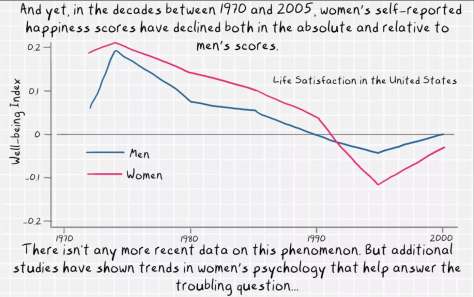
Are feminists right to think that gender-neutral marriage makes women happier?

Male And Female Happiness After Feminism And Socialism
Male and female happiness throughout America’s adoption of radical feminism

I was reading this article by a feminist fiction writer on Vox, where she explains that although feminists have gotten what they wanted (careers, contraceptives, promiscuity, abortion, no-fault-divorce, daycare, etc. it hasn’t made them happier. So, what does this feminist fiction writer think would make feminists happier?

She gives two reasons why women women are still unhappy after feminism has been adopted by our society:

  • men don’t do enough housework
  • women are not as successful as men because they are discriminated against, the so-called “glass ceiling”

I think those complaints are pretty popular among feminists. Let’s take a look at some studies to see if her opinions are supported by peer-reviewed studies.

First study:

COUPLES who share housework duties run a higher risk of divorce than couples where the woman does most of the chores, a study has found.

The divorce rate among couples who shared housework equally was around 50 per cent higher than among those where the woman did most of the work.

“The more a man does in the home, the higher the divorce rate,” Thomas Hansen, co-author of the study entitled Equality in the Home, said.

Second study:

Researchers at the University of Illinois examined data on nearly 1,500 men and 1,800 women, aged between 52 and 60. Their well-being was evaluated through surveys.

The researchers first found that men’s well-being decreased once they had exited the workforce to become home-makers.

Meanwhile, the inverse was not so for women: Women’s psychological well-being was not affected by leaving their jobs to become stay-at-home mothers.

Third study:

A study called “Egalitarianism, Housework and Sexual Frequency in Marriage,” which appeared in The American Sociological Review last year, surprised many, precisely because it went against the logical assumption that as marriages improve by becoming more equal, the sex in these marriages will improve, too. Instead, it found that when men did certain kinds of chores around the house, couples had less sex. Specifically, if men did all of what the researchers characterized as feminine chores like folding laundry, cooking or vacuuming — the kinds of things many women say they want their husbands to do — then couples had sex 1.5 fewer times per month than those with husbands who did what were considered masculine chores, like taking out the trash or fixing the car. It wasn’t just the frequency that was affected, either — at least for the wives. The more traditional the division of labor, meaning the greater the husband’s share of masculine chores compared with feminine ones, the greater his wife’s reported sexual satisfaction.

Regarding the pay gap, that is entirely caused by women’s own choices. E.g. – the choice to study creative writing instead of petroleum engineering, the choice to work 35 hour weeks instead of 70 hour weeks, etc.

Fourth study:  (summarized by AEI economist)

When the [Bureau of Labor Statistics] reports that women working full-time in 2018 earned 81.4% of what men earned working full-time, that is very much different from saying that women earned 81.4% of what men earned for doing exactly the same work while working the exact same number of hours in the same occupation, with exactly the same educational background and exactly the same years of continuous, uninterrupted work experience, and with exactly the same marital and family (e.g., number of children) status. As shown above, once we start controlling individually for the many relevant factors that affect earnings, e.g., hours worked, age, marital status, and having children, most of the raw earnings differential disappears.

Fifth study:

This study leads to the unambiguous conclusion that the differences in the compensation of men and women are the result of a multitude of factors and that the raw wage gap should not be used as the basis to justify corrective action. Indeed, there may be nothing to correct. The differences in raw wages may be almost entirely the result of the individual choices being made by both male and female workers.

I think that women are entitled to make their own decisions, but they aren’t allowed to force the rest of us to subsidize their failures and celebrate their destructive outcomes.

I could go on, but I think enough has been said to show that research is very much at odds with feminist rhetoric. They feel they know what will make them happy and we gave them everything they asked for. They eliminated shaming of promiscuity with sex education. They get preferential treatment in the schools in a female-dominated education system.They are hired because of affirmative action quotas. They get expensive daycare, government schools, welfare and other programs. Taxes are raised to equalize outcomes for divorced women who choose men for feelings, and then nuke their own marriage enterprise. We have been on a long experiment of giving feminists everything they felt they wanted, at the expense of men’s rights and children’s rights, and it hasn’t even produced the results that feminists felt it would.

The social costs of feelings-based decision-making

Let’s look at two examples of policies that feminists asked for in the past, which didn’t work out the way they wanted.

I can understand why feminists would introduce sex education. They felt that “if everyone is having sex, then I won’t be the only one chasing attention from hot no-commitment bad boys by giving them recreational sex before marriage”.  They wanted to eliminate the standards of chastity and marriage-focused dating and normalize fun-focused drunken promiscuity. And they got that. But since they didn’t consult any research and evidence about how that would affect their future marriage stability and marriage happiness, they are even more unhappy than before.

How about no-fault divorce? No-fault divorce was brought in by a coalition of feminists, Marxists and trial lawyers. The Marxists want to destroy the family in order to increase dependence on the state. The trial lawyers wanted to make money. And the feminists thought that the standard approach to courting and marriage was just too much work. They didn’t want to be chaste. They didn’t want to be sober. They didn’t want to evaluate a man for traditional husband and father roles. The no-fault divorce laws gave them an escape from the messes caused by their own feelings-driven choices. But divorce just makes makes men and women much poorer, and passes the costs of supporting single mothers onto taxpayers.

And the costs of the failures of feminism are passed onto taxpayers.

Consider this study:

This paper examines the growth of government during this century as a result of giving women the right to vote. Using cross-sectional time-series data for 1870–1940, we examine state government expenditures and revenue as well as voting by U.S. House and Senate state delegations and the passage of a wide range of different state laws. Suffrage coincided with immediate increases in state government expenditures and revenue and more liberal voting patterns for federal representatives, and these effects continued growing over time as more women took advantage of the franchise. Contrary to many recent suggestions, the gender gap is not something that has arisen since the 1970s, and it helps explain why American government started growing when it did.

We are already $28 trillion in debt, partly because of feminism’s replacement of husbands and families with higher taxes and big government. Every time we transfer money from tax-paying men to feminists to fix their mistakes, it leaves less money in the hands of the men who actually want to get married. The declining value of marriage after feminism for men explains why marriage is being delayed, and why marriage rates are plunging.

Study explains why university women embrace binge-drinking and hook ups

This study is from the Institute for American Values. Despite their name, they are not conservatives. It was done by Norval Glenn and Elizabeth Marquardt.

If you download the 88 page PDF, the first few pages are an executive summary.

There are a couple of things that really struck me about this IAV study on hooking-up.

First, this one from p. 15:

A notable feature of hook ups is that they almost always occur when both participants are drinking or drunk.

A Rutgers University student observed, “You always hear people say, oh my gosh, I was so drunk, I hooked up with so and so…” Perhaps not surprisingly, many noted that being drunk helped to loosen one’s inhibitions and make it easier to hook up. A number of students noted that being drunk could later serve as your excuse for the hook up. A Yale University student said, “Some people like hook up because they’re drunk or use being drunk as an excuse to hook up.” A New York University student observed, “[Alcohol is] just part of an excuse, so that you can say, oh, well, I was drinking.”

A Rutgers University student commented, “If you’re drinking a lot it’s easier to hook up with someone… [and] drugs, it’s kind of like a bonding thing… and then if you hook up with them and you don’t want to speak to them again, you can always blame it on the drinking or the drugs.”

Other women observed that being drunk gives a woman license to act sexually interested in public in ways that would not be tolerated if she were sober. For instance, a University of Michigan student said, “Girls are actually allowed to be a lot more sexual when they are drunk…”

A University of Chicago junior observed, “One of my best friends… sometimes that’s her goal when we go out. Like she wants to get drunk so I guess she doesn’t have to feel guilty about [hooking up].”

Some reported that drinking had led them to do things they later regretted. A University of Virginia student said, “My last random hook up was last October and it was bad. I was drunk and I just regretted it very much.”

And this one from p. 30 on the effects of hooking-up on their future commitments:

A few women did see an unambiguous connection between present relationships and future marriage.

[…]Many women either saw little or no connection between present and future relationships, or their understanding of this connection was curiously flat. A student at New York University said, “[The present and the future are] connected because I will still have the same values and principles that I have now, but I just won’t be single anymore.”A number of women said that the present and the future are connected because whatever heartache or confusion they experience now gives them lessons for the future.

A University of Michigan student said, “Early relationships prepare you for marriage because it’s like, oh, what type of person do I want to be with? Oh, I’ve had these bad experiences. Or, I’ve learned from this relationship that I should do this and I shouldn’t do this.”

A sophomore at Howard University said that “I am kind of learning from a lot of the mistakes that I have made.” At a further extreme, some women saw their future marriage as the reason to experiment widely in the present. A Rutgers University student said,“I think hooking up with different people and seeing what you like and don’t like is a good idea. Because eventually you’re going to have to… marry someone and I’d just like to know that I experienced everything.”

Although it is admirable to take risks and learn from one’s mistakes, these women would probably find it difficult to explain how having your heart broken a few or even many times in your early years — or trying to separate sex from feeling, as in hooking up — is good preparation for a trusting and happy marriage later on.

And on p. 42, we learn what women think marriage is and isn’t for:

For instance, in the on-campus interviews one student complained, “[With] marriage…you have to debate everything… Why do you need a piece of paper to bond a person to you? …But I know if I don’t get married I’ll probably feel like… [a] lonely old woman… If anything, I’d get married [because of] that.”

This student went on to say that she would be satisfied to live with a man, but added that, if the man was committed to her, he would offer to marry her, and that this was the kind of commitment that she wanted. A student at the University of Washington said,“I don’t want to get married right after I graduate from college. I just think that would stunt my growth in every way that there is. I would like to be in a very steady, committed relationship with a guy.”

And on p. 44, we learn that they like co-habitation, which increases the risk of divorce by about 50% (but they don’t know that):

In the national survey, 58 percent of the respondents agreed that “It is a good idea to live with someone before deciding to marry him.” This belief often coexists with a strong desire to marry, because it was embraced by 49 percent of the respondents who strongly agreed that marriage was a very important goal for them.

[…]Women we interviewed on campus reflected a similar range of attitudes about cohabitation. Some women thought that cohabitation was a good way to test whether one could spend a lifetime with a potential partner. In such cases, women often cited fears of divorce as the reason for trying cohabitation first. A senior at the University of Washington said, “I kind of don’t really see marriages work ever, so I want to make sure that everything’s all right before [we get married]. I don’t see how people can get married without living together because I know like I have a best friend and I live with her and we want to kill each other, like, every few months.”

Other women felt that, in an age of divorce, cohabitation was a preferable alternative to marriage. A student at New York University said, “You see so [many] people getting divorces… I just don’t see the necessity [of marriage].” She went on to say, “I think that I don’t have to be married to [the] person that I’m with…. You know like… Goldie Hawn [and Kurt Russell]? They’re not married.”

But let’s get back to the drinking and the hook-up sex…

Once a woman abandons femininity for feminism, then sex is all that she can use to get noticed by a man. Men are like hiring managers, and courting is like a job interview for the job of marriage and mothering. If a woman tries to get the job by having sex with the interviewer, he isn’t going to hire her for the marriage job, since sex has almost nothing to do with the marriage job. Men have to think about things like fidelity and mothering ability when they are choosing a wife. The problem is that thanks to feminism, women have stopped trying to show their ability to be wives and mothers to men, preferring to instead act like bad boys – no emotions, toughness, hardness, binge-drinking, promiscuity. Men may be happy to have sex with women like that, but they do not commit to them for life. They’re just looked upon as feral animals, to be pumped and dumped by every man who isn’t a Christian. And Christian men are disqualified for relationships with young feminists, because we have morals.

Moreover, if a man is constantly being offered sex from feminist women during his 20s and 30s, he basically loses all the time that he could be training for his roles as protector, provider and moral/spiritual leader. He will never take on those roles if he is handed sex before marriage for free. That is the root cause of the “man-up” complaint that women make. Why don’t men grow up? Because they don’t have to. They don’t have to do a thing to audition for husband roles, in order to get sex. They just have to be “hot” and feign liberal political views. Many (most?) teenage women are giving the bad boys oral sex on the first date now. Women aren’t looking for husbands until much later, when their effort to achieve self-esteem through slutty behavior stalls out, and they realize that the whole feminist project was futile and unsustainable.

In a previous post, I explained how feminist leaders wanted to get women to drink like men, have sex like men, and to abolish courtship and marriage. Under the influence of cultural definitions of what makes a good man and a good relationship, women began to choose men to have sex with without any consideration of morality, religion, marriage, etc. This results in a cycle of binge-drinking, one-night-stands, cheating, co-habitating, breaking-up, stalking, aborting, etc., until the woman’s ability to trust and love anyone – including herself – is completely destroyed. And yet these college women somehow believe this is is “fun” and “adventurous”, that it makes them feel “sexy”, and that the experience of being selfish and seeing the worst kind of men acting in the worst possible ways, point blank, somehow prepares them for marriage and motherhood. They are told this, and they are so unable to break out of their need to “fit in” with their peers and culture that by the time they realized they’ve been had, it’s too late to fix it. And yet, they themselves made those decisions. They are responsible, whether they intended the consequences or not. No one was stopping them from investigating what was likely to happen, if they decided to play the fool sexually.