Tag Archives: Husband

Dennis Prager explains what feminism has achieved for women

Man and woman working on a computer upgrade

Dennis Prager has summarized many of my viewpoints on this blog in a tiny, tiny little article. He calls it “Four Legacies of Feminism“.

Read the whole glorious thing and bask in its wisdom!

Full text:

As we approach the 50th anniversary of the publication of Betty Friedan’s feminist magnum opus, The Feminine Mystique, we can have a perspective on feminism that was largely unavailable heretofore.

And that perspective doesn’t make feminism look good. Yes, women have more opportunities to achieve career success; they are now members of most Jewish and Christian clergy; women’s college sports teams are given huge amounts of money; and there are far more women in political positions of power. But the prices paid for these changes — four in particular — have been great, and outweigh the gains for women, let alone for men and for society.

1) The first was the feminist message to young women to have sex just as men do. There is no reason for them to lead a different sexual life than men, they were told. Just as men can have sex with any woman solely for the sake of physical pleasure, so, too, women ought to enjoy sex with any man just for the fun of it. The notion that the nature of women is to hope for at least the possibility of a long-term commitment from a man they sleep with has been dismissed as sexist nonsense.

As a result, vast numbers of young American women had, and continue to have, what are called “hookups”; and for some of them it is quite possible that no psychological or emotional price has been paid. But the majority of women who are promiscuous do pay prices. One is depression. New York Times columnist Ross Douthat recently summarized an academic study on the subject: “A young woman’s likelihood of depression rose steadily as her number of partners climbed and the present stability of her sex life diminished.”

Long before this study, I had learned from women callers to my radio show (an hour each week — the “Male-Female Hour” — is devoted to very honest discussion of sexual and other man-woman issues) that not only did female promiscuity coincide with depression, it also often had lasting effects on women’s ability to enjoy sex. Many married women told me that in order to have a normal sexual relationship with their husband, they had to work through the negative aftereffects of early promiscuity — not trusting men, feeling used, seeing sex as unrelated to love, and disdaining their husband’s sexual overtures. And many said they still couldn’t have a normal sex life with their husband.

2) The second awful legacy of feminism has been the belief among women that they could and should postpone marriage until they developed their careers. Only then should they seriously consider looking for a husband. Thus, the decade or more during which women have the best chance to attract men is spent being preoccupied with developing a career. Again, I cite woman callers to my radio show over the past 20 years who have sadly looked back at what they now, at age 40, regard as 20 wasted years. Sure, these frequently bright and talented women have a fine career. But most women are not programmed to prefer a great career to a great man and a family. They feel they were sold a bill of goods at college and by the media. And they were. It turns out that most women without a man do worse in life than fish without bicycles.

3) The third sad feminist legacy is that so many women — and men — have bought the notion that women should work outside the home that for the first time in American history, and perhaps world history, vast numbers of children are not primarily raised by their mothers or even by an extended family member. Instead they are raised for a significant part of their childhood by nannies and by workers at daycare centers. Whatever feminists may say about their only advocating choices, everyone knows the truth: Feminism regards work outside the home as more elevating, honorable, and personally productive than full-time mothering and making a home.

4) And the fourth awful legacy of feminism has been the demasculinization of men. For all of higher civilization’s recorded history, becoming a man was defined overwhelmingly as taking responsibility for a family. That notion — indeed the notion of masculinity itself — is regarded by feminism as the worst of sins: patriarchy.

Men need a role, or they become, as the title of George Gilder’s classic book on single men describes them: Naked Nomads. In little more than a generation, feminism has obliterated roles. If you wonder why so many men choose not to get married, the answer lies in large part in the contemporary devaluation of the husband and of the father — of men as men, in other words. Most men want to be honored in some way — as a husband, a father, a provider, as an accomplished something; they don’t want merely to be “equal partners” with a wife.

In sum, thanks to feminism, very many women slept with too many men for their own happiness; postponed marriage too long to find the right man to marry; are having hired hands do much of the raising of their children; and find they are dating boy-men because manly men are so rare.

Feminism exemplifies the truth of the saying, “Be careful what you wish for — you may get it.”

I wish I could add something to this, but I can’t because every time I think of something to add, he says it in the next sentence. I think it’s so important for women to read about feminism, and to understand how women used to approach men and marriage before feminism. Women today don’t realize how their priorities have been changed from older generations, because of the promotion of feminism in the culture. Women today ought to take a step back and think about what works for them in the long term. What kind of man is the best kind? What do men want out of marriage? What should men and women do now to prepare for marriage?

If you like Prager’s short essay, then this medium essay arguing against feminism authored by Barbara Kay would be nice follow-up.
Wage gap: are women paid less than men because of discrimination?

The pay gap is caused by women's own choices
The pay gap is caused by women’s preference for having children

Liberal feminist Hanna Rosin takes a look at this question in the far-left Slate, of all places.

Excerpt:

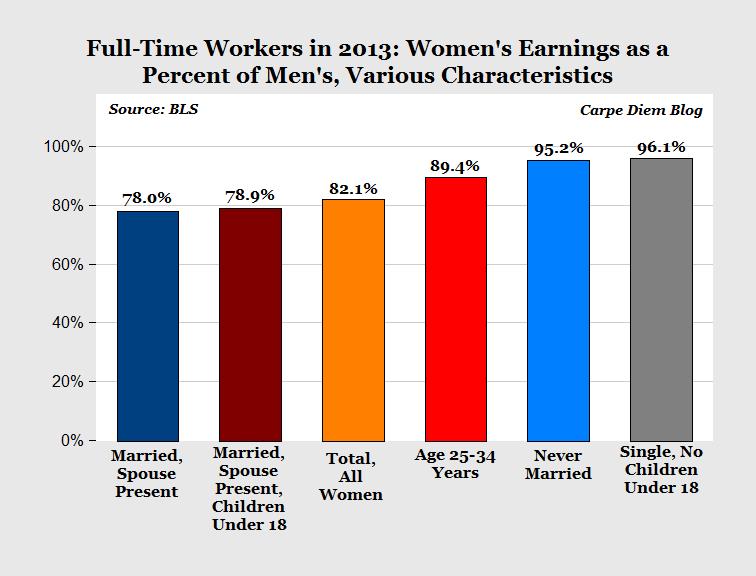
The official Bureau of Labor Department statistics show that the median earnings of full-time female workers is 77 percent of the median earnings of full-time male workers. But that is very different than “77 cents on the dollar for doing the same work as men.” The latter gives the impression that a man and a woman standing next to each other doing the same job for the same number of hours get paid different salaries. That’s not at all the case. “Full time” officially means 35 hours, but men work more hours than women. That’s the first problem: We could be comparing men working 40 hours to women working 35.

How to get a more accurate measure? First, instead of comparing annual wages, start by comparing average weekly wages. This is considered a slightly more accurate measure because it eliminates variables like time off during the year or annual bonuses (and yes, men get higher bonuses, but let’s shelve that for a moment in our quest for a pure wage gap number). By this measure, women earn 81 percent of what men earn, although it varies widely by race. African-American women, for example, earn 94 percent of what African-American men earn in a typical week. Then, when you restrict the comparison to men and women working 40 hours a week, the gap narrows to 87 percent.

But we’re still not close to measuring women “doing the same work as men.” For that, we’d have to adjust for many other factors that go into determining salary. Economists Francine Blau and Lawrence Kahn did that in a recent paper, “The Gender Pay Gap.”.”They first accounted for education and experience. That didn’t shift the gap very much, because women generally have at least as much and usually more education than men, and since the 1980s they have been gaining the experience. The fact that men are more likely to be in unions and have their salaries protected accounts for about 4 percent of the gap. The big differences are in occupation and industry. Women congregate in different professions than men do, and the largely male professions tend to be higher-paying. If you account for those differences, and then compare a woman and a man doing the same job, the pay gap narrows to 91 percent. So, you could accurately say in that Obama ad that, “women get paid 91 cents on the dollar for doing the same work as men.”

I believe that the remainder of the gap can be accounted for by looking at other voluntary factors that differentiate men and women.

The Heritage Foundation says that a recent study puts the number at 95 cents per dollar.

Excerpt:

Women are more likely than men to work in industries with more flexible schedules. Women are also more likely to spend time outside the labor force to care for children. These choices have benefits, but they also reduce pay—for both men and women. When economists control for such factors, they find the gender gap largely disappears.

A 2009 study commissioned by the Department of Labor found that after controlling for occupation, experience, and other choices, women earn 95 percent as much as men do. In 2005, June O’Neil, the former director of the Congressional Budget Office, found that “There is no gender gap in wages among men and women with similar family roles.” Different choices—not discrimination—account for different employment and wage outcomes.

A popular article by Carrie Lukas in the Wall Street Journal agrees.

Excerpt:

The Department of Labor’s Time Use survey shows that full-time working women spend an average of 8.01 hours per day on the job, compared to 8.75 hours for full-time working men. One would expect that someone who works 9% more would also earn more. This one fact alone accounts for more than a third of the wage gap.

[…]Recent studies have shown that the wage gap shrinks—or even reverses—when relevant factors are taken into account and comparisons are made between men and women in similar circumstances. In a 2010 study of single, childless urban workers between the ages of 22 and 30, the research firm Reach Advisors found that women earned an average of 8% more than their male counterparts. Given that women are outpacing men in educational attainment, and that our economy is increasingly geared toward knowledge-based jobs, it makes sense that women’s earnings are going up compared to men’s.

When women make different choices about education and labor that are more like what men choose, they earn just as much or more than men.

A lesson about men for marriage-minded women from the movie “High Noon”

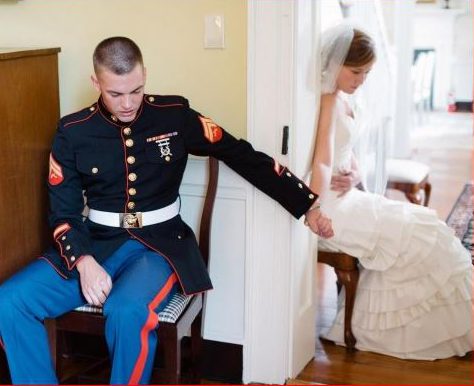
Marine prays with his wife on their wedding day

One of my favorite movies for explaining the differences between men and women is “High Noon” (1952).

Here’s the summary from IMDB:

Former marshal Will Kane (Gary Cooper) is preparing to leave the small town of Hadleyville, New Mexico, with his new bride, Amy (Grace Kelly), when he learns that local criminal Frank Miller has been set free and is coming to seek revenge on the marshal who turned him in. When he starts recruiting deputies to fight Miller, Kane is discouraged to find that the people of Hadleyville turn cowardly when the time comes for a showdown, and he must face Miller and his cronies alone.

The main theme of the film concerns Amy’s decision to break her wedding vows the very day that she makes them. She tells her new husband that he must bow to her will, and give up his male role as protector. When he explains his reasons for standing his ground to her practically (Miller will hunt them down) and morally (he has a duty protect the town), she dismisses both. She tells him that if he doesn’t run away from Miller and his gang with her, that she will get on the train and leave town by herself.

The intro of film shows the member’s of Miller’s gang assembling, and the words of the song explain the central conflict between husband and wife:

Here’s the part of the lyrics we care about:

The noonday train will bring Frank Miller.
If I’m a man I must be brave
And I must face that deadly killer
Or lie a coward, a craven coward,
Or lie a coward in my grave.

O to be torn ‘twixt love and duty!
S’posin’ I lose my fair-haired beauty!
Look at that big hand move along
Nearin’ high noon.

He made a vow while in State’s Prison,
Vow’d it would be my life or his’n
I’m not afraid of death, but O,
What will I do if you leave me?

Do not forsake me O my darlin’
You made that promise when we wed.
Do not forsake me O my darlin’
Although you’re grievin’, I can’t be leavin’
Until I shoot Frank Miller dead.

What’s interesting is that his new wife Amy apparently does not understand the meaning of wedding vows or the natural roles of good men as protectors of the weak, and fighters against evil. Although she vowed to stick by him and help him, the minute anything threatening appears that makes her feel unhappy, she abandons her vows and abandons her man. Let’s break down her mistakes now, using actual conversations from the movie.

First, she doesn’t understand or respect the man she married as a man:

Kane: [while riding out of town] It’s no good. I’ve got to go back, Amy.

Amy: Why?

Kane: This is crazy. I haven’t even got any guns.

Amy: Then let’s go on. Hurry.

Kane: No, that’s what I’ve been thinkin’. They’re making me run. I’ve never run from anybody before.

Amy: I don’t understand any of this.

Kane: [after looking at his vest watch] Well, I haven’t got time to tell ya.

Amy: Then don’t go back, Will.

Kane: I’ve got to. That’s the whole thing. [He turns the buggy around and rides back into town]

Her feelings and her desires for the world to be a happy place for her are so strong that they cloud her judgment.

Second, she doesn’t understand the threat posed by evil men:

More:

Kane: I sent a man up five years ago for murder. He was supposed to hang. But up North, they commuted it to life and now he’s free. I don’t know how. Anyway, it looks like he’s coming back.

Amy: I still don’t understand.

Kane: He was always wild and kind of crazy. He’ll probably make trouble.

Amy: But that’s no concern of yours, not anymore.

Kane: I’m the one who sent him up.

Amy: Well, that was part of your job. That’s finished now. They’ve got a new marshal.

Kane: He won’t be here until tomorrow. Seems to me I’ve got to stay. Anyway, I’m the same man with or without this. [He pins his badge on his vest]

Amy: Oh, that isn’t so.

Kane: I expect he’ll come lookin’ for me. Three of his old bunch are waiting at the depot.

Amy: That’s exactly why we ought to go.

Kane: They’ll just come after us, four of ’em, and we’d be all alone on the prairie.

Amy: We’ve got an hour.

Kane: What’s an hour?…What’s a hundred miles? We’d never be able to keep that store, Amy. They’d come after us and we’d have to run again, as long as we live.

Amy: No we wouldn’t, not if they didn’t know where to find us. Oh Will! Will, I’m begging you, please let’s go.

Kane: I can’t.

Amy: Don’t try to be a hero. You don’t have to be a hero, not for me.

Kane: I’m not trying to be a hero. If you think I like this, you’re crazy.

Instead of recognizing how her feelings are deceiving her about the threat and trusting her husband, she tries to force him to accept her mistaken view of reality by threatening to abandon him.

One of Kane’s ex-girlfriends has a talk with Amy, which helps her to understand who Kane is, and what is expected of her:

Amy: That man downstairs, the clerk, he said things about you and Will. I’ve been trying to understand why he wouldn’t go with me, and now all I can think of is that it’s got to be because of you…Let him go, he still has a chance. Let him go.

Helen: He isn’t staying for me. I haven’t spoken to him for a year – until today. I am leaving on the same train you are…What kind of woman are you? How can you leave him like this? Does the sound of guns frighten you that much?

Amy: I’ve heard guns. My father and my brother were killed by guns. They were on the right side but that didn’t help them any when the shooting started. My brother was nineteen. I watched him die. That’s when I became a Quaker. I don’t care who’s right or who’s wrong. There’s got to be some better way for people to live. Will knows how I feel about it.

Helen: I hate this town. I always hated it – to be a Mexican woman in a town like this.

Amy: I understand.

Helen: You do? That’s good. I don’t understand you. No matter what you say. If Kane was my man, I’d never leave him like this. I’d get a gun. I’d fight.

Amy: Why don’t you?

Helen: He is not my man. He’s yours.

Helen understands the need for a wife to stand by her man. But Amy’s response to evil is to shut her eyes and focus on feeling good and being happy. Notice that her “better way” is unspecified – it’s just a feeling she has that pacificism and no-violence will somehow “work” to stop evil. But in reality, pacifism is not a “better way” of dealing with evil – it does not work. Her pacifist response not only does not make evil go away, it actually encourages more evil. Weakness emboldens evildoers, and laying down your arms provokes them to do more evil. Will Kane knows this, but she won’t listen to him.

You can watch the final gunfight here, as well as Amy’s final decision:

So, this is why I really recommend this movie as a discussion-starter when you like a girl and are thinking of marrying her. It clarifies the essential problem with many young women today not being ready for marriage. To be fair, most women come around to respect their husbands and his different roles after they get married. However, the risk of divorce is so dangerous that it makes sense to bring it up for discussion before the marriage happens. Marriage is supposed to be an engine to serve God, and the success of that enterprise cannot be left to chance. You can’t just rely on the fact that she says the words of the vow, you have to check to see if she has a habit of keeping her promises when it goes against her own self-interest.

Ask yourself: Who are you, as a man? And does your woman accept that you have obligations to stand up to evil and do good ? Will she support you in your battle against evil, or will the marriage just be about her feelings and desires? I would especially beware of women who think that God is speaking to them through their feelings and desires. Look at her friends: are they practical and successful? Or are they irresponsible, unaccountable and reckless? Look at her father: does he have a plan for her, and does he lead her to be practical, frugal and hard-working? If you are not going to get an ally and a supporter in a wife, then you will not be able to serve God well, as a married man. Think about it.