Tag Archives: Divorce

New study finds that egalitarian marriage doesn’t make women happier

Elusive Wapiti writes about in this blog post.

Excerpt:

Norwegian researchers confirm and extend Brad Wilcox and Steven Nock’s research suggesting that egalitarianism sets couples up to fail:

“What we’ve seen is that sharing equal responsibility for work in the home doesn’t necessarily contribute to contentment,” said Thomas Hansen, co-author of the study entitled “Equality in the Home”.

The lack of correlation between equality at home and quality of life was surprising, the researcher said. “One would think that break-ups would occur more often in families with less equality at home, but our statistics show the opposite,” he said.

The figures clearly show that “the more a man does in the home, the higher the divorce rate,” he went on. The reasons, Mr Hansen said, lay only partially with the chores themselves. “Maybe it’s sometimes seen as a good thing to have very clear roles with lots of clarity … where one person is not stepping on the other’s toes,” he suggested. “There could be less quarrels, since you can easily get into squabbles if both have the same roles and one has the feeling that the other is not pulling his or her own weight.”

See, Wilcox’s view is this:

The companionate theory of marriage suggests that egalitarianism in practice and belief leads to higher marital quality for wives and higher levels of positive emotion work on the part of husbands. Our analysis of women’s marital quality and men’s marital emotion work provides little evidence in support of this theory. Rather, in examining women’s marital quality and men’s emotional investments in marriage, we find that dyadic commitment to institutional ideals about marriage and women’s contentment with the division of household tasks are more critical. We also show that men’s marital emotion work is a very important determinant of women’s marital quality. We conclude by noting that her marriage is happiest when it combines elements of the new and old: that is, gender equity and normative commitment to the institution of marriage.

His full study from 2006 is here.

And more again from Elusive Wapiti’s post about the new Norwegian study:

Men’s emotion work (and women’s assessments of that work) is the most crucial determinant of women’s marital quality. It is more important than patterns of household labor, perceptions of housework equity, female labor force participation, childbearing, education and a host of other traditional predictors of global marital quality. This finding suggests that the functions, character, and stability of contemporary marriages are intimately tied to [women’s] emotional well-being.

…our findings suggest that increased departures from a male-breadwinning/female-homemaking model may also account for declines in marital quality, insofar as men and women continue to tacitly value gendered patterns of behavior in marriage. Specifically, we find that the gendered character of marriage seems to remain sufficiently powerful as a tacit ideal among women to impact women’s marital quality, even apart from the effects of the continuing mismatch between female gender role attitudes and male practices.

[W]omen are not happier in marriages marked by egalitarian practices and beliefs…For the most part, marriages that are more egalitarian in belief and practice are not marked by higher levels of men’s positive emotion work [EW: love, affection, and understanding] or by women’s happiness with such emotion work…women who are more egalitarian-minded and more upset with the division of household labor receive lower levels of positive emotion work from their husbands, perhaps because they are more likely to initiate conflict with their husbands. Thus, rising expectations among women for marital equality may also have the unintended effect of lowering investments in marital emotion work on the part of men. [N]o measure of egalitarianism in practice or belief is associated with higher levels of men spending quality time with their wives. Indeed, in keeping with the gender model of marriage, wives’ gender egalitarianism and work outside of the home leads to less positive emotion work on the part of husbands.

Instead, we find modest evidence that wives’ gender traditionalism is independently related to higher levels of men’s positive emotion work in marriage. We also find evidence that homemaking wives report greater happiness with their husband’s emotion work, and may be more likely to receive such work from their husbands. In other words, adherence to traditional beliefs and practices regarding gender seems to be tied not only to global marital happiness but also – surprisingly enough – to expressive patterns of marriage.

[S]hared church attendance and normative support for the institution of marriage are associated with higher levels of women’s marital happiness. Thus, declines in religious attendance over the past four decades (Steensland, Park, Regnerus, Robinson, Wilcox and Woodberry 2000), along with the liberalization of attitudes to divorce and extramarital sex (Thornton and Young-DeMarco 2001), may also account for recent shifts in marital quality insofar as they reduce the social and normative supports that foster higher investments in marriage.

Wives who share high levels of church attendance are more likely to report happiness with their husband’s emotion work in marriage. Moreover, wives who share a normative commitment to marriage with their husbands are more likely to report happiness with the emotion work done by their husbands…socially conservative practices and (possibly) beliefs appear to be linked to lower expectations of marital emotion work on the part of women. But it is also possible that they are associated with more expressive marriages. In any case, women who share a commitment to the institution of marriage with their husbands express greater happiness. [2]

He has an interesting graph there of what women want from marriage, and what men want. Who knew that women wanted gardening?

In any case, I really do think that this is important to understand, because I see a lot of pastors and evangelical leaders embracing egalitarianism, because they can’t make the case for complementarianism using anything except the Bible. Well, the Bible does support complementarianism. But when you are debating it with an egalitarian, it helps to have the evidence.

Related posts

Traditional marriage is a threat to the values of single women

Stuart Schneiderman takes a closer look at view of marriage among single women today.

Excerpt:

You probably haven’t heard of Nicole Rodgers, editor a gender-bending feminist website called Role/Reboot.

[…]While Democratic politicos and pundits are happy to pay lip service to Mitt Romney’s sterling personal character and exemplary private life, behind the scenes many of them are surely thinking what Nicole Rodgers is thinking, namely that Romney’s life represents a counterrevolutionary, even a reactionary force in American cultural politics.

Rodgers got herself totally lathered up because Romney dared to suggest, at the last presidential debate, that there would be less gun violence if there were fewer illegitimate births.

In truth, the point is not even controversial. Everyone but Nicole Rodgers knows that children who are brought up in families that look like the Romney family do much, much better in life than children who are brought up in any other family configuration.

Here’s the research to back up his assertion about single motherhood vs marriage, but that’s not what I am interested in. I am interested in why feminists are opposed to traditional marriage and why they fear Romney’s positive example of marriage with 5 children. Do feminists really want traditional marriage at all? It depends on what you mean by marriage.

This reminds me of a fascinating article on Dalrock’s blog in which he looks at the changing definition of marriage, which he calls the “debasement” of marriage. This is a must-read post.

Excerpt:

Feminists and their enablers have slowly shaved off the value of marriage for men.  Marriage for men no longer means:

  • Being the legally and socially recognized head of the household.
  • An expectation of regular sex.
  • Legal rights to children.
  • Lifetime commitment.

He also adds the elimination of the preservation chastity and the embrace of the hook-up culture on campus to the list, so that there are 5 debasements to marriage in total. Men liked the original version of marriage without the debasements. Do they like the new debased version as much?

It’s very important, especially for Christians, to understand that many women who say that they want marriage do not really want what marriage has always been. They want to live happily ever after. What this means is not what traditional marriage means. Traditional marriage means preparing for marriage by making good decisions – like premarital chastity. It means a separation of roles where each side performs roles that are of value to the other. Today, the majority of single women today have been influenced by feminism and they reject that view of marriage. They have been taught that marriage means happiness and full autonomy for the woman at the expense of men and children. They have been taught that there is no need to prepare for marriage with good decisions like chastity, and no need to prefer men who are good leaders, providers and protectors in the home. The moral dimension of marriage – the obligations and virtues – have been obliterated.

The majority of single women also vote for policies that will enable this new definition of marriage: social programs that make husbands dispensable, welfare subsidies for single mothers, early sex education to turn young men away from chastity and fidelity, co-ed education, recognition of cohabitation as marriage, no-fault divorce, punitive anti-male divorce courts, taxpayer-funding of contraceptives, taxpayer-funding of abortions, taxpayer-funding of day care, affirmative action in education, affirmative action in employment decisions, discrimination against male teachers in schools, and so on. The goal of all of this is to eliminate male leadership, men as main providers, and men as protectors. Many single women who choose poorly do not even want other women who prefer traditional men and traditional marriage to succeed, which is why they vote Democrat in order to tax, regulate and undermine the marriages of these more responsible married women.

Men start off chaste. We start off wanting romantic love and life-long traditional marriage. But it is drummed out of us because of a society in which feminist notions of recreational sex without consequences are on us through taxes, policies, schools and culture. Men learn that recreational sex is “normal” at very young ages, in schools that are dominated by female teachers and female administrators. The majority of these women are feminists who value careers first, and who seek to undermine traditional marriage and chastity. More and more men are being raised fatherless so there is no resistance from husband-fathers (who know better!) in the home. The result is a generation of men who trained to expect the sexual ethics of Sandra Fluke: government-funded promiscuity, irresponsibility, big government socialism and selfishness. Sandra Fluke doesn’t want marriage, and neither do single women like her who mostly vote Democrat.

Related posts

New report: welfare spending hits record $1 trillion, up 32% in Obama’s first term

Democrats control the House and Senate in 2007

Dad sent me this excellent article from the Daily Caller.

Excerpt:

The government spent approximately $1.03 trillion on 83 means-tested federal welfare programs in fiscal year 2011 alone — a price tag that makes welfare that year the government’s largest expenditure, according to new data released by the Republican side of the Senate Budget Committee.

The total sum taxpayers spent on federal welfare programs was derived from a new Congressional Research Service (CRS) report on federal welfare spending — which topped out at $745.84 billion for fiscal year 2011 — combined with an analysis from the Republican Senate Budget Committee staff of state spending on federal welfare programs (based on “The Oxford Handbook of State and Local Government Finance”), which reached $282.7 billion in fiscal year 2011.

[…]According to the CRS report, which focused solely on federal spending for federal welfare programs, spending on federal welfare programs increased $563.413 billion in fiscal year 2008 to $745.84 billion in fiscal year 2011 — a 32 percent increase.

[…]The total federal spending on federal welfare programs vastly outpaced fiscal year 2011 spending on such federal expenditures as non-war defense ($540 billion), Social Security ($725 billion), Medicare ($480 billion), and departments such as Justice ($30.5 billion), Transportation ($77.3 billion) and Education ($65.486 billion) — a fact that alarmed the ranking member of the Senate Budget Committee, Alabama Sen. Jeff Sessions, who requested the report from CRS.

“These astounding figures demonstrate that the United States spends more on federal welfare than any other program in the federal budget,” Sessions wrote The Daily Caller in an email. “It is time to restore — not retreat from — the moral principles of the 1996 welfare reform. Such reforms, combined with measures to promote growth, will help both the recipient and the Treasury.”

When state spending on federal welfare programs — specifically Medicaid and the Children’s Health Insurance Program — was thrown into the mix, the amount spent on federal welfare increased 28 percent, from $798.813 billion in fiscal year 2008 to $1.028.54 trillion in fiscal year 2011.

“No longer should we measure compassion by how much money the government spends, but by how many people we help to rise out of poverty,” Sessions continued. “Welfare assistance should be seen as temporary whenever possible, and the goal must be to help more of our fellow citizens attain gainful employment and financial independence. This is about more than rescuing our finances. It’s about creating a more optimistic future for millions of struggling Americans.”

With food assistance spending increasing the most out of every category, Sessions, who has been sounding the alarm on the expanding food stamp rolls, noted that the Obama administration has allowed for the food stamp increase through misleading promotion and a disregard for self-reliance.

“The administration ludicrously argues that every five dollars in food stamp spending results in nearly 10 dollars in economic benefit. They insist that communities ‘lose out’ when more people don’t sign up for benefits,” Sessions noted. “[The United States Department of Agriculture] even awarded a recruitment worker for overcoming people’s ‘mountain pride.’ Is this a hopeful vision for the future? Do these priorities make our country stronger and our economy more secure?”

Do these numbers surprise you, because of what you hear from Obama and his allies in the media? Well, Democrats are always lying about how the Bush tax cuts caused the deficits. The truth is that revenues went up after the tax cuts because more wealthy invested their savings since they stood to keep more of the gains if their risks panned out. People invest more when they are allowed to keep more of the profit, if they get a profit. That’s how investing works – when you stand to gain more for the same risk, you risk more. And risking money in a business venture means MORE JOBS, since people get hired to take the risk, and do the work.

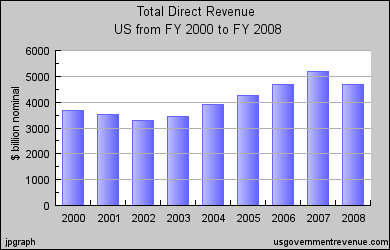
Bush’s tax cuts were passed in 2001 and 2003, and look what happened to revenues:

Did the Bush tax cuts make revenues decrease? No!

Not only that, but the unemployment rate went down to just over 4% after the tax cuts. The two wars cost about $550 billion, and we actually got national security out of it. What do we get for paying people not to work? Is it government’s job to pay people not to work? I think that charity is best done by individuals, businesses and especially churches, where we can expect some moral accountability from the recipient – some improved decision-making and personal responsibility. That’s simply lacking when government mails out checks paid for by working families and their employers.

Not every Republican is good on cutting spending, but Jeff Sessions is one of the Republican majority who opposes spending. We just just need to keep getting rid of the RINOs and Democrats, and this problem will get solved. We are never going to turn this economy around when people who think that more dependency and fewer jobs cause economic growth. They are wrong about the facts and they need to go in November.