

Why are so many women with good careers being forced to freeze their eggs?

Is this woman choosing a path that leads to marriage?

The New York Times says that more and more women are having to freeze their eggs because they can’t find good men to marry. The NYT doesn’t think that women are doing anything wrong. They blame the men for refusing to commit. According to feminism, women who value careers, abortion rights, no-fault divorce, big government, high taxes, etc. are doing everything right. But does it work?

I thought it might be a good idea to help Western women to make better decisions with men and marriage. Although setting out boundaries seems harsh and restrictive, it’s actually protective and loving. If we want women to get to a stable marriage and children, (what they really need long term, after they lose their looks and youth), then we should be bold about leading them.

The first thing to point out is that the women celebrated by the New  York Times are intentionally delaying marriage for their education and careers.

Another New York Times article explains:

It could be that the new generation of millennial women is delaying having children even longer than the women who came before them, as prime childbearing years are also critical years for advancing in a career. A recent study shows that the marital pay gap that springs up after a first child is born typically does not close if the birth happens between age 25 and 35.

Shannon Hettinger, a 32-year-old from Washington, D.C., said she definitely wanted children. She grew up in a large family in a small town in Pennsylvania and almost all her high school friends are married with children. But she moved to Washington, and spent her 20s deciding on a career. Now that she has one she loves — she works in residential real estate sales — she is not going to stop until she gets established. That means not having children for a while.

“I just want to build my book of business and see where I can go from here,” she said. “My whole focus is career growth. That’s my No. 1 priority.”

“Once I achieve a certain level of success,” she added, “then I’ll start thinking about a family.”

Ivy Gray-Klein, 26, who lives in Philadelphia and works at the University of Pennsylvania School of Design, said she was open to having children but cannot imagine doing so until she is 30 or 35. She wants to feel settled in her own life first. Now she has three roommates, is paying down her student loans and is working to build a little bit of savings.

“I’m just really trying to get myself to a place that is solid,” she said by phone. “Having a child right now would be so destabilizing. Children just seem like such an enormous financial undertaking.”

Marriage is something that men are willing to do with women in their early 20s. They want a woman to commit and invest herself in his life early. They don’t commit to a woman who has spent her 20s running up debts, traveling, being promiscuous, etc. The pattern of selfish behavior that  women get into damages their ability to be good wives and mothers later. And men know that.

But in this post, I’m discuss something that I think is responsible for women not finding good men: and that’s the fact that many women are not looking for good men. In fact, some women are very attracted to very bad men.

Here’s the first editorial about women and domestic terrorist Dzhokar Tsarnaev, one of the Boston marathon bombers.

Excerpt:

Mostly, though, they think Dzhokhar is cute. The Bambi eyes (looking right out of his Instagram-doctored photos at you!), the hipster facial stubble, the masses of wine-dark tousled hair — adorable! Impassioned believers have written “Dzhokhar is innocent” on their hands and plastered “Innocent until proven guilty!!!!” posters around their towns. An 18-year-old waitress interviewed by the New York Post vowed to have Dzhokhar’s last tweet before the bombing tattooed onto her arm: “If you have the knowledge and the inspiration all that’s left is to take action.”

[…]But the real cause of the Jahar craze more likely lies in something more primal and less pretty in the female psyche. I’m betting that women, young and old, are drawn to Dzhokhar not because he is a good-looking late adolescent but because he is a good-looking accused killer. He’s a classic “bad boy” of the sort to whom women are chronically attracted because they want to reform them, or minister to their wounds, or be the healing presence they’ve never had — but mostly because they find them sexy.

That article also noted:

It’s not surprising, then, that every homicide perp on death row who is reasonably attractive has groupies. Consider the handsome (and widely philandering) Scott Peterson, sentenced in 2005 for killing his wife and unborn son and throwing their remains into San Francisco Bay. The day he checked into San Quentin, he received three dozen phone calls from smitten women, including an 18-year-old who wanted to become the second Mrs. Peterson.

Some of the tweets and other fangirl comments about Tsarnaev were collected in this New York Post article.

Lots of Western women from the UK, France, Russia, etc. all picked up and moved to the Middle East to become ISIS jihadi brides.

Excerpt:

Western women joining Islamic State are increasingly from comfortable backgrounds and often well educated with romantic notions of adventure often quickly dispelled by the harshness of life as a “Jihadi bride”, according to a British research report.

Some 550 women from Western countries have left their homelands to join Islamic State, which has captured swathes of Syria and Iraq, said the report by the Institute for Strategic Dialogue and the International Centre for the Study of Radicalisation at King’s College, London.

[…]It said female recruits were increasingly younger, some from comfortable backgrounds and often well-educated, and were playing “crucial” propaganda and recruitment roles.

That article is three years old, the numbers have more than doubled since then. The most common reasons cited for leaving are romance and adventure.

Psychology Today has some comments about why some women do this:

In her post, “Women Who Love Serial Killers,” PT blogger, Katherine Ramsland, offers some suggestions about why some women can be so attracted to, or hopelessly beguiled by, the most terrifying of human predators. At first, she provides explanations from the women themselves, women who actually married these dangerously unhinged criminals. Their reasons (somewhat elaborated here) include the assumptions that:

  • their love can transform the convict: from cunning and cruel, to caring, concerned, and compassionate.

  • there’s a wounded child nested somewhere inside the killer that can be healed through a devoted nurturance that only they can provide.

  • they might share the killer’s media spotlight, and so triumphantly emerge from their anonymity, and maybe in the process even land a book or movie deal (an aspiration about as cynical as it is narcissisticand self-serving).

And this is even more interesting:

To simplify this work’s findings for my present purpose, however, let me begin by emphasizing that Ogas and Gaddam find substantial evidence from Web searches, posts, and many 1,000s of romance novels that women demonstrate a strong erotic preference for dominant men. Or toward what’s now commonly referred to as alpha males—in the authors’ words, men who are “strong, confident, [and] swaggering [as in “cocky,” and the pun is intended].” Unfortunately, what these descriptors often imply is behavior sufficiently bearish, self-centered, and insensitive as to often cross the line into a physical, mental, and emotional abuse that can be downright brutal.

[…]Moreover, in responding to the question as to whether some men, such as “serial killers, violent offenders, and rapists,” might be too dominant for women to accept, Ogas and Gaddam note: “It turns out that killing people is an effective way to elicit the attention of many women: virtually every serial killer, including Ted Bundy, Charles Manson, and David Berkowitz, have received love letters from large numbers of female fans” (p. 98).

Women choose good-looking bad boys, because they think that they can change them:

The fantasy that seems to be operating in such devotees, and that constitutes the plot of virtually all erotic/romantic novels written with women in mind, is that the “misogyny and jerkdom” they might have to battle with in such super-dominant males is only temporary. That it doesn’t really represent the man’s innermost reality. That his violence and lack of tender feelings is only the beginning of the story, and that their unsparing love, affection, and dedication can ultimately transform his character by helping him get in touch with his, well, “inner goo.”

I blogged before about feminists going after pro-choice bad boys like William Clinton, Peter Strzok, Eliot Spitzer, Anthony Weiner, John Edwards, Harvey Weinstein, etc. These men support selfish policies like abortion and no-fault divorce. Women seem to not understand that men who support selfishness as policy might actually BE selfish in their own lives. Men who are able to commit and raise children are not pro-abortion and pro-divorce. Those are the men who women should be pursuing, and during their early-to-mid 20s.

Are gay relationships more stable than straight ones?

Sherlock Holmes and John Watson are going to take a look at the data

Let’s look at this post from The Public Discourse and see if gay relationships are as stable, or even more stable, than straight ones.

Excerpt:

The [NFSS] study found that the children who were raised by a gay or lesbian parent as little as 15 years ago were usually conceived within a heterosexual marriage, which then underwent divorce or separation, leaving the child with a single parent. That parent then had at least one same-sex romantic relationship, sometimes outside of the child’s home, sometimes within it. To be more specific, among the respondents who said their mother had a same-sex romantic relationship, a minority, 23%, said they had spent at least three years living in the same household with both their mother and her romantic partner. Only 2 out of the 15,000 screened spent a span of 18 years with the same two mothers. Among those who said their father had had a same-sex relationship, 1.1% of children reported spending at least three years together with both men.

This strongly suggests that the parents’ same-sex relationships were often short-lived, a finding consistent with the broader research on elevated levels of instability among same-sex romantic partners. For example, a recent 2012 study of same-sex couples in Great Britain finds that gay and lesbian cohabiting couples are more likely to separate than heterosexual couples.[3] A 2006 study of same sex marriages in Norway and Sweden found that “divorce risk levels are considerably higher in same-sex marriages”[4] such that Swedish lesbian couples are more than three times as likely to divorce as heterosexual couples, and Swedish gay couples are 1.35 times more likely to divorce (net of controls). Timothy Biblarz and Judith Stacey, two of the most outspoken advocates for same-sex marriage in the U.S. academy, acknowledge that there is more instability among lesbian parents.[5]

This paper from the Family Research Council makes the same point:

The 2003-2004 Gay/Lesbian Consumer Online Census surveyed the lifestyles of 7,862 homosexuals. Of those involved in a “current relationship,” only 15 percent describe their current relationship as having lasted twelve years or longer, with five percent lasting more than twenty years.[4] While this “snapshot in time” is not an absolute predictor of the length of homosexual relationships, it does indicate that few homosexual relationships achieve the longevity common in marriages.

In The Sexual Organization of the City, University of Chicago sociologist Edward Laumann argues that “typical gay city inhabitants spend most of their adult lives in ‘transactional’ relationships, or short-term commitments of less than six months.”[5]

A study of homosexual men in the Netherlands published in the journal AIDS found that the “duration of steady partnerships” was 1.5 years.[6]

In his study of male homosexuality in Western Sexuality: Practice and Precept in Past and Present Times, Pollak found that “few homosexual relationships last longer than two years, with many men reporting hundreds of lifetime partners.”[7]

In Male and Female Homosexuality, Saghir and Robins found that the average male homosexual live-in relationship lasts between two and three years.[8]

It’s a Grindr lifestyle. And it’s not a good environment for meeting the needs of children. (Example)

There is one study (Rosenfeld, 2014) that tries to argue against the conclusion of all these other studies, and the problems with it are discussed in this post.

The right way to think about gay marriage is to think about it as an extension of no-fault divorce. The same feminists and leftists who pushed for the legalization of no-fault divorce told us back then that the children would be fine, that children are resilient. No-fault divorce was a change in the definition of marriage. The leftists said that divorce would never become widespread, and that it would not harm children in any way. It was all a pack of lies. If the practices of the gay lifestyle become conflated with marriage, then marriage will come to denote relationships engaged in for “love” not children, such that unchastity, infidelity, increased domestic violence and frequent break-ups are incorporated back into the definition of marriage. Marriage is about permanence, exclusivity and building an environment that can welcome children and supply for their needs. It’s not about government giving people respect for their romantic feelings. Those are volatile. What government ought to be rewarding is lifelong commitment.

Information Enigma: 21-minute video explains intelligent design

Can random mutation and natural selection create new functional information?

The video is here:

I have read and listened and watched a lot of material on intelligent design, but I have never seen so much value packed into such a short lecture. I really hope you’ll watch this and that it’s helpful to you.

Summary:

  • the big question when discussing the origin of life: where did the information in living systems come from?
  • Until 530 million years ago, the oceans were largely devoid of life
  • In a 10 million year period, many new forms of animal life emerged
  • New biological forms of life require new information
  • the discovery of DNA shows that living systems work because cells have information that allows them to build the components of molecular machines: cell types, proteins, etc.
  • can random mutation and natural selection create new functional information?
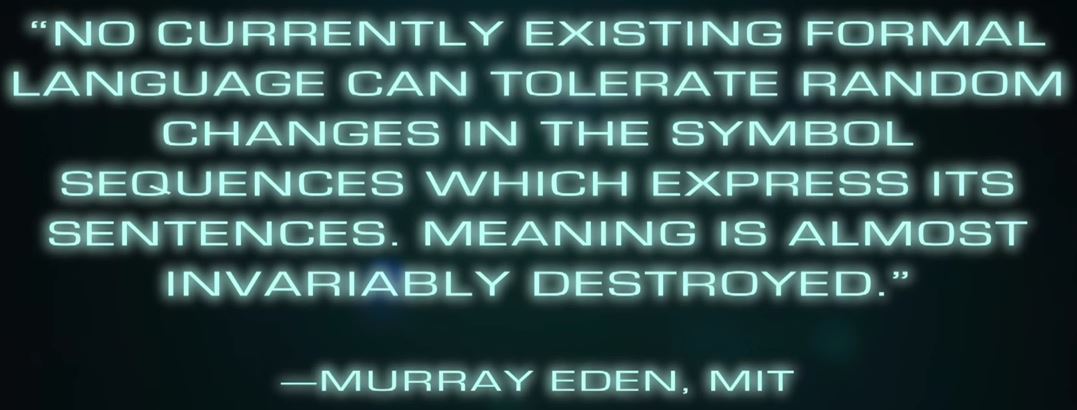
  • normally, random mutations tend to degrade the functionality of information, e.g. – randomly changing symbols in an applications code does not usually introduce useful new functions, it usually renders what is there non-functional
  • the majority of possible sequences will NOT have functions, so random mutations will more likely give you non-functional code, rather than functional code
  • example: a bicycle lock  with 4 numbers has many possible sequences for the 4 numbers, and only one of them has unlock functionality, the rest have no functionality
  • if you have lots of time, then you might be able to guess the combination, but if the lock as has 10 billion numbers, and only one combination that unlocks, you can spend your whole life trying to unlock it and won’t succeed
  • how likely is it to arrive at a functional protein or gene by chance? Is it more like the 4-dial lock (can be done with lots of time) or the 10 billion dial lock (amount of time required exceeds the time available)?
  • the probability is LOW because there is only one sequence of numbers that has unlock function
  • consider a short protein of 150 amino acids has 10 to the 195th power possible sequences
  • if many of these sequences of amino acides had biological function, then it might be easier to get to one by random mutation and selection than it is with a lock that only unlocks for ONE sequence
  • how many of the possible sequences have biological function?
  • Thanks to research done by Douglas Axe, we now know that the number of functional amino acid sequences for even a short protein is incredibly small…
  • Axe found that the odds of getting a functional sequence of amino acids that will fold and have biological function is 1 in 10 to the 77th power
  • Is that number too improbable to reach by chance? well, there are 10 to 65th atoms in the entire Milky Way galaxy… so yes, this is a very improbable outcome
  • can random genetic mutations search through all the sequences in order to find the one in 10 to the 77th power one that has biological function? It depends on how much guessers we have and how many guesses we get in the time available
  • even with the entire 3.5 billion year history of life on Earth, only about 10 to the 40th organisms have ever lived, which far smaller fraction of the 10 to the 77th total sequences
  • even with a very fast mutation rate, you would not be able to reach a functional protein even with all that time, and even with all those organisms

I was once having a discussion with a woman about the research that Axe did at the Cambridge University lab. He published four articles in the Journal of Molecular Biology. I held out one of the papers to her and showed her the numbers. She said over and over “I hate the Discovery Institute! I hate the Discovery Institute!” Well, yeah, but you can’t make the Journal of Molecular Biology go away with hating the Discovery Institute. JMB is peer-reviewed, and this was experimental evidence – not a theory, not a hypothesis.

We have been blessed by the Creator and Designer of the universe in this time and place with overwhelming evidence – an abundance of riches. For those who have an open mind, this is what you’ve been waiting for to make your decision. For the naturalists who struggle so mightily to block out the progress of experimental science, they’ll need to shout louder and shut their eyes tighter and push harder to block their ears. Maybe if they keep screaming “Star Trek” and “Star Wars” over and over to themselves, they will be able to ignore the real science a little longer.