
30% of gorilla genome contradicts Darwinian prediction of human and ape phylogeny

The latest episode of ID the Future discusses a recent (March 2012) paper about the gorilla genome.

Details:

On this episode of ID The Future, Casey Luskin discusses how the recent complete sequencing of the gorilla genome has challenged conventional thinking about human ancestry and explains what neo-Darwinists are doing to try to minimize the impact of this new information. Says Luskin: “There is not a clear signal of ancestral relationships that is coming out of the gorilla genome once you add it into the mix.” Tune in to hear about this interesting development!

The MP3 file is here.

Rather than summarize this short 10-minute podcast, I wanted to excerpt a post of Evolution News about it.

Excerpt: (links removed)

A whopping 30% of the gorilla genome — amounting to hundreds of millions of base pairs of gorilla DNA — contradicts the standard supposed evolutionary phylogeny of great apes and humans. That’s the big news revealed last week with the publication of the sequence of the full gorilla genome. But there’s a lot more to this story.

Eugenie Scott once taught us that when some evolutionary scientist claims some discovery “sheds light” on some aspect of evolution, we might suspect that’s evolution-speak for ‘this find really messed up our evolutionary theory.’ That seems to be the case here. Aylwyn Scally, the lead author of the gorilla genome report, was quoted saying, “The gorilla genome is important because it sheds light on the time when our ancestors diverged from our closest evolutionary cousins around six to 10 million years ago.” NPR titled its story similarly: “Gorilla Genome Sheds Light On Human Evolution.” What evolutionary hypothesis did the gorilla genome mess up?

The standard evolutionary phylogeny of primates holds that humans and chimps are more closely related to one-another than to other great apes like gorillas. In practice, all that really means is that when we sequence human, chimp, and gorilla genes, human and chimp genes have a DNA sequence that is more similar to one-another’s genes than to the gorilla’s genes. But huge portions of the gorilla genome contradict that nice, neat tidy phylogeny. That’s because these gorilla genes are more similar to the human or chimp version than the human or chimp versions are to one-another. In fact, it seems that some 30% of the gorilla genome contradicts the standard primate phylogeny in this manner.

The Evolution News post then cites New Scientist and Nature’s comments on the study.

This isn’t the first time we’ve heard about a study like this – the last time was about the chimpanzee genome and the paper was published in Nature – the most prestigious peer-reviewed journal.
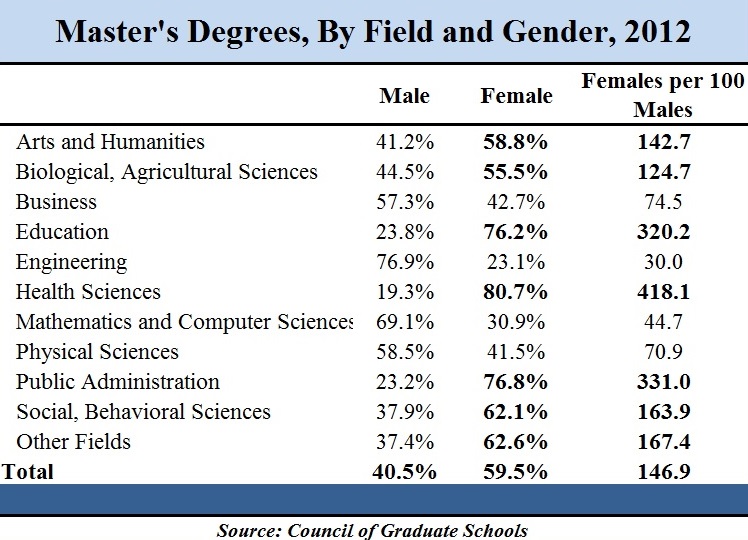
Women earned more doctoral and Master’s degrees than men in 2012

Women now earning majority of graduate degrees

From the American Enterprise Institute Ideas blog.

Excerpt:

The Council of Graduate Schools (CGS) released its annual report recently on U.S. graduate school enrollment and degrees for 2012, and here are some of the more interesting findings in this year’s report:

1. For the fourth year in a row, women in 2012 earned a majority of doctoral degrees. Of the 67,220 doctoral degrees awarded in 2012 at U.S. universities, women earned 34,761 of those degrees and 52.2% of the total, compared to 31,830 degrees awarded to men who earned 47.8% of the total (see top chart above).

[…]2. By field of study, women earning doctoral degrees in 2012 outnumbered men in 7 of the 11 graduate fields tracked by the CGS (see top chart above)

[…]3. The middle chart above shows the gender breakdown for master’s degrees awarded in 2012, and the gender disparity in favor of females is significant – women earned just under 60% of all master’s degrees in 2012, which would also mean that women earned 146.9 master’s degrees last year for every 100 degrees earned by men.

[…]Women represent 58.5% of all graduate students in the U.S., meaning that there are now 141 women enrolled in graduate school for every 100 men.

Click here for the charts.

The author of the post, Dr. Mark Perry, concludes this:

MP: Here’s my prediction – the facts that: a) men are underrepresented in graduate school enrollment overall (100 men were enrolled in 2012 for every 141 women), b) men received fewer master’s (40.5% of the total) and doctoral degrees (47.8% of the total) than women in 2012, and c) men were underrepresented in 7 out of 11 graduate fields of study at both the master’s and doctoral levels last year will get no attention at all from the media, universities and anybody in the higher education industry.

Additionally, there will be no calls for government studies, or increased government funding to address the significant gender disparities in graduate schools, and nobody will refer to the gender graduate school enrollment and degree gaps favoring women as a problem or a “crisis.”  Further, neither President Obama nor Congress will address the gender graduate enrollment and degree gaps by invoking the Title IX gender-equity law, like they have threatened to do for the gender gap in some college math and science programs. And there won’t be any executive orders to address the huge gender disparity in graduate schools by creating a White House Council on Boys and Men like the executive order issued by President Obama in 2009 to create the “White House Council on Women and Girls.”  Finally, despite their stated commitment to “gender equity,” the hundreds of university women’s centers around the country are unlikely to show any concern about the significant gender inequities in graduate school enrollment and degrees, and universities will not be allocating funding to set up men’s centers or create graduate scholarships for men.

Bottom Line: If there is any attention about gender differences in the CGS annual report, it will likely be about the fact that women are a minority in 4 of the 11 fields of graduate study including engineering and computer science (a gender gap which some consider to be a “national crisis”), with calls for greater awareness of female under-representation in STEM graduate fields of study and careers (except for the STEM field of biology, where women areover-represented).  But don’t expect any concern about the fact that men have increasingly become the second sex in higher education.  The concern about gender imbalances will remain extremely selective, and will only focus on cases when women, not men, are underrepresented and in the minority.

Men outnumber women in business, computer science, engineering and physical sciences.

I echo Dr. Perry’s point, and want to add this. In traditional Christianity, men are responsible for providing for their families. One of the ways that we men prepare for this is by getting advanced degrees in STEM-related fields, since these fields are the hardest and also pay the best. So with that in mind, what does it mean for men who want to prepare for this provider role that there is this obvious discrimination against men in graduate schools and doctoral programs? Is anyone going to do anything to change policies and incentives to favor men, like they did when women were under-represented? Of course not. The only thing that will be done is to ignorantly urge men to “man up”, while ignoring the real problems, e.g. – a lack of male teachers, schools that are not geared to male learning styles, and so on.

Related posts

Democrats refuse another offer from Republicans to avoid government shutdown

As expected, the Senate Democrats rejected the compromise on Tuesday.

Last Night, Senate Democrats Voted Along Party Lines To Shut Down The Government Rather Than Agree To Delay Obamacare’s Individual Mandate And Surrender Their Special Insurance Subsidies. “In an extraordinary back-and-forth between the House and Senate that extended late into the night, Democrats beat back attempt after attempt to gut President Barack Obama’s signature health care law. After Senate Democrats rejected the House’s year-long delay of Obamacare and a repeal of the medical device tax on Monday afternoon, Democrats returned to the floor after 9 p.m. to kill another House GOP proposal. The second measure would have kept the government open in exchange for delaying the health care law’s individual mandate and eliminating federal health care contributions for lawmakers and Capitol Hill aides. (Burgess Everett and Manu Raju, “Government Shutdown Update: Senate Rejects House Plan – Again,” Politico, 9/30/13)

According To The Congressional Budget Office, Delaying The Individual Mandate By One Year Would Reduce The Federal Budget Deficit By $35 Billion. “CBO and the staff of the Joint Committee on Taxation (JCT) estimate that enacting H.R. 2668 would reduce federal deficits by roughly $36 billion over the 2014-2018 period and by roughly $35 billion over the 2014-2023 period.” (Cost Estimate Of H.R. 2668: An Act To Delay The Application Of The Individual Health Insurance Mandate, To Delay The Application Of The Employer Health Insurance Mandate, And For Other Purposes, Congressional Budget Office, 9/6/13)

A July Poll Found That 77 Percent Of Registered Voters Support Delaying The Individual Mandate Or Repealing It Entirely. (Morning Consult Poll, 2,076 RV, MOE 2%, 7/24-26/13)

Member of Congress And Their Staff Are Required To Enroll In ObamaCare’s Exchanges. “Sen. Charles Grassley, R-Iowa, then succeeded in adding a measure to Obama’s health care bill three years ago requiring members of Congress and employees in their offices to leave the Federal Employee Health Benefits program and start buying their insurance through the state exchanges that open Tuesday under the Obamacare law.” (Laurie Kellman, “GOP demanded lawmakers pay more for health care,” The Associated Press, 10/1/13)

But OPM Granted Congress The Ability To Provide Subsidies, Which Are Not Available For Other Americans, To Help Purchase Insurance Though The Exchanges. “But the statute means that about 11,000 Members and Congressional staff will lose the generous coverage they now have as part of the Federal Employees Health Benefits Program (FEHBP). Instead they will get the lower-quality, low-choice “Medicaid Plus” of the exchanges. The Members-annual salary: $174,000-and their better paid aides also wouldn’t qualify for ObamaCare subsidies. That means they could be exposed to thousands of dollars a year in out-of-pocket insurance costs…And now the White House is suspending the law to create a double standard. The Office of Personnel Management (OPM) that runs federal benefits will release regulatory details this week, but leaks to the press suggest that Congress will receive extra payments based on the FEHBP defined-contribution formula, which covers about 75% of the cost of the average insurance plan. For 2013, that’s about $4,900 for individuals and $10,000 for families.” (Editorial, “Congress’s ObamaCare Exemption,” The Wall Street Journal, 8/5/13)

I listened to a recent episode of the Weekly Standard podcast, and guest Bill Kristol was advising the GOP to make exactly this proposal, saying that it was a strong move by the Republicans. I agree. We now have vulnerable Democrats going on record in favor of special perks for themselves and their staff, as well as the hated individual mandate. As soon as people see the sticker shock of being forced to buy insurance, or pay a fine, we are going to have a valuable tool in the 2014 elections. The left-wing media isn’t going to be able to protect the Democrats from their own votes.

UPDATE: The Weekly Standard approves of what the GOP is doing.