Why do students turn away from Christianity in college? It might have something to do with what they choose to study.
Rice University reports on a new study conducted by sociologist Elaine Howard Ecklund.
Excerpt:
The public’s view that science and religion can’t work in collaboration is a misconception that stunts progress, according to a new survey of more than 10,000 Americans, scientists and evangelical Protestants. The study by Rice University also found that scientists and the general public are surprisingly similar in their religious practices.
The study, “Religious Understandings of Science (RUS),” was conducted by sociologist Elaine Howard Ecklund and presented today in Chicago during the annual American Association for the Advancement of Science (AAAS) conference. Ecklund is the Autrey Professor of Sociology and director of Rice’s Religion and Public Life Program.
“We found that nearly 50 percent of evangelicals believe that science and religion can work together and support one another,” Ecklund said. “That’s in contrast to the fact that only 38 percent of Americans feel that science and religion can work in collaboration.”
The study also found that 18 percent of scientists attended weekly religious services, compared with 20 percent of the general U.S. population; 15 percent consider themselves very religious (versus 19 percent of the general U.S. population); 13.5 percent read religious texts weekly (compared with 17 percent of the U.S. population); and 19 percent pray several times a day (versus 26 percent of the U.S. population).
[…]RUS is the largest study of American views on religion and science.
Meanwhile, Reasonable Faith has a podcast about the study, and what they discuss is how students who go into non-STEM university programs lose their interest in religion at a much higher rate than people who study STEM.
DR. CRAIG: Right. If you look at their chart they give, where it shows the changes in religiosity by college major, it shows that in biology, engineering, and physical science and math they were mixed. The overall effect was neither negative nor positive. For some it was positive, some negative. But those majors did not seem to have a very significant effect upon the person’s religious behavior. The majors that had a very positive impact on religiosity were education, vocational or clerical education, business, and what is classified as “other.” All of those majors – whatever those are – have an overall positive impact upon students’ religiosity.
KEVIN HARRIS: And attendance as well – attendance to church services.
DR. CRAIG: Yes.
KEVIN HARRIS: The big fly in the ointment here is that “both the Humanities and the Social Sciences see dramatic declines in attendance and even more in religious beliefs.” It lowers church attendance, synagogue attendance, and even more in religious beliefs. What do we mean by the humanities and the social sciences?
DR. CRAIG: Humanities would include your non-scientific areas; for example, literature (hence the title of the article), politics.[3] I don’t know if they would include economics in this or not. Religious studies. In the social sciences are things like anthropology and sociology would be included there.
KEVIN HARRIS: The study of art?
DR. CRAIG: Yes, I suppose the arts would be in the humanities – that would be music and graphic arts. It is a big, big catch-all category.
And why does Dr. Craig think this is happening?
DR. CRAIG: […]It could well be that it is because it is in the humanities that the radicals of the 1960s were able to find a place in the university and become ensconced as professors with the relativism that they were championing. In areas like anthropology and sociology you find tremendous relativism where you simply study these cultures and societies without making any sort of judgment as to truth with regard to what they believe. This leads to the belief that it is all relative; there isn’t anything that is objectively true. John Searle is a very prominent philosopher at the University of California, Berkeley. Searle says that he believes that because of the commitment to the objectivity of truth and logic and the scientific method the hard sciences were barred to these radicals of the 1960s – getting into them and influencing them. But where they found an opening was in things like the Women’s Studies Department, Religious Studies, Anthropology, Sociology. These soft sciences. He says the professors in these disciplines are the children of the 1960s that have carried into it their relativistic views of truth. I noticed here the conclusion by the researchers of the University of Michigan (apparently who did this study), “Our results suggest that it is Postmodernism, not Science, that is the bête noir [the black beast or the hated thing] of religiosity.” The enemy of religiosity is postmodernism, not science.
KEVIN HARRIS: Postmodernism, as you’ve pointed out, was mainly a thing confined to literature and the soft sciences.
DR. CRAIG: Right. Women’s Studies, Religious Studies is rampant with Postmodernist perspectives. That has a real ring of truth to it, and could be the reason behind these statistics.
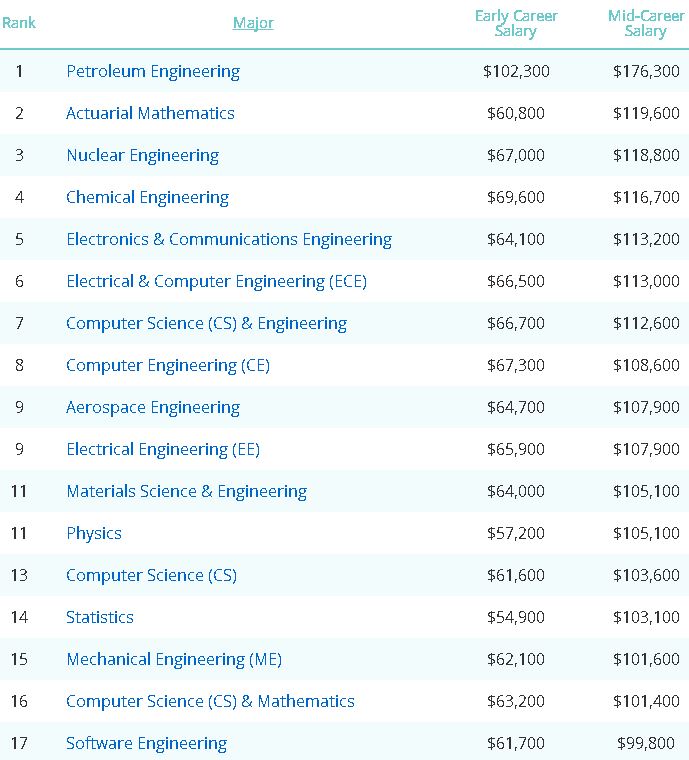
And this is why I recommend that people not drop math in high school, and pick a STEM field to study in college (or a trade in trade school). You are wasting your money when you let people in non-STEM areas indoctrinate you in fact-free irrationality. By the way, I love business administration as a major, for those who do not want to do the lab work. It attracts a lot of conservatives and entrepreneurs.
If you’re not worried about your faith, then you should at least be worried about your wallet:
STEM degrees are good for your finances as well
It’s much easier to have an influence as a Christian if you get your financial house in order. Having a degree that leads to a good paying job is certainly a good way to fund your life plan. Money also helps you to not worry too much about what the secular left can do to you. It’s good for offense and defense, in short.
When people ask me whether the progress of science is more compatible with theism or atheism, I offer the following four basic pieces of scientific evidence that are more compatible with theism than atheism.
Here are the four pieces of evidence best explained by a Creator/Designer:
the kalam argument from the origin of the universe
the cosmic fine-tuning (habitability) argument
the biological information in the first replicator (origin of life)
the sudden origin of all of the different body plans in the fossil record (Cambrian explosion)
And I point to specific examples of recent discoveries that confirm those four arguments. Here are just a few of them:
Nature 302, 505 – 506 (07 April 1983); doi:10.1038/302505a0
The impossibility of a bouncing universe
ALAN H. GUTH* & MARC SHER†
*Center for Theoretical Physics, Laboratory for Nuclear Science and Department of Physics, Massachusetts Institute of Technology, Cambridge, Massachusetts 02139, USA
†Department of Physics, University of California, Irvine, California 92717, USA
Petrosian1 has recently discussed the possibility that the restoration of symmetry at grand unification in a closed contracting Robertson–Walker universe could slow down and halt the contraction, causing the universe to bounce. He then went on to discuss the possibility that our universe has undergone a series of such bounces. We disagree with this analysis. One of us (M.S.) has already shown2 that if a contracting universe is dominated by radiation, then a bounce is impossible. We will show here two further results: (1) entropy considerations imply that the quantity S (defined in ref. 1 and below), which must decrease by ~1075 to allow the present Universe to bounce, can in fact decrease by no more than a factor of ~2; (2) if the true vacuum state has zero energy density, then a universe which is contracting in its low temperature phase can never complete a phase transition soon enough to cause a bounce.
The universe is not only expanding, but that expansion appears to be speeding up. And as if that discovery alone weren’t strange enough, it implies that most of the energy in the cosmos is contained in empty space — a concept that Albert Einstein considered but discarded as his “biggest blunder.” The new findings have been recognized as 1998’s top scientific breakthrough by Science magazine.
[…]The flood of findings about the universe’s expansion rate is the result of about 10 years of study, said Saul Perlmutter, team leader of the Supernova Cosmology Project at Lawrence Berkeley National Laboratory.
Perlmutter and others found such a yardstick in a particular kind of exploding star known as a Type 1A supernova. Over the course of several years, the astronomers developed a model to predict how bright such a supernova would appear at any given distance. Astronomers recorded dozens of Type 1A supernovae and anxiously matched them up with redshifts to find out how much the universe’s expansion was slowing down.
To their surprise, the redshift readings indicated that the expansion rate for distant supernovae was lower than the expansion rate for closer supernovae, Perlmutter said. On the largest scale imaginable, the universe’s galaxies appear to be flying away from each other faster and faster as time goes on.
“What we have found is that there is a ‘dark force’ that permeates the universe and that has overcome the force of gravity,” said Nicholas Suntzeff of the Cerro Tololo Inter-American Observatory, who is the co-founder of another group called the High-z Supernova Search Team. “This result is so strange and unexpected that it perhaps is only believable because two independent international groups have found the same effect in their data.”
There has only been one creation of the universe, and the universe will never reverse its expansion, so that it could oscillate eternally. That view is popular, perhaps in part because many people watched videos of Carl Sagan speculating about it in public school classrooms, but all it was was idle naturalistic speculation, (Sagan was a naturalist, and held out hope that science would vindicate naturalism), and has been contradicted by good experimental science. You should be familiar with the 3 evidences for the Big Bang (redshift, light element abundances (helium/hydrogen) and the cosmic microwave background radiation. There are others, (radioactive element abundances, second law of thermodynamics, stellar lifecycle), but those are the big three. Point out how the experimental evidence for the Big Bang has piled up, making the problem even worse for the eternal-universe naturalists.
2) The multiverse has not been tested experimentally, it’s pure speculation.
Multiverse thinking or the belief in the existence of parallel universes is more philosophy or science fiction than science. ”Cosmology must seem odd to scientists in other fields”.
George Ellis, a well-known mathematician and cosmologist, who for instance has written a book with Stephen Hawking, is sceptical of the idea that our universe is just another universe among many others.
A few weeks ago, Ellis, professor emeritus of applied mathematics at the University of Cape Town, reviewed Brian Greene’s book The Hidden Reality: Parallel Universes and the Deep Laws of the Cosmos (Knopf/Allen Lane, 2011) in the journal Nature. He is not at all convinced that the multiverse hypothesis is credible: ”Greene is not presenting aspects of a known reality; he is telling of unproven theoretical possibilities.”
According to professor Ellis, there is no evidence of multiverses, they cannot be tested and they are not science.
Ellis is not the only multiverse sceptic in this universe. A few months ago, science writer John Horgan wrote a column in Scientific American, expressing his doubt in multiverses.
When you get into a debate, you must never ever let the other side get away with asserting something they have no evidence for. Call them on it – point out that they have no evidence, and then hammer them with evidence for your point. Pile up cases of fine-tuning on top of each other and continuously point out that they have no experimental evidence for their speculations. Point out that more evidence we get, the more cases of fine-tuning we find, and the tougher the problem gets for naturalists. There is no evidence for a multiverse, but there is evidence for fine-tuning. TONS OF IT.
3) Naturalistic theories for the origin of life have two problems: can’t make the amino acids in an oxydized atmosphere and can’t make protein and DNA sequences by chance in the time available.
The oxidation state of Hadean magmas and implications for early Earth’s atmosphere
Dustin Trail, E. Bruce Watson & Nicholas D. Tailby
Nature 480, 79–82 (01 December 2011) doi:10.1038/nature10655
[…]These results suggest that outgassing of Earth’s interior later than ~200?Myr into the history of Solar System formation would not have resulted in a reducing atmosphere.
Estimating the prevalence of protein sequences adopting functional enzyme folds.
Axe DD.
The Babraham Institute, Structural Biology Unit, Babraham Research Campus, Cambridge CB2 4AT, UK. doug.axe@bbsrc.ac.uk
Proteins employ a wide variety of folds to perform their biological functions. How are these folds first acquired? An important step toward answering this is to obtain an estimate of the overall prevalence of sequences adopting functional folds.
[…]Starting with a weakly functional sequence carrying this signature, clusters of ten side-chains within the fold are replaced randomly, within the boundaries of the signature, and tested for function. The prevalence of low-level function in four such experiments indicates that roughly one in 10(64) signature-consistent sequences forms a working domain. Combined with the estimated prevalence of plausible hydropathic patterns (for any fold) and of relevant folds for particular functions, this implies the overall prevalence of sequences performing a specific function by any domain-sized fold may be as low as 1 in 10(77), adding to the body of evidence that functional folds require highly extraordinary sequences.
So atheists are in double jeopardy here. They don’t have a way to build the Scrabble letters needed for life, and they don’t have a way to form the Scrabble letters into meaningful words and sentences. Point out that the more research we do, the tougher the problem gets to solve for naturalists, and the more it looks like an effect of intelligence. Write out the calculations for them.
4) The best candidate to explain the sudden origin of the Cambrian era fossils was the Ediacaran fauna, but those are now recognized as not being precursors to the Cambrian fossils.
Evidence of the single-celled ancestors of animals, dating from the interval in Earth’s history just before multicellular animals appeared, has been discovered in 570 million-year-old rocks from South China by researchers from the University of Bristol, the Swedish Museum of Natural History, the Paul Scherrer Institut and the Chinese Academy of Geological Sciences.
[…]This X-ray microscopy revealed that the fossils had features that multicellular embryos do not, and this led the researchers to the conclusion that the fossils were neither animals nor embryos but rather the reproductive spore bodies of single-celled ancestors of animals.
Professor Philip Donoghue said: “We were very surprised by our results — we’ve been convinced for so long that these fossils represented the embryos of the earliest animals — much of what has been written about the fossils for the last ten years is flat wrong. Our colleagues are not going to like the result.”
Professor Stefan Bengtson said: “These fossils force us to rethink our ideas of how animals learned to make large bodies out of cells.”
The trend is that there is no evolutionary explanation for the body plans that emerged in the Cambrian era. If you want to make the claim that “evolution did it”, then you have to produce the data today. Not speculations about the future. The data we have today says no to naturalism. The only way to affirm naturalistic explanations for the evidence we have is by faith. But rational people know that we need to minimize our leaps of faith, and go with the simplest and most reasonable explanation – an intelligence is the best explanation responsible for rapid generation of biological information.
Conclusion
I do think it’s important for Christians to focus more on scientific apologetics and to focus their academic careers in scientific fields. So often I look at Christian blogs, and I see way too much G. K. Chesterton, Francis Chan and other untestable, ineffective jibber-jabber. We need to bring the hard science, and stop making excuses about not being able to understand it because it’s too hard. It’s not too hard. Everyone can understand Lee Strobel’s “The Case for a Creator“. That’s more than enough for the average Christian on science apologetics. We all have to do our best to learn what works. You don’t want to be anti-science and pro-speculation like atheists are. I recommend reading Uncommon Descent and Evolution News every day for a start.
This study is from the Institute for American Values. Despite their name, they are not conservatives. It was done by Norval Glenn and Elizabeth Marquardt.
If you download the 88 page PDF, the first few pages are an executive summary.
There are a couple of things that really struck me about this IAV study on hooking-up.
First, this one from p. 15:
A notable feature of hook ups is that they almost always occur when both participants are drinking or drunk.
A Rutgers University student observed, “You always hear people say, oh my gosh, I was so drunk, I hooked up with so and so…” Perhaps not surprisingly, many noted that being drunk helped to loosen one’s inhibitions and make it easier to hook up. A number of students noted that being drunk could later serve as your excuse for the hook up. A Yale University student said, “Some people like hook up because they’re drunk or use being drunk as an excuse to hook up.” A New York University student observed, “[Alcohol is] just part of an excuse, so that you can say, oh, well, I was drinking.”
A Rutgers University student commented, “If you’re drinking a lot it’s easier to hook up with someone… [and] drugs, it’s kind of like a bonding thing… and then if you hook up with them and you don’t want to speak to them again, you can always blame it on the drinking or the drugs.”
Other women observed that being drunk gives a woman license to act sexually interested in public in ways that would not be tolerated if she were sober. For instance, a University of Michigan student said, “Girls are actually allowed to be a lot more sexual when they are drunk…”
A University of Chicago junior observed, “One of my best friends… sometimes that’s her goal when we go out. Like she wants to get drunk so I guess she doesn’t have to feel guilty about [hooking up].”
Some reported that drinking had led them to do things they later regretted. A University of Virginia student said, “My last random hook up was last October and it was bad. I was drunk and I just regretted it very much.”
And this one from p. 30 on the effects of hooking-up on their future commitments:
A few women did see an unambiguous connection between present relationships and future marriage.
[…]Many women either saw little or no connection between present and future relationships, or their understanding of this connection was curiously flat. A student at New York University said, “[The present and the future are] connected because I will still have the same values and principles that I have now, but I just won’t be single anymore.”A number of women said that the present and the future are connected because whatever heartache or confusion they experience now gives them lessons for the future.
A University of Michigan student said, “Early relationships prepare you for marriage because it’s like, oh, what type of person do I want to be with? Oh, I’ve had these bad experiences. Or, I’ve learned from this relationship that I should do this and I shouldn’t do this.”
A sophomore at Howard University said that “I am kind of learning from a lot of the mistakes that I have made.” At a further extreme, some women saw their future marriage as the reason to experiment widely in the present. A Rutgers University student said,“I think hooking up with different people and seeing what you like and don’t like is a good idea. Because eventually you’re going to have to… marry someone and I’d just like to know that I experienced everything.”
Although it is admirable to take risks and learn from one’s mistakes, these women would probably find it difficult to explain how having your heart broken a few or even many times in your early years — or trying to separate sex from feeling, as in hooking up — is good preparation for a trusting and happy marriage later on.
And on p. 42, we learn what women think marriage is and isn’t for:
For instance, in the on-campus interviews one student complained, “[With] marriage…you have to debate everything… Why do you need a piece of paper to bond a person to you? …But I know if I don’t get married I’ll probably feel like… [a] lonely old woman… If anything, I’d get married [because of] that.”
This student went on to say that she would be satisfied to live with a man, but added that, if the man was committed to her, he would offer to marry her, and that this was the kind of commitment that she wanted. A student at the University of Washington said,“I don’t want to get married right after I graduate from college. I just think that would stunt my growth in every way that there is. I would like to be in a very steady, committed relationship with a guy.”
And on p. 44, we learn that they like co-habitation, which increases the risk of divorce by about 50% (but they don’t know that):
In the national survey, 58 percent of the respondents agreed that “It is a good idea to live with someone before deciding to marry him.” This belief often coexists with a strong desire to marry, because it was embraced by 49 percent of the respondents who strongly agreed that marriage was a very important goal for them.
[…]Women we interviewed on campus reflected a similar range of attitudes about cohabitation. Some women thought that cohabitation was a good way to test whether one could spend a lifetime with a potential partner. In such cases, women often cited fears of divorce as the reason for trying cohabitation first. A senior at the University of Washington said, “I kind of don’t really see marriages work ever, so I want to make sure that everything’s all right before [we get married]. I don’t see how people can get married without living together because I know like I have a best friend and I live with her and we want to kill each other, like, every few months.”
Other women felt that, in an age of divorce, cohabitation was a preferable alternative to marriage. A student at New York University said, “You see so [many] people getting divorces… I just don’t see the necessity [of marriage].” She went on to say, “I think that I don’t have to be married to [the] person that I’m with…. You know like… Goldie Hawn [and Kurt Russell]? They’re not married.”
But let’s get back to the drinking and the hook-up sex…
Once a woman abandons femininity for feminism, then sex is all that she can use to get noticed by a man. Men are like hiring managers, and courting is like a job interview for the job of marriage and mothering. If a woman tries to get the job by having sex with the interviewer, he isn’t going to hire her for the marriage job, since sex has almost nothing to do with the marriage job. Men have to think about things like fidelity and mothering ability when they are choosing a wife. The problem is that thanks to feminism, women have stopped trying to show their ability to be wives and mothers to men, preferring to instead act like bad boys – no emotions, toughness, hardness, binge-drinking, promiscuity. Men may be happy to have sex with women like that, but they do not commit to them for life. They’re just looked upon as feral animals, to be pumped and dumped by every man who isn’t a Christian. And Christian men are disqualified for relationships with young feminists, because we have morals.
Moreover, if a man is constantly being offered sex from feminist women during his 20s and 30s, he basically loses all the time that he could be training for his roles as protector, provider and moral/spiritual leader. He will never take on those roles if he is handed sex before marriage for free. That is the root cause of the “man-up” complaint that women make. Why don’t men grow up? Because they don’t have to. They don’t have to do a thing to audition for husband roles, in order to get sex. They just have to be “hot” and feign liberal political views. Many (most?) teenage women are giving the bad boys oral sex on the first date now. Women aren’t looking for husbands until much later, when their effort to achieve self-esteem through slutty behavior stalls out, and they realize that the whole feminist project was futile and unsustainable.
In a previous post, I explained how feminist leaders wanted to get women to drink like men, have sex like men, and to abolish courtship and marriage. Under the influence of cultural definitions of what makes a good man and a good relationship, women began to choose men to have sex with without any consideration of morality, religion, marriage, etc. This results in a cycle of binge-drinking, one-night-stands, cheating, co-habitating, breaking-up, stalking, aborting, etc., until the woman’s ability to trust and love anyone – including herself – is completely destroyed. And yet these college women somehow believe this is is “fun” and “adventurous”, that it makes them feel “sexy”, and that the experience of being selfish and seeing the worst kind of men acting in the worst possible ways, point blank, somehow prepares them for marriage and motherhood. They are told this, and they are so unable to break out of their need to “fit in” with their peers and culture that by the time they realized they’ve been had, it’s too late to fix it. And yet, they themselves made those decisions. They are responsible, whether they intended the consequences or not. No one was stopping them from investigating what was likely to happen, if they decided to play the fool sexually.




 WINTERY KNIGHT