
Tag Archives: Mental Health

Study explores whether atheism is rooted in reason or emotion

Navy SEAL Matthew "Axe" Axelson
Image of Navy SEAL Matthew “Axe” Axelson from the movie “Lone Survivor”

From First Things, based on research reported by CNN.

A new set of studies in the Journal of Personality and Social Psychology finds that atheists and agnostics report anger toward God either in the past or anger focused on a hypothetical image of what they imagine God must be like. Julie Exline, a psychologist at Case Western Reserve University and the lead author of this recent study, has examined other data on this subject with identical results. Exline explains that her interest was first piqued when an early study of anger toward God revealed a counterintuitive finding: Those who reported no belief in God reported more grudges toward him than believers.

At first glance, this finding seemed to reflect an error. How could people be angry with God if they did not believe in God? Reanalyses of a second dataset revealed similar patterns: Those who endorsed their religious beliefs as “atheist/agnostic” or “none/unsure” reported more anger toward God than those who reported a religious affiliation.

Exline notes that the findings raised questions of whether anger might actually affect belief in God’s existence, an idea consistent with social science’s previous clinical findings on “emotional atheism.”

Studies in traumatic events suggest a possible link between suffering, anger toward God, and doubts about God’s existence. According to Cook and Wimberly (1983), 33% of parents who suffered the death of a child reported doubts about God in the first year of bereavement. In another study, 90% of mothers who had given birth to a profoundly retarded child voiced doubts about the existence of God (Childs, 1985). Our survey research with undergraduates has focused directly on the association between anger at God and self-reported drops in belief (Exline et al., 2004). In the wake of a negative life event, anger toward God predicted decreased belief in God’s existence.

The most striking finding was that when Exline looked only at subjects who reported a drop in religious belief, their faith was least likely to recover if anger toward God was the cause of their loss of belief. In other words, anger toward God may not only lead people to atheism but give them a reason to cling to their disbelief.

I think the best defense to this phenomena is for the church to not tell people that God’s job is to make them happy in this life on Earth. I think if we spent less time selling Christianity to young people as life enhancement, we would have much fewer apostates. If young people get into their minds that God is their boss, not their waiter, then that is a good preparation for the real world. And all of the challenges that Christians face – from poverty, to peer pressure, to health problems to persecution. Stop expecting happiness, that is not God’s goal for you.

I was blessed to have discovered apologetics at a very early age. This passage from C. S. Lewis’ “The Screwtape Letters” always stood out to me back then:

Do not be deceived, Wormwood. Our cause is never more in danger than when a human, no longer desiring, but still intending, to do our Enemy’s will, looks round upon a universe from which every trace of Him seems to have vanished, and asks why he has been forsaken, and still obeys.

When I was young, I shortened this quote into my motto, which lasted until just a few years  back when I finally started to feel some security because of my contingency fund’s size. And that motto was “nothing works”. Nothing works. That’s right, so get used to it. Everything sucks, nothing works. Nothing works.

Stop expecting God to make you happy. You are a soldier, and your job is to fight to the last breath in your body for the General. Hold until relieved. You’re damn right it’s unfair. Your whole life is unfair and then you die. Get used to it. When I was in college, my Christian friends and I used to joke that even if we fought our entire lives for God and he tossed us into Hell like firewood, we would still do the same things. We were happy to serve and we didn’t think about whether we were getting what we wanted.

Certainly, we did not take stupid chances to get ourselves into trouble deliberately. But we just didn’t care about being happy, that was not our goal. We felt that God was in the right, and sinful humans were in the wrong, and that it was enough for us to serve on the right side. We didn’t expect anyone to care how we felt, we just expected to serve. And if our first plan failed, we went on to the next plan, and the next, until we found a way to serve in spite of the unfairness of it all.

There is no way that you could read the New Testament and come out with the idea that Jesus wanted fun and thrills and good feelings. He never laughed. He was killed for his obedience to God. He desperately wanted to avoid punishment, but he did things that he did not feel like doing because it was for the benefit of others, in obedience to God his Father. And it’s that kind of realistic pessimism – downbeat practical resignation – that we ought to be striving for. This life is not a trip to the mall where everything is on sale and we grab what we like. At all.

Study: fathers are important for the development of children’s brains

Fathers and children

The study was reported in the Wall Street Journal.

Excerpt:

Dr. Braun’s group found that at 21 days, the fatherless animals had less dense dendritic spines compared to animals raised by both parents, though they “caught up” by day 90. However, the length of some types of dendrites was significantly shorter in some parts of the brain, even in adulthood, in fatherless animals.

“It just shows that parents are leaving footprints on the brain of their kids,” says Dr. Braun, 54 years old.

The neuronal differences were observed in a part of the brain called the amygdala, which is related to emotional responses and fear, and the orbitofrontal cortex, or OFC, the brain’s decision-making center.

[…]The balance between these two brain parts is critical to normal emotional and cognitive functioning, according to Dr. Braun. If the OFC isn’t active, the amygdala “goes crazy, like a horse without a rider,” she says. In the case of the fatherless pups, there were fewer dendritic spines in the OFC, while the dendrite trees in the amygdala grew more and longer branches.

A preliminary analysis of the degus’ behavior showed that fatherless animals seemed to have a lack of impulse control, Dr. Braun says. And, when they played with siblings, they engaged in more play-fighting or aggressive behavior.

In a separate study in Dr. Braun’s lab conducted by post-doctoral researcher Joerg Bock, degu pups were removed from their caregivers for one hour a day. Just this small amount of stress leads the pups to exhibit more hyperactive behaviors and less focused attention, compared to those who aren’t separated, Dr. Braun says. They also exhibit changes in their brain.

The basic wiring between the brain regions in the degus is the same as in humans, and the nerve cells are identical in their function. “So on that level we can assume that what happens in the animal’s brain when it’s raised in an impoverished environment … should be very similar to what happens in our children’s brain,” Dr. Braun says.

Read the whole thing.

I think this is important because we hear so much today that marriage can be redefined, that having one of each parent doesn’t matter, that live-in boyfriends and stepfathers have the same motivation to care for a woman’s children as the biological father does. We don’t want to make judgments, even if setting boundaries is better for children. A child’s well-being is enormously affected by the woman’s choice of biological father.  You can’t have it both ways – either we are going to judge women who choose men who don’t have the desire to commit to marriage, and do the father role, OR we are going to take things away from children by encouraging women to choose men based on “feelings” instead of abilities. Lowering moral standards and removing moral obligations hurts children. It sounds so nice when we tell women, “you can do whatever you feel like, and just forget about responsibilities, expectations and obligations”, but letting women be guided by their feelings harms children. My stock broker makes me feel uncomfortable because he knows more than I do, and does not respect my opinion. But I pay him to make investment decisions for me. I mustn’t let my pride get in the way of letting him do his job – a job he is more qualified than I am to do. Let him do his job.

Here’s a related question: Are biological fathers or unrelated men more dangerous for children?

This article from the Weekly Standard answers the question.

Excerpt:

A March 1996 study by the Bureau of Justice Statistics contains some interesting findings that indicate just how widespread the problem may be. In a nationally representative survey of state prisoners jailed for assaults against or murders of children, fully one-half of respondents reported the victim was a friend, acquaintance, or relative other than offspring. (All but 3 percent of those who committed violent crimes against children were men.) A close relationship between victim and victimizer is also suggested by the fact that three-quarters of all the crimes occurred in either the perpetrator’s home or the victim’s.

A 1994 paper published in the Journal of Comparative Family Studies looked at 32,000 documented cases of child abuse. Of the victims, only 28 percent lived with both biological parents (far fewer than the 68 percent of all children who live with both parents); 44 percent lived with their mother only (as do 25 percent of all children); and 18 percent lived with their mother and an unrelated adult (double the 9 percent of all children who live with their mother and an unrelated adult).

These findings mirror a 1993 British study by the Family Education Trust, which meticulously explored the relationship between family structure and child abuse. Using data on documented cases of abuse in Britain between 1982 and 1988, the report found a high correlation between child abuse and the marital status of the parents.

Specifically, the British study found that the incidence of abuse was an astounding 33 times higher in homes where the mother was cohabiting with an unrelated boyfriend than in stable nuclear families. Even when the boyfriend was the children’s biological father, the chances of abuse were twice as high.

These findings are consonant with those published a year earlier by Leslie Margolin of the University of Iowa in the journal Child Abuse and Neglect. Prof. Margolin found that boyfriends were 27 times more likely than natural parents to abuse a child. The next-riskiest group, siblings, were only twice as likely as parents to abuse a child.

More recently, a report by Dr. Michael Stiffman presented at the latest meeting of the American Academy of Pediatrics, in October, studied the 175 Missouri children under the age of 5 who were murdered between 1992 and 1994. It found that the risk of a child’s dying at the hands of an adult living in the child’s own household was eight times higher if the adult was biologically unrelated.

The Heritage Foundation’s Patrick Fagan discovered that the number of child-abuse cases appeared to rise in the 1980s along with the general societal acceptance of cohabitation before, or instead of, marriage. That runs counter to the radical-feminist view, which holds that marriage is an oppressive male institution of which violence is an integral feature. If that were true, then child abuse and domestic violence should have decreased along with the rise in cohabitation.

Heritage also found that in the case of very poor children (those in households earning less than $ 15,000 per year), 75 percent lived in a household where the biological father was absent. And 50 percent of adults with less than a high-school education lived in cohabitation arrangements. “This mix — poverty, lack of education, children, and cohabitation — is an incubator for violence,” Fagan says.

Why, then, do we ignore the problem? Fagan has a theory: “It is extremely politically incorrect to suggest that living together might not be the best living arrangement.”

The moral of the story is that it is a lot safer for children if we promote marriage as a way of attaching mothers and fathers to their children. Fathers who have a biological connection to children are a lot less likely to harm them. We should probably be teaching women to choose men who have a certain tenderness towards people they mentor or nurture, as well. These things are not free, you have to persuade women to value the male tendency to want to lead / guide / mentor. A lot of social problems like child poverty, promiscuity and violence cannot be solved by replacing a father with a check from the government. We need to support fathers by empowering them in their traditional roles. Let the men lead. Swallow your feminist instincts, and prefer men who take seriously their role of leading others upward.

Study: brain of child neglected by mother is smaller and underdeveloped

Dina sent me this article from the UK Daily Mail.

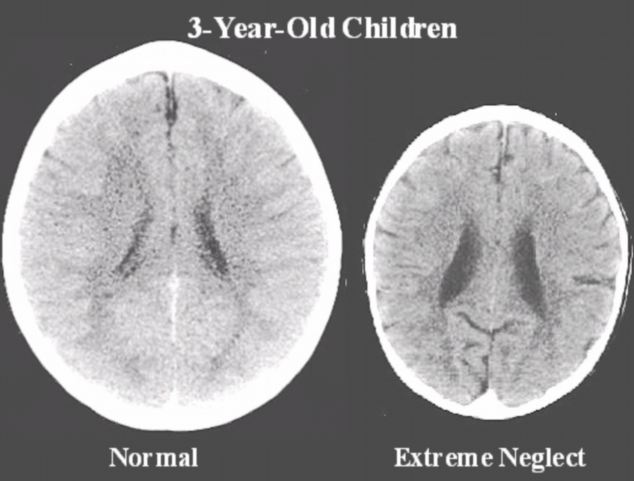
Here is the scan:

Brain scans of 3-year old children: normal vs neglected

Excerpt:

Both of these images are brain scans of a two three-year-old children, but the brain on the left is considerably larger, has fewer spots and less dark areas, compared to the one on the right.

According to neurologists this sizeable difference has one primary cause – the way each child was treated by their mothers.

The child with the larger and more fully developed brain was looked after by its mother – she was constantly responsive to her baby, reported The Sunday Telegraph.

But the child with the shrunken brain was the victim of severe neglect and abuse.

According to research reported by the newspaper, the brain on the right worryingly lacks some of the most fundamental areas present in the image on the left.

The consequences of these deficits are pronounced – the child on the left with the larger brain will be more intelligent and more likely to develop the social ability to empathise with others.

But in contrast, the child with the shrunken brain will be more likely to become addicted to drugs and involved in violent crimes, much more likely to be unemployed and to be dependent on state benefits.

The child is also more likely to develop mental and other serious health problems.

Professor Allan Schore, of UCLA, told The Sunday Telegraph that if a baby is not treated properly in the first two years of life, it can have a fundamental impact on development.

He pointed out that the genes for several aspects of brain function, including intelligence, cannot function.

[…]The study correlates with research released earlier this year that found that children who are given love and affection from their mothers early in life are smarter with a better ability to learn.

The study by child psychiatrists and neuroscientists at Washington University School of Medicine in St. Louis, found school-aged children whose mothers nurtured them early in life have brains with a larger hippocampus, a key structure important to learning, memory and response to stress.

The research was the first to show that changes in this critical region of children’s brain anatomy are linked to a mother’s nurturing, Neurosciencenews.com reports.

The research is published online in the Proceedings of the National Academy of Sciences Early Edition.

Lead author Joan L. Luby, MD, professor of child psychiatry, said the study reinforces how important nurturing parents are to a child’s development.

I have a very good feminist non-Christian friend who sometimes comments here. I once asked her about marriage and she said that her skills would be wasting on raising children. I explained to her my view that a mother needs to stay at home with the children, and that is more important work. I expect my future wife to read all kinds of books on child care and to give the child attention, nutrition, exercise and play so that the child will grow up to be an effective Christian. Maybe I need to be clear. I am not going to spend hundreds of thousands per child with just any woman. I need a woman who can produce influential and effective Christians who will engage in the public square. And we do not entrust that job to just anyone. Professional women who are willing to be stay-at-home moms in the first five years of each child’s life.

I expect the woman I marry (if I marry) to have a college degree, and preferably a graduate degree, and a couple of years of employment. Then she has to stay home and invest in those children through the first five years at least. After that she can stay home or work as much as she thinks is beneficial to the family goals of impacting the university, the church and the public square – as well as continuing to raise those children. It’s not a waste of her talent to make the next William Lane Craig, the next Marsha Blackburn, the next Doug Axe, or the next Edith Jones. Even if we only aim for those guys and get decent, hard-working Christians who make a difference using apologetics, that would still be something. The main thing is not to be scared to try to achieve something with the family – if you aim at nothing, you always hit it.

UPDATE: I am linking to a relevant post from Lindsay, a Christian mother who has a graduate degree in biology and was teaching biology before leaving her career to care for her children.