
Tag Archives: Marriage

Unmarried 35-year-old woman reflects on her adventurous life of fun, travel and serial cohabitation

Telling a woman how to make wise decisions protects her

I found an interesting article featuring a 35-year-old woman who is alarmed that her approach to life has left her in debt and single, with a gap-filled resume of short-term jobs. I thought it might be useful for young women to read this, and consider whether making “rash” decisions and being “adventurous” works out.

She writes:

I feel like a ghost. I’m a 35-year-old woman, and I have nothing to show for it. My 20s and early 30s have been a twisting crisscross of moves all over the West Coast, a couple of brief stints abroad, multiple jobs in a mediocre role with no real upward track. I was also the poster child for serial monogamy. My most hopeful and longest lasting relationship (three and a half years, whoopee) ended two years ago. We moved to a new town (my fourth new city), created a home together, and then nose-dived into a traumatic breakup that launched me to my fifth and current city and who-knows-what-number job.

Rash decisions, adventure, exploring…. and lots of debt:

For all these years of quick changes and rash decisions, which I once rationalized as adventurous, exploratory, and living an “original life,” I have nothing to show for it. I have no wealth, and I’m now saddled with enough debt from all of my moves, poor decisions, and lack of career drive that I may never be able to retire. I have no career milestones and don’t care for my line of work all that much anyway, but now it’s my lifeline, as I only have enough savings to buy a hotel room for two nights.

No STEM degree, which means she doesn’t like to study hard things that can be tested against the real world for correctness:

I used to consider myself creative — a good writer, poetic, passionate, curious. Now, after many years of demanding yet uninspiring jobs, multiple heartbreaks, move after move, financial woes, I’m quite frankly exhausted.

Surprised by aging and poor health:

Also, within the past year I’ve had a breast-cancer scare and required surgery on my uterus due to a fertility issue. On top of that, I’m 35 and every gyno and women’s-health website this side of the Mississippi is telling me my fertility is dropping faster than a piano falling out of the sky. Now I’m looking into freezing my eggs, adding to my never-ending financial burden, in hopes of possibly making something of this haunted house and having a family someday with a no-named man.

She’s still trying to be the sexpot 25-year-old she used to be:

I’m dating. I’m working out and working hard. Listening to music I enjoy and loving my cat. Calling my mom…. I’m drinking too much… And with men I date, I feel pressure to make something of the relationship too soon (move in, get married, “I have to have kids in a couple of years”; fun times!). All the while still trying to be the sexpot 25-year-old I thought I was until what seemed like a moment ago.

But her plan hasn’t worked out:

I used to think I was the one who had it all figured out. Adventurous life in the city! Traveling the world! Making memories! Now I feel incredibly hollow. And foolish. How can I make a future for myself that I can get excited about out of these wasted years?  What reserves or identity can I draw from when I feel like I’ve accrued nothing up to this point with my life choices?

Well, I’ve known women like this, and I think we’re going to see more and more women like this as the society becomes more secular and feminist. I want to say something about whether she is sincere about wanting to get married and have children, and what women should do to avoid ending up like her.

Do women today understand male nature and marriage?

This woman’s demonstrated life plan is that she chose whatever made her feel good from age 18-35+, and now wants to enter into a marriage some time after age 35. And what does marriage mean to her? Has she prioritized entering the traditional roles of wife and mother? Don’t listen to her words. Look at her actions. Her actions show that marriage and children were of NO importance to her. And her current approach to getting married and having kids is the same as ever – work out in order to look hot, and try to coerce a man who signs up for recreational sex with no commitment into becoming a man who makes a life-long commitment to provide for her and her children (which is the opposite of what he signed up for). She wants marriage now for the same reason that she’s wanted anything: for fun, thrills, adventure and to keep up with her girlfriends who are already married.

What kind of man should she have been pursuing from age 18 to 35, if she really wanted marriage and children? Well, the first thing to realize is that not all men want marriage. And the next thing to realize is that women who are serious about marriage need to focus ONLY on men who want to marry. All the men that the women quoted above wanted in her youth didn’t want to marry. They wanted premarital recreational sex with her, and that was fine with her – she chose them, and disregarded the men who were interested in marriage.

A man who was interested in marrying her would have:

  • ….told her no to sex before marriage (because the more sexual partners a woman has, the less happy she will be in marriage, and the more unstable her marriage will be).
  • …led her to become better at being a wife and mother, by discouraging her thrill-seeking, traveling and wasteful spending, and instead encouraging her focus on a STEM education, career and getting debt-free.
  • …led her to develop a Christian worldview in which she would understand the importance of marriage and children, and learn to sacrifice her own interests to love and care for others.

Was she interested in getting ready for marriage? No. She never chose those marriage-minded men. She didn’t want to be a wife. The men she chose were chosen for fun, for thrills, and to show off their outward appearance to her girlfriends.

So, who are the men in this group of marriage-minded men? How do you recognize them? Marriage-minded men are interested in marriage because they want to lead a home. They will have invested a lot of time learning how to protect others, how to provide, and how to debate and lead on moral and spiritual issues. Marriage-minded men see the marriage enterprise as a way of advancing the causes that they care about most. Women who really want to get married will recognize those men, and pursue those men. And they’ll do it early, so that they can invest in their husbands early and be young enough to have children.

My conversation about morality with an atheist millennial man

This is one of the memes from the Wintery Knight facebook page
Congratulations! Your view of what’s moral aligns exactly with your actions!

I spent some time talking to an atheist millennial recently. He considers himself a moral person, and he is very helpful to others. I asked him to define morality, and he said that morality was feeling good, and helping other people to feel good. I was trying to think of a way to punch a hole in his feelings-based utilitarianism. How could I show him that happy feelings are not a good basis for morality?

Now, you’re probably thinking that abortion is the most obvious example of something that is morally wrong – it’s just killing a baby because adults don’t want to take responsibility for their foolish pursuit of pleasure. But atheists typically don’t think of unborn children as people. They usually believe in naturalistic evolution, and they are committed to a view of reality where the universe is an accident, human beings are accidents, there are no objective human rights, and biological evolution progresses because the strong survive while the weak die. So you aren’t going to be able to generate a moral standard that includes compassion for weak unborn children on that scenario. If the rule is “let’s do what makes us happy”, and the unborn child can’t voice her opinion, then the selfish grown-ups win.

Instead, I decided to focus on fatherlessness. I asked him whether he thought that fatherlessness harmed children. Surprisingly, he said that it didn’t, and that he had a relative who was doing a great job raising fatherless kids. I asked him if he had ever looked at the research on what father absence does to children. He hadn’t. Then I asked him if a system of sexual rules based on “me feeling good, and other people around me feeling good”, was likely to protect children. He went silent.

Well, that was the end of that conversation. And I think it was a nice window into how millennials – who are absolutely clueless about what research says about sex, dating, marriage and parenting – think about relationships. They’re making decisions based on their feelings, then acting surprised when their “common sense” decisions based on happiness “in the moment” blow up in their faces, and destroy the lives of their children, including their unborn children.

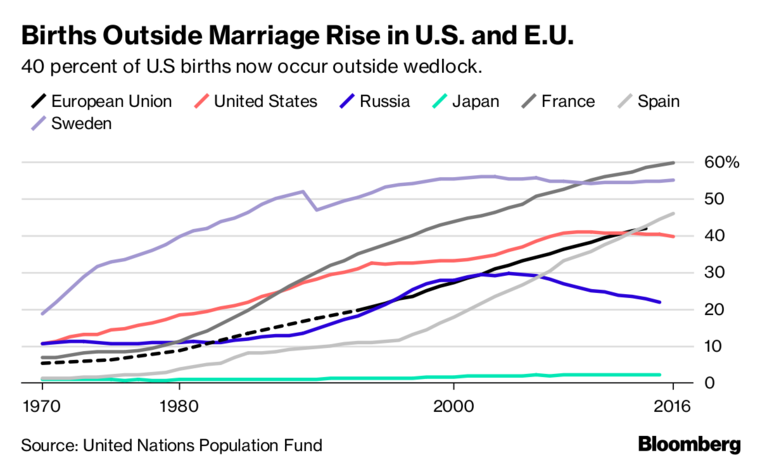
Unfortunately, young people are having children outside of a marriage commitment more and more.

Out-of-wedlocks births rising as cohabitation replaces marriage

Far-left Bloomberg News reports:

Forty percent of all births in the U.S. now occur outside of wedlock, up from 10 percent in 1970, according to an annual report released on Wednesday by the United Nations Population Fund (UNFPA), the largest international provider of sexual and reproductive health services. That number is even higher in the European Union.

The EU has a higher rate of fatherless births because they have high taxes and big government to allow women to have children without having to commit to a husband:

The EU likely sees more births out of wedlock because many member countries have welfare systems that support gender-balanced child care, said Michael Hermann, UNFPA’s senior adviser on economics and demography, in an interview. Public health care systems, paid paternal leave, early education programs and tax incentives give unwed parents support beyond what a partner can provide.

More welfare and more government services make it easier for women to pursue relationships with men who aren’t interested in marriage. Hot bad boys who give them all the tingles. Big government makes those boring, predictable marriage-ready men dispensable. Big government also makes it much harder for a man who does marry to afford a stay-at-home mother for his kids, because he has to pay higher taxes for big government.

More:

The data show such births in the U.S. and EU are predominantly to unmarried couples living together rather than to single mothers, the report says.

[…]Jones also noted that the rise in births outside of marriage is closely correlated to delays in childbearing. “Women are claiming their ground professionally,” she said. “Delaying motherhood is a rational decision when you consider the impact it can have on your career, and that’s contributing to this trend.”

[….]The traditional progression of Western life “has been reversed,” said John Santelli, a professor in population, family health and pediatrics at Columbia’s Mailman School of Public Health. “Cohabiting partners are having children before getting married. That’s a long-term trend across developing nations.”

Regardless of marital status, more couples are choosing not to have kids at all. The U.S. fertility rate hit a historic 30-year low last year, according to the Centers for Disease Control and Prevention. Hermann said the rise in births outside of wedlock has actually mitigated the decline in fertility, which “would be much steeper if women weren’t having children outside marriage.”

What’s interesting about this anti-marriage article is that they have nothing to say about the research showing that cohabitation – and also marriages that occur after a period of cohabitation – are inferior to no-cohabitation marriages. People who are serious about self-control, and who are serious about committing through thick and thin, tend to have longer lasting marriages. But we don’t prioritize chastity, fidelity and self-sacrificial commitment anymore, because that relationships that require self-denial make us unhappy.

The article concludes: “We can’t go back to the ’50s”. Right. Because if feelings-based “morality” is assumed, then any choice between adult happiness and children’s happiness will favor the adults. Today’s young people carefully AVOID any evidence that contradicts their new “happiness-morality”. They act surprised when their unstable relationships dissolve, leaving children separated from their fathers. Marriage requires that both partners have a system of morality that puts the commitment above happy feelings. People have to be accustomed to doing things that feel bad, just because they are good and moral things to do according to an objective standard of morality. The new atheist morality of happy feelings doesn’t develop the character needed for commitment.

If you ask an atheist millennial, they think they are doing a great job of being “moral”. They don’t see the messes they are making for children as something that they are causing themselves, with their own foolish feelings-based decision-making. They think they know everything about relationships through their feelings. They think that they are exempt from the patterns of cause and effect in the peer-reviewed research.

Are gay relationships more stable than straight ones?

Sherlock Holmes and John Watson are going to take a look at the data

Let’s look at this post from The Public Discourse and see if gay relationships are as stable, or even more stable, than straight ones.

Excerpt:

The [NFSS] study found that the children who were raised by a gay or lesbian parent as little as 15 years ago were usually conceived within a heterosexual marriage, which then underwent divorce or separation, leaving the child with a single parent. That parent then had at least one same-sex romantic relationship, sometimes outside of the child’s home, sometimes within it. To be more specific, among the respondents who said their mother had a same-sex romantic relationship, a minority, 23%, said they had spent at least three years living in the same household with both their mother and her romantic partner. Only 2 out of the 15,000 screened spent a span of 18 years with the same two mothers. Among those who said their father had had a same-sex relationship, 1.1% of children reported spending at least three years together with both men.

This strongly suggests that the parents’ same-sex relationships were often short-lived, a finding consistent with the broader research on elevated levels of instability among same-sex romantic partners. For example, a recent 2012 study of same-sex couples in Great Britain finds that gay and lesbian cohabiting couples are more likely to separate than heterosexual couples.[3] A 2006 study of same sex marriages in Norway and Sweden found that “divorce risk levels are considerably higher in same-sex marriages”[4] such that Swedish lesbian couples are more than three times as likely to divorce as heterosexual couples, and Swedish gay couples are 1.35 times more likely to divorce (net of controls). Timothy Biblarz and Judith Stacey, two of the most outspoken advocates for same-sex marriage in the U.S. academy, acknowledge that there is more instability among lesbian parents.[5]

This paper from the Family Research Council makes the same point:

The 2003-2004 Gay/Lesbian Consumer Online Census surveyed the lifestyles of 7,862 homosexuals. Of those involved in a “current relationship,” only 15 percent describe their current relationship as having lasted twelve years or longer, with five percent lasting more than twenty years.[4] While this “snapshot in time” is not an absolute predictor of the length of homosexual relationships, it does indicate that few homosexual relationships achieve the longevity common in marriages.

In The Sexual Organization of the City, University of Chicago sociologist Edward Laumann argues that “typical gay city inhabitants spend most of their adult lives in ‘transactional’ relationships, or short-term commitments of less than six months.”[5]

A study of homosexual men in the Netherlands published in the journal AIDS found that the “duration of steady partnerships” was 1.5 years.[6]

In his study of male homosexuality in Western Sexuality: Practice and Precept in Past and Present Times, Pollak found that “few homosexual relationships last longer than two years, with many men reporting hundreds of lifetime partners.”[7]

In Male and Female Homosexuality, Saghir and Robins found that the average male homosexual live-in relationship lasts between two and three years.[8]

It’s a Grindr lifestyle. And it’s not a good environment for meeting the needs of children. (Example)

There is one study (Rosenfeld, 2014) that tries to argue against the conclusion of all these other studies, and the problems with it are discussed in this post.

The right way to think about gay marriage is to think about it as an extension of no-fault divorce. The same feminists and leftists who pushed for the legalization of no-fault divorce told us back then that the children would be fine, that children are resilient. No-fault divorce was a change in the definition of marriage. The leftists said that divorce would never become widespread, and that it would not harm children in any way. It was all a pack of lies. If the practices of the gay lifestyle become conflated with marriage, then marriage will come to denote relationships engaged in for “love” not children, such that unchastity, infidelity, increased domestic violence and frequent break-ups are incorporated back into the definition of marriage. Marriage is about permanence, exclusivity and building an environment that can welcome children and supply for their needs. It’s not about government giving people respect for their romantic feelings. Those are volatile. What government ought to be rewarding is lifelong commitment.