Dina tweeted this UK Daily Mail article that made me think about how women vote.
Excerpt:
More than a third of working mothers would like to give up their jobs completely and stay at home with their children, a major Government survey has found.
It showed that millions of mothers of young children who go out to work do so only because they need to work to pay the bills.
The research for the Department for Education found that, far from being anxious to get out of their homes and into employment, the great majority of mothers are only reluctant workers.
Nearly six out of ten of all working mothers would cut down their hours to spend more time with their families if they could afford to, it said.
The yearning among mothers to leave their jobs and look after their children instead is even more pronounced among the highest achieving women, the survey indicated.
More than two-thirds of those in senior and middle management roles would spend fewer hours in the office and devote more time to their children if they had enough money, it said.
[…]Yesterday’s survey also undermines the claims that prejudice and discrimination against women in male-dominated companies is the reason why women are heavily outnumbered in the boardroom.
Rather, it suggests that many women who could get to the top in business choose instead to put their children before their careers.
The problem is that when government gives people free stuff, people who work have to work more to pay for it. And the strangest thing is that even though women seem to want to stay home with their kids (which is good), when it comes time to vote, they actually vote NOT to stay home with their kids. How? By growing the size of government, which results in higher taxes. To find out what women really think about staying home with their kids, we can look at how they vote.
Women voted 56-44 for more government spending in 2012
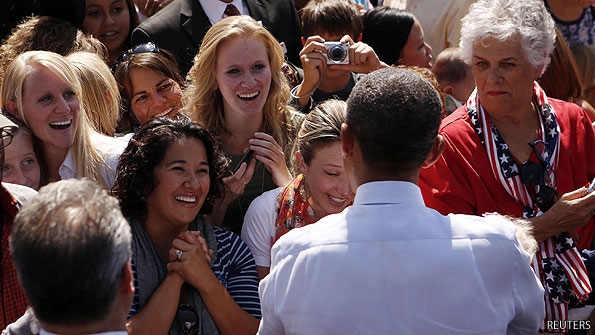
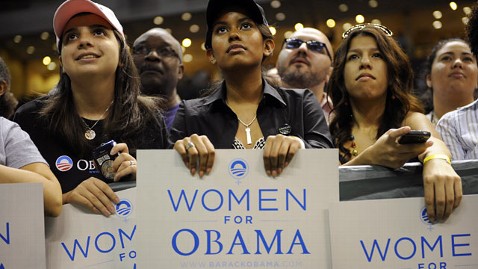
According to CNN’s exit polls, 55% of women and 45% of men voted for Obama and 44% of women and 52% of men voted for Romney. That level of female support for the president made an especially big impact in swing states like Ohio where the gender breakdown mirrored the national figures.
[…]There are some indications that social issues directly impacting women might have helped sway votes in some states.
Tuesday’s early exit polls showed 51% of Missouri voters said they believed abortion should be legal all or most of the time. Of those voters, exit polls showed 76% supported Democratic incumbent Claire McCaskill, who won Tuesday night, while 19% voted for Akin.
Forty-seven percent of Missouri’s voters said abortion should be illegal. Exit polls showed Akin netted 67% of this group’s votes while 27% of people who think abortion should be illegal supported McCaskill.
But much more than social issues, pocketbook economic issues most concerned women voters, exit polling showed.
“Women like all voters felt the economics were most important,” Swers said. “Women tend to be more supportive of government spending… than men are … so they were less responsive to Romney in that way and more responsive to Obama’s message on empathy and helping the middle class.”
Gallup reported that the gender gap in the 2012 election was actually 20 points. That was the largest ever measured in a Presidential election. The actual vote for Obama among women, according to Gallup, was 56-44.
Women are also more pro-abortion more than men
Here is a peer-reviewed research paper that shows the problem that we need to warn women about, so that they vote smarter.
The abstract reads:
This paper examines the growth of government during this century as a result of giving women the right to vote. Using cross‐sectional time‐series data for 1870–1940, we examine state government expenditures and revenue as well as voting by U.S. House and Senate state delegations and the passage of a wide range of different state laws. Suffrage coincided with immediate increases in state government expenditures and revenue and more liberal voting patterns for federal representatives, and these effects continued growing over time as more women took advantage of the franchise. Contrary to many recent suggestions, the gender gap is not something that has arisen since the 1970s, and it helps explain why American government started growing when it did.
When people vote for government to do more for everyone else, then men who work have to pay more in taxes.
Women vote for higher taxes, so they have to work more
If women want to stay home with their children more, then they need to vote for their husbands (present or future) to pay less in taxes when they work. That means voting for smaller government, more liberty and more personal responsibility. Until women get to the point of connecting their future plans (marriage and parenting) for their lives with their current voting, this situation is not going to change. Marriages run on money. It’s no good to urge men to “man-up” and then take away their ability to provide by taxing more of their earnings to pay for Sandra Fluke’s birth control pills and abortions. Keep the money in the family, and then you can stay home with the kids more.
One of the most troubling things I see in the modern church is the tendency of church people and pastors to blame men for not being more aggressive about marrying. Often, the blame is placed on men. Men are told that we need to do better in school, work harder at work, and that we need to be more aggressive about courting and marrying. Very often, you hear the slogan “man up” directed at men, and we are told to stop playing video games and looking at porn and grow up.
The first thing to note is that marriage is much less attractive to men these days. First, the value proposition of marriage changed – especially the problem of no-fault divorce and divorce courts. The economic situation facing men has changed as well – the economy is poor, but the debt is very very high. Those are two important factors.
Another problem is fatherlessness, which is caused by welfare incentives. A lot of the behavior of young men is based on whether there is a father present in the home. The fact of the matter is that single motherhood by choice has become commonplace, and the aggravating factor for this trend is support for welfare. Welfare is bad for two reasons. First, it encourages women to raise children without a father. Boys raised without a father are not as likely to pursue courtship and marriage as boys raised with a father, because fatherlessness harms a boy’s ability to learn to do the things needed for marriage.
Another problem is the availability of pre-marital sex. When a man can get sex without marriage, then he doesn’t feel the same desire to get married.
So there are a few examples of things that we can change to nudge men toward marriage. Just speaking slogans like “man up” to men doesn’t really address these problems.
But in this post, I want to look at a problem that I haven’t even mentioned yet – the problem of schools that don’t produce men who can provide for a family.
Women in the United States now earn 62 percent of associate’s degrees, 57 percent of bachelor’s degrees, 60 percent of master’s degrees, and 52 percent of doctorates.
[…]Boys in all ethnic groups and social classes are far less likely than their sisters to feel connected to school, to earn good grades, or to have high academic aspirations. A recent working paper from the National Bureau of Economic Research documents a remarkable trend among high-achieving students: In the 1980s, nearly the same number of top male and female high school students said they planned to pursue a postgraduate degree (13 percent of boys and 15 percent of girls). By the 2000s, 27 percent of girls expressed that ambition, compared with 16 percent of boys. During the same period, the gap between girls and boys earning mostly A’s nearly doubled—from three to five percentage points.
I was a minority boy before I became a minority man – look at this:
This gap in education engagement has dire economic consequences for boys. A 2011 Brookings Institution report quantifies the economic decline of the median male: For men ages 25 to 64 with no high school diploma, median annual earnings have declined 66 percent since 1969; for men with only a high school diploma, wages declined by 47 percent. Millions of male workers, say the Brookings authors, have been “unhitched from the engine of growth.” The College Board delivered this disturbing message in a 2011 report about Hispanic and African-American boys and young adults: “Nearly half of young men of color age 15 to 24 who graduate from high school will end up unemployed, incarcerated or dead.” Working-class white boys are faring only slightly better. When economist Andrew Sum and his colleagues at the Center for Labor Market Studies at Northeastern University examined gender disparities in the Boston Public Schools, they found that for the class of 2007, among blacks and Hispanics, there were 186 females for every 100 males attending a four-year college or university. For white students: 153 females to every 100 males.
Is this a U.S. – only problem? No. The problem exists in many places. But Dr. Sommers lists some of the initiatives those other countries are taking – trying to understand why boys are different and what needs to be done differently in order to get them to engage and succeed. But we are not doing anything here. Why not?
Well, first – let’s see what works:
In a rare example of the academic establishment taking note of boys’ trouble in school, the Harvard Graduate School of Education recently published a major study, Pathways to Prosperity, that highlights the “yawning gender gap” in education favoring women: “Our system… clearly does not work well for many, especially young men.” The authors call for a national revival of vocational education in secondary schools. They cite several existing programs that could serve as a model for national reform, including the Massachusetts system, sometimes called the “Cadillac of Career Training Education.”
Massachusetts has a network of 26 academically rigorous vocational-technical high schools serving 27,000 male and female students. Students in magnet schools such as Worcester Technical, Madison Park Technical Vocational, and Blackstone Valley Regional Vocational Technical take traditional academic courses but spend half their time apprenticing in a field of their choice. These include computer repair, telecommunications networking, carpentry, early childhood education, plumbing, heating, refrigeration, and cosmetology. AsPathways reports, these schools have some of the state’s highest graduation and college matriculation rates, and close to 96 percent pass the states’ rigorous high-stakes graduation test.
Blackstone Valley Tech in Upton, Massachusetts, should be studied by anyone looking for solutions to the boy problem. It is working wonders with girls (who comprise 44 percent of the student body), but its success with boys is astonishing. According to a white paper on vocational education by the Commonwealth’s Pioneer Institute, “One in four Valley Technical students enter their freshman year with a fourth-grade reading level.” The school immerses these students in an intense, individualized remediation program until they read proficiently at grade level. These potentially disaffected students put up with remediation as well as a full load of college preparatory courses (including honors and Advanced Placement classes), because otherwise they could not spend half the semester apprenticing in diesel mechanics, computer repair, or automotive engineering.
In former times, vocational high schools were often dumping grounds for low achievers. Today, in Massachusetts, they are launching pads into the middle class.
Who could possibly be opposed to turning boys into marriage-minded men? Look:
Recent research shows that enrollment in high school vocational programs has dramatic effects on students’ likelihood of graduating from high school—especially boys. But efforts to engage more boys in career and technical programs face a formidable challenge. In a series of scathing reports, the National Council on Women and Girls Education (NCWGE—a 38-year-old consortium that today includes heavy hitters such the AAUW, the National Women’s Law Center, the ACLU, NOW, the Ms. Foundation, and the National Education Association) has condemned high school vocational training schools as hotbeds of “sex segregation.”
Because of decades of successful lobbying by NCWGE groups, high school and college career and technical training programs face government sanctions and loss of funds if they fail to recruit and graduate sufficient numbers of female students into “non-traditional” fields. Over the years, untold millions of state and federal dollars have been devoted to recruiting and retaining young women into fields like pipefitting, automotive repair, construction, drywall installing, manufacturing, and refrigeration mechanics. But according to Statchat, a University of Virginia workforce blog, these efforts at vocational equity “haven’t had much of an impact.” Despite an unfathomable number of girl-focused programs and interventions, “technical and manual occupations tend to be dominated by men, patterns that have held steady for many years.”
In March 2013 NCWGE released a report urging the need to fight even harder against “barriers girls and women face in entering nontraditional fields.” Among its nine key recommendations to Congress: more federal funding and challenge grants to help states close the gender gaps in career and technical education (CTE); mandate every state to install a CTE gender equity coordinator; and impose harsher punishments on states that fail to meet “performance measures” –i.e. gender quotas.
Instead of spending millions of dollars attempting to transform aspiring cosmetologists into welders, education officials should concentrate on helping young people, male and female, enter careers that interest them. And right now, boys are the underserved population requiring attention.
So. We know what works to make boys into marriage-ready men. And now we know who is standing in the way. What I’d like to see from the man-up crowd, especially the man-up crowd in the church, is a serious assessment of the research on this issue and some action.
But this is what we get from Mark Driscoll: (whom I almost always agree with)
The number one consumer of online pornography is 12- to 17-year-old boys. What that means is he’s home eating junk food, drinking Monster energy drinks, downloading porn, masturbating and screwing around with his friends. That really doesn’t prepare you for responsible adulthood. That’s a really sad picture, especially if you’re a single gal hoping to get married someday. You’re like: “Seriously, that’s the candidate pool? You’ve got to be kidding me.” That’s why 41 percent of births right now are to unmarried women. A lot of women have decided: “I’m never going to find a guy who is actually dependable and responsible to have a life with. So I’ll just get a career and have a baby and just intentionally be a single mother because there are no guys worth spending life with.”
We really need better leadership – informed leadership – on these issues from prominent pastors. They need to start to read some research (e.g. – what Dr. Sommers presented) on these issues. Maybe pastors need to affirm the traditional view of the Bible on sexual morality, and then take on the root cause of the disengaged boys problem: feminism in the schools. We don’t want to take on these problems in a superficial way and then actually make the problem worse by making excuses for views of sexuality that are unBiblical.
By the way, you should subscribe to the AEI podcast, which is on my list of favorite podcasts. And Dr. Sommers has a new edition of her classic book defending young men. If you have ever wondered what is going wrong with men, that book is required reading. It is required reading for anyone who wants to comment on this issue, in fact.
Weakening marital norms and severing the connection of marriage with responsible procreation are the admitted goals of many prominent advocates of redefining marriage. E. J. Graff celebrates the fact that redefining marriage would change the “institution’s message” so that it would “ever after stand for sexual choice, for cutting the link between sex and diapers.” Enacting same-sex marriage, she argues, “does more than just fit; it announces that marriage has changed shape.”[3]
Andrew Sullivan says that marriage has become “primarily a way in which two adults affirm their emotional commitment to one another.”[4]
The Norm of Monogamy. New York University Professor Judith Stacey has expressed hope that redefining marriage would give marriage “varied, creative and adaptive contours,” leading some to “question the dyadic limitations of Western marriage and seek…small group marriages.”[5] In their statement “Beyond Same-Sex Marriage,” more than 300 “LGBT and allied” scholars and advocates call for legal recognition of sexual relationships involving more than two partners.[6]
University of Calgary Professor Elizabeth Brake thinks that justice requires using legal recognition to “denormalize[] heterosexual monogamy as a way of life” and “rectif[y] past discrimination against homosexuals, bisexuals, polygamists, and care networks.” She supports “minimal marriage” in which “individuals can have legal marital relationships with more than one person, reciprocally or asymmetrically, themselves determining the sex and number of parties, the type of relationship involved, and which rights and responsibilities to exchange with each.”[7]
In 2009, Newsweek reported that the United States already had over 500,000 polyamorous households.[8] The author concluded:
[P]erhaps the practice is more natural than we think: a response to the challenges of monogamous relationships, whose shortcomings…are clear.… [C]an one person really satisfy every need? Polyamorists think the answer is obvious—and that it’s only a matter of time before the monogamous world sees there’s more than one way to live and love.[9]
A 2012 article in New York Magazine introduced Americans to “throuple,” a new term akin to a “couple,” but with three people whose “throuplehood is more or less a permanent domestic arrangement. The three men work together, raise dogs together, sleep together, miss one another…and, in general, exemplify a modern, adult relationship. Except that there are three of them.”[10]
The Norm of Exclusivity. Andrew Sullivan, who has extolled the “spirituality” of “anonymous sex,” also thinks that the “openness” of same-sex unions could enhance the bonds of husbands and wives:
[A]mong gay male relationships, the openness of the contract makes it more likely to survive than many heterosexual bonds.… [T]here is more likely to be greater understanding of the need for extramarital outlets between two men than between a man and a woman.… [S]omething of the gay relationship’s necessary honesty, its flexibility, and its equality could undoubtedly help strengthen and inform many heterosexual bonds.[11]
“Openness” and “flexibility” are Sullivan’s euphemisms for sexual infidelity. Similarly, in a New York Times Magazine profile, gay activist Dan Savage encourages spouses to adopt “a more flexible attitude” about allowing each other to seek sex outside their marriage.[12] TheNew York Times recently reported on a study finding that exclusivity was not the norm among gay partners: “‘With straight people, it’s called affairs or cheating,’ said Colleen Hoff, the study’s principal investigator, ‘but with gay people it does not have such negative connotations.’”[13]
Leading Advocates of Redefining Marriage Celebrate That It Will Weaken Marriage
Some advocates of redefining marriage embrace the goal of weakening the institution of marriage in these very terms. “[Former President George W.] Bush is correct,” says Victoria Brownworth, “when he states that allowing same-sex couples to marry will weaken the institution of marriage…. It most certainly will do so, and that will make marriage a far better concept than it previously has been.”[14]Professor Ellen Willis celebrates the fact that “conferring the legitimacy of marriage on homosexual relations will introduce an implicit revolt against the institution into its very heart.”[15]
Michelangelo Signorile urges same-sex couples to “demand the right to marry not as a way of adhering to society’s moral codes but rather to debunk a myth and radically alter an archaic institution.”[16]Same-sex couples should, he says, “fight for same-sex marriage and its benefits and then, once granted, redefine the institution of marriage completely, because the most subversive action lesbians and gay men can undertake…is to transform the notion of ‘family’ entirely.”[17]
It is no surprise that there is already evidence of this occurring. A federal judge in Utah allowed a legal challenge to anti-bigamy laws.[18] A bill that would allow a child to have three legal parents passed both houses of the California state legislature in 2012 before it was vetoed by the governor, who claimed he wanted “to take more time to consider all of the implications of this change.”[19]
It’s very important to understand that the typical gay relationship between males is not going to conform to the lifelong, exclusive commitment that heterosexual marriage involves. You can read about the numbers right here on this paper from the Family Research Council, which collects together evidence from secular sources, such as the U.S. Census and peer-reviewed research.
Take a look:
Research indicates that the average male homosexual has hundreds of sex partners in his lifetime:
· The Dutch study of partnered homosexuals, which was published in the journal AIDS, found that men with a steady partner had an average of eight sexual partners per year.[12]
· Bell and Weinberg, in their classic study of male and female homosexuality, found that 43 percent of white male homosexuals had sex with 500 or more partners, with 28 percent having one thousand or more sex partners.[13]
· In their study of the sexual profiles of 2,583 older homosexuals published in the Journal of Sex Research, Paul Van de Ven et al. found that “the modal range for number of sexual partners ever [of homosexuals] was 101-500.” In addition, 10.2 percent to 15.7 percent had between 501 and 1,000 partners. A further 10.2 percent to 15.7 percent reported having had more than one thousand lifetime sexual partners.[14]
· A survey conducted by the homosexual magazine Genre found that 24 percent of the respondents said they had had more than one hundred sexual partners in their lifetime. The magazine noted that several respondents suggested including a category of those who had more than one thousand sexual partners.[15]
[…]Even in those homosexual relationships in which the partners consider themselves to be in a committed relationship, the meaning of “committed” or “monogamous” typically means something radically different than in heterosexual marriage.
· A Canadian study of homosexual men who had been in committed relationships lasting longer than one year found that only 25 percent of those interviewed reported being monogamous.” According to study author Barry Adam, “Gay culture allows men to explore different…forms of relationships besides the monogamy coveted by heterosexuals.”[16]
· The Handbook of Family Diversity reported a study in which “many self-described ‘monogamous’ couples reported an average of three to five partners in the past year. Blasband and Peplau (1985) observed a similar pattern.”[17]
· In The Male Couple, authors David P. McWhirter and Andrew M. Mattison reported that, in a study of 156 males in homosexual relationships lasting from one to thirty-seven years:
Only seven couples have a totally exclusive sexual relationship, and these men all have been together for less than five years. Stated another way, all couples with a relationship lasting more than five years have incorporated some provision for outside sexual activity in their relationships.[18]
Are we ready to call that marriage? Isn’t it bad enough that we already have undermined the permanence and stability of marriage with no-fault divorce laws and giving benefits to common-law couples? Don’t you think that these factors will undermine stability, the same way that infidelity undermines heterosexual relationships?
But marriage is a particular thing. It’s permanent. It’s exclusive. It’s not based on feelings and desires. The purpose of marriage is to recognize and encourage people to constrain and bound their sexual activity for the benefit of society. We want to encourage parents to bond together permanently and exclusively, so that the bond is stable. We should be encouraging people to be chaste before marriage, to make good decisions about who to marry, to reward marriages that last, and to make it harder to get out of a marriage. Especially one with children.



 WINTERY KNIGHT