Tag Archives: Christina Hoff Sommers

Women earned more doctoral and Master’s degrees than men in 2012

Women now earning majority of graduate degrees

From the American Enterprise Institute Ideas blog.

Excerpt:

The Council of Graduate Schools (CGS) released its annual report recently on U.S. graduate school enrollment and degrees for 2012, and here are some of the more interesting findings in this year’s report:

1. For the fourth year in a row, women in 2012 earned a majority of doctoral degrees. Of the 67,220 doctoral degrees awarded in 2012 at U.S. universities, women earned 34,761 of those degrees and 52.2% of the total, compared to 31,830 degrees awarded to men who earned 47.8% of the total (see top chart above).

[…]2. By field of study, women earning doctoral degrees in 2012 outnumbered men in 7 of the 11 graduate fields tracked by the CGS (see top chart above)

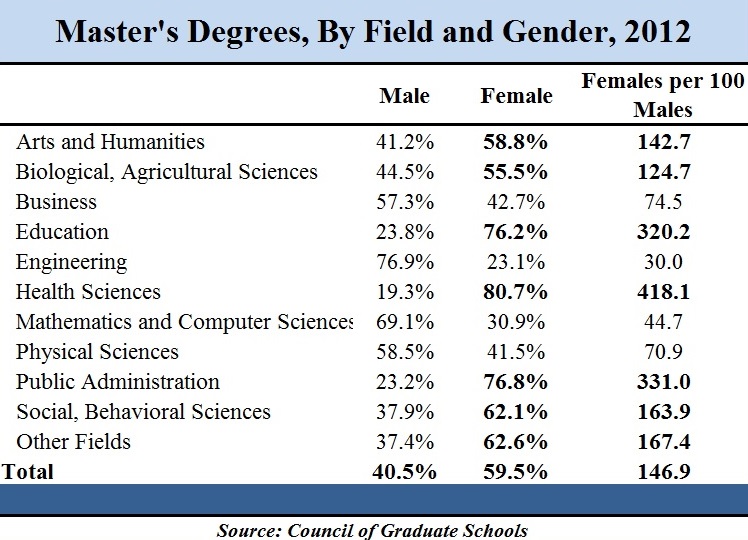
[…]3. The middle chart above shows the gender breakdown for master’s degrees awarded in 2012, and the gender disparity in favor of females is significant – women earned just under 60% of all master’s degrees in 2012, which would also mean that women earned 146.9 master’s degrees last year for every 100 degrees earned by men.

[…]Women represent 58.5% of all graduate students in the U.S., meaning that there are now 141 women enrolled in graduate school for every 100 men.

Click here for the charts.

The author of the post, Dr. Mark Perry, concludes this:

MP: Here’s my prediction – the facts that: a) men are underrepresented in graduate school enrollment overall (100 men were enrolled in 2012 for every 141 women), b) men received fewer master’s (40.5% of the total) and doctoral degrees (47.8% of the total) than women in 2012, and c) men were underrepresented in 7 out of 11 graduate fields of study at both the master’s and doctoral levels last year will get no attention at all from the media, universities and anybody in the higher education industry.

Additionally, there will be no calls for government studies, or increased government funding to address the significant gender disparities in graduate schools, and nobody will refer to the gender graduate school enrollment and degree gaps favoring women as a problem or a “crisis.”  Further, neither President Obama nor Congress will address the gender graduate enrollment and degree gaps by invoking the Title IX gender-equity law, like they have threatened to do for the gender gap in some college math and science programs. And there won’t be any executive orders to address the huge gender disparity in graduate schools by creating a White House Council on Boys and Men like the executive order issued by President Obama in 2009 to create the “White House Council on Women and Girls.”  Finally, despite their stated commitment to “gender equity,” the hundreds of university women’s centers around the country are unlikely to show any concern about the significant gender inequities in graduate school enrollment and degrees, and universities will not be allocating funding to set up men’s centers or create graduate scholarships for men.

Bottom Line: If there is any attention about gender differences in the CGS annual report, it will likely be about the fact that women are a minority in 4 of the 11 fields of graduate study including engineering and computer science (a gender gap which some consider to be a “national crisis”), with calls for greater awareness of female under-representation in STEM graduate fields of study and careers (except for the STEM field of biology, where women areover-represented).  But don’t expect any concern about the fact that men have increasingly become the second sex in higher education.  The concern about gender imbalances will remain extremely selective, and will only focus on cases when women, not men, are underrepresented and in the minority.

Men outnumber women in business, computer science, engineering and physical sciences.

I echo Dr. Perry’s point, and want to add this. In traditional Christianity, men are responsible for providing for their families. One of the ways that we men prepare for this is by getting advanced degrees in STEM-related fields, since these fields are the hardest and also pay the best. So with that in mind, what does it mean for men who want to prepare for this provider role that there is this obvious discrimination against men in graduate schools and doctoral programs? Is anyone going to do anything to change policies and incentives to favor men, like they did when women were under-represented? Of course not. The only thing that will be done is to ignorantly urge men to “man up”, while ignoring the real problems, e.g. – a lack of male teachers, schools that are not geared to male learning styles, and so on.

Related posts

Christina Hoff Sommers: school has become hostile to boys

Christina Hoff Sommers

In the leftist Time magazine, of all places.

Excerpt:

As school begins in the coming weeks, parents of boys should ask themselves a question: Is my son really welcome? A flurry of incidents last spring suggests that the answer is no. In May, Christopher Marshall, age 7, was suspended from his Virginia school for picking up a pencil and using it to “shoot” a “bad guy” — his friend, who was also suspended. A few months earlier, Josh Welch, also 7, was sent home from his Maryland school for nibbling off the corners of a strawberry Pop-Tart to shape it into a gun. At about the same time, Colorado’s Alex Evans, age 7, was suspended for throwing an imaginary hand grenade at “bad guys” in order to “save the world.”

In all these cases, school officials found the children to be in violation of the school’s zero-tolerance policies for firearms, which is clearly a ludicrous application of the rule. But common sense isn’t the only thing at stake here. In the name of zero tolerance, our schools are becoming hostile environments for young boys.

[…]Boys are nearly five times more likely to be expelled from preschool than girls. In grades K-12, boys account for nearly 70% of suspensions, often for minor acts of insubordination and defiance. In the cases of Christopher, Josh and Alex, there was no insubordination or defiance whatsoever. They were guilty of nothing more than being typical 7-year-old boys. But in today’s school environment, that can be a punishable offense.

[…][M]illions of boys are struggling academically. A large and growing male cohort is falling behind in grades and disengaged from school. College has never been more important to a young person’s life prospects, and today boys are far less likely than girls to pursue education beyond high school. As our schools become more risk averse, the gender gap favoring girls is threatening to become a chasm.

[…]Across the country, schools are policing and punishing the distinctive, assertive sociability of boys. Many much-loved games have vanished from school playgrounds. At some schools, tug of war has been replaced with “tug of peace.” Since the 1990s, elimination games like dodgeball, red rover and tag have been under a cloud — too damaging to self-esteem and too violent, say certain experts. Young boys, with few exceptions, love action narratives. These usually involve heroes, bad guys, rescues and shoot-ups. As boys’ play proceeds, plots become more elaborate and the boys more transfixed. When researchers ask boys why they do it, the standard reply is, “Because it’s fun.”

According to at least one study, such play rarely escalates into real aggression — only about 1% of the time. But when two researchers, Mary Ellin Logue and Hattie Harvey, surveyed classroom practices of 98 teachers of 4-year-olds, they found that this style of play was the least tolerated. Nearly half of teachers stopped or redirected boys’ dramatic play daily or several times a week — whereas less than a third reported stopping or redirecting girls’ dramatic play weekly.

Play is a critical basis for learning. And boys’ heroic play is no exception. Logue and Harvey found that “bad guy” play improved children’s conversation and imaginative writing. Such play, say the authors, also builds moral imagination, social competence and imparts critical lessons about personal limits and self-restraint. Logue and Harvey worry that the growing intolerance for boys’ action-narrativeplay choices may be undermining their early language development and weakening their attachment to school. Imagine the harm done to boys like Christopher, Josh and Alex who are not merely discouraged from their choice of play, but are punished, publicly shamed and ostracized.

So what’s the problem? Well, here’s some data to help us fix the problem.

Excerpt:

A lack of male role models at home and school is turning boys off reading at a young age as they increasingly reject books as “feminine”, it is claimed.

Large numbers of boys are failing to develop a love of reading during primary education because of a shortage of male teachers combined with an anti-book culture among many fathers, an inquiry has found.

Gavin Barwell, chairman of the All-Party Parliamentary Group on Literacy, said reading was not seen as a “masculine thing” by boys – leaving them lagging behind girls from the age of four onwards.

In many cases, schools failed to equip them with a selection of adventure and action novels by authors such as Enid Blyton, Roald Dahl and J.R.R Tolkien that are significantly more likely to appeal to boys at a young age, he suggested.

It is claimed that a failure to read properly as an infant has a serious impact on standards across the curriculum, with children struggling to grasp the basics in all other major academic subjects.

According to Government figures, boys are less likely to read basic words or recite the alphabet by the age of five and the gap widens throughout compulsory education.

By the age of 16, fewer than 59 per cent of boys gained a good GCSE in English last year compared with 72.5 per cent of girls.

[…]On Monday, the cross-party committee of MPs and peers – along with the National Literacy Trust – will publish the findings of a six-month inquiry into reading failure among boys.

It is expected to make a series of sweeping recommendations designed to get boys interested in books at home and school, including more gender-specific books and the introduction of reading mentors.

Speaking before the launch, Mr Barwell, the Conservative MP for Croydon Central, said boys were currently held back because of a “number of gender stereotypes which seem to kick in early”.

“Dads are much less likely to read with their sons and they are also much less likely than mum to be seen reading themselves, so from a very young age boys will clearly pick up in a home environment that reading is not a masculine thing,” he said.

He added: “The primary school workforce is also very feminised and it is now rare to have more than one male teacher.

“I have boys of my own and when I want to recommend books for them I think of what I read when I was their age; The Hobbit, The Famous Five books or something by Roald Dahl.

“It may well be that schools – with the workforce being all female – are going to struggle to pick up on the stuff that appeals to boys because they’ve not read it themselves.”

The report is likely to conclude that boys are struggling to read in the majority of schools and most have no plan in place to tackle the gender gap.

You can read about a couple more studies here that also argue that the problem is a lack of male teachers in the classroom. The Canadians are already looking into how to solve the problem. But that isn’t likely to happen here. I also wrote previously about a study showing that female teachers were grading boys more harshly than girls.

So boys aren’t reading as well as girls are. You can’t do well in school if you can’t read. But boys have no interest in reading girly nonsense books. Boys like war, monsters and adventures. But girly nonsense is what female teachers and female administrators and female education bureaucrats pick as classroom texts. So the boys are stuck reading boring books. The only way out of this mess for boys is homeschooling or private schools, which are hard to do since their parents are already paying for these useless, underperforming public schools. And the educational bureaucracy resist any attempts to give parents more choice. Their goal is to maintain their inflated salaries and job security, not to educate boys.

So we need more male teachers in the classroom – why don’t we have them? There are many reasons why men are discouraged from becoming teachers. Discrimination, unionization, political correctness, being forced to teach left-wing propaganda to children, etc. Don’t look for the performance of boys to improve any time soon unless we get serious at changing education policy to attract more men. Of course, the people in charge have a vested interest in preventing that. They’ll just keep blaming boys for underperforming and refuse to solve the real problem.

New study finds that female teachers give male students lower marks

From the liberal UK Independent.

Excerpt:

A key reason why boys lag behind in the classroom is revealed for the first time today – female teachers.

Ground-breaking research shows that boys lower their sights if they think their work is going to be marked by a woman because they believe their results will be worse.

It also shows their suspicions are correct – female teachers did, on average, award lower marks to boys than unidentified external examiners. Male teachers, by contrast, awarded them higher marks than external examiners.

The findings, published by the Centre for Economic Performance today, could have immense repercussions for boys because of the dearth of male teachers in the profession. Only 15 per cent of primary school staff are men.

The findings were yesterday described as “fascinating” by one of the country’s leading academic researchers, Professor Alan Smithers, of the Centre for Education and Employment at the University of Buckingham.

He said the research, carried out among 1,200 children in 29 schools across the country, had shown a possible reason for the glaring gap in performance between girls and boys right through schooling.

I wonder if feminism and misandry (antagonism towards men) has anything to do with the results of this study?

Where are the male teachers?

Another contributing  factor causing men to underperform in school is that there are almost no male teachers and also that boys don’t learn well in co-ed classrooms – they get distracted by girls. The curriculum is not suitable for boys, who learn better with different materials that focus more on things that boys like, like wars, guns and adventures. Boys learn better with male teachers and all-male classrooms because they need male role models in order to succeed.

Consider this article on male/female teachers.

Excerpt:

The organization MenTeach, a Minnesota organization dedicated to increasing the number of males working with young children, posted a survey on its Web site showing that males constitute less than 20 percent of America’s 2.9 million elementary and middle school teachers. The 2008 survey, based on source data from the Bureau of Labor Statistics, showed even more drastic differences among different grade levels:

  • 44 percent of America’s 1.2 million secondary school teachers.
  • 18.8 percent of America’s 2.9 million elementary and middle school teachers.
  • 2.4 percent of America’s 685,000 pre-kindergarten and kindergarten teachers.

No wonder women are earning 60% of college undergraduate degrees and men are struggling to find jobs.  Most women want men to be strong husbands and fathers, so they’ll need to make sure that men have jobs. In order for men to have jobs, they’ll want to oppose feminists who discriminate against men in the education system.

The War Against Boys

An excellent book on this topic is Christina Hoff Sommers’ “The War Against Boys“. You can read a summary of her argument here.

Excerpt: (links removed)

By the late 1990s the myth of the downtrodden girl was showing some signs of unraveling, and concern over boys was growing. In 1997 the Public Education Network (PEN) announced at its annual conference the results of a new teacher-student survey titled The American Teacher 1997: Examining Gender Issues in Public Schools. The survey was funded by the Metropolitan Life Insurance Company and conducted by Louis Harris and Associates.

During a three-month period in 1997 various questions about gender equity were asked of 1,306 students and 1,035 teachers in grades seven through twelve. The MetLife study had no doctrinal ax to grind. What it found contradicted most of the findings of the AAUW, the Sadkers, and the Wellesley College Center for Research on Women: “Contrary to the commonly held view that boys are at an advantage over girls in school, girls appear to have an advantage over boys in terms of their future plans, teachers’ expectations, everyday experiences at school and interactions in the classroom.”

Some other conclusions from the MetLife study: Girls are more likely than boys to see themselves as college-bound and more likely to want a good education. Furthermore, more boys (31 percent) than girls (19 percent) feel that teachers do not listen to what they have to say.

At the PEN conference, Nancy Leffert, a child psychologist then at the Search Institute, in Minneapolis, reported the results of a survey that she and colleagues had recently completed of more than 99,000 children in grades six through twelve. The children were asked about what the researchers call “developmental assets.” The Search Institute has identified forty critical assets—”building blocks for healthy development.” Half of these are external, such as a supportive family and adult role models, and half are internal, such as motivation to achieve, a sense of purpose in life, and interpersonal confidence. Leffert explained, somewhat apologetically, that girls were ahead of boys with respect to thirty-seven out of forty assets. By almost every significant measure of well-being girls had the better of boys: they felt closer to their families; they had higher aspirations, stronger connections to school, and even superior assertiveness skills. Leffert concluded her talk by saying that in the past she had referred to girls as fragile or vulnerable, but that the survey “tells me that girls have very powerful assets.”

The Horatio Alger Association, a fifty-year-old organization devoted to promoting and affirming individual initiative and “the American dream,” releases annual back-to-school surveys. Its survey for 1998 contrasted two groups of students: the “highly successful” (approximately 18 percent of American students) and the “disillusioned” (approximately 15 percent). The successful students work hard, choose challenging classes, make schoolwork a top priority, get good grades, participate in extracurricular activities, and feel that teachers and administrators care about them and listen to them. According to the association, the successful group in the 1998 survey is 63 percent female and 37 percent male. The disillusioned students are pessimistic about their future, get low grades, and have little contact with teachers. The disillusioned group could accurately be characterized as demoralized. According to the Alger Association, “Nearly seven out of ten are male.”

That was all written in 2000 – the problem is much worse now.

Sommers’ book is must reading for any parent of a boy. It would also be a good book for pastors to read, so that they have an accurate understanding of the problems facing men, and can mentor them so that they can succeed.