Tag Archives: Business

Kevin DeYoung’s article opposing gay marriage has broad appeal

Marriage and family
Marriage and family

In my own secular case against gay marriage from last year, I argued for 3 points:

  • same-sex marriage is bad for liberty, especially religious liberty
  • same-sex marriage is bad for children
  • same-sex marriage is bad for public health

My hope when I wrote that was that pastors and other Christian leaders would learn to argue for what the Bible says by using evidence from outside the Bible, so that they would be able to appeal to more people instead of only appealing to the minority of people who accept the Bible. I think that Christians who argue for their views by citing the Bible only will only be convincing to people who already accept the Bible. But there is not a majority of people who do accept the Bible as an authority, so I think that pastors have to make another plan. They need to argue using the Bible to those who accept the Bible, and without the Bible to those who don’t accept it.

Now with that said, take a look at this article by pastor Kevin DeYoung that Dina sent me. It’s from earlier this week. The article makes the same exact three points as I made in my article last year. Let’s take a look at how Kevin does that.

My first point was liberty, especially religious liberty. He writes:

[I]n the long run, the triumph of gay marriage (should it triumph as a cultural and legal reality) will mean the restriction of freedoms for millions of Americans.

This will happen in obvious ways at first–by ostracizing those who disagree, by bullying with political correctness, and by trampling on religious liberty. Surely, Christians must realize that no matter how many caveats we issue, not matter how much we nuance our stance, no matter how much we encourage or show compassion for homosexuals, it will not be enough to ward off the charges of hatred and homophobia.

[G]ay marriage will challenge our freedoms in others way too. It’s not just Evangelicals, traditional Catholics, and Mormons who will be threatened. Once the government gains new powers, it rarely relinquishes them. There will be a soft tyranny that grows as the power of the state increases, a growth that is intrinsic to the  notion of gay marriage itself.

My second point was bad for children. He writes:

[T]he state has an interest in promoting the familial arrangement which has a mother and a father raising the children that came from their union. The state has been in the marriage business for the common good and for the well-being of the society it is supposed to protect. Kids do better with a mom and a dad. Communities do better when husbands and wives stay together. Hundreds of studies confirm both of these statements (though we all can think of individual exceptions I’m sure). Gay marriage assumes that marriage is re-definable and the moving parts replaceable.

My third point was bad for public health. He writes:

The unspoken secret, however, is that homosexual behavior is not harmless. Homosexuals are at a far greater risk for diseases like syphilis, HIV/AIDS, hepatitis, gonorrhea, HPV, and gay bowel syndrome. The high rate of these diseases is due both to widespread promiscuity in the gay community and the nature of anal and oral intercourse itself. Homosexual relationships are usually portrayed as a slight variation on the traditional “norm” of husband-wife monogamy. But monogamy is much less common among homosexual relationships, and even for those who value monogamy the definition of fidelity is much looser.

He also talks about the definition of marriage, and more.

I’ve criticized pastors before for dealing with social issues by only citing the Bible, like John Piper does. That approach won’t work on enough people to change society, because not enough people consider the Bible to be an authority in their decision-making. We have to use evidence from outside the Bible – like Wayne Grudem does in his “Politics According to the Bible”.

I think that pastor Kevin’s article is quality work, because it follows the pattern of taking an all-of-the-above approach to persuasion. He uses all means to persuade so that he might win some over to his side. I hope that many more pastors will do the same thing on this issue of marriage and other issues – even fiscal issues. Fiscal issues do have an impact on moral issues – think of how abortion subsidies and single mother welfare lower the penalties of recreational premarital sex. We can do this, we just have to do what works, instead of what makes us feel “holier-than-thou”.
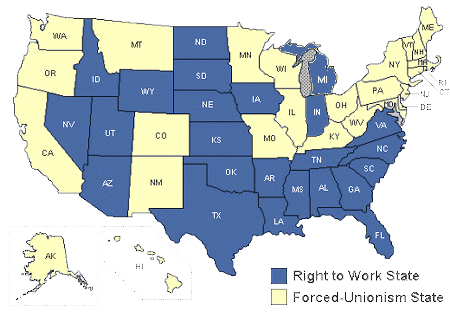
Unemployment rates are lower and wages are higher in right-to-work states

Map of right-to-work states: Michigan is #24

Previously, we saw that unemployment rates in right-to-work states were MUCH lower than in states that force workers to join unions and pay union dues in order to work.

Curtis sent me this article from Investors Business Daily, which looks at whether wages are lower in states that have right-to-work laws.

Excerpt:

The president says right-to-work laws mean “the right to work for less money.” So how does he explain the fact that incomes are up in RTW states while forced unionism is a proven job killer?

Campaigning Monday in Michigan as it stood poised to become the nation’s 24th right-to-work state, President Obama spoke the exact opposite of the truth to union workers at a Daimler Detroit Diesel plant in the birthplace of organized labor.

Is Obama telling the truth?

Let’s see:

According to Michigan’s Mackinac Center, using data taken from the Bureau of Economic Analysis and Bureau of Labor Statistics, private-sector, inflation-adjusted employee compensation in right-to-work states increased by 12% between 2001 and 2011 compared with just 3% over the same period in forced-unionization states.

These good wages came from good jobs. Employment in right-to-work states expanded 2.4% over the same stretch vs. a 3.4% decline in non-right-to-work states. Ironically, Obama is taking credit for jobs created in RTW states.

According to the National Institute for Labor Relations Research, right-to-work states (excluding Indiana, which passed a RTW law in early 2012) “were responsible for 72% of all net household job growth across the U.S. from June 2009 through September 2012.”

This is why people vote with their feet and move to these states. RTW states experienced large population gains of 15.3% from 2000 to 2010, compared to 5.9% in non-RTW states.

Obama did get one thing right, though, when he said the bills that passed both houses of the Michigan legislature “don’t have to do with economics. They have everything to do with politics.”

The president who fought Boeing’s expansion in RTW South Carolina knows it’s all about his keeping union dues flowing into Democratic coffers and maintaining the plush lifestyles of the union leaders who support him.

The right thing for Republicans to do when they get elected is to cut off all sources of funding for the Democrat Party. Right-to-work laws and school choice promote freedom and diminish the amount of power that left-wing, pro-abortion, pro-gay-marriage labor unions can exert. They will have less money, and with less money, they will have less influence on elections. Let the people decide, not the powerful, corrupt labor unions.

Related posts

Michigan governor Rick Snyder signs right-to-work bill into law

Map of right-to-work states: Michigan is #24

It’s official – Michigan has enacted a new right-to-work law that will create more jobs and free workers from having to violate their consciences by forcibly supporting pro-abortion, pro-gay marriage policies via their mandatory union dues.

Here’s an interesting article by Byron York in the Washington Examiner, discussing the political significance of this development.

Excerpt:

Republicans say the move would not only give current workers the freedom to choose whether to join a union and pay dues but would, more importantly, bring many, many new jobs to Michigan. Rep. Gov. Rick Snyder, who supports the bill, points out that Indiana enacted (after a long and bitter fight) the same kind of law earlier this year. “We’ve carefully watched what’s gone on in Indiana since they passed similar legislation back in February,” Snyder told Fox News’ Greta van Susteren last week, “and they’ve seen a significant increase in the number of companies talking about [bringing] thousands of jobs to their state.”

Of course, the move is not just economic. It’s political, too. Democrats depend on millions — actually, billions — of dollars in support from the forced dues of union members. If that money supply were to dry up, or even just decrease, the Democratic Party would be in serious trouble.

De-funding the unions is the first step to education reform. And Michigan students need education reform very badly. Even 40% of the union workers – who are much more sensible and patriotic than the union bosses – agree with the new law:

Regardless of news reports, the people of Michigan are behind this. A recent poll showed that 51 percent of Michigan voters support right-to-work. Only 41 percent are opposed. In fact, 40 percent of union households supported it. In November, Michigan voters rejected a ballot proposal that would have amended the state constitution to prevent the legislature from passing a right-to-work law and elevated union contracts above state law. The New York Times called it “a test case on enshrining the rights of unions,” and unions spent more than $23 million campaigning for the initiative. It lost by 15 points.

[…][M]aking union dues voluntary makes union organizers less aggressive—they get less financial benefit from organizing new firms, because they cannot force workers to pay them. Union organizing attempts drop 40 percent to 50 percent after states pass a right-to-work law. That in turn attracts business investment. Employers want to know unions will leave them alone if they treat their workers well. As a result, right-to-work states have lower unemployment rates—and more manufacturing jobs.

CNS News reports that only 7% of Detroit public school 8th graders can read at proficiency level.

Excerpt:

In the public schools in Detroit, Mich., according to the U.S. Department of Education, only 7 percent of the eighth graders are grade-level proficient or better in reading.

Some public school teachers in the City of Detroit and around the state of Michigan are reportedly taking a vacation or a sick day today to protest right-to-work legislation likely to be approved by the state legislature. Under current law, Michigan public school teachers must pay dues to the teachers’ union. If the right-to-work law is enacted, Michigan public-school teachers will be free to join the union and pay dues to it if they wish, but they will also be free not to join the union and not to pay it dues.

Detroit public-school eighth graders do even worse in math than they do in reading, according to the Department of Education. While only 7 percent scored highly enough on the department’s National Assessment of Educational Progress test in 2011 to be rated “proficient” or better in reading, only 4 percent scored highly enough to be rated “proficient” or better in math.

Statewide in Michigan, only 32 percent of public-school eighth graders scored grade-level proficient or better in reading, and only 31 percent scored grade-level proficient or better in math.

According to this report, over 26,000 students missed school because of the “sick day” protest by the teachers.

Here’s a video of what happens at the protests:

The actual unemployment rate of right-to-work states is 6.7%. Compare that with the 8.7% unemployment rate of forced-unionism states. Jobs are the number one priority right now, and right-to-work means more jobs.

Related posts