Stephen C. Meyer lectures on intelligent design and the origin of life

A MUST-SEE lecture based on Dr. Stephen C. Meyer’s book “Signature in the Cell“. One of my favorite 6 arguments for a Creator and Designer is the origin of the simplest replicating living system. When you look into the cell, what you’ll find is carefully sequenced components that for complex structures, like proteins. In this lecture, you’ll learn all about this “biological information”.

I highly recommend watching the lecture, and looking at the slides. The quality of the video and the content is first class. There is some Q&A (9 minutes) at the end of the lecture.

Topics:

  • intelligent design is concerned with measuring the information-creating capabilities of natural forces like mutation and selection
  • Darwinists think that random mutations and natural selection can explain the origin and diversification of living systems
  • Darwinian mechanisms are capable of explaining small-scale adaptive changes within types of organisms
  • but there is skepticism, even among naturalists, that Darwinian mechanisms can explain the origin of animal designs
  • even if you concede that Darwinism can account for all of the basic animal body plans, there is still the problem of life’s origin
  • can Darwinian mechanisms explain the origin of the first life? Is there a good naturalistic hypothesis to explain it?
  • there are at least two places in the history of life where new information is needed: origin of life, and Cambrian explosion
  • overview of the structure of DNA and protein synthesis (he has helpful pictures and he uses the snap lock blocks, too)
  • the DNA molecule is composed of a sequence of bases that code for proteins, and the sequence is carefully selected to have biological function
  • meaningful sequences of things like computer code, English sentences, etc. require an adequate cause
  • it is very hard to arrive at a meaningful sequence of a non-trivial length by randomly picking symbols/letters
  • although any random sequence of letters is improbable, the vast majority of sequences are gibberish/non-compiling code
  • similarly, most random sequences of amino acids are lab-proven (Doug Axe’s work) to be non-functional gibberish
  • the research showing this was conducted at Cambridge University and published in the Journal of Molecular Biology
  • so, random mutation cannot explain the origin of the first living cell
  • however, even natural selection coupled with random mutation cannot explain the first living cell
  • there must already be replication in order for mutation and selection to work, so they can’t explain the first replicator
  • but the origin of life is the origin of the first replicator – there is no replication prior to the first replicator
  • the information in the first replicator cannot be explained by law, such as by chemical bonding affinities
  • the amino acids are attached like magnetic letters on a refrigerator
  • the magnetic force sticks the letters ON the fridge, but they don’t determine the specific sequence of the letters
  • if laws did determine the sequence of letters, then the sequences would be repetitive
  • the three materialist explanations – chance alone, chance and law, law alone – are not adequate to explain the effect
  • the best explanation is that an intelligent cause is responsible for the biological explanation in the first replicator
  • we know that intelligent causes can produce functional sequences of information, e.g. – English, Java code
  • the structure and design of DNA matches up nicely with the design patterns used by software engineers (like WK!)

There are some very good tips in this lecture so that you will be able to explain intelligent design to others in simple ways, using everyday household items and children’s toys to symbolize the amino acids, proteins, sugar phosphate backbones, etc.

Proteins are constructed from a sequence of amino acids:

A sequence of amino acids forming a protein

Proteins sticking onto the double helix structure of DNA:

Some proteins sticking onto the sugar phosphate backbone

I highly, highly recommend this lecture. You will be delighted and you will learn something.

Here is an article that gives a general overview of how intelligent design challenges. If you want to read something more detailed about the material that he is covering in the lecture above related to the origin of life, there is a pretty good article here.

There is a good breakdown of some of the slides with helpful flow charts here on Uncommon Descent.

Positive arguments for Christian theism

Theologian R.C. Sproul asks: “If there’s a God, why are there atheists?”

Brian Auten has a book review posted up at Apologetics 315.

The book is “If There’s A God, Why Are There Atheists?”, by theologian R.C. Sproul. R.C. Sproul is one of my favorite theologians. The book in question has a very, very special place in my heart, because I think that it is one of the major reasons why I was able to resist pernicious ideas like religious pluralism and postmodernism for so long. Once you put on the glasses of Romans 1 and see for the first time what man is really doing with respect to God, you can never see things the same again. I’ll say more about this at the end, but let’s see what Brian wrote first.

The review

So often, you hear atheists complaining about religion is nothing but wish-fulfillment or some sort of crutch for people who are frightened by a variety of things. They think that God is invented to solve several problems. 1) how does the world work?, 2) is there meaning to suffering and evil?, 3) why should I be moral?, and 4) what will happen to me and my loved ones when I die?. On the atheistic view, God is just a crutch that people cling to out of weakness and ignorance. But is this really the case?

Sproul starts the book by investigating three atheists who sought to explain religious belief as a result of psychological factors.

Brian writes:

Before tackling the psychology of atheism, Sproul spends a chapter on the psychology of theism, from the perspective of Freud’s question “If there is no God, why is there religion?” What follows is an overview of various psychological explanations of theistic belief: Feuerbach’s “religion is a dream of the human mind.” Marx’s belief that religion is “due to the devious imagination of particular segment of mankind.” And Nietzche’s idea that “religion endures because weak men need it.” The author properly reiterates: “We must be careful to note that the above arguments can never be used as proof for the nonexistence of God. They can be useful for atheists who hear theists state that the only possible explanation for religion is the existence of God.” That being said, Sproul also reveals what these arguments presume:

Their arguments already presupposed the nonexistence of God. They were not dealing with the question, Is there a God? They were dealing with the question, Since there is no God, why is there religion?16

Sproul points out the weaknesses of each of these approaches and says “there are just as many arguments showing that unbelief has its roots in the psychological needs of man.”

Wow, could that really be true? What are the real reasons why people reject God? Does the Bible have anything to say about what those reasons are?

Brian cites Sproul’s contention:

The New Testament maintains that unbelief is generated not so much by intellectual causes as by moral and psychological ones. The problem is not that there is insufficient evidence to convince rational beings that there is a God, but that rational beings have a natural hostility to the being of God.

[…]Man’s desire is not that the omnipotent, personal Judeo-Christian God exist, but that He not exist.

In Romans 1:18-23, the apostle Paul explains what is really going on:

18The wrath of God is being revealed from heaven against all the godlessness and wickedness of men who suppress the truth by their wickedness,

19since what may be known about God is plain to them, because God has made it plain to them.

20For since the creation of the world God’s invisible qualities—his eternal power and divine nature—have been clearly seen, being understood from what has been made, so that men are without excuse.

21For although they knew God, they neither glorified him as God nor gave thanks to him, but their thinking became futile and their foolish hearts were darkened.

22Although they claimed to be wise, they became fools

23and exchanged the glory of the immortal God for images made to look like mortal man and birds and animals and reptiles.

On this blog, I regularly present many, many arguments for theism in general, and Christian theism in particular:

Sproul explains why atheists cannot allow themselves to live according to the evidence that is presented to them:

The cumulative effect of this knowledge that is clearly seen is to leave men ‘without excuse.’ Herein lies the basis of the universal guilt of man. No one can claim ignorance of the knowledge of God. No one can cite insufficient evidence for not believing in God. Though people are not persuaded by the evidence, this does not indicate an insufficiency in the evidence, but rather an insufficiency in man.

[…]The basic stages of man’s reaction to God can be formulated by means of the categories of trauma, repression, and substitution.

[…]If God exists, man cannot be a law unto himself. If God exists, man’s will-to-power is destined to run head-on into the will of God.

And this is the force that is animating atheists today. They don’t want to be accountable to God in a relationship, no matter what the evidence is. They have to deny it, so that they can be free to get the benefits of a universe designed for them, without having to give any recognition or acknowledgement back. If they have to lie to themselves to deny the evidence, they will do it. Anything to insulate themselves from the Creator and Designer who reveals himself in Jesus Christ.

The rest of the book review, and the book, deals with explaining in detail how atheists respond to an all-good, all-powerful, all-knowing Creator/Designer. I encourage you to click through and read the whole book review. You can read the review, and the book, and then investigate for yourself whether atheists really are like that.

Survey of scientific literature finds that children need their mom for first 3 years

Recently, an article published in the Wall Street Journal reported on a research survey done by a far-left Democrat psychotherapist based in far-left New York City. Surprisingly, her book caused an uproar among the author’s left-wing allies. How come?

Excerpt:

Motherhood used to be as American as apple pie. Nowadays it can be as antagonistic as American politics. Ask Erica Komisar.

Ms. Komisar, 53, is a Jewish psychoanalyst who lives and practices on the Upper West Side of Manhattan. If that biographical thumbnail leads you to stereotype her as a political liberal, you’re right. But she tells me she has become “a bit of a pariah” on the left because of the book she published this year, “Being There: Why Prioritizing Motherhood in the First Three Years Matters.”

[…]The premise of Ms. Komisar’s book—backed by research in psychology, neuroscience and epigenetics—is that “mothers are biologically necessary for babies,” and not only for the obvious reasons of pregnancy and birth. “Babies are much more neurologically fragile than we’ve ever understood,” Ms. Komisar says. She cites the view of one neuroscientist, Nim Tottenham of Columbia University, “that babies are born without a central nervous system” and “mothers are the central nervous system to babies,” especially for the first nine months after birth.

What does that mean? “Every time a mother comforts a baby in distress, she’s actually regulating that baby’s emotions from the outside in. After three years, the baby internalizes that ability to regulate their emotions, but not until then.” For that reason, mothers “need to be there as much as possible, both physically and emotionally, for children in the first 1,000 days.”

What’s interesting about this is how the left responds to the science. They don’t want to see anything that challenges their desires to focus on fun in the short-term, but have marriage and successful children in the long-term.

More:

Christian radio stations “interviewed me and loved me,” she says. She went on “Fox & Friends,” and “the host was like, your book is the best thing since the invention of the refrigerator.” But “I couldn’t get on NPR,” and “I was rejected wholesale—particularly in New York—by the liberal press.” She did appear on ABC’s “Good Morning America,” but seconds before the camera went live, she says, the interviewer told her: “I don’t believe in the premise of your book at all. I don’t like your book.”

[…]Ms. Komisar tells of hosting a charity gathering for millennials at her apartment. One young woman “asked me what my book was about. I told her, and she got so angry. She almost had fire coming out of her eyes, she was so angry at my message. She said, ‘You are going to set women back 50 years.’ I said, ‘Gosh, I wouldn’t want to do that.’ ”

[…]The needs of children get lost in all this—and Ms. Komisar hears repeatedly that the hostility to her message is born of guilt. When she was shopping for a literary agent, she tells me, “a number of the agents said, ‘No, we couldn’t touch that. That would make women feel guilty.’ ” Another time she was rejected for a speaking gig at a health conference. She quotes the head of the host institution as telling her: “You are going to make women feel badly. How dare you?”

[…]“The thing I dislike the most is day care,” she says. “It’s really not appropriate for children under the age of 3,” because it is “overstimulating” given their neurological undevelopment. She cites the “Strange Situation experiments,” devised in 1969 by developmental psychologist Mary Ainsworth, a pioneer of attachment theory: “A mother and the baby are on the floor playing. The mother gets up and leaves the baby in the room alone. The baby has a separation-anxiety response. A stranger walks in; the baby has a stressed reaction to the stranger.”

[…]Researchers sample the infant’s saliva and test it for cortisol, a hormone associated with stress (and inversely correlated with oxytocin). In a series of such experiments in which Ms. Komisar herself participated, “the levels were so high in the babies that the anticipation was that it would . . . in the end, cause disorders and problems.” In a more recent variant of the experiment, scientists use functional magnetic resonance imaging to look directly at the brain of an infant reacting to photos of the mother and of a stranger.

You’d think that people would be happy to find out how the world works, and adjust their decisions to match. But they’re not. The only good evidence is evidence that confirms their desires and ideology.

Let’s look at one of the studies, to see some evidence.

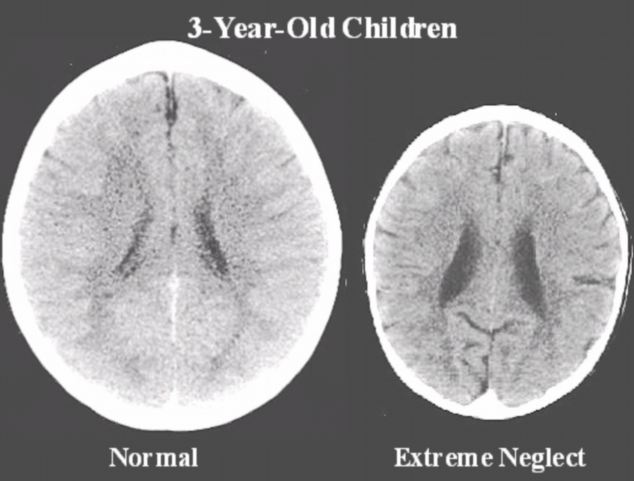
Brain scans of 3-year old children: normal vs neglected

The UK Telegraph reported on a recent study that measured the brain development of 3-year-old children.

Excerpt:

Take a careful look at the image of two brains on this page. The picture is of the brains of two three-year-old children. It’s obvious that the brain on the left is much bigger than the one on the right. The image on the left also has fewer spots, and far fewer dark “fuzzy” areas.

To neurologists who study the brain, and who have worked out how to interpret the images, the difference between these two brains is both remarkable and shocking. The brain on the right lacks some of the most fundamental areas present in the image on the left. Those deficits make it impossible for that child to develop capacities that the child on the left will have: the child on the right will grow into an adult who is less intelligent, less able to empathise with others, more likely to become addicted to drugs and involved in violent crime than the child on the left. The child on the right is much more likely to be unemployed and to be dependent on welfare, and to develop mental and other serious health problems.

[…]The primary cause of the extraordinary difference between the brains of these two three-year-old children is the way they were treated by their mothers. The child with the much more fully developed brain was cherished by its mother, who was constantly and fully responsive to her baby.

The child with the shrivelled brain was neglected and abused. That difference in treatment explains why one child’s brain develops fully, and the other’s does not.

[…]Professor Allan Schore, of UCLA, who has surveyed the scientific literature and has made significant contributions to it, stresses that the growth of brain cells is a “consequence of an infant’s interaction with the main caregiver [usually the mother]”.

The growth of the baby’s brain “literally requires positive interaction between mother and infant. The development of cerebral circuits depends on it.”

I like bringing science to bear on moral issues. The more you read about the science, the less wiggle-room there is for feelings. Doing the right thing (e.g. – saving money for a stay-at-home mom) is hard because it feels bad. But when you inform yourself with science, it makes it easier to override your bad feelings, because you know you’re doing the right thing to achieve a result.