Tag Archives: Men

On wargames, history and heroes: “this story shall the good man teach his son”

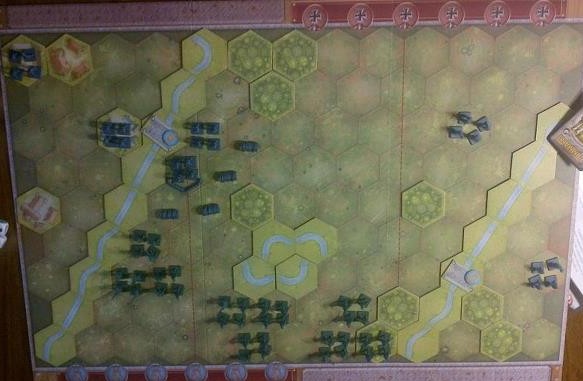
Memoir '44: Pegasus Bridge setup
Memoir ’44: Pegasus Bridge setup

Reposting this old post because Dina and I spent Friday night playing games again! And this is one of my favorite posts. Last night was Portal 2 and Orcs Must Die! 2.

Last night, I played through the Pegasus Bridge scenario from the Memoir ’44 wargame with Dina a few times. We actually played the online version of the game, using Steam. She was very gracious to play a wargame with me, which I don’t think is necessarily the first thing on most women’s lists of things to do on a Thursday night! I appreciated her agreeing to learn how to play and then playing with me several times. I think that Christians need to plan and execute more “together” activities like that – activities that involve interaction, co-operation, communication and engagement. We try to avoid doing things where we are both spectators. Playing wargames is not the only thing we do – we also do Bible study and cooking lessons (for me), for example.

Anyway, the point of this post is to express the deeper meaning behind playing wargames. I think that it is important to recognize and celebrate those who have demonstrated good character, whether it be now, or in the past. I think that it is important for us to search out the best role models ourselves, so that they will influence the way we act in our own lives. The second world war was a clear example of good versus evil. Anyone on the Allied side who demonstrated bravery and courage should be celebrated for safeguarding the security, liberty and prosperity that we enjoy today. In the case of Pegasus bridge, the hero is Major John Howard of the British paratroops.

Here is a quick re-cap of his exploits that day from the New York Times:

Maj. John Howard, the commander of glider-borne British infantrymen who seized the strategically vital Pegasus Bridge in the first battle of the D-Day invasion of Normandy, died Wednesday in a hospital in Surrey, England. He was 86 and had lived in Burford, near Oxford.

Under cover of night on June 6, 1944, six gliders carrying 181 officers and men of the Second Oxfordshire and Buckinghamshire Light Infantry landed on the eastern flank of a 60-mile invasion front on the northern coast of France. The regiment had a heritage going back to the battles of Bunker Hill and New Orleans, to Waterloo and to World War I. Now its soldiers were in the vanguard of the invasion of Hitler’s Europe.

Major Howard’s D Company was ordered to seize two bridges, one over the Caen Canal and the other spanning the parallel Orne River. If the Germans held on to those bridges, panzer units could move across them in a counterattack isolating 10,000 British paratroopers jumping behind the British invasion beach known as Sword, where infantry forces would arrive at daybreak. And Major Howard’s men sought to strike swiftly to prevent the Germans from blowing up the bridges if they were overwhelmed; the British needed those bridges to resupply their airborne units.

British Halifax bombers towed the gliders over the English Channel, then cut them loose.

Major Howard’s lead glider landed at 12:16 A.M., only 50 yards from the Caen Canal bridge, but the glider’s nose collapsed on impact, knocking everybody aboard unconscious for a few seconds. The soldiers quickly emerged, and over the next five minutes the men directly under Major Howard killed the surprised German defenders.

The nearby Orne River bridge was captured by other troops in Major Howard’s unit, and soon the words ”Ham and Jam,” signifying mission accomplished, were radioed to the airborne.

Two British soldiers were killed and 14 wounded in the operation.

Over the next 12 hours, British paratroopers and commandos reinforced Major Howard’s men, and British forces were able to move toward the city of Caen, their flank having been protected by the capture of the bridges.

On July 16, Major Howard received the Distinguished Service Order, Britain’s second-highest award for valor. On the 10th anniversary of D-Day, he received the Croix de Guerre Avec Palme from the French Government, which had renamed the Caen Canal span Pegasus Bridge, for the flying horse symbolizing the British airborne. The road crossing the bridge was later renamed Esplanade Major John Howard.

Why is this important? Well, it’s important to think on the things that are excellent. There are so many things in the culture that are not excellent that we are confronted with every day. We have to make it our business to do things together where goodness is celebrated. Especially when manly virtues like courage are celebrated. We don’t do that much anymore. And I think there’s a connection between wargames and Christian apologetics that we need to deliberately encourage.

Here’s an excellent passage from Shakespeare’s “Henry V” that makes the point:

This day is called the feast of Crispian:
He that outlives this day and comes safe home,
Will stand a tip-toe when this day is named,
And rouse him at the name of Crispian.
He that shall live this day, and see old age,
Will yearly on the vigil feast his neighbours,
And say, ‘To-morrow is Saint Crispian:’
Then will he strip his sleeve and show his scars,
And say, ‘These wounds I had on Crispin’s day.’
Old men forget: yet all shall be forgot,
But he’ll remember with advantages
What feats he did that day. Then shall our names,
Familiar in his mouth as household words,
Harry the King, Bedford and Exeter,
Warwick and Talbot, Salisbury and Gloucester,
Be in their flowing cups freshly remembered.
This story shall the good man teach his son;
And Crispin Crispian shall ne’er go by,
From this day to the ending of the world,
But we in it shall be rememberèd;
We few, we happy few, we band of brothers;
For he to-day that sheds his blood with me
Shall be my brother; be he ne’er so vile
This day shall gentle his condition:
And gentlemen in England, now a-bed
Shall think themselves accursed they were not here,
And hold their manhoods cheap whiles any speaks
That fought with us upon Saint Crispin’s day. (4.3.43)

This is from the famous speech in which King Henry charges his men to fight well before the famous Battle of Agincourt.

You can read more about the history of the British Airborne division and Pegasus bridge. The famous historian of the second world war Stephen E. Ambrose also wrote a history of the Pegasus bridge battle, called “Pegasus Bridge: June 6, 1944“. You won’t find many military historians better than Stephen E. Ambrose!

You might be surprised how many men are interested in military history and wargames, precisely because men instinctively look up to men like John Howard who embody qualities like bravery and courage. We have a dearth of moral character in this society. And we don’t do much to teach young men about manly virtues, even in the church. I think that it is important for us to think of creative ways for us to present good character to our young men. Young women should also learn about good character, because they must separate out the good men from the bad when they are courting.

Thanks to Dina for helping me to edit this post!

Ryan T. Anderson presents the case for natural / traditional marriage

A must-read long paper from the Heritage Foundation. It’s a great concise presentation of the reasons why the United States should not redefine marriage. (H/T A tweet from Ryan T. Anderson)

Abstract:

Marriage is based on the truth that men and women are complementary, the biological fact that reproduction depends on a man and a woman, and the reality that children need a mother and a father. Redefining marriage does not simply expand the existing understanding of marriage; it rejects these truths. Marriage is society’s least restrictive means of ensuring the well-being of children. By encouraging the norms of marriage—monogamy, sexual exclusivity, and permanence—the state strengthens civil society and reduces its own role. The future of this country depends on the future of marriage. The future of marriage depends on citizens understanding what it is and why it matters and demanding that government policies support, not undermine, true marriage.

Excerpt:

Supporters of redefinition use the following analogy: Laws defining marriage as a union of a man and a woman are unjust—fail to treat people equally—exactly like laws that prevented interracial marriage. Yet such appeals beg the question of what is essential to marriage. They assume exactly what is in dispute: that gender is as irrelevant as race in state recognition of marriage. However, race has nothing to with marriage, and racist laws kept the races apart. Marriage has everything to do with men and women, husbands and wives, mothers and fathers and children, and that is why principle-based policy has defined marriage as the union of one man and one woman.

Marriage must be color-blind, but it cannot be gender-blind. The color of two people’s skin has nothing to do with what kind of marital bond they have. However, the sexual difference between a man and a woman is central to what marriage is. Men and women regardless of their race can unite in marriage, and children regardless of their race need moms and dads. To acknowledge such facts requires an understanding of what, at an essential level, makes a marriage.

And a bit later:

If the law taught a falsehood about marriage, it would make it harder for people to live out the norms of marriage because marital norms make no sense, as matters of principle, if marriage is just intense emotional feeling. No reason of principle requires an emotional union to be permanent or limited to two persons, much less sexually exclusive. Nor should it be inherently oriented to family life and shaped by its demands. This does not mean that a couple could not decide to live out these norms where temperament or taste so motivated them, just that there is no reason of principle to demand that they do so. Legally enshrining this alternate view of marriage would undermine the norms whose link to the common good is the basis for state recognition of marriage in the first place.

Insofar as society weakens the rational foundation for marriage norms, fewer people would live them out, and fewer people would reap the benefits of the marriage institution. This would affect not only spouses, but also the well-being of their children. The concern is not so much that a handful of gay or lesbian couples would be raising children, but that it would be very difficult for the law to send a message that fathers matter when it has redefined marriage to make fathers optional.

And one last one:

In fact, much of this is already occurring. Heritage Foundation Visiting Fellow Thomas Messner has documented multiple instances in which redefining marriage has already become a nightmare for religious liberty.[48] If marriage is redefined to include same-sex relationships, then those who continue to believe the truth about marriage—that it is by nature a union of a man and a woman—would face three different types of threats to their liberty: the administrative state, nondiscrimination law, and private actors in a culture that is now hostile to traditional views.[49]

After Massachusetts redefined marriage to include same-sex relationships, Catholic Charities of Boston was forced to discontinue its adoption services rather than place children with same-sex couples against its principles.[50] Massachusetts public schools began teaching grade-school students about same-sex marriage, defending their decision because they are “committed to teaching about the world they live in, and in Massachusetts same-sex marriage is legal.” A Massachusetts appellate court ruled that parents have no right to exempt their children from these classes.[51]

The New Mexico Human Rights Commission prosecuted a photographer for declining to photograph a same-sex “commitment ceremony.” Doctors in California were successfully sued for declining to perform an artificial insemination on a woman in a same-sex relationship. Owners of a bed and breakfast in Illinois who declined to rent their facility for a same-sex civil union ceremony and reception were sued for violating the state nondiscrimination law. A Georgia counselor was fired after she referred someone in a same-sex relationship to another counselor.[52] In fact, the Becket Fund for Religious Liberty reports that “over 350 separate state anti-discrimination provisions would likely be triggered by recognition of same-sex marriage.”[53]

This article is long and comprehensive. It will take some time to read. It’s includes logical arguments as well as empirical evidence from research – with footnotes. I really recommend taking a look at the article. Even if it takes a long time to read, it will definitely expand your mind to think about why we had a definition of marriage in the first place, and what we would lose by changing that definition. When you debate people who want to redefine marriage, it’s very important to appeal to logical arguments and evidence from studies. Get the conversation away from emotions and instead introduce facts and arguments.

You can get an even longer treatment in the new book by Ryan T. Anderson and his co-authors Sherif Girgis and Robert P. George. This is *the* book to get on the marriage issue.

Related posts

Dennis Prager explains what feminism has achieved for women

Dennis Prager has summarized many of my viewpoints on this blog in a tiny, tiny little article. He calls it “Four Legacies of Feminism“.

Read the whole glorious thing and bask in its wisdom!

Full text:

As we approach the 50th anniversary of the publication of Betty Friedan’s feminist magnum opus, The Feminine Mystique, we can have a perspective on feminism that was largely unavailable heretofore.

And that perspective doesn’t make feminism look good. Yes, women have more opportunities to achieve career success; they are now members of most Jewish and Christian clergy; women’s college sports teams are given huge amounts of money; and there are far more women in political positions of power. But the prices paid for these changes — four in particular — have been great, and outweigh the gains for women, let alone for men and for society.

1) The first was the feminist message to young women to have sex just as men do. There is no reason for them to lead a different sexual life than men, they were told. Just as men can have sex with any woman solely for the sake of physical pleasure, so, too, women ought to enjoy sex with any man just for the fun of it. The notion that the nature of women is to hope for at least the possibility of a long-term commitment from a man they sleep with has been dismissed as sexist nonsense.

As a result, vast numbers of young American women had, and continue to have, what are called “hookups”; and for some of them it is quite possible that no psychological or emotional price has been paid. But the majority of women who are promiscuous do pay prices. One is depression. New York Times columnist Ross Douthat recently summarized an academic study on the subject: “A young woman’s likelihood of depression rose steadily as her number of partners climbed and the present stability of her sex life diminished.”

Long before this study, I had learned from women callers to my radio show (an hour each week — the “Male-Female Hour” — is devoted to very honest discussion of sexual and other man-woman issues) that not only did female promiscuity coincide with depression, it also often had lasting effects on women’s ability to enjoy sex. Many married women told me that in order to have a normal sexual relationship with their husband, they had to work through the negative aftereffects of early promiscuity — not trusting men, feeling used, seeing sex as unrelated to love, and disdaining their husband’s sexual overtures. And many said they still couldn’t have a normal sex life with their husband.

2) The second awful legacy of feminism has been the belief among women that they could and should postpone marriage until they developed their careers. Only then should they seriously consider looking for a husband. Thus, the decade or more during which women have the best chance to attract men is spent being preoccupied with developing a career. Again, I cite woman callers to my radio show over the past 20 years who have sadly looked back at what they now, at age 40, regard as 20 wasted years. Sure, these frequently bright and talented women have a fine career. But most women are not programmed to prefer a great career to a great man and a family. They feel they were sold a bill of goods at college and by the media. And they were. It turns out that most women without a man do worse in life than fish without bicycles.

3) The third sad feminist legacy is that so many women — and men — have bought the notion that women should work outside the home that for the first time in American history, and perhaps world history, vast numbers of children are not primarily raised by their mothers or even by an extended family member. Instead they are raised for a significant part of their childhood by nannies and by workers at daycare centers. Whatever feminists may say about their only advocating choices, everyone knows the truth: Feminism regards work outside the home as more elevating, honorable, and personally productive than full-time mothering and making a home.

4) And the fourth awful legacy of feminism has been the demasculinization of men. For all of higher civilization’s recorded history, becoming a man was defined overwhelmingly as taking responsibility for a family. That notion — indeed the notion of masculinity itself — is regarded by feminism as the worst of sins: patriarchy.

Men need a role, or they become, as the title of George Gilder’s classic book on single men describes them: Naked Nomads. In little more than a generation, feminism has obliterated roles. If you wonder why so many men choose not to get married, the answer lies in large part in the contemporary devaluation of the husband and of the father — of men as men, in other words. Most men want to be honored in some way — as a husband, a father, a provider, as an accomplished something; they don’t want merely to be “equal partners” with a wife.

In sum, thanks to feminism, very many women slept with too many men for their own happiness; postponed marriage too long to find the right man to marry; are having hired hands do much of the raising of their children; and find they are dating boy-men because manly men are so rare.

Feminism exemplifies the truth of the saying, “Be careful what you wish for — you may get it.”

I wish I could add something to this, but I can’t because every time I think of something to add, he says it in the next sentence.

If you like this short essay, then this medium essay arguing against feminism authored by Barbara Kay would be nice follow-up.

It might be worth forwarding these articles along to your friends. And I highly recommend books on male-female relationships and roles by George Gilder, especially “Men and Marriage“.