Tag Archives: Jobs

Women earned more doctoral and Master’s degrees than men in 2012

Women now earning majority of graduate degrees

From the American Enterprise Institute Ideas blog.

Excerpt:

The Council of Graduate Schools (CGS) released its annual report recently on U.S. graduate school enrollment and degrees for 2012, and here are some of the more interesting findings in this year’s report:

1. For the fourth year in a row, women in 2012 earned a majority of doctoral degrees. Of the 67,220 doctoral degrees awarded in 2012 at U.S. universities, women earned 34,761 of those degrees and 52.2% of the total, compared to 31,830 degrees awarded to men who earned 47.8% of the total (see top chart above).

[…]2. By field of study, women earning doctoral degrees in 2012 outnumbered men in 7 of the 11 graduate fields tracked by the CGS (see top chart above)

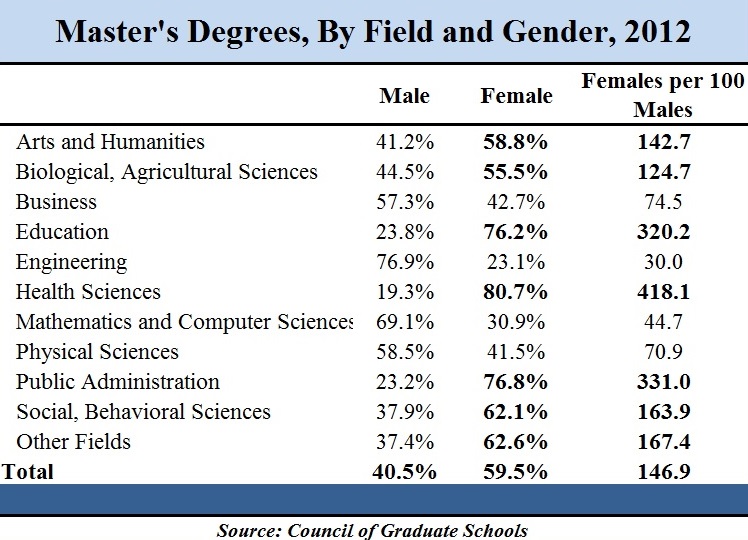
[…]3. The middle chart above shows the gender breakdown for master’s degrees awarded in 2012, and the gender disparity in favor of females is significant – women earned just under 60% of all master’s degrees in 2012, which would also mean that women earned 146.9 master’s degrees last year for every 100 degrees earned by men.

[…]Women represent 58.5% of all graduate students in the U.S., meaning that there are now 141 women enrolled in graduate school for every 100 men.

Click here for the charts.

The author of the post, Dr. Mark Perry, concludes this:

MP: Here’s my prediction – the facts that: a) men are underrepresented in graduate school enrollment overall (100 men were enrolled in 2012 for every 141 women), b) men received fewer master’s (40.5% of the total) and doctoral degrees (47.8% of the total) than women in 2012, and c) men were underrepresented in 7 out of 11 graduate fields of study at both the master’s and doctoral levels last year will get no attention at all from the media, universities and anybody in the higher education industry.

Additionally, there will be no calls for government studies, or increased government funding to address the significant gender disparities in graduate schools, and nobody will refer to the gender graduate school enrollment and degree gaps favoring women as a problem or a “crisis.”  Further, neither President Obama nor Congress will address the gender graduate enrollment and degree gaps by invoking the Title IX gender-equity law, like they have threatened to do for the gender gap in some college math and science programs. And there won’t be any executive orders to address the huge gender disparity in graduate schools by creating a White House Council on Boys and Men like the executive order issued by President Obama in 2009 to create the “White House Council on Women and Girls.”  Finally, despite their stated commitment to “gender equity,” the hundreds of university women’s centers around the country are unlikely to show any concern about the significant gender inequities in graduate school enrollment and degrees, and universities will not be allocating funding to set up men’s centers or create graduate scholarships for men.

Bottom Line: If there is any attention about gender differences in the CGS annual report, it will likely be about the fact that women are a minority in 4 of the 11 fields of graduate study including engineering and computer science (a gender gap which some consider to be a “national crisis”), with calls for greater awareness of female under-representation in STEM graduate fields of study and careers (except for the STEM field of biology, where women areover-represented).  But don’t expect any concern about the fact that men have increasingly become the second sex in higher education.  The concern about gender imbalances will remain extremely selective, and will only focus on cases when women, not men, are underrepresented and in the minority.

Men outnumber women in business, computer science, engineering and physical sciences.

I echo Dr. Perry’s point, and want to add this. In traditional Christianity, men are responsible for providing for their families. One of the ways that we men prepare for this is by getting advanced degrees in STEM-related fields, since these fields are the hardest and also pay the best. So with that in mind, what does it mean for men who want to prepare for this provider role that there is this obvious discrimination against men in graduate schools and doctoral programs? Is anyone going to do anything to change policies and incentives to favor men, like they did when women were under-represented? Of course not. The only thing that will be done is to ignorantly urge men to “man up”, while ignoring the real problems, e.g. – a lack of male teachers, schools that are not geared to male learning styles, and so on.

Related posts

Nancy Pelosi: forcing workers to work fewer hours gives them “freedom”

The video above shows a typical Democrat reaction to Obamacare’s side-effect of forcing workers from full-time to part-time work. Let them eat cake!

You don’t need to get paid for 40 hours per week, do you? It’s freedom to follow your passion – you don’t really need the money and work experience, do you?

The College Fix explains how students working their way through college feel about having their workers hours cut to comply with Obamacare.

Here’s an example from their article:

Emily Klug, 22, a psychology and sociology major at the College of the Ozarks in Branson, Mo., is another Obamacare victim.

Klug’s university offered her a work-study program over the summer, which she turned down in order to accept a full-time summer job for a national retailer. This would have allowed her to pay for the coming year of college, as well as save for grad school. Shortly thereafter, Klug learned that her employer had modified their policies: she would only be allowed to work part-time.

“Their maximum limit happened to be the same one as the Obamacare classification for full-time,” she told The Fix.

She spent the summer working 20 to 25 hours weekly, unable to save for grad school.

“I’m not happy with it,” Klug added, regarding the Affordable Care Act. “I feel that it’s unconstitutional, and an infringement on my rights. I’m not looking forward to either buying insurance or paying the fine. I will probably be paying the fine. It’s my personal choice. That’s what I object to most in Obamacare – my personal choice is removed.”

Yes, but you get free condoms!!1! It’s so worth it! Maybe you could find another job. A job that uses a lot of free condoms!!! You’re free to pursue your passion. It’s about wellness! And if you have an unplanned pregnancy, then abortions and single mother welfare are free! Just follow your heart.

OK. And it’s not just off-campus work that’s being affected, it’s on-campus work, too.

Investors Business Daily explains.

Excerpt:

If one job category stands out for bearing a heavy price from ObamaCare-related cuts to work hours, it might be adjunct college faculty.

Among 313 employers now on IBD’s ObamaCare Employer Mandate List Of Cuts To Hours, Jobs that have cut work hours or permanent staff, or shifted to part-time hiring, there are 54 colleges and universities that have scaled back the hours adjunct faculty may teach.

The list also includes 80 public school districts that have cut hours or outsourced the job functions of teacher aides, cafeteria workers and other employees.

Still, the inclusion of a number of community college systems such as MaricopaIvy Techand Dallas County means that cuts in adjunct faculty hours now extend to nearly 200 college and university campuses attended by about 1.6 million students.

All over the country, adjunct teaching loads are being limited to nine credit hours — just below the 30-hour threshold at which Affordable Care Act employer penalties hit. That’s the equivalent of nine hours per week in the classroom and 18 hours of work preparing, grading, etc.

In lean budget times, many schools became heavily dependent upon modestly paid, part-time faculty members who were ineligible for health benefits. Now, faced with providing the same type of generous coverage offered tenured professors or cutting hours, many see little choice but to cut.

Of a dozen employers added to IBD’s list on Sept. 25, nine are colleges and universities. Of those, eight put new restrictions on adjunct hours. Several also cut work hours for students, a step backward for helping future grads emerge with manageable levels of student loan debt.

They told me if I didn’t vote for Obama, then college students would have a harder time paying for college. And they were right!

Related posts

Basic economics: what’s wrong with raising minimum wage rates?

Economist Thomas Sowell

From Investors Business Daily, an article by famous economist Thomas Sowell.

Excerpt:

Political crusades for raising the minimum wage are back again. Advocates of minimum-wage laws often give themselves credit for being more “compassionate” towards “the poor.”

But they seldom bother to check what are the actual consequences of such laws.

One of the simplest and most fundamental economic principles is that people tend to buy more when the price is lower and less when the price is higher.

Yet advocates of minimum-wage laws seem to think that the government can raise the price of labor without reducing the amount of labor that will be hired.

[…]Switzerland is one of the few modern nations without a minimum-wage law. In 2003, the Economist magazine reported: “Switzerland’s unemployment neared a five-year high of 3.9% in February.”

In February of this year, Switzerland’s unemployment rate was 3.1%. A recent issue of the Economist showed Switzerland’s unemployment rate as 2.1%.

Most Americans today have never seen unemployment rates that low. However, there was a time when there was no federal minimum-wage law in the United States.

The last time was during the Coolidge administration, when the annual unemployment rate went as low as 1.8%. When Hong Kong was a British colony, it had no minimum-wage law. In 1991 its unemployment rate was under 2%.

[…]Most people in the lower income brackets are not an enduring class. Most working people in the bottom 20% in income at a given time do not stay there over time. More of them end up in the top 20% than remain behind in the bottom 20%.

There is nothing mysterious about the fact that most people start off in entry-level jobs that pay much less than they will earn after they get some work experience.

But when minimum-wage levels are set without regard to their initial productivity, young people are disproportionately unemployed — priced out of jobs.

In European welfare states where minimum wages, and mandated job benefits to be paid for by employers, are more generous than in the United States, unemployment rates for younger workers are often 20% or higher, even when there is no recession.

Unemployed young people lose not only the pay they could have earned but, at least equally important, the work experience that would enable them to earn higher rates of pay later on.

Minorities, like young people, can also be priced out of jobs. In the United States, the last year in which the black unemployment rate was lower than the white unemployment rate — 1930 — was also the last year when there was no federal minimum-wage law.

Inflation in the 1940s raised the pay of even unskilled workers above the minimum wage set in 1938. Economically, it was the same as if there were no minimum-wage law by the late 1940s.

In 1948 the unemployment rate of black 16-year-old and 17-year-old males was 9.4%. This was a fraction of what it would become in even the most prosperous years from 1958 on, as the minimum wage was raised repeatedly to keep up with inflation.

A survey of American economists found that 90% of them regarded minimum-wage laws as increasing the rate of unemployment among low-skilled workers.

Harvard University economist Greg Mankiw puts the agreement level at 79%. This is not controversial. This is one of the most widely-accepted facts in economics. Generally, if you raise the price of domestic labor, without any increase in worker productivity, then it reduces demand for domestic labor and causes companies to reduce hiring and retention, possibly looking elsewhere for labor. Compassionate-sounding policies actually cause negative results like outsourcing and layoffs. The very people who agitate the most for a “living wage” cause higher unemployment – especially among youth and minorities.

The only sure way to help workers is to give them marketable skills and job experience – that’s what really draws higher salaries and better benefits. And that means advocating for smarter policies: fewer regulations on job creators, lowering the employer portion of payroll taxes, merit pay for teachers, vouchers to encourage competition between schools, making work pay more than collecting welfare for doing nothing. And so on. That would actually solve the problem of people not having work.