Tag Archives: Children

New study finds that children do best in traditional mother-father families

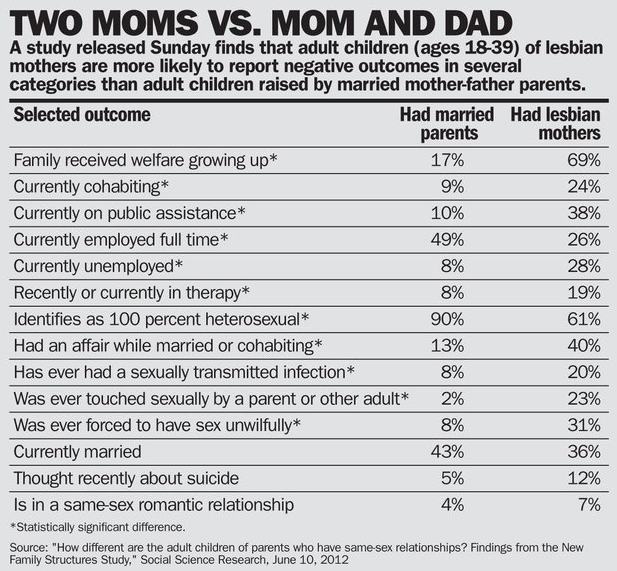
Straight vs. lesbian parenting (click for larger image)

From the Washington Times. (H/T Jonathan)

Excerpt: (links removed)

Two studies released Sunday may act like brakes on popular social-science assertions that gay parents are the same as — or maybe better than — married, mother-father parents.

“The empirical claim that no notable differences exist must go,” Mark Regnerus, a sociology professor at the University of Texas at Austin, said in his study in Social Science Research.

Using a new, “gold standard” data set of nearly 3,000 randomly selected American young adults, Mr. Regnerus looked at their lives on 40 measures of social, emotional and relationship outcomes.

He found that, when compared with adults raised in married, mother-father families, adults raised by lesbian mothers had negative outcomes in 24 of 40 categories, while adults raised by gay fathers had negative outcomes in 19 categories.

Findings such as these do not support claims that there are “no differences” between gay parenting and heterosexual, married parents, said Mr. Regnerus, who helped develop the New Family Structures Study at the university.

Instead, “children appear most apt to succeed well as adults when they spend their entire childhood with their married mother and father, and especially when the parents remain married to the present day,” he wrote.

Mr. Regnerus‘ study of 2,988 persons ages 18 to 39 — including 175 adults raised by lesbian mothers and 73 adults raised by gay fathers — marks the first research from the new dataset, which initially included some 15,000 persons.

The second study, also in Social Science Research, takes a critical look at the basis of an oft-cited American Psychological Association (APA) report on gay parenting.

The APA brief says, “Not a single study has found children of lesbian or gay parents to be disadvantaged in any significant respect relative to children of heterosexual parents,” said Loren Marks, associate professor at the School of Human Ecology at Louisiana State University.

However, after looking at the 59 studies that undergird this assertion, “the jury is still out,” Mr. Marks said. “The lack of high-quality data leaves the most significant questions [about gay parenting] unaddressed and unanswered.”

Problems with the APA-cited studies were their tiny size; dependence on wealthy, white, well-educated lesbian mothers; and a failure to examine common outcomes for children, such as their education, employment and risks for poverty, criminality, early childbearing, substance abuse and suicide. Instead, the APA studies often looked at children’s gender-role behaviors, emotional functioning and sexual identity.

This story was also reported on Science Daily, with the predictable liberal spin.

Here is my previous post on the data that shows why same-sex unions are not good for raising children.

How the presence and quality of fathers affects belief in God

Here’s an article by Paul Copan which points out how father presence/absence and father quality affects belief and disbelief in God.

Excerpt:

Seventh, the attempt to psychologize believers applies more readily to the hardened atheist.It is interesting that while atheists and skeptics often psychoanalyze the religious believer, they regularly fail to psychoanalyze their ownrejection of God. Why are believers subject to such scrutiny and not atheists? Remember another feature of Freud’s psychoanalysis — namely, an underlying resentment that desires to kill the father figure.

Why presume atheism is the rational, psychologically sound, and default position while theism is somehow psychologically deficient? New York University psychology professor Paul Vitz turns the tables on such thinking. He essentially says, “Let’s look into the lives of leading atheists and skeptics in the past. What do they have in common?” The result is interesting: virtually all of these leading figures lacked a positive fatherly role model — or had no father at all.11

Let’s look at some of them.

  • Voltaire(1694–1778): This biting critic of religion, though not an atheist, strongly rejected his father and rejected his birth name of François-Marie Arouet.
  • David Hume(1711–76): The father of this Scottish skeptic died when Hume was only 2 years old. Hume’s biographers mention no relatives or family friends who could have served as father figures.
  • Baron d’Holbach(1723–89): This French atheist became an orphan at age 13 and lived with his uncle.
  • Ludwig Feuerbach (1804–72): At age 13, his father left his family and took up living with another woman in a different town.
  • Karl Marx(1818–83): Marx’s father, a Jew, converted to being a Lutheran under pressure — not out of any religious conviction. Marx, therefore, did not respect his father.
  • Friedrich Nietzsche(1844–1900): He was 4 when he lost his father.
  • Sigmund Freud(1856–1939): His father, Jacob, was a great disappointment to him; his father was passive and weak. Freud also mentioned that his father was a sexual pervert and that his children suffered for it.
  • Bertrand Russell(1872–1970): His father died when he was 4.
  • Albert Camus(1913–60): His father died when he was 1 year old, and in his autobiographical novel The First Man, his father is the central figure preoccupation of his work.
  • Jean-Paul Sartre(1905–80): The famous existentialist’s father died before he was born.12
  • Madeleine Murray-O’Hair (1919–95): She hated her father and even tried to kill him with a butcher knife.
  • We could throw in a few more prominent contemporary atheists not mentioned by Vitz with similar childhood challenges:
  • Daniel Dennett (1942–): His father died when he was 5 years of age and had little influence on Dennett.13
  • Christopher Hitchens (1949–): His father (“the Commander”) was a good man, according to Hitchens, but he and Hitchens “didn’t hold much converse.” Once having “a respectful distance,” their relationship took on a “definite coolness” with an “occasional thaw.” Hitchens adds: “I am rather barren of paternal recollections.”14
  • Richard Dawkins (1941–): Though encouraged by his parents to study science, he mentions being molested as a child — no insignificant event, though Dawkins dismisses it as merely embarrassing.15

Moreover, Vitz’s study notes how many prominent theists in the past — such as Blaise Pascal, G.K. Chesterton, Karl Barth, and Dietrich Bonhoeffer — have had in common a loving, caring father in their lives.16

Not only is there that anecdotal evidence, but there is also statistical evidence.

Excerpt:

In 1994 the Swiss carried out an extra survey that the researchers for our masters in Europe (I write from England) were happy to record. The question was asked to determine whether a person’s religion carried through to the next generation, and if so, why, or if not, why not. The result is dynamite. There is one critical factor. It is overwhelming, and it is this: It is the religious practice of the father of the family that, above all, determines the future attendance at or absence from church of the children.

If both father and mother attend regularly, 33 percent of their children will end up as regular churchgoers, and 41 percent will end up attending irregularly. Only a quarter of their children will end up not practicing at all. If the father is irregular and mother regular, only 3 percent of the children will subsequently become regulars themselves, while a further 59 percent will become irregulars. Thirty-eight percent will be lost.

If the father is non-practicing and mother regular, only 2 percent of children will become regular worshippers, and 37 percent will attend irregularly. Over 60 percent of their children will be lost completely to the church.

Let us look at the figures the other way round. What happens if the father is regular but the mother irregular or non-practicing? Extraordinarily, the percentage of children becoming regular goesupfrom 33 percent to 38 percent with the irregular mother and to 44 percent with the non-practicing, as if loyalty to father’s commitment grows in proportion to mother’s laxity, indifference, or hostility.

[…]In short, if a father does not go to church, no matter how faithful his wife’s devotions, only one child in 50 will become a regular worshipper. If a father does go regularly, regardless of the practice of the mother, between two-thirds and three-quarters of their children will become churchgoers (regular and irregular). If a father goes but irregularly to church, regardless of his wife’s devotion, between a half and two-thirds of their offspring will find themselves coming to church regularly or occasionally.

A non-practicing mother with a regular father will see a minimum of two-thirds of her children ending up at church. In contrast, a non-practicing father with a regular mother will see two-thirds of his children never darken the church door. If his wife is similarly negligent that figure rises to 80 percent!

The results are shocking, but they should not be surprising. They are about as politically incorrect as it is possible to be; but they simply confirm what psychologists, criminologists, educationalists, and traditional Christians know. You cannot buck the biology of the created order. Father’s influence, from the determination of a child’s sex by the implantation of his seed to the funerary rites surrounding his passing, is out of all proportion to his allotted, and severely diminished role, in Western liberal society.

Basically, anyone who doesn’t have a benevolent, involved father is going to have an enormously difficult time believing that moral boundaries set by an authority are for the benefit of the person who is being bounded. The best way to make moral boundaries stick is to see that they apply to the person making the boundaries as well – and that these moral boundaries are rational, evidentially-grounded and not arbitrary. It is therefore very important to children to be shepherded by a man who has integrity and who has studied moral issues like chastity, abortion and same-sex marriage in order to know how to be persuasive to others, using real-world evidence and non-religious arguments.

I think from a practical point of view, it’s also important for women to think carefully about men they choose to have sex with and to marry. The relationship with the child with the man who raises them is vital to belief in God. Judging from the evidence above, one can make a case that any woman who participates in men who are not capable of life-long commitment, providing and protecting, etc. and who are not capable of leading on moral spiritual issues is basically risking her ability to present her child to God as a Christian.

A child’s relationship with God begins with his/her mother’s ability to control herself and choose the right man for the job of being a father. Note that superficial qualities like “deep voice”, “broad shoulders”, “expensive shoes”, “likes dogs” and “makes me laugh” have no bearing on a man’s ability to commit and lead on moral/spiritual issues. We don’t really do a good job of showing evidence of choices and outcomes to women in the church, which is why there are so many fatherless children being conceived by women who go to church. Christian women are following their feelings to premarital sex, missionary cohabitation, and abortions under the supervision of ignorant, man-blaming pastors who don’t want to judge the delicate women by offering them facts.

What causes women to become single mothers by choice? Are men to blame?

Dina sent me this revealing article from the UK Daily Mail. It answers the question “Where does fatherlessness come from?”.

Excerpt:

My marriage ended, without rancour or argument, 18 months after it had begun. There was no recrimination, just a realisation, as sharp as physical pain, that we would never — could never — agree on one fundamental point.

I wanted children; my husband Anthony did not. You may think we should have resolved this crucial issue long before we bought a house and vowed to spend the rest of our lives together, but love had a way of blinding us to the depth of our disagreement.

By “love” she means three things: 1) he was physically attractive, 2) she became sexually active with him after one month of meeting him, and 3) she moved in with him before he made a commitment to marriage and parenting. (As we shall see) As far as I can tell, she spent her late 20s to mid 30s with this guy – a guy she chose of her own free will. A guy who never indicated any interest in children, but who indicated plenty of interest in recreational sex.

More:

Today, I am 37 and a single mum to gorgeous three-month-old twin boys Charlie and William. They were conceived through IVF, using my eggs and sperm from an anonymous donor, and the love I feel for them is all-consuming.

[…]Anthony, a policeman, was easy and fun; we chatted comfortably together, and when we started dating I was impressed by his integrity. He had passionate views about fairness and loyalty. He was attractive, too — tall, dark hair, blue eyes — and I felt we could build a loving relationship together.

“Easy and fun” = no divisive truth claims, no moral judgments, no moral boundaries, no goals, no plans, no expectations, no obligations. Perfect! The modern feminist ideal.

More:

After a month or so, our physical relationship began, but we did not rush things. It was a couple of years before he moved into my flat in Crawley, West Sussex, and I expected we’d eventually marry and have kids.

Looking back, I suppose I should have heeded the warning signals. When I broached the subject of children, he stalled. His stock reply was: ‘We’ll have them later.’

So although he was non-committal, I loved him and assumed that his paternal instinct would kick in as he grew older. But the years passed and I was not reassured.

She thinks that a man who agrees to recreational sex after a month and then agrees to cohabitation after two years is the kind of man who is capable of making a lifelong commitment to be faithful to her and to raise children. That strikes me as equivalent to saying that a man whose favorite movie is Top Gun would also make a good airline pilot.

More:

And then I reached 30. My friends were marrying; settling into comfortable domesticity, preparing for parenthood, and Anthony and I were still in this limbo.

[…]Then my best friend announced she was pregnant and the joy I felt for her was tainted by Anthony’s absence of commitment to the idea of having children with me. So we had another discussion — this time, it was a passionate one. ‘It’s a deal-breaker,’ I said. ‘Much as I love you, if you don’t want children we can’t carry on.’

But, again, he assured me that it would all happen. I just had to bide my time.

So I waited until Anthony was 30, an age when I felt he was old enough to settle down. We loved each other whole-heartedly; we’d bought two successive homes together and the understanding was implicit: my future was bound up in his.

[…]I wanted so much to believe he would warm to the idea, but Anthony equivocated. He still wasn’t ready, he protested.

[…]But then Anthony demonstrated just how strong his aversion to babies was. We were visiting a friend who’d recently given birth and, when her baby cried, Anthony made his excuses and went home.

‘I just can’t stand the sound of that crying,’ he said testily when I confronted him later. ‘If we had a baby, I’d have to move out for the first six weeks.’

It wasn’t a propitious sign, but eventually he seemed to soften.

‘If we’re going to have children, we’ll have to get married first,’ he said the next time I raised the subject, and for once I agreed absolutely. We should get married; by making a public commitment to stay together for the rest of our lives, we would be taking the first step towards establishing a secure home for our future babies.

[…]After six months as man and wife, there had been no mention from Anthony of children. So one day, as we walked home from town, I broached the subject again.

‘We can’t afford to have children,’ he responded sharply and, rather than discuss the topic further, he marched off ahead of me.

[…]This was not the life I had planned for myself: for the first time I started to feel anger towards Anthony. I felt he had forced this situation onto me.

Have no fear, the government was there to give her taxpayer-funded IVF and single mother welfare payments, free day care, free public schools, and free health care. After all, none of this was her fault. It was all that beastly man’s fault. It’s nothing that can’t be solved by taking a little money from the other single men’s pockets, though. After all, if they have less money, that will make them even MORE likely to marry and conceive children. Anthony couldn’t afford to have children, so the solution to that is to tax all the other men so that they can’t afford to have children. Fatherless children impose enormous costs on society as well, most directly through increased crime. But who cares? As long as this woman gets what she wants, right?

And it goes on and on and on, with feminists completely ignorant about how they are causing their own messes with their support for wealth redistribution and their own irresponsible choices with men. He was attractive though. Very attractive. I’m sure her friends were all impressed and envious of her on the wedding day. After all, if a man has a square jaw and enjoys recreational sex, that is a clear sign he is ready for marriage and parenting. Right?