Being a boy can be a serious liability in today’s classroom. As a group, boys are noisy, rowdy and hard to manage. Many are messy, disorganized and won’t sit still. Young male rambunctiousness, according to a recent study, leads teachers to underestimate their intellectual and academic abilities. “Girl behavior is the gold standard in schools,” says psychologist Michael Thompson. “Boys are treated like defective girls.”
These “defective girls” are not faring well academically. Compared with girls, boys earn lower grades, win fewer honors and are less likely to go to college. One education expert has quipped that if current trends continue, the last male will graduate from college in 2068. In today’s knowledge-based economy, success in the classroom has never been more crucial to a young person’s life prospects. Women are adapting; men are not.
Some may say, “Too bad for the boys.” The ability to regulate one’s impulses, sit still and pay attention are building blocks of success in school and in life. As one critic told me, the classroom is no more rigged against boys than workplaces are rigged against lazy or unfocused workers. That is absurd: unproductive workers are adults — not 5- and 6-year-old children who depend on us to learn how to become adults. If boys are restive and unfocused, we must look for ways to help them do better.
She introduces three ideas to fix the problem, and here’s the third one:
In his delightful Boy Writers: Reclaiming their Voices, celebrated author and writing instructor Ralph Fletcher advises teachers to consider their assignments from the point of view of boys. Too many writing teachers, he says, take the “confessional poet” as the classroom ideal. Personal narratives full of emotion and self-disclosure are prized; stories describing video games, skateboard competitions or a monster devouring a city are not.
Peg Tyre’s The Trouble With Boys illustrates the point. She tells the story of a third-grader in Southern Californianamed Justin who loved Star Wars, pirates, wars and weapons. An alarmed teacher summoned his parents to school to discuss a picture the 8-year-old had drawn of a sword fight — which included several decapitated heads. The teacher expressed “concern” about Justin’s “values.” The father, astonished by the teacher’s repugnance for a typical boy drawing, wondered if his son could ever win the approval of someone who had so little sympathy for the child’s imagination.
Teachers have to come to terms with the young male spirit. As Fletcher urges, if we want boys to flourish, we are going to have to encourage their distinctive reading, writing, drawing and even joke-telling propensities. Along with personal “reflection journals,” Fletcher suggests teachers permit fantasy, horror, spoofs, humor, war, conflict and, yes, even lurid sword fights.
If boys are constantly subject to disapproval for their interests and enthusiasms, they are likely to become disengaged and lag further behind. Our schools need to work with, not against, the kinetic imaginations of boys to move them toward becoming educated young men.
Dr. Sommers participated in a recent debate where she argued in favor of allowing all-male schools against a radical feminist. That page has audio and a transcript as well.
My thoughts
I do think that women need to realize that boys have to be encouraged to do the different things that boys do, if we want boys to be engaged. The good things that boys do in society are not free – they need to be encouraged and not dismissed. Playing a wargame or an adventurous boardgame with a boy is good. Firing real guns with a boy is good. Playing adventurous role-playing games with a boy is good. Going to a war museum or on a camping trip with a boy is good. Watching patriotic war movies or adventurous movies with a boy is good. Reading military history and military biographies is good. Reading classical adventure novels with a boy is good. Listening to adventurous music with a boy is good. Even watching the news with a boy is good.
Nothing is free. We have to create the boys we want, and encourage them to be aggressive, active and righteous.
1. For the fourth year in a row, women in 2012 earned a majority of doctoral degrees. Of the 67,220 doctoral degrees awarded in 2012 at U.S. universities, women earned 34,761 of those degrees and 52.2% of the total, compared to 31,830 degrees awarded to men who earned 47.8% of the total (see top chart above).
[…]2. By field of study, women earning doctoral degrees in 2012 outnumbered men in 7 of the 11 graduate fields tracked by the CGS (see top chart above)
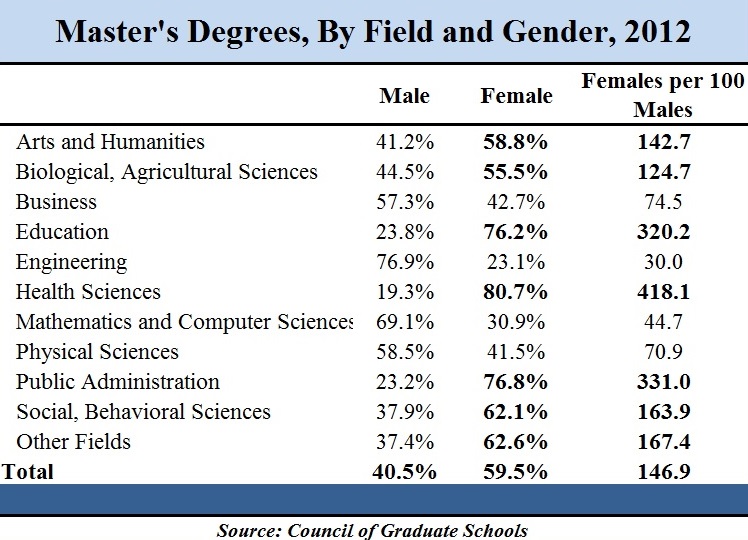
[…]3. The middle chart above shows the gender breakdown for master’s degrees awarded in 2012, and the gender disparity in favor of females is significant – women earned just under 60% of all master’s degrees in 2012, which would also mean that women earned 146.9 master’s degrees last year for every 100 degrees earned by men.
[…]Women represent 58.5% of all graduate students in the U.S., meaning that there are now 141 women enrolled in graduate school for every 100 men.
The author of the post, Dr. Mark Perry, concludes this:
MP: Here’s my prediction – the facts that: a) men are underrepresented in graduate school enrollment overall (100 men were enrolled in 2012 for every 141 women), b) men received fewer master’s (40.5% of the total) and doctoral degrees (47.8% of the total) than women in 2012, and c) men were underrepresented in 7 out of 11 graduate fields of study at both the master’s and doctoral levels last year will get no attention at all from the media, universities and anybody in the higher education industry.
Additionally, there will be no calls for government studies, or increased government funding to address the significant gender disparities in graduate schools, and nobody will refer to the gender graduate school enrollment and degree gaps favoring women as a problem or a “crisis.” Further, neither President Obama nor Congress will address the gender graduate enrollment and degree gaps by invoking the Title IX gender-equity law, like they have threatened to do for the gender gap in some college math and science programs. And there won’t be any executive orders to address the huge gender disparity in graduate schools by creating a White House Council on Boys and Men like the executive order issued by President Obama in 2009 to create the “White House Council on Women and Girls.” Finally, despite their stated commitment to “gender equity,” the hundreds of university women’s centers around the country are unlikely to show any concern about the significant gender inequities in graduate school enrollment and degrees, and universities will not be allocating funding to set up men’s centers or create graduate scholarships for men.
Bottom Line: If there is any attention about gender differences in the CGS annual report, it will likely be about the fact that women are a minority in 4 of the 11 fields of graduate study including engineering and computer science (a gender gap which some consider to be a “national crisis”), with calls for greater awareness of female under-representation in STEM graduate fields of study and careers (except for the STEM field of biology, where women areover-represented). But don’t expect any concern about the fact that men have increasingly become the second sex in higher education. The concern about gender imbalances will remain extremely selective, and will only focus on cases when women, not men, are underrepresented and in the minority.
Men outnumber women in business, computer science, engineering and physical sciences.
I echo Dr. Perry’s point, and want to add this. In traditional Christianity, men are responsible for providing for their families. One of the ways that we men prepare for this is by getting advanced degrees in STEM-related fields, since these fields are the hardest and also pay the best. So with that in mind, what does it mean for men who want to prepare for this provider role that there is this obvious discrimination against men in graduate schools and doctoral programs? Is anyone going to do anything to change policies and incentives to favor men, like they did when women were under-represented? Of course not. The only thing that will be done is to ignorantly urge men to “man up”, while ignoring the real problems, e.g. – a lack of male teachers, schools that are not geared to male learning styles, and so on.
One of the most troubling things I see in the modern church is the tendency of church people and pastors to blame men for not being more aggressive about marrying. Often, the blame is placed on men. Men are told that we need to do better in school, work harder at work, and that we need to be more aggressive about courting and marrying. Very often, you hear the slogan “man up” directed at men, and we are told to stop playing video games and looking at porn and grow up.
The first thing to note is that marriage is much less attractive to men these days. First, the value proposition of marriage changed – especially the problem of no-fault divorce and divorce courts. The economic situation facing men has changed as well – the economy is poor, but the debt is very very high. Those are two important factors.
Another problem is fatherlessness, which is caused by welfare incentives. A lot of the behavior of young men is based on whether there is a father present in the home. The fact of the matter is that single motherhood by choice has become commonplace, and the aggravating factor for this trend is support for welfare. Welfare is bad for two reasons. First, it encourages women to raise children without a father. Boys raised without a father are not as likely to pursue courtship and marriage as boys raised with a father, because fatherlessness harms a boy’s ability to learn to do the things needed for marriage.
Another problem is the availability of pre-marital sex. When a man can get sex without marriage, then he doesn’t feel the same desire to get married.
So there are a few examples of things that we can change to nudge men toward marriage. Just speaking slogans like “man up” to men doesn’t really address these problems.
But in this post, I want to look at a problem that I haven’t even mentioned yet – the problem of schools that don’t produce men who can provide for a family.
Women in the United States now earn 62 percent of associate’s degrees, 57 percent of bachelor’s degrees, 60 percent of master’s degrees, and 52 percent of doctorates.
[…]Boys in all ethnic groups and social classes are far less likely than their sisters to feel connected to school, to earn good grades, or to have high academic aspirations. A recent working paper from the National Bureau of Economic Research documents a remarkable trend among high-achieving students: In the 1980s, nearly the same number of top male and female high school students said they planned to pursue a postgraduate degree (13 percent of boys and 15 percent of girls). By the 2000s, 27 percent of girls expressed that ambition, compared with 16 percent of boys. During the same period, the gap between girls and boys earning mostly A’s nearly doubled—from three to five percentage points.
I was a minority boy before I became a minority man – look at this:
This gap in education engagement has dire economic consequences for boys. A 2011 Brookings Institution report quantifies the economic decline of the median male: For men ages 25 to 64 with no high school diploma, median annual earnings have declined 66 percent since 1969; for men with only a high school diploma, wages declined by 47 percent. Millions of male workers, say the Brookings authors, have been “unhitched from the engine of growth.” The College Board delivered this disturbing message in a 2011 report about Hispanic and African-American boys and young adults: “Nearly half of young men of color age 15 to 24 who graduate from high school will end up unemployed, incarcerated or dead.” Working-class white boys are faring only slightly better. When economist Andrew Sum and his colleagues at the Center for Labor Market Studies at Northeastern University examined gender disparities in the Boston Public Schools, they found that for the class of 2007, among blacks and Hispanics, there were 186 females for every 100 males attending a four-year college or university. For white students: 153 females to every 100 males.
Is this a U.S. – only problem? No. The problem exists in many places. But Dr. Sommers lists some of the initiatives those other countries are taking – trying to understand why boys are different and what needs to be done differently in order to get them to engage and succeed. But we are not doing anything here. Why not?
Well, first – let’s see what works:
In a rare example of the academic establishment taking note of boys’ trouble in school, the Harvard Graduate School of Education recently published a major study, Pathways to Prosperity, that highlights the “yawning gender gap” in education favoring women: “Our system… clearly does not work well for many, especially young men.” The authors call for a national revival of vocational education in secondary schools. They cite several existing programs that could serve as a model for national reform, including the Massachusetts system, sometimes called the “Cadillac of Career Training Education.”
Massachusetts has a network of 26 academically rigorous vocational-technical high schools serving 27,000 male and female students. Students in magnet schools such as Worcester Technical, Madison Park Technical Vocational, and Blackstone Valley Regional Vocational Technical take traditional academic courses but spend half their time apprenticing in a field of their choice. These include computer repair, telecommunications networking, carpentry, early childhood education, plumbing, heating, refrigeration, and cosmetology. AsPathways reports, these schools have some of the state’s highest graduation and college matriculation rates, and close to 96 percent pass the states’ rigorous high-stakes graduation test.
Blackstone Valley Tech in Upton, Massachusetts, should be studied by anyone looking for solutions to the boy problem. It is working wonders with girls (who comprise 44 percent of the student body), but its success with boys is astonishing. According to a white paper on vocational education by the Commonwealth’s Pioneer Institute, “One in four Valley Technical students enter their freshman year with a fourth-grade reading level.” The school immerses these students in an intense, individualized remediation program until they read proficiently at grade level. These potentially disaffected students put up with remediation as well as a full load of college preparatory courses (including honors and Advanced Placement classes), because otherwise they could not spend half the semester apprenticing in diesel mechanics, computer repair, or automotive engineering.
In former times, vocational high schools were often dumping grounds for low achievers. Today, in Massachusetts, they are launching pads into the middle class.
Who could possibly be opposed to turning boys into marriage-minded men? Look:
Recent research shows that enrollment in high school vocational programs has dramatic effects on students’ likelihood of graduating from high school—especially boys. But efforts to engage more boys in career and technical programs face a formidable challenge. In a series of scathing reports, the National Council on Women and Girls Education (NCWGE—a 38-year-old consortium that today includes heavy hitters such the AAUW, the National Women’s Law Center, the ACLU, NOW, the Ms. Foundation, and the National Education Association) has condemned high school vocational training schools as hotbeds of “sex segregation.”
Because of decades of successful lobbying by NCWGE groups, high school and college career and technical training programs face government sanctions and loss of funds if they fail to recruit and graduate sufficient numbers of female students into “non-traditional” fields. Over the years, untold millions of state and federal dollars have been devoted to recruiting and retaining young women into fields like pipefitting, automotive repair, construction, drywall installing, manufacturing, and refrigeration mechanics. But according to Statchat, a University of Virginia workforce blog, these efforts at vocational equity “haven’t had much of an impact.” Despite an unfathomable number of girl-focused programs and interventions, “technical and manual occupations tend to be dominated by men, patterns that have held steady for many years.”
In March 2013 NCWGE released a report urging the need to fight even harder against “barriers girls and women face in entering nontraditional fields.” Among its nine key recommendations to Congress: more federal funding and challenge grants to help states close the gender gaps in career and technical education (CTE); mandate every state to install a CTE gender equity coordinator; and impose harsher punishments on states that fail to meet “performance measures” –i.e. gender quotas.
Instead of spending millions of dollars attempting to transform aspiring cosmetologists into welders, education officials should concentrate on helping young people, male and female, enter careers that interest them. And right now, boys are the underserved population requiring attention.
So. We know what works to make boys into marriage-ready men. And now we know who is standing in the way. What I’d like to see from the man-up crowd, especially the man-up crowd in the church, is a serious assessment of the research on this issue and some action.
But this is what we get from Mark Driscoll: (whom I almost always agree with)
The number one consumer of online pornography is 12- to 17-year-old boys. What that means is he’s home eating junk food, drinking Monster energy drinks, downloading porn, masturbating and screwing around with his friends. That really doesn’t prepare you for responsible adulthood. That’s a really sad picture, especially if you’re a single gal hoping to get married someday. You’re like: “Seriously, that’s the candidate pool? You’ve got to be kidding me.” That’s why 41 percent of births right now are to unmarried women. A lot of women have decided: “I’m never going to find a guy who is actually dependable and responsible to have a life with. So I’ll just get a career and have a baby and just intentionally be a single mother because there are no guys worth spending life with.”
We really need better leadership – informed leadership – on these issues from prominent pastors. They need to start to read some research (e.g. – what Dr. Sommers presented) on these issues. Maybe pastors need to affirm the traditional view of the Bible on sexual morality, and then take on the root cause of the disengaged boys problem: feminism in the schools. We don’t want to take on these problems in a superficial way and then actually make the problem worse by making excuses for views of sexuality that are unBiblical.
By the way, you should subscribe to the AEI podcast, which is on my list of favorite podcasts. And Dr. Sommers has a new edition of her classic book defending young men. If you have ever wondered what is going wrong with men, that book is required reading. It is required reading for anyone who wants to comment on this issue, in fact.


 WINTERY KNIGHT