
Category Archives: Commentary

Are House Republicans doing anything wrong by refusing to fund Obamacare?

Economist Thomas Sowell

Thomas Sowell explains separation of powers.

Excerpt:

The Republican-controlled House of Representatives voted all the money required to keep all government activities going — except for ObamaCare.

This is not a matter of opinion. You can check the Congressional Record.

As for the House of Representatives’ right to grant or withhold money, that is not a matter of opinion either. You can check the Constitution of the United States. All spending bills must originate in the House of Representatives, which means that Congressmen there have a right to decide whether or not they want to spend money on a particular government activity.

Whether ObamaCare is good, bad or indifferent is a matter of opinion. But it is a matter of fact that members of the House of Representatives have a right to make spending decisions based on their opinion.

ObamaCare is indeed “the law of the land,” as its supporters keep saying, and the Supreme Court has upheld its Constitutionality.

But the whole point of having a division of powers within the federal government is that each branch can decide independently what it wants to do or not do, regardless of what the other branches do, when exercising the powers specifically granted to that branch by the Constitution.

[…]When Barack Obama keeps claiming that it is some new outrage for those who control the money to try to change government policy by granting or withholding money, that is simply a bald-faced lie. You can check the history of other examples of “legislation by appropriation” as it used to be called.

Whether legislation by appropriation is a good idea or a bad idea is a matter of opinion. But whether it is both legal and not unprecedented is a matter of fact.

Perhaps the biggest of the big lies is that the government will not be able to pay what it owes on the national debt, creating a danger of default. Tax money keeps coming into the Treasury during the shutdown, and it vastly exceeds the interest that has to be paid on the national debt.

Even if the debt ceiling is not lifted, that only means that government is not allowed to run up new debt. But that does not mean that it is unable to pay the interest on existing debt.

The House Republicans have been passing bill after bill in order to fund essential responsibilities of government. It’s their decision to fund whatever they want, because that’s what the House does. But the Senate has been rejecting most of these bills. If parts of the government are “shut down” it’s the fault of the Senate Democrats. But then again, they are no more obligated to approve whatever the House wants than the House is obligated to approve what the Senate wants. Or what the President wants. That’s why there is a separation of powers: checks and balances.
Obama lied, health care died: 10 states where Obamacare killed existing health care plans

From the Daily Caller.

Excerpt:

President Barack Obama famously promised, “If you like your health care plan, you can keep your health care plan.” He later got even more specific.

“If you are among the hundreds of millions of Americans who already have health insurance through your job, or Medicare, or Medicaid, or the VA, nothing in this plan will require you or your employer to change the coverage or the doctor you have,” Obama said.

But as Obamacare’s rollout approaches, we have learned this is not true. Here are the ten states where consumers may like their health care plans, but they won’t be able to keep them.

I’ll pick just three of the states:

1) California:58,000 will lose their plans under Obamacare. The first bomb dropped in California with a mass exodus from the most populated state’s Obamacare exchange. Aetna, the country’s third largest insurer, left first in July and was closely followed by UnitedHealth. Anthem Blue Cross pulled out of California’s Obamacare exchange for small businesses as well.

Fifty-four percent of Californians expect to lose their coverage, according to an August poll.

3) Connecticut: Aetna, the third largest insurer in the nation, won’t offer insurance on the Obamacare exchange in its own home state, where it was founded in 1850. The reason? “We believe the modification to the rates filed by Aetna will not allow us to collect enough premiums to cover the cost of the plans and meet the service expectations of our customers,” said Aetna spokesman Susan Millerick.

5) South Carolina:28,000 people were insured by Medical Mutual of Ohio, SC’s second-largest insurance company, until it decided to leave the state entirely in July due to Obamacare’s “vast and quite complex” new regulations. Company spokesman Ed Byers said Medical Mutual’s patients would be switched over to United Healthcare plans instead.

When Obama said that people could keep their health care plans if they liked them, what evidence did we have to believe him? What reason did we have to believe that he actually knew what he was talking about, instead of just reading a teleprompter-assisted speech that someone else wrote for him? Had he been governor of a state where he put in a similar program and people kept their health plans? Did he commission a study that showed that people would be able to keep their health plans? What evidence did we have to believe him?

Women earned more doctoral and Master’s degrees than men in 2012

Women now earning majority of graduate degrees

From the American Enterprise Institute Ideas blog.

Excerpt:

The Council of Graduate Schools (CGS) released its annual report recently on U.S. graduate school enrollment and degrees for 2012, and here are some of the more interesting findings in this year’s report:

1. For the fourth year in a row, women in 2012 earned a majority of doctoral degrees. Of the 67,220 doctoral degrees awarded in 2012 at U.S. universities, women earned 34,761 of those degrees and 52.2% of the total, compared to 31,830 degrees awarded to men who earned 47.8% of the total (see top chart above).

[…]2. By field of study, women earning doctoral degrees in 2012 outnumbered men in 7 of the 11 graduate fields tracked by the CGS (see top chart above)

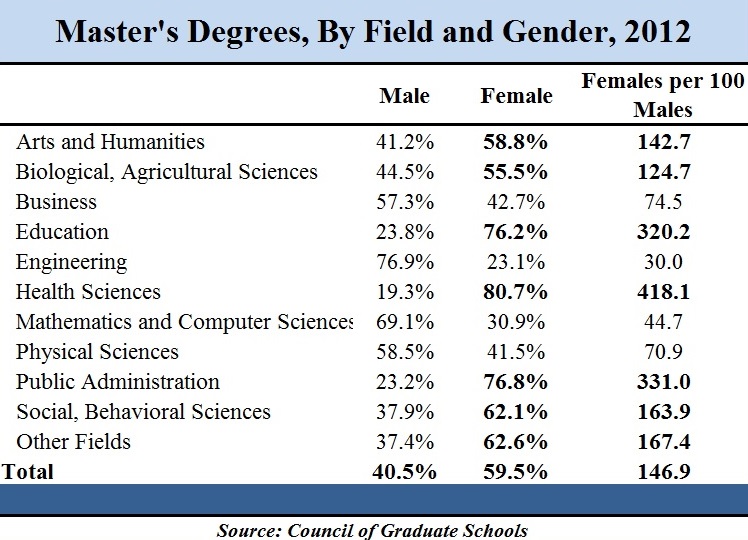
[…]3. The middle chart above shows the gender breakdown for master’s degrees awarded in 2012, and the gender disparity in favor of females is significant – women earned just under 60% of all master’s degrees in 2012, which would also mean that women earned 146.9 master’s degrees last year for every 100 degrees earned by men.

[…]Women represent 58.5% of all graduate students in the U.S., meaning that there are now 141 women enrolled in graduate school for every 100 men.

Click here for the charts.

The author of the post, Dr. Mark Perry, concludes this:

MP: Here’s my prediction – the facts that: a) men are underrepresented in graduate school enrollment overall (100 men were enrolled in 2012 for every 141 women), b) men received fewer master’s (40.5% of the total) and doctoral degrees (47.8% of the total) than women in 2012, and c) men were underrepresented in 7 out of 11 graduate fields of study at both the master’s and doctoral levels last year will get no attention at all from the media, universities and anybody in the higher education industry.

Additionally, there will be no calls for government studies, or increased government funding to address the significant gender disparities in graduate schools, and nobody will refer to the gender graduate school enrollment and degree gaps favoring women as a problem or a “crisis.”  Further, neither President Obama nor Congress will address the gender graduate enrollment and degree gaps by invoking the Title IX gender-equity law, like they have threatened to do for the gender gap in some college math and science programs. And there won’t be any executive orders to address the huge gender disparity in graduate schools by creating a White House Council on Boys and Men like the executive order issued by President Obama in 2009 to create the “White House Council on Women and Girls.”  Finally, despite their stated commitment to “gender equity,” the hundreds of university women’s centers around the country are unlikely to show any concern about the significant gender inequities in graduate school enrollment and degrees, and universities will not be allocating funding to set up men’s centers or create graduate scholarships for men.

Bottom Line: If there is any attention about gender differences in the CGS annual report, it will likely be about the fact that women are a minority in 4 of the 11 fields of graduate study including engineering and computer science (a gender gap which some consider to be a “national crisis”), with calls for greater awareness of female under-representation in STEM graduate fields of study and careers (except for the STEM field of biology, where women areover-represented).  But don’t expect any concern about the fact that men have increasingly become the second sex in higher education.  The concern about gender imbalances will remain extremely selective, and will only focus on cases when women, not men, are underrepresented and in the minority.

Men outnumber women in business, computer science, engineering and physical sciences.

I echo Dr. Perry’s point, and want to add this. In traditional Christianity, men are responsible for providing for their families. One of the ways that we men prepare for this is by getting advanced degrees in STEM-related fields, since these fields are the hardest and also pay the best. So with that in mind, what does it mean for men who want to prepare for this provider role that there is this obvious discrimination against men in graduate schools and doctoral programs? Is anyone going to do anything to change policies and incentives to favor men, like they did when women were under-represented? Of course not. The only thing that will be done is to ignorantly urge men to “man up”, while ignoring the real problems, e.g. – a lack of male teachers, schools that are not geared to male learning styles, and so on.

Related posts