Tag Archives: University

American university gender gap: 57% female, 43% male

Story here in the Gainesville Sun.(H/T Why Boys Fail)

They focus mostly on the gender gaps in Florida universities, but I think these schools reflect the national situation. Boys are falling behind girls in schools, and in life.

Excerpt:

Women make up 57 percent of college enrollment nationally, according to the most recent federal statistics. In Florida, five of the 11 state universities have female enrollments topping 60 percent.

…Graduation rates support the thought. More than 63 percent of women graduate from UF in four years, compared with 42 percent of men.

I agree with this statement from Thomas Mortenson, a senior scholar at the Pell Institute for the Study of Opportunity in Higher Education:

He calls for changing the way in which boys are educated. Boys learn through a more active, hands-on learning style than girls, he said. Mischief-making boys are treated as criminals or sent to special education classes, he said.

“Boys aren’t allowed to be boys today,” he said. “They’re treated as defective girls.”

Does anyone care enough to ask men why they are not motivated? Are there proper schools, teachers and incentives in place to prod men towards responsible manhood?

Are things beginning to turn around in Alberta?

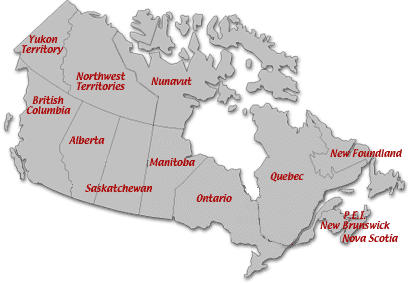
Political Map of Canada

I blogged before about the California school district that is indoctrinating 5-year olds with homosexual propaganda in kindergarten. Well, Canada had a similar problem in the province of British Columbia, where the entire curriculum was going to be designed by gay activists. Now, you might think that the Canadians would be a lot more leftist on such issues, you’d be wrong.

Alberta has a bill in the works to give rights to parents to opt out of programs like this.

Check out this story from the Globe and Mail. (H/T My friend Andrew)

Bill 44, which proposes amendments to Alberta’s Human Rights, Citizenship, and Multiculturalism Act, contains two significant changes. The first adds sexual orientation to proscribed grounds of discrimination. This would bring Alberta’s human rights legislation into conformity with a Supreme Court of Canada ruling that “read in” sexual orientation after it had been deliberately omitted three times by the Legislative Assembly in Edmonton. The amendment has been widely praised.

Section 11 of the new act is more controversial. It requires that parents be notified whenever instructional materials are taught dealing “explicitly with religion, sexuality or sexual orientation.” If parents object in writing, the student can be excused from class.

According to Rob Anderson, Conservative MLA from Airdrie-Chestermere, a riding just north of Calgary, Bill 44 “is one of the most positive and meaningful advances for human rights that this province and this country has seen for many years.” Specifically, he explained, the “parental rights clause” enshrines Article 26 (3) of the United Nations universal declaration of human rights: “Parents have a prior right to choose the kind of education that shall be given to their children.” Premier Ed Stelmach added that his government “supports a very, very fundamental right and that is parental rights with respect to education.”

This article was written by a political science professor at the University of Calgary, which is the school where their prime minister Stephen Harper got both his degrees in economics. They are known for their conservative views. They even have a special name: the “Calgary School” of economics, just like you might talk about the “Chicago School” and the “Austrian School”. Awesome!

Here’s a letter to the editor from a University of Lethbridge (Alberta) professor that I found in the National Post, (H/T Blazing Cat Fur)

Bill 44 is a response to a B. C. Human Rights Tribunal decision mandating two gay activists to commandeer the Ministry of Education in that province to impose a “social justice” course into the curriculum. Parents’ rights, never mind those of local school boards, were overridden.

The B. C. example and Alberta’s Bill 44 indicate how HRCs have poisoned politics in those two provinces.

Now everyone, not just Christian preachers, has to worry about getting dragged before an HRC. A former chairman of the Calgary School Board once proclaimed the state “owns” children who must be liberated from the supposedly claustrophobic viewpoints of their parents. This goes to show how little this debate has to do with promoting critical thinking or cosmopolitanism, as the Post’s article suggests.

If there is an upside to this, perhaps now there will be sufficient support across the political spectrum to dismantle the HRCs.

Go Canada, eh?

Has the university become intolerant and close-minded?

This article by prestigious McGill University ethicist Margaret Somerville is worth reading. (H/T Commenter ECM) She is one of the leading defenders of traditional marriage in Canada. She is a moderate social conservative. Here is a brief summary of her case against same-sex marriage. Her short article in the journal Academic Matters is about the intolerance of the leftist university elites against their opponents.

Here is the abstract:

In this edited excerpt from her Research and Society Lecture to the 2008 Congress of the Humanities and Social Sciences, ethicist Margaret Somerville argues that universities are becoming forums of intolerance. Keeping the university as an intellectually open and respectful place is critical, she says, to finding the “shared ethics” essential to maintaining healthy, pluralistic democracies.

And here is an excerpt in which she discusses the impact of moral relativism on moral disagreements:

That is where political correctness enters the picture. It excludes politically incorrect values from the “all values are equal” stable. The intense moral relativists will tolerate all values except those they deem to be politically incorrect—which just happen to be the ones that conflict with their values.

Political correctness operates by shutting down non-politically correct people’s freedom of speech. Anyone who challenges the politically correct stance is, thereby, automatically labeled as intolerant, a bigot, or hatemonger. The substance of their arguments against a politically correct stance is not addressed; rather people labeled as politically incorrect are, themselves, attacked as being intolerant and hateful simply for making those arguments. This derogatorily -label-the-person-and-dismiss-them-on-the-basis-of-that-label approach is intentionally used as a strategy to suppress strong arguments against any politically correct stance and, also, to avoid dealing with the substance of these arguments.

It is important to understand the strategy employed: speaking against same-sex marriage, for example, is not characterized as speech; rather, it is characterized as a discriminatory act against homosexuals and, therefore, a breach of human rights or even a hate crime. Consequently, it is argued that protections of freedom of speech do not apply.

She illustrates with some examples:

We need to look at what “pure” moral relativism and intense tolerance, as modified by political correctness, mean in practice. So let ‘s look at the suppression of pro-life groups and pro-life speech on Canadian university campuses. Whatever one’s views on abortion, we should all be worried about such developments. Pro-choice students are trying to stop pro-life students from participating in the collective conversation on abortion that should take place. In fact, they don’t want any conversation, alleging that to question whether we should have any law on abortion is, in itself, unacceptable.

In some instances some people are going even further: they want to force physicians to act against their conscience under threat of being in breach of human rights or subject to professional disciplinary procedures for refusing to do so. The Ontario Human Rights Commission recently advised the College of Physicians and Surgeons of Ontario to this effect.

Political correctness is being used to try to impose certain views and even actions that breach rights to freedom of conscience; to shut down free speech; and to contravene academic freedom. I do not need to emphasize the dangers of this in universities. The most fundamental precept on which a university is founded is openness to ideas and knowledge from all sources.

She spends the rest of the paper arguing for a system of “shared ethics” that grounds open, respectful debate between disagreeing parties. I hope this catches on before secular-left moves from censorship to outright violence, against those who would dare to disagree with them.

A short bio of Margaret Somerville

Margaret Somerville is Samuel Gale Professor in the Faculty of Law and a professor in the Faculty of Medicine at McGill University and is the founding director of the McGill Centre for Medicine, Ethics and Law. In 2004, she received the UNESCO Avicenna Prize for Ethics in Science and in 2006 delivered the prestigious Massey Lectures.