Tag Archives: Teacher

Dennis Prager: Does a full-time homemaker swap her mind for a mop?

On National Review, Dennis Prager argues that going to work full-time is not as intellectually fulfilling as being a stay-at-home mother – if it’s done right.

Excerpt:

I seek to refute the idea that full-time home making is intellectually vapid and a waste of a college education.

Let me first state that I have no argument with those mothers who need or even just wish to work outside the home. My argument is with those who believe that staying at home is necessarily mind-numbing.

Nor do I wish to romanticize child rearing. As a rule, little children don’t contribute much to the intellectual life of a parent (although older children who are intellectually curious can spur a parent to seek answers to challenging questions they may not have considered before). Any intellectually alive woman who is a full-time mother must therefore find intellectual stimulation elsewhere.

The point is that she can find such stimulation without leaving her house. Furthermore, the intellectual input she can find is likely to be greater than most women (or men) find working outside the home. There is a reason that about half the audience of my national radio show is female — they listen to talk radio for hours a day and broaden their knowledge considerably. To the Left, the notion that talk radio enhances intellectual development is akin to fish needing bicycles. But that is because the Left’s greatest achievement is demonizing the Right, and because they never actually listen to the best of us.

I am syndicated by the Salem Radio Network. My colleagues are Bill Bennett, Mike Gallagher, Michael Medved, and Hugh Hewitt. Two of us attended Harvard, one Yale, and one Columbia; one of us taught at Harvard, another at the City University of New York, and a third teaches constitutional law at a law school. In addition to reviewing the news and discussing our own views, we all routinely interview authors and experts — left and right — in almost every field. The woman who listens to us regularly will know more about economics, politics, current events, world affairs, American history, and religion than the great majority of men and women who work full-time outside of the home.

Lest the latter seem a self-serving suggestion, there are many other opportunities for full-time homemakers to broaden their intellectual horizons: recorded books and a few television networks, for example. And if a woman can get help from grandparents, neighbors, older children, or a baby sitter, there are also myriad opportunities for study outside the house — such as community-college classes, book clubs, etc. — and for volunteer work in intellectually more stimulating areas than most paid work.

Let me give an example of the woman I know best, my wife. She is a non-practicing lawyer with a particular interest in, and knowledge of, taxation and the economy. She decided to stay home to be a full-time mother to her two boys (one of whom is autistic) and her two nieces (who lost their mother, my wife’s sister, to cancer when they were very young). Between talk radio, History Channel documentaries, BookTV on C-SPAN2, recorded lectures from The Teaching Company/The Great Courses, and constant reading, she has led a first class intellectual life while shuttling kids, folding laundry, and making family dinners.

I guess by now everyone knows my view on this. I expect a good wife to have a college degree, and preferably a graduate degree, and then a couple of  years experience before the children start to arrive. At that point, her job becomes the most important job in the world: making sure that the children that the husband entrusts her with are able to have more of an impact for Christian than either the wife or the husband. That is one of the major reasons why Christians get married in the first place, in my view.

The husband’s job is to go to work and do mindless, useless drudgery in exchange for money. This is the more self-sacrificial role in marriage. He does this so that he can afford to keep a professional teacher in the house to bond with the young children, make sure that they learn empathy and relational skills, and then go on to get bachelor and graduate degrees and influential jobs. She has to plan all of this out and then navigate their path to success – which means she has to know how to follow the path, and how to neutralize any obstacles that may appear. The woman’s role in the home is a massive undertaking, and more significant (ultimately) than the man’s role outside the home.

It’s very important for a woman to choose a man to marry who has this vision for what a woman does in the home. He has to have set the pattern in courtship that it is his responsibility to help her to know as much as possible about all kinds of different subjects. She has to study more than the man, and then impart the knowledge the children. The man only has to have an overall big picture, but the woman has to know the details. In order for the woman to get the details of math, science, foreign policy, economics, etc., she needs to have a constant feed of intellectually challenging materials, and quiet time for study. And it’s the man’s job to provide these materials and that time, so that she can produce influential children.

Please note that I do not endorse any of the other hosts on the Salem Radio Network. In particular, Medved, Bennett and Hewitt are center-left and support Mitt Romney, with all that that entails.
What should you study to prepare yourself for a career?

Here’s an interesting post from the Chapman Kids blog. The father is a software engineer like me, and he’s serious and intentional about how he is leading his children.

In a recent post, he talks about one of the adventures that the two kids are having with a community college professor of English writing. The post is entitled “Continued conversation with the kid’s commie teacher”.

He writes:

As many already know, Kelly and Christian take a “writing” class at the community college where the dear leader of the class lectures on the evils of all things Christian, the beauty of communism and atheism, and the righteousness of drug legalization and abortion.  Today’s topic was Christianity.

[…]At the point when he made the claim that Adam and Eve could not have existed because of the scientific evidence for evolution, Christian raised his hand and said, “There is just as much scientific evidence against macroevolution as there is for it.”

“You don’t believe in evolution!” exclaimed the professor incredulously with a look of disdain and horror.

“We DO believe in microevolution.  It is grossly arrogant for you NOT to question your own beliefs when it comes to evolution” said Kelly.  “That is what you are demanding from us.”

The professor said, “Evolution is established scientific fact” and used several of the standard canards (fossil record, etc.) to establish his point.

Then they were off to the races.  Fortunately, during homeschool, Christian and Kelly had read books like The Victory of Reason:  How Christianity Led to Freedom, Capitalism, and Western Success by Rodney Stark, Understanding Intelligent Design:  Everything You Need to Know in Plain Language by William Dembski and Sean McDowell, Tactics: A Game Plan for Discussing Your Christian Convictions by Greg Koukl, and Intellectuals by Paul Johnson.  The professor was armed with shibboleths about the truth of macroevolution and quotes from John Shelby Spong about the virgin birth.  John Shelby Spong!?!!  You have to be WILDLY out of touch with both current scholarship and reality if you quote John Shelby Spong about virtually anything.  He quotes the likes of losers like Noam Chomsky and Bertrand Russell, too.

I tweeted Kelly a link to the William Lane Craig vs John Shelby Spong. Here is part 1 and part 2 of that debate on Youtube. It’s worth watching if you haven’t seen it before.

Mr. Chapman continues his post:

It is frustrating.  Here is a writing a professor who fervently believes he is making students question their beliefs through these profoundly silly arguments.  The subject matter is objectionable, but this guy’s incompetence is even more objectionable.  He does not appear to understand the difference between scientific method and historic method (very important in discussion of the resurrection).  Neither does he understand that it is impossible to argue for the primacy of scientific method without consideration of its philosophical underpinings.  I guess I should be grateful he is incompetent with respect to his arguments–he does nothing to get the kids to question their faith or worldview.  Still, a lot of taxpayer money is wasted on professors like this throughout the land.

Well, the kids have to learn how to write, but I think it is important to note English classes are especially politicized. There is an awful lot of ideology in English classes, because that’s the easiest place for people who want to teach to go if they want to avoid being corrected by real life. In English, and other similar areas, it’s easier for a teacher to go on and on about their ideas without have to test them against the real world. It’s the easiest subject for teachers to force students to agree with your ideology without allowing them to be able to bring in facts to disagree. Basically, a secular lefty teacher can always find literature (usually modern literature, blech!) that casts Christians as brutes, Christian moral standards as outdated and harmful, and non-Christian behavior as praiseworthy. Because literature is necessarily made-up – it’s just opinion.

Even someone like me who gets courting and chivalry guidance from Shakespeare and Austen is cautious about taking courses in literature. Plus, you can can get into a lot of trouble for disagreeing with the teacher. I took English electives during my undergraduate degree and they do grade you on your viewpoint, something which is much harder for them to do in math, science, physics, chemistry, etc.

Another post from Mr. Chapman discusses how children should study STEM (science, technology, engineering and math) topics, even if those children intend to work in a non-STEM field.

He writes:

I found a great article in the Wall Street Journal this morning titled Generation Jobless:  Students Pick Easier Majors Despite Less Pay.  It had some startling statistics:

Workers who majored in psychology have median earnings that are $38,000 below those of computer engineering majors, according to an analysis of U.S. Census data by Georgetown University.

Wow.  The article tells a story about a student who switched from Electrical and Computer Engineering because her team stayed up past midnight in a lab to write a soda machine program.  They could not get it to work, so to keep from getting a bad grade, she withdrew from the course.  Then she switched from engineering to a double major in psychology and policy management.  Her grades went from B’s and C’s to A’s.  She said her high school did not prepare her for the rigor of an engineering degree.

So the upshot is that she is willing to work in a low-paying career for the rest of her life because she was unwilling to do what was necessary to pass a few hard classes.  I have had this discussion with people before.  If you cannot handle a specifc course, you can do a TON of things to make it happen. You can get a tutor.  You can take the class two or even three times if needed.  You can take a more remedial course, then try the tough one again.  Is it worth it to go to school for a year or two more to do something you like and that pays well for the next forty or fifty year?  It seems like a no brainer.

The crazy part is that even for those who want to do less technical jobs, it is best to prepare for that non-technical job with a hard degree.

Research has shown that graduating with these majors provides a good foundation not just for so-called STEM jobs, or those in the science, technology, engineering, and math fields, but a whole range of industries where earnings expectations are high. Business, finance and consulting firms, as well as most health-care professions, are keen to hire those who bring quantitative skills and can help them stay competitive.

We joked about this quite a bit, but I wanted to get it into the kids head that, if they went to college (not necessarily a given–preparation for many careers–pilot, electrician, writer, and small business owner are monumentally better served through some type of preparation other than college), they could study their passion, but they needed to start with a rigorous degree.  We defined rigorous as anything that involves hard math.  The use of hard math and statistics is creating new breakthroughs in a lot of fields right now:  medicine, agriculture, sociology, etc., etc. etc.

I agree with Mr. Chapman. And I think that he is definitely going to raise successful, influential Christians, because he and the children are well prepared and engaged. He has a great relationship with his kids. They are definitely more advanced than I was when I was their age. It’s encouraging to me to see a Christian Dad who is focused and purposeful about having solid relationships with his kids, and preparing them for the dangerous world they are entering as adults. I think it’s important to admire the people who are getting it right (the parents and the kids together) and learn from their successes. I like that he is still involved with what his children are learning even after they are finished with high school.

I really do think that engineers make the best husbands and fathers. Engineers learn how to gather requirements, evaluate alternative solutions, and then implement. Engineers care about designing to support expandability, maintenance, security and unexpected emergencies. They are easy to argue with, because they believe in logic and evidence. They are pragmatic – they make decisions based on what works, not what sounds good or feels good. Good engineers also have training in project management, budgeting, leadership and resource management, too. The best engineers are the entrepreneurs, who understand business, economics, business law and politics. It really is an ideal skill set for marriage and parenting. Engineers try to build things, and those building skills can be re-used to build a family.

What is issue 2? Should you vote no on Ohio issue 2?

In the 2010 mid-term elections, Republican John Kasich won the governorship and promised to balance the state’s budget by reining in the state’s spending on salaries and benefits for public sector union employees. To accomplish this, the Ohio legislature pass Senate Bill 5. However, an effort is on the ballot to repeal the law, and Ohio voters will get a chance to keep or scrap the law on Tuesday, November 8th, 2011.

Here’s what Ohio’s State Issue 2 is all about:

Issue 2 makes some very fair and common sense requests of our government employees to give local communities the flexibility they need to get taxes and spending under control, while providing the essential services that we rely on.

  • It allows an employee’s job performance to be considered when determining compensation, rather than just awarding automatic pay increases based only on an employee’s length of service.
  • It asks that government employees pay at least 15 percent of the cost of their health insurance premium. That’s less than half of what private sector workers are currently paying.
  • It requires that government health care benefits apply equally to all government employees, whether they work in management or non-management positions. No special favors.
  • It asks our government employees to pay their own share of a generous pension contribution, rather than forcing taxpayers to pay both the employee and employer shares.
  • It keeps union bosses from protecting bad teachers and stops the outdated practice of laying off good teachers first just because they haven’t served long enough.
  • Finally, it preserves collective bargaining for government employees, but it also returns some basic control of our schools and services to the taxpayers who fund them, not the union bosses who thrive on their mismanagement.

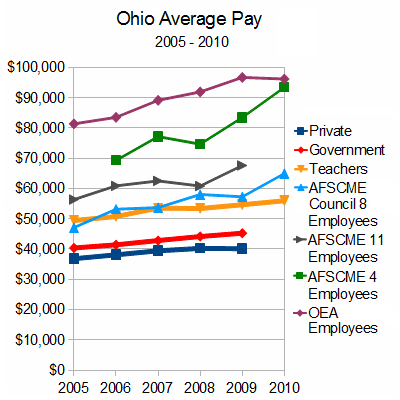
Even under the reforms of State Issue 2, Ohio’s government employees will still receive better pay, better health care and better retirement benefits, on average, than the vast majority of Ohioans who work in the private sector.

There are a number of myths going around about Issue 2, and it’s important to set the record straight, so I’ll do that below.

Ohio Average Pay: Public vs. Private
Ohio Average Pay: Public Unions vs. Private

Myths and truths about Ohio State Issue 2

Here’s a common myth:

State Issue 2 would “cut salaries and benefits.”

The truth:

Issue 2 would not cut salaries or benefits for any government employee. Employees would simply be asked to pay a modest share of their benefits, just like employees in the private sector do. For health care coverage, they would pay at least 15% of their overall plan. (Many local government employees currently pay less than 9% of their health care premium, while the average private sector worker pays upwards of 30%.) In addition, employees would be required to pay their personal share of a retirement plan (only 10%), rather than asking taxpayers to pay that share. That’s not too much to ask at a time when many private sector workers get no retirement benefit at all. Finally, Issue 2 requires that benefits apply equally to all public employees, so no one gets special treatment.

And another common myth:

State Issue 2 will eliminate government employee pensions.

The truth:

Government employees will still get a very generous pension benefit – an annual payment that averages their three highest annual salaries. That’s a pretty nice deal, when many private sector workers get no retirement benefit at all. State Issue 2 only ends a practice where some government union contracts require taxpayers to pick up the tab for BOTH the employer AND employee shares of a required pension contribution. In this economy, it’s simply not right to ask struggling taxpayers to foot the bill so government employees can get a free retirement. Issue 2 simply says government employees should pay their required share (10 percent) and taxpayers will contribute the employer share (14 percent).

Another myth:

State Issue 2 will cut teacher salaries.

The truth:

That’s one of the scare tactics government unions are using to turn people against these reforms. Nothing in Issue 2 determines salary levels. It only ends the practice of handing out automatic pay raises, or “step” increases, and longevity pay – or bonuses just for holding the job for a certain period of time. Issue 2 also asks that performance be added as a factor in teacher compensation, a goal President Barack Obama set out in his national education policy in 2009.

And another myth:

State Issue 2 will cost jobs

The truth:

Just the opposite is true. Ohio’s state and local tax burden ranks among the top third in the nation. As a result, companies large and small have left our state in pursuit of better tax incentives elsewhere, taking hundreds of thousands of jobs with them. If Ohio hopes to compete for new job growth, we have to make our state a more affordable place to live, work and do business. That starts with getting the cost of government under control so we can direct more of our limited resources into economic development, community revitalization and better schools.

More myths about Ohio State Issue 2 are corrected on this page.

Newspaper endorsements

So far, Issue 2 has been endorsed by several Ohio newspapers, including the biggest ones.

The Cleveland Plain Dealer:

The fiscal picture of local governments and school districts, especially, will improve as they are able to right-size their work forces and their expenditures on services. That will happen over time, not overnight, as new contracts are established.

Repeal SB 5, though, and it’s going to be awfully hard for local governments to manage their payrolls without resorting to larger-scale layoffs than would otherwise be necessary. And local governments will continue to be hamstrung by anti-merit seniority rules that lead to worker complacency and protect dead weight and time-servers.

Voting YES on Issue 2 will prevent layoffs by keeping public sector wages and benefits in line with what the private sector can afford to pay.

The Columbus Dispatch:

Despite the insistence of opponents, the effort to reform Ohio’s out-of-balance collective-bargaining law is not an expression of disrespect for or dissatisfaction with Ohio teachers, police officers, firefighters and other government employees. It is a much-needed attempt to restore control over public spending to the public officials elected to exercise that control.

It does not assert that public employees are worth less than the compensation they’re receiving, only that the compensation has grown faster than the public’s ability to pay for it.

[…]With more ability to control the escalation of salary and benefit costs, governments won’t be forced as often to impose layoffs, and might be able to afford to keep even more police and firefighters on the streets.

Again, no one is saying that public sector workers don’t matter – the question is whether we can afford to give them better wages and benefits than the private sector workers who are their customers and their employers. Public sector workers work for the public, and the public can only afford to pay so much.

Conclusion

Government employees are paid 43% more than private sector employees, in salary and benefits:

I think that people who care about the long-term prosperity of Ohio should vote “YES” on Issue 2 to make public and private salaries and benefits MORE EQUAL. Ohio is facing enormous economic pressure from the global recession, and everyone has to make sacrifices. Now is not the time for public sector workers to insist on higher wages and benefits, especially when the private sector workers who pay their salaries don’t make as much money, nor do they get the pensions, nor do they get the better job security. Ohio voters can certainly go back and renegotiate union salaries and benefits when Ohio is out of the recession.

Click here to learn more about Ohio State Issue 2.