Tag Archives: State

Ohio Issue 2: Should voters vote yes or vote no on Ohio State Issue 2?

In the 2010 mid-term elections, Republican John Kasich won the governorship and promised to balance the state’s budget by reining in the state’s spending on salaries and benefits for public sector union employees. To accomplish this, the Ohio legislature pass Senate Bill 5. However, an effort is on the ballot to repeal the law, and Ohio voters will get a chance to keep or scrap the law on Tuesday, November 8th, 2011.

Here’s what Ohio’s Issue 2 is all about:

Issue 2 makes some very fair and common sense requests of our government employees to give local communities the flexibility they need to get taxes and spending under control, while providing the essential services that we rely on.

  • It allows an employee’s job performance to be considered when determining compensation, rather than just awarding automatic pay increases based only on an employee’s length of service.
  • It asks that government employees pay at least 15 percent of the cost of their health insurance premium.  That’s less than half of what private sector workers are currently paying.
  • It requires that government health care benefits apply equally to all government employees, whether they work in management or non-management positions.  No special favors.
  • It asks our government employees to pay their own share of a generous pension contribution, rather than forcing taxpayers to pay both the employee and employer shares.
  • It keeps union bosses from protecting bad teachers and stops the outdated practice of laying off good teachers first just because they haven’t served long enough.
  • Finally, it preserves collective bargaining for government employees, but it also returns some basic control of our schools and services to the taxpayers who fund them, not the union bosses who thrive on their mismanagement.

Even under the reforms of State Issue 2, Ohio’s government employees will still receive better pay, better health care and better retirement benefits, on average, than the vast majority of Ohioans who work in the private sector.

There are a number of myths going around about Issue 2, and it’s important to set the record straight, so I’ll do that below.
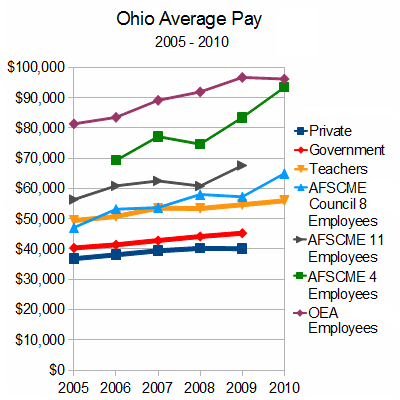
Ohio Average Pay: Public vs. Private
Ohio Average Pay: Public Unions vs. Private

Myths and truths about Ohio State Issue 2

Here’s a common myth:

State Issue 2 would “cut salaries and benefits.”

The truth:

Issue 2 would not cut salaries or benefits for any government employee. Employees would simply be asked to pay a modest share of their benefits, just like employees in the private sector do. For health care coverage, they would pay at least 15% of their overall plan. (Many local government employees currently pay less than 9% of their health care premium, while the average private sector worker pays upwards of 30%.) In addition, employees would be required to pay their personal share of a retirement plan (only 10%), rather than asking taxpayers to pay that share. That’s not too much to ask at a time when many private sector workers get no retirement benefit at all. Finally, Issue 2 requires that benefits apply equally to all public employees, so no one gets special treatment.

And another common myth:

State Issue 2 will eliminate government employee pensions.

The truth:

Government employees will still get a very generous pension benefit – an annual payment that averages their three highest annual salaries. That’s a pretty nice deal, when many private sector workers get no retirement benefit at all. State Issue 2 only ends a practice where some government union contracts require taxpayers to pick up the tab for BOTH the employer AND employee shares of a required pension contribution. In this economy, it’s simply not right to ask struggling taxpayers to foot the bill so government employees can get a free retirement. Issue 2 simply says government employees should pay their required share (10 percent) and taxpayers will contribute the employer share (14 percent).

Another myth:

State Issue 2 will cut teacher salaries.

The truth:

That’s one of the scare tactics government unions are using to turn people against these reforms. Nothing in Issue 2 determines salary levels. It only ends the practice of handing out automatic pay raises, or “step” increases, and longevity pay – or bonuses just for holding the job for a certain period of time. Issue 2 also asks that performance be added as a factor in teacher compensation, a goal President Barack Obama set out in his national education policy in 2009.

And another myth:

State Issue 2 will cost jobs

The truth:

Just the opposite is true. Ohio’s state and local tax burden ranks among the top third in the nation. As a result, companies large and small have left our state in pursuit of better tax incentives elsewhere, taking hundreds of thousands of jobs with them. If Ohio hopes to compete for new job growth, we have to make our state a more affordable place to live, work and do business. That starts with getting the cost of government under control so we can direct more of our limited resources into economic development, community revitalization and better schools.

More myths are corrected on this page.

Newspaper endorsements

So far, Issue 2 has been endorsed by several Ohio newspapers, including the biggest ones.

The Cleveland Plain Dealer:

The fiscal picture of local governments and school districts, especially, will improve as they are able to right-size their work forces and their expenditures on services. That will happen over time, not overnight, as new contracts are established.

Repeal SB 5, though, and it’s going to be awfully hard for local governments to manage their payrolls without resorting to larger-scale layoffs than would otherwise be necessary. And local governments will continue to be hamstrung by anti-merit seniority rules that lead to worker complacency and protect dead weight and time-servers.

Voting YES on Issue 2 will prevent layoffs by keeping public sector wages and benefits in line with what the private sector can afford to pay.

The Columbus Dispatch:

Despite the insistence of opponents, the effort to reform Ohio’s out-of-balance collective-bargaining law is not an expression of disrespect for or dissatisfaction with Ohio teachers, police officers, firefighters and other government employees. It is a much-needed attempt to restore control over public spending to the public officials elected to exercise that control.

It does not assert that public employees are worth less than the compensation they’re receiving, only that the compensation has grown faster than the public’s ability to pay for it.

[…]With more ability to control the escalation of salary and benefit costs, governments won’t be forced as often to impose layoffs, and might be able to afford to keep even more police and firefighters on the streets.

Again, no one is saying that public sector workers don’t matter – the question is whether we can afford to give them better wages and benefits than the private sector workers who are their customers and their employers. Public sector workers work for the public, and the public can only afford to pay so much.

Conclusion

Government employees are paid 43% more than private sector employees, in salary and benefits:

I think that people who care about the long-term prosperity of Ohio should vote “YES” on Issue 2 to make public and private salaries and benefits MORE EQUAL. Ohio is facing enormous economic pressure from the global recession, and everyone has to make sacrifices. Now is not the time for public sector workers to insist on higher wages and benefits, especially when the private sector workers who pay their salaries don’t make as much money, nor do they get the pensions, nor do they get the better job security. Ohio voters can certainly go back and renegotiate union salaries and benefits when Ohio is out of the recession.

Click here to learn more about Ohio Issue 2.

Jennifer Roback Morse debates same-sex marriage at SMU

Description:

Southern Methodist University hosts a debate between Dr J (invited by the Federalist Society) and Dallas attorney (invited by OutLaw) on the legal definition of marriage.

The MP3 file is here.

Here is my snarky summary. Just bear in mind that Dr. J’s opponent is a lawyer, so I want to be clear that I am caricaturing and satirizing her speeches deliberately for humor, and these are not factual statements about what she said at all. So don’t sue me.

I do think you should listen to her actual words to see what factual arguments she makes, and whether her reasoning about what marriage is is compatible with polygamy, incestuous marriage, and anything else involving loving, committed consenting adults. And it you like this debate, you can find other debates on the Ruth Institute podcast. Jennifer Roback Morse is the William Lane Craig of the marriage issue.

Dr. Morse opening speech

No-Fault divorce as a case study:
– studies were produced to show that as long as divorced parents were happy, the divorced children would be fine
– but that research was wrong, children do suffer from divorce
– when you change the understanding of marriage, you change the way that generations relate
– you have to wait for one or more generations to see the effects of the change

The essential public purpose of marriage:
– to attach mothers and fathers to their children and to one another
– marriage exists in virtually every known society
– societies need marriage in order to allow children to develop over a period of time
– human babies have a long period of dependency, and we need parents to sick around for the duration
– there are many private reasons to get married, but we are insterested in the public purpose
– marriage identifies two people who made the child as having responsibility for the child

Marriage and the law
– currently there is the presumption of paternity – the woman’s husband is presumed to be the father
– the presumption of paternity is being changed to the presumption of the parent
– now, the other partner is presumed to be the other parent
– but if same-sex marriage were legal, the partner is never the child’s biological parent
– so, if you redefine marriage, then you are necessarily re-defining parenthood as well
– the children of same-sex unions are not being treated equally
– the children of same-sex unions are not going to have the same access to their biological parents

Children:
– children have a right to know who their mother and father are
– in general, children need a mother and father when they are growing up
– we have lots of data from single parents, divorced parents, divorced/remarried parents to show it

Biological parents and the state:
– in countries that redefine marriage, the state determines who the parents are
– the state creates criteria independent of biology to decide who parents are
– this is too much power for the state to have.

Opponent’s opening speech:

Marriage is about people having feelings of love, not the rights of children:
– marriage has no definition outside of what the state says it is
– there are lots of children being raised in same-sex households
– marriage is not necessarily about parenting, because old infertile people get married
– it doesn’t matter what children need or want, so long as adults feel happy
– lots of liberal organizations say that same-sex parents are BETTER than married bio-parents
– a family can be anything that we decide it is
– marriage has no basis biologically, marriage is assigned by the state with a civil license

Boohoohoo:
– there are lots of rights and responsibilities that married couples have that same-sex couples don’t
– for example bereavement leave, property inheritance, visitation rights, joint tax returns, etc.

Same-sex marriage is the same as multi-racial marriage:
– men and women are indistinguishable and interchangeable

Keep your morality off my selfishness:
– it’s nobody else’s business if children don’t grow up with their mothers and fathers

Dr. Morse’s rebuttal:

Rebuttal:
– your statistics on the number of children in same-sex households are false: here are the actual numbers
– interracial marriage IS marriage: it produces children and requires parents be attached to those children
– a better solution to same-sex couples with children is adoption, not redefining marriage

Opponent’s rebuttal:

You’re a meany!
– if you don’t like same-sex marriage, then you opposed desegregation
– if you don’t like same-sex marriage, then you opposed women getting the right to vote
– I believe in justice, equality and civil rights, you don’t
– Yay social justice! I’m on the right side of history!

Greek men deprived of provider role commit suicide in record numbers

From the Wall Street Journal, a reminder that recessions hit men the hardest. (H/T Tom)

Excerpt:

]Gross domestic product in the second quarter was down more than 7% from a year before, amid government spending cuts and tax increases that, combined, will add up to about 20% of GDP. Unemployment is over 16%. Crime, homelessness, emigration and personal bankruptcies are on the rise.The most dramatic sign of Greece’s pain, however, is a surge in suicides.

Recorded suicides have roughly doubled since before the crisis to about six per 100,000 residents annually, according to the Greek health ministry and a charitable organization called Klimaka.

[…]Suicide has also risen in much of the rest of Europe since the financial crisis began, according to a recent study published in the British medical journal The Lancet, which said Greece is among the hardest hit.Suicide has also risen in much of the rest of Europe since the financial crisis began, according to a recent study published in the British medical journal The Lancet, which said Greece is among the hardest hit.

[…]A suicide help line at Klimaka, the charitable group, used to get four to 10 calls a day, but “now there are days when we have up to 100,” says a psychologist there, Aris Violatzis.

The caller often fits a certain profile: male, age 35 to 60 and financially ruined. “He has also lost his core identity as a husband and provider, and he cannot be a man any more according to our cultural standards,” Mr. Violatzis says.

Heraklion, commercial center of the island of Crete, has had a spate of such deaths.

[…]Victims once were typically adolescent males or old people facing severe illness, and in normal times suicide cases often involve a mixture of factors including mental illness, says local psychiatrist Eva Maria Tsapaki.

But the economic crash has created a “new phenomenon of entrepreneurs with no prior history of mental illness who are found dead every other week,” she says. “It’s very unusual.”

Hans Bader had a recent post about Obama’s stimulus bill that is relevant.

Excerpt: (links removed)

A logical place to have financed road and bridge repairs would have been Obama’s $800 billion stimulus package. But the stimulus package was purged of most investments in roads and bridges, and filled instead with welfare and social spending, out of political correctness, after feminist leaders complained that building and repairing roads and bridges would put unemployed blue-collar men to work, rather than women.

Christina Hoff Sommers points out that “of the 5.7 million jobs Americans lost between December 2007 and May 2009, nearly 80 percent had been held by men,” because men “predominate in manufacturing and construction, the hardest-hit sectors, which have lost more than 3 million jobs since December 2007.” But when some administration officials floated the concept of “an ambitious . . . stimulus program to modernize roads, bridges, schools, electrical grids, public transportation, and dams” as a way of “reinvigorating the hardest-hit sectors of the economy,” “Women’s groups were appalled,” asking “Where are the New Jobs for Women?” and denouncing what they called “The Macho Stimulus Plan.”

As Sommers notes, the Obama administration quickly knuckled under to this pressure, replacing its recovery package with an $800 billion stimulus package that instead “skews job creation somewhat towards women” by spending money instead on social services like welfare that are administered mostly by female employees.

As a 2009 Associated Press story reported, “Stimulus Funds Go to Social Programs Over ‘Shovel-ready’ Projects.” A team of six AP reporters who have been tracking the funds find that the $300 billion sent to the states is being used mainly for health care, education, unemployment benefits, food stamps, and other social services.” Or, as another AP report put it, “Stimulus Aid Favors Welfare, Not Work, Programs.”

The stimulus package also repealed welfare reform, as Slate’s Mickey Kaus and the Heritage Foundation have noted. (In 2008, Obama ran campaign ads claiming to support welfare reform, even though he had sought to undermine welfare reform as an Illinois legislator. The stimulus package largely repealed the 1996 welfare-reform law.)

Men: don’t vote for this man in 2012.

Related posts