
Tag Archives: Single-Motherhood

Survey of scientific literature finds that children need their mom for first 3 years

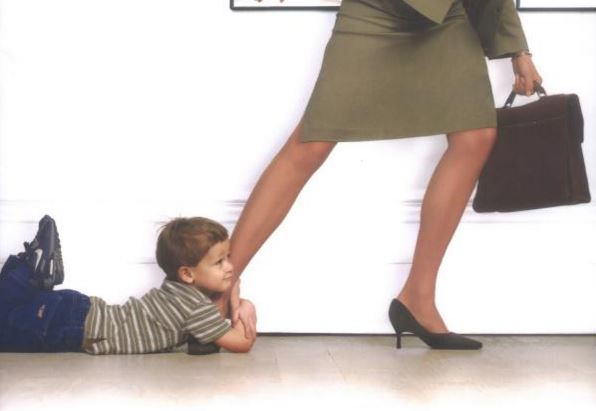
Child grabs for his mom, who is leaving for work

Recently, an article published in the Wall Street Journal reported on research survey done why a far-left Democrat psychotherapist based in far-left New York City. Surprisingly, her book caused an uproar among the author’s left-wing allies. How come?

Excerpt:

Motherhood used to be as American as apple pie. Nowadays it can be as antagonistic as American politics. Ask Erica Komisar.

Ms. Komisar, 53, is a Jewish psychoanalyst who lives and practices on the Upper West Side of Manhattan. If that biographical thumbnail leads you to stereotype her as a political liberal, you’re right. But she tells me she has become “a bit of a pariah” on the left because of the book she published this year, “Being There: Why Prioritizing Motherhood in the First Three Years Matters.”

[…]The premise of Ms. Komisar’s book—backed by research in psychology, neuroscience and epigenetics—is that “mothers are biologically necessary for babies,” and not only for the obvious reasons of pregnancy and birth. “Babies are much more neurologically fragile than we’ve ever understood,” Ms. Komisar says. She cites the view of one neuroscientist, Nim Tottenham of Columbia University, “that babies are born without a central nervous system” and “mothers are the central nervous system to babies,” especially for the first nine months after birth.

What does that mean? “Every time a mother comforts a baby in distress, she’s actually regulating that baby’s emotions from the outside in. After three years, the baby internalizes that ability to regulate their emotions, but not until then.” For that reason, mothers “need to be there as much as possible, both physically and emotionally, for children in the first 1,000 days.”

What’s interesting about this is how the left responds to the science. You might have heard that the left is very fond of science, but veterans of debates about God’s existence know that people on the left tend to be hostile to science that goes against their view: the Big Bang cosmology, cosmic fine-tuning, biological information, irreducible complexity, molecular machines, habitability, etc. And early childhood education is no exception.

More:

Christian radio stations “interviewed me and loved me,” she says. She went on “Fox & Friends,” and “the host was like, your book is the best thing since the invention of the refrigerator.” But “I couldn’t get on NPR,” and “I was rejected wholesale—particularly in New York—by the liberal press.” She did appear on ABC’s “Good Morning America,” but seconds before the camera went live, she says, the interviewer told her: “I don’t believe in the premise of your book at all. I don’t like your book.”

[…]Ms. Komisar tells of hosting a charity gathering for millennials at her apartment. One young woman “asked me what my book was about. I told her, and she got so angry. She almost had fire coming out of her eyes, she was so angry at my message. She said, ‘You are going to set women back 50 years.’ I said, ‘Gosh, I wouldn’t want to do that.’ ”

[…]The needs of children get lost in all this—and Ms. Komisar hears repeatedly that the hostility to her message is born of guilt. When she was shopping for a literary agent, she tells me, “a number of the agents said, ‘No, we couldn’t touch that. That would make women feel guilty.’ ” Another time she was rejected for a speaking gig at a health conference. She quotes the head of the host institution as telling her: “You are going to make women feel badly. How dare you?”

[…]“The thing I dislike the most is day care,” she says. “It’s really not appropriate for children under the age of 3,” because it is “overstimulating” given their neurological undevelopment. She cites the “Strange Situation experiments,” devised in 1969 by developmental psychologist Mary Ainsworth, a pioneer of attachment theory: “A mother and the baby are on the floor playing. The mother gets up and leaves the baby in the room alone. The baby has a separation-anxiety response. A stranger walks in; the baby has a stressed reaction to the stranger.”

[…]Researchers sample the infant’s saliva and test it for cortisol, a hormone associated with stress (and inversely correlated with oxytocin). In a series of such experiments in which Ms. Komisar herself participated, “the levels were so high in the babies that the anticipation was that it would . . . in the end, cause disorders and problems.” In a more recent variant of the experiment, scientists use functional magnetic resonance imaging to look directly at the brain of an infant reacting to photos of the mother and of a stranger.

I spoke to a millennial co-worker in my office who is very proud of his strong feminist views. His wife just had a baby, and they stuck the baby in daycare after 3 months so that she could go back to work. I did speak to him about what the research says (daycare and public school studies are a hobby of mine!), but I try to only disagree with him on one thing at a time, and right now, we’re disagreeing about cohabitation and marital stability. It’s amazing how confident millennials are about taking positions on things like daycare, cohabitation, public schools, etc. without ever having consulted the relevant peer-reviewed science.

Let’s look at one of the studies, to see some evidence.
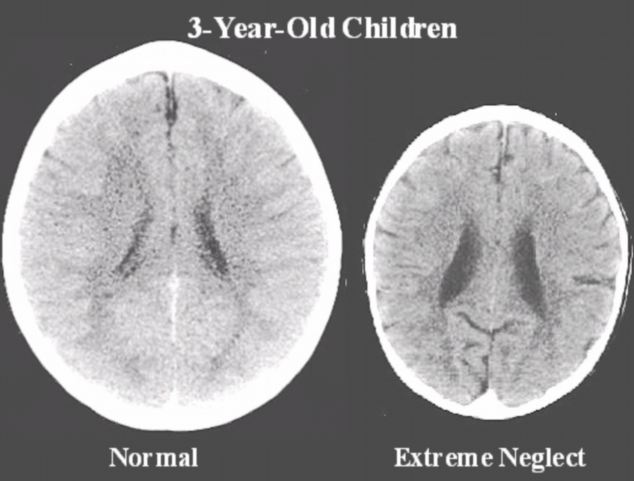
Brain scans of 3-year old children: normal vs neglected

The UK Telegraph reported on a recent study that measured the brain development of 3-year-old children.

Excerpt:

Take a careful look at the image of two brains on this page. The picture is of the brains of two three-year-old children. It’s obvious that the brain on the left is much bigger than the one on the right. The image on the left also has fewer spots, and far fewer dark “fuzzy” areas.

To neurologists who study the brain, and who have worked out how to interpret the images, the difference between these two brains is both remarkable and shocking. The brain on the right lacks some of the most fundamental areas present in the image on the left. Those deficits make it impossible for that child to develop capacities that the child on the left will have: the child on the right will grow into an adult who is less intelligent, less able to empathise with others, more likely to become addicted to drugs and involved in violent crime than the child on the left. The child on the right is much more likely to be unemployed and to be dependent on welfare, and to develop mental and other serious health problems.

[…]The primary cause of the extraordinary difference between the brains of these two three-year-old children is the way they were treated by their mothers. The child with the much more fully developed brain was cherished by its mother, who was constantly and fully responsive to her baby.

The child with the shrivelled brain was neglected and abused. That difference in treatment explains why one child’s brain develops fully, and the other’s does not.

[…]Professor Allan Schore, of UCLA, who has surveyed the scientific literature and has made significant contributions to it, stresses that the growth of brain cells is a “consequence of an infant’s interaction with the main caregiver [usually the mother]”.

The growth of the baby’s brain “literally requires positive interaction between mother and infant. The development of cerebral circuits depends on it.”

Prof Schore points out that if a baby is not treated properly in the first two years of life, the genes for various aspects of brain function, including intelligence, cannot operate, and may not even come into existence. Nature and nurture cannot be disentangled: the genes a baby has will be profoundly affected by the way it is treated.

I always like to consult the findings of science to find out the right way to achieve a goal. This puts off some prospective mates, who want to avoid planning and preparation so they can ride a roller-coaster of emotions and just do whatever they want to be happy in the moment. But in every other area of life, I’ve found that doing things the right way always involves studying and planning, then careful execution of a plan. Nobody passes an exam by going clubbing when they should be studying. Going clubbing is more fun “in the moment”, but studying always gets better results.

In this case, it’s very clear that keeping a mother at home for the first three years of each child would require some earning and saving by me, since men are the principal providers. And I expect that women who are looking for husbands to raise their children with will look for men who have made preparations to give the young children what they need. Not everything a man does is about looks and fun – there are real requirements here. It’s very important for young people to prepare for marriage and raising children by working backward from what the science says about children’s needs.

The more you read about the science, the less wiggle-room there is for feelings. Doing the right thing (saving money for a stay-at-home mom) is hard because it feels bad. But when you inform yourself with science, it makes it easier to override your bad feelings, because you know you’re doing the right thing to achieve a result. If you can’t bring yourself to prepare now to do things right later, then you should read more science, and that might make it easier to do the right thing.


Is living together before marriage the same as getting married?

Marriage and family
Marriage and family

Dad sent me this article from the Daily Signal. Let’s look at it, then I’ll give my opinion on this research.

Five points:

  1. Cohabiting couples are more prone to break up (and break up for good) than married couples
  2. Even after marrying, women who cohabitated prior to marriage are more apt to separate or divorce than those who did not.
  3. Men who cohabit tend to make less money than their married counterparts
  4. Among young mothers, married women are more financially secure than cohabiting women
  5. Cohabiting couples report more depression and more alcohol problems than married couples

The key points for me:

1. Cohabiting couples are more prone to break up (and break up for good) than married couples.  In the May 2003 issue of the Journal of Marriage and Family Study, Georgina Binstock and Arland Thornton found that, in the first year of living together, couples who cohabited were eight times more likely to end their relationships than those who were married.  In the second and third years, those rates decreased to four and three times more likely, respectively.  And when it comes to getting back together after a breakup, cohabiting couples were about a third less likely to get back together again.

2. Even after marrying, women who cohabitated prior to marriage are more apt to separate or divorce than those who did not.  One study demonstrated that for women who lived with their partners before marriage, it was 33 percent more likely for their marriages to result in separation or divorce.

5. Cohabiting couples report more depression and more alcohol problems than married couples.  Even when controlling for race, age and gender, cohabiting individuals reported higher levels of depression than married ones, 2.8 points according to one study.  In another study, cohabiting individuals were three times more likely to report having problems with alcohol consumption than those who were married, as well as 25 percent more problems than single people who did not cohabit.  Cohabiting women indicated more alcohol problems than married women—and men who cohabited said they had more alcohol problems than both married and single men.

This article from the UK Daily Mail that Dina sent me says that 9 in 10 children being born now will see their parents split by the time the children reach 16.

It says:

Nearly nine out of ten babies born to co-habiting parents this year will have seen their family break up by the time they reach the age of 16, says a study.

Half of all children born this year will not be living with both natural parents when they reach their mid-teens, and almost all those who suffer family breakdown will be the children of unmarried parents, added the report.

The study, based on figures from the national census and large-scale academic surveys, extrapolates from current trends and calculates that just 9 per cent of babies born to cohabiting couples today will still have their parents living together by the time they are 16.

The report adds that the declining popularity of marriage and the rise of co-habitation will damage the lives of increasing numbers of children.

The figures were produced by researcher Harry Benson, of the Marriage Foundation think tank, who said: ‘The report provides solid evidence that married parents are more stable than unmarried parents.

[…]The study by the think  tank, which is headed by High Court family division judge Sir Paul Coleridge, was based  on findings from the census of 2001 and recent results from Understanding Society, a government-backed survey which charts the lives of people in 40,000 homes.

The report said that in 2001, four out of ten teenagers aged 15 were not living with both parents, and among the parents of 15-year-olds who stayed together, 97 per cent were married.

The article is from 2013, but I don’t see why things would have gotten any better. We are even more supportive as a society now of adult selfishness and less inclined to take care in our courting so that children are not deprived of fathers and/or mothers through our poor decision making.

So I’ve had experiences mentoring two women who started off as Christian, fell away from Christianity, then returned to the faith. Both of them spend time cohabitating with atheist men. So when I read numbers like the ones above, I want to warn Christian parents. You should not assume that your daughter will always be a Christian when you are raising them. You have to talk to them about these issues and share these numbers with them. Although you can start by telling them what the Bible says, you have to go on from there to explain what a romantic relationship looks like between Christians, and what happens to people who reject the Bible and start having premarital sex.

Can recreational sex turn a selfish, irresponsible man into a marriage-minded provider?

Man helping a woman with proper handgun marksmanship

An article from the American Thinker answers the question that vexes many men. As you read this excerpt below, ask yourself if it is a man or a woman writing this.

First of all, liberal women seem to be having an awful lot of sex these days. They are losing their virginity early, and working their way through as many “alpha males” as possible, but all the while they insist that a stream of recreational-sex relationships is somehow a path to lifelong married love. Can you turn a man who wants nothing more than recreational sex into the perfect husband, simply by invoking the magical power of vagina?

Liberal women think that you can:

On the one hand, liberal women believe wholeheartedly in the idiotic social construct they call, “sexual liberation.”  They pride themselves on losing their virginity, as though that “accomplishment” had ever been above the challenge-scale of an alley cat in heat.

These liberal women I’ve known, having given away their female V-card over and over and over again, all the while scour their host of intimate “trial runs” searching for that mythical, Hollywood-construct, Mr. Right.  This Mr. Right guy, for whom they are searching, is known to them up front as even more sexually-liberated than they, but this little factoid seems not to register in their liberated little heads as they frantically search for the equally mythical family home with the white picket fence, which somehow never gets hit by any of life’s roving tornadoes.  One can almost hear them say in unison, “And they all lived happily ever after.”

I think it’s one of the deepest mysteries of the world why women think that a man who has lots and lots of recreational sex is somehow marriage material. When I think of men who are qualified for marriage, I think of men who have studied hard subjects, gotten marketable skills, worked and worked, saved and saved, and shown that they can be faithful in marriage by exhibiting self-control in the courtship. But liberal women think that all of this reasoning is junk, and you must just jump right into sex to see if the relationship will “work out” or to find out what you “like”. Recreational sex, they insist, is a superior way of finding a husband. Discussing who will do what in an actual marriage and what the actual marriage is for is apparently ineffective.

More:

Evidently, the liberal woman is capable of the most severe form of psychological denial known to humankind.  Certain that one of the men with whom she has copulated without strings will suddenly morph into a faithfully monogamous creature the minute she can convince one of them to say “I do” in front of a few witnesses, the liberal woman marches blindly down the aisle towards near-certain, adulterous doom.  Yet, no amount of honest reason can dissuade liberal women from this self-destructive, moral myopia.

What other term but “morally schizoid” could possibly describe this blatantly contradictory tendency among liberal women?

Having spent their youth casually throwing their own sexual morality to the winds of fairytale “liberation,” these liberal women still steadfastly cling to the faithfully monogamous ideal for that sometime-later moment when they actually do desire all the traditional things — the husband, the kids, the white picket fence — those pesky female-nature embedded longings, which coincidentally ensure the continuation of the human race.

But these liberal women somehow — in perfect schizoid manner — convince themselves that once married, they will be the gratuitous beneficiaries of the monogamous respect they still desire, but have never once demanded or deserved.  Intuitively, women know that strict monogamy provides the only real security for themselves and their own offspring.  Yet, they continue themselves to spurn the demands of monogamy until the very last minute, believing that fidelity springs forth naturally in miraculous profusion among all “married” humans.  Such pure poppycock can only be explained as a mental disorder.

I think women need to ask themselves questions honestly and rationally:

  • can recreational sex make an unemployed man get a job?
  • can recreational sex make a violent man be courteous and respectful?
  • can recreational sex make an atheist turn into a Christian?
  • can recreational sex make a male slut stay faithful?
  • can recreational sex make wastefulness turn into frugality?
  • can recreational sex make laziness turn into diligence?
  • can recreational sex make irresponsibility turn into commitment?

Marriages last because both partners have prepared themselves for self-sacrifice, rational discussions, problem solving and cooperation.

Previously, I provided the male perspective on liberal women’s poor decision-making about men and marriage. Read the article from the American Thinker (written by a woman), then read mine.