Tag Archives: Raising

Dawn Stefanowicz explains her experience being raised by a gay parent

*** WARNING: This post is definitely for grown-ups only! ***

I was listening to the latest Dr. J podcast on “Why Marriage Matters”, and I heard about a woman named Dawn Stefanowicz, who was raised by her gay father in Toronto.

So, I looked around and found this interview with Dawn posted on MercatorNet. This is mature subject matter.

Intro:

Gay marriage and gay adoption are being fiercely debated in a number of countries. Usually these issues are framed as a human rights issue. But whose rights? Patrick Meagher, MercatorNet’s contributing editor in Canada, recently interviewed a woman who was raised by a homosexual father. She feels that her rights as a child were completely ignored.

Dawn Stefanowicz (www.DawnStefanowicz.com) grew up in Toronto. Now in her 40s, she has written a book, Out From Under: Getting Clear of the Wreckage of a Sexually Disordered Home, to be released later this year. Stefanowicz has now been married for 22 years, is raising a family, and also works as an accountant. She has also testified about same-sex marriage in Washington and Ottawa.

Sample:

MercatorNet: How did you feel about what was going on around you?

Stefanowicz: You become used to it and desensitised. I was told at eight years old not to talk about this but I knew that something was wrong. I was not thinking “this is right or wrong” but I was disturbed by what I was experiencing. I was unhappy, fearful, anxious and confused. I was not allowed to tell my father that his lifestyle upset me. You can be four-years-old and questioning, “Where is Daddy?” You sense women are not valued. You think Daddy doesn’t have time for you or Daddy is too busy to play a game with you. All this is hard because as a child this is the only experience you have.

MercatorNet: How did this affect your relationship with others?

Stefanowicz: I had a hard time concentrating in school on day-to-day subjects and with peers. I felt insecure. I was already stressed out by an early age. I’m now in my 40s. You’re looking at life-long issues. There is a lot of prolonged and unresolved grief in this kind of home environment and with what you witness in the subcultures.

It took me until I was into my 20s and 30s, after making major life choices, to begin to realise how being raised in this environment had affected me. Unfortunately, it was not until my father, his sexual partners and my mother had died, that I was free to speak publicly about my experiences.

And:

MercatorNet: Why do so few children speak out?

Stefanowicz: You’re terrified. Absolutely terrified. Children who open up these family secrets are dependent on parents for everything. You carry the burden that you have to keep secrets. You learn to put on an image publicly of the happy family that is not reality. With same-sex legislation, children are further silenced. They believe there is no safe adult they can go to.

I noticed that Bill Muehlenberg has an even more controversial review of Dawn’s book about her childhood, too. When I was doing research on these issues, I read Dr. Jeffrey Satinover’s “Homosexuality and the Politics of Truth” and Dr. Joseph Nicolosi’s “A Parent’s Guide to Preventing Homosexuality“. But I think I am going to buy Dawn’s book, too. It sounds like a tough read, but it may be necessary to understand what is really at stake, so my views can be formed by real data.

NOTE: Comments to this post will be strictly filtered in accordance with Obama’s hate crimes bill.

Related posts

Why did 77% of young unmarried women vote for Obama in 2008?

Consider this analysis from a left-wing site of the 2008 election.

Excerpt:

On Tuesday, the nation made history. It made history in electing the first African American president; it made history in building a bigger margin for the first female Speaker of the House; it made history in delivering the biggest Democratic margin since 1964; it made history in sending a record number of people to the polls and the highest percentage turnout since the 1960 election.

[…]But one thing is immediately clear. Unmarried women played a pivotal role in making this history and in changing this nation. They delivered a stunning 70 to 29 percent margin to Barack Obama and delivered similarly strong margins in races for Congress and the U.S. Senate. Although unmarried women have voted Democratic consistently since marital status has been was tracked, this election represents the highest margin recorded and a 16-point net gain at the Presidential level from 2004.

In particular, note the chart that shows that younger unmarried women voted 77-22 for Obama. 77-22 for Obama. This is actually in keeping with my previous post on this topic, which documented how women have continuously voted for bigger and bigger government since they started voting. The problem with big government policies is that they drain money from the family which is then redistributed outside of the family.

To have a strong family, you need more than just money. You need independence so that you can keep your vision distinct and separate from the vision of the government. If a family depends on the government, then they are beholden to the government’s values. The government can even overrule conscience rights and religious liberty. Keeping the family strong and separate from government is especially important for Christian parents who have a specific goal of passing on their faith to their children.

Here are just a few of the things I thought of that help make a marriage strong: (there are many more)

  • low taxes so the household has more money to spend on the things we need for our plan
  • access to low cost energy provided by domestic energy production by private firms
  • access to low cost, high quality consumer goods through increased free trade
  • the ability to choose homeschooling or private schools (and the more school choice, the better)
  • the ability to fund a retirement plan that covers the family – not anyone else
  • the ability to purchase a health care plan that covers the family – not anyone else
  • the ability to own firearms for protection of the home and the family
  • the ability to pass Christian convictions on to children without interference from the state
  • the ability to speak and act as a Christian in public without reprisals from secular left special interest groups
  • low threat of being the victim of criminal activity
  • low threat of being bankrupted by the costs of divorce court
  • low threat of being arrested on a false domestic violence charge (e.g. – verbal abuse)
  • low threat of never seeing your children because of loss of custody after a divorce
  • low threat of being imprisoned due to failure to pay alimony and child support after a job loss

It seems to me that a vote for Obama is a vote against all of these things. So then why did unmarried women (especially Christian women) vote for him? It seems as thought they are less interested in marriage and family and more interested in having the government provide incentives for anti-child, anti-family behaviors like pre-marital sex, contraceptives, abortions, welfare for single mothers, divorce courts, government coercion of husbands, state-run day-care, government-run schools, in-vitro fertilization, etc. I don’t mind if people need these things, but they should pay for it themselves. but I don’t see why unmarried women should favor family money being spent on government programs that help other people to avoid the cost and consequences of their own decisions.

Why do people oppose same-sex marriage?

UPDATE: The research paper seems to have expired from the FRC web site, but you can see the whole thing here.

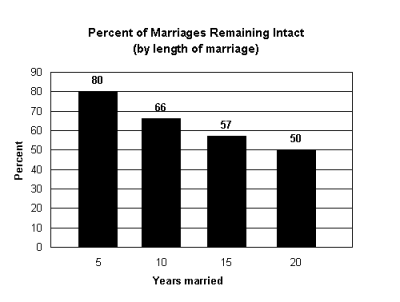
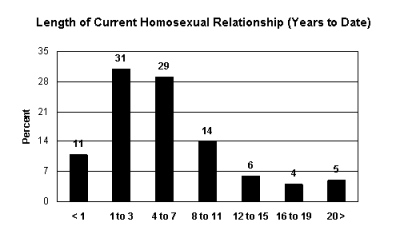
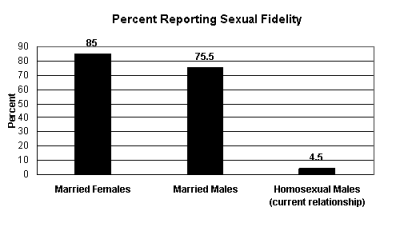
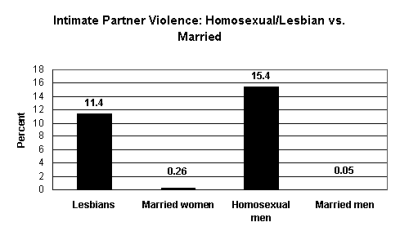
I found this research paper at the Family Research Council web site. The paper compares same-sex couples and heterosexual married couples, in the following ways:

  • relationship duration
  • monogamy vs. promiscuity
  • relationship commitment
  • number of children being raised
  • health risks
  • rates of intimate partner violence

Are there really significant differences between the two arrangements? Let’s take a look at the some of the data.

Relationship duration

% of Marriages Remaining Intact

Source: National Center for Health Statistics, Centers for Disease Control and Prevention (2001)

Length of Current Homosexual Relationship

Source: 2003-2004 Gay/Lesbian Consumer Online Census

Monogamy vs Promiscuity

% Reporting Sexual Fidelity

Sources:Laumann, The Social Organization of Sexuality, 216; McWhirter and Mattison, The Male Couple: How Relationships Develop (1984): 252-253; Wiederman, “Extramarital Sex,” 170.

Rates of intimate partner violence

Intimate Partner Violence

Sources: “Extent, Nature, and Consequences of Intimate Partner Violence,” U.S. Department of Justice: Office of Justice Programs: 30; “Intimate Partner Violence,” Bureau of Justice Statistics Special Report:11.

Conclusion

Marriage is a relationship that has a specific purpose. That purpose is to bind together two opposite natures and to produce children that are biologically linked to the parents. The children gain the benefits of being parented by the two different natures, so they get two perspectives. The fact that the children are genetically linked to two parents helps to ensure the stability of the commitment, as we see in the animal kingdom where animals protect their young.

The goal of marriage is not to increase the happiness of the adults, or to “recognize” the love of adults. The goal of marriage is have two people enter into a relationship where they understand that it is not about adults being fulfilled. Marriage is about people having a goal of raising children, which are tremendously stressful to raise. Marriage requires self-denial and sacrifice in order to raise those children – that is the main point of it. It also requires fidelity and chastity, so that the environment is kept stable for the children over a long period of time.

Children benefit from the stability that is more common in traditional marriages than it is in other arrangements, including heterosexual co-habitation which is similarly unstable (50% greater chance of divorce, more domestic violence, etc.). Therefore, it is important to keep the concept of marriage separate from other kinds of relationships so that the focus on commitment for the sake of the children is clear to those who contemplate marriage. Society needs to give special recognition to married couples, in view of their child-focused commitment.

I apologize in advance if this post causes anyone any harm or distress, I am just trying to explain why people have that opinion. They could be wrong, but that is the case they make. Obviously, married couples fall short of the goal, but that is their goal.

Further study

Two much bigger challenges to marriage are big-government socialism and especially no-fault divorce. I also wrote about same-sex marriage and co-habitation before, in the context of European states like Sweden and Norway.

You may also be interested in a recent post about whether homosexuality is caused by a “gay gene”.