Ryan T. Anderson researches and writes about marriage and religious liberty as the William E. Simon Fellow at The Heritage Foundation. He also focuses on justice and moral principles in economic thought, health care and education, and has expertise in bioethics and natural law theory.
Anderson, who joined the leading Washington think tank’s DeVos Center for Religion and Civil Society in 2012, also is the editor of Public Discourse, the online journal of the Witherspoon Institute of Princeton, N.J.
Anderson’s recent work at Heritage focuses on the constitutional questions surrounding same-sex “marriage.” He is the co-author with Princeton’s Robert P. George and Sherif Girgis of the acclaimed book “What Is Marriage? Man and Woman: A Defense” (Encounter Books, December 2012).
The lecture starts at 7:20 in. The lecture ends at 49:35. There are 32 minutes of Q&A.
Introduction:
When talking about marriage in public, we should talk about philosophy, sociology and public policy
Gay marriage proponents need to be pressed to define what marriage is, on their view
Every definition of marriage is going to include some relationships, and exclude others
It’s meaningless to portray one side as nice and the other mean
Typically, marriage redefiners view marriage as a more intense emotional relationship
Marriage redefiners should be challenged in three ways:
1) Does the redefined version of marriage have a public policy reason to prefer only two people?
2) Does the redefined version of marriage have a reason to prefer permanence?
3) Does the redefined version of marriage have a reason to prefer sexual exclusivity?
Also, if marriage is just about romance, then why is the state getting involved in recognizing it?
The talk: 1) What marriage is, 2) Why marriage matters, 3) What are the consequences of redefining marriage?
What marriage is:
Marriage unites spouses – hearts, minds and bodies
Marriage unites spouses to perform a good: creating a human being and raising that human being
Marriage is a commitment: permanent and exclusive
Male and female natures are distinct and complementary
The public purpose of marriage:
to attach men and women to each other
to attach mothers and fathers to their children
there is no such thing as parenting, there is only mothering and fathering
the evidence shows that children benefit from mothering and fathering
boys who grow up without fathers are more likely to commit crimes
girls who grow up without fathers are more likely to have sex earlier
Children benefit from having a mother and a father
can’t say that fathers are essential for children if we support gay marriage, which makes fathers optional
without marriage: child poverty increases, crime increases, social mobility decreases, welfare spending increases
when government encourages marriage, then government has less do to – stays smaller, spends less
if we promote marriage as an idea, we are not excluding gay relationships or even partner benefits
finally, gay marriage has shown itself to be hostile to religious liberty
Consequences redefining marriage:
it undermines the norm in public like that kids deserve a mom and a dad – moms and dads are interchangeable
it changes the institution of marriage away from the needs of children, and towards the needs of adults
it undermines the norm of permanence
we learned what happens when marriage is redefined before: with no-fault divorce
no-fault divorce: after this became law, divorce rates doubled – the law changed society
gay marriage would teach society that mothers and fathers are optional when raising children
if marriage is what people with intense feelings do, then how can you rationally limit marriage to only two people?
if marriage is what people with intense feelings do, then if other people cause intense feelings, there’s no fidelity
if marriage is what people with intense feelings do, then if the feelings go away, there is no permanence
the public policy consequences to undermining the norms of exclusivity and permanence = fatherless children and fragmented families
a final consequences is the decline and elimination of religious liberty – e.g. – adoption agencies closing, businesses being sued
We’re doing very well on abortion, but we need to get better at knowing how to discuss marriage. If you’re looking for something short to read, click here. If you want to read a long paper that his book is based on.
Over the weekend I debated with Christian feminists about marriage on The Transformed Wife Facebook page. At one point, I asserted that Christian women ought to have some knowledge of how to defend their faith using scientific and historical evidence. Some women asked me: “are you joking?” In this post, I’ll explain why I’m serious, and then I’ll ask them some questions of my own.
Let’s start with Jesus. Jesus set an example by showing the importance of knowing how to answer questions and challenges from skeptics in the New Testament. His favorite way to answer a challenge was by using evidence to support his truth claims.
So, take this story that’s in Mark 2:1-12, Matthew 9:1-8 and Luke 5:17-26. This story is accepted even by skeptical historians because it’s in three different books, and one of them is early (Mark).
In each version of the story, there are 4 steps:
Jesus forgives the sins of a paralyzed man
The Pharisees say that he doesn’t have authority to forgive sins
Jesus miraculously heals the paralyzed man
Jesus explains the evidence of the healing supports his claim that he has authority to forgive sins
And this is an example that you will find repeated in many places in the life of Jesus. You can see it in the Old Testament as well, where God performs miracles so that people who don’t believe in his existence or respect the Scriptures can still be convinced.
Christian apologetics is the skill of being able to give a defense for the Christian worldview when presented with a challenge from a non-Christian.
15 But in your hearts revere Christ as Lord. Always be prepared to give an answer to everyone who asks you to give the reason for the hope that you have. But do this with gentleness and respect,
16 keeping a clear conscience, so that those who speak maliciously against your good behavior in Christ may be ashamed of their slander.
This passage applies to every one who claims to be a disciple of Jesus, whether they like to prepare a defense or not. How much work must you put into it? It depends on the sophistication of the challenges you get. In the mountains of Pakistan, you don’t need to know much because there might not be a sophisticated challenge. In an American society filled with college graduates, the challenges are more difficult. So you will need to prepare a lot more, because the challenges will be a lot harder.
Those who take this passage seriously are doing something difficult, and time-consuming, in order to serve Christ. Buying books costs money. Reading books takes time. Debating with non-Christians can make you look bad to others. But the Bible commands us to be ready with answers for the people around us. Sometimes, doing what the Bible says makes us feel bad, or look bad to others. But we have do what the Bible says anyway. Part of being a real Christian is being obedient even if it feels bad or makes you look bad.
William Lane Craig on apologetics and the culture
What’s in an apologetics book?
So, with that said, let’s look at the table of contents of my favorite introduction to Christian apologetics, which is “Is God Just a Human Invention?” written by Sean McDowell and Jonathan Morrow.
In that book, you will find 18 topics.
Is Faith Irrational? (Commentary by: Gregory Koukl)
Are Science and Christianity at Odds? (Commentary by: John Warwick Montgomery)
Are Miracles Possible? (Commentary by: Gary R. Habermas)
Is Darwinian Evolution the Only Game in Town? (Commentary by: William A. Dembski)
How Did the Universe Begin? (Commentary by: R. Douglas Geivett)
How Did Life Begin? (Commentary by: Fazale R. Rana)
Why Is the Universe Just Right for Life? (Commentary by: Jay W. Richards)
Has Science Shown There Is No Soul? (Commentary by: Dale Fincher and Jonalyn Fincher)
Is God Just a Human Invention? (Commentary by: Garry DeWeese)
Is Religion Dangerous? (Commentary by: Douglas Groothuis)
Does God Intend for Us to Keep Slaves? (Commentary by: Paul Copan)
Is Hell a Divine Torture Chamber? (Commentary by: Frank Turek)
Is God a Genocidal Bully? (Commentary by: Clay Jones)
Is Christianity the Cause of Dangerous Sexual Repression? (Commentary by: Kerby Anderson)
Can People Be Good Without God? (Commentary by: Mark D. Linville)
Is Evil Only a Problem for Christians? (Commentary by: Randy Alcorn)
What Good Is Christianity? (Commentary by: Glenn S. Sunshine)
Why Jesus Instead of the Flying Spaghetti Monster? (Commentary by: Darrell L. Bock)
Prominent atheist scholars are quoted in each chapter to introduce the challenges, and then scholarly arguments and evidence are presented to defend the Christian worldview. The language is simple enough, but the material is solid enough to use in a real debate. I would say that introductory books like this one are more than enough to equip you for everyone who will challenge you.
Why are these 18 topics important? Because these are the questions that atheists ask. These are the questions that cause Christians to leave the faith. These are the questions that your children will face in high school and college, which might cause them to leave the faith.
Let’s start with chapter one. One of the most prominent arguments by atheists is that faith is irrational. This chapter allows you to define faith using the Bible’s definition of faith, which relies on logic and evidence.
Atheists also say that Christianity is at war with science. In chapter 2, they discuss the history of science and how Christianity provided the framework that allowed scientific method to take root and flourish.
Atheists like to claim that miracles are impossible. Chapter 3 defends the view that God, if he exists, is capable of interacting with his created world.
Atheists love to put forward Darwinism as means to deny that God is the designer of life. Chapter 4 explains the concept of intelligent design, and why intelligent design is a better explanation for the history of life.
Atheists love to talk about how the universe has always existed, and there’s no need for a Creator. Chapter 5 contains a philosophical argument that is supported by mainstream science to argue that the universe had a beginning, just like the Bible says.
Atheists love to argue that life can emerge from non-life, and the process is simple. Chapter 6 is written by a biochemist, and it takes a look at the real complexity of the simplest living cell.
Atheists like to argue that the universe itself is just an accident, and there is no need for a Designer. Chapter 7 introduces the scientific evidence for fine-tuning and habitability.
Atheists like to say that there is no soul and no afterlife. Chapter 8 gives some arguments for the existence of the soul.
Atheists like to argue that Christians invent God because God makes them feel good. But chapter 9 explains that having an all-powerful God who can hold humans accountable is the last thing any human would want to invent.
Atheists like to talk about how religion, with it’s habit of teaching to believe in things that can’t be tested, causes religious people to do a lot of harm. Chapter 10 takes a look at the real record of Christianity as a force for good in the world.
Atheists like to talk about slavery in the Bible. Chapter 11 talks about what the Bible really says, and provides some rational responses to the accusation.
Atheists like to talk about eternal punishment in Hell isn’t a just punishment for just getting a few questions wrong on a theology exam. Chapter 12 provides an explanation and defense of the concept of Hell.
Atheists love to talk about how God commanded the Israelites to attack their enemies in the Bible. Chapter 13 explains who their enemies really were, and what was really happening in those wars.
Atheists feel that unrestricted sexual activity is very healthy and normal, and that the Biblical prohibitions outside of male-female marriage are repressive and unhealthy. Chapter 14 explains why God has these rules in place, and supports his rules with evidence.
Atheists love to assert that they don’t need God, because they can behave morally on their own. Chapter 15 explains how to answer this claim by talking about how well atheism grounds objective moral values, objective moral duties, free will and moral accountability: the minimum requirements for objective morality.
Atheists think that the mere existence of natural disasters and human immorality are incompatible with the God of the Bible. Chapter 16 explains why this argument doesn’t work, and why even the concept of evil requires God to exist.
I have an atheist friend in my office who can’t defeat my scientific arguments for the origin of the universe, the fine-tuning and the origin of life. But still, he says to me, even if God exists, why would that matter to my life? Chapter 17 explains what difference Christianity makes in a person’s life.
Atheists think that the life of Jesus has no relevance to their life, and that he has nothing to offer them anyway. Chapter 18 explains the uniqueness of Jesus and explains why his resurrection is relevant to our lives today.
It’s important to understand that this book is not on the level of A. W. Tozer, G.K. Chesterton, Francis Chan, John Piper, etc. Those authors write for a Christian audience and therefore they do not equip you to answer realistic challenges from non-Christians. But the apologetics book we looked at actually equips you to answer challenges from non-Christians using logical arguments and evidence from mainstream history and science. You can use the material in that book in discussions outside the confines of your home and your church.
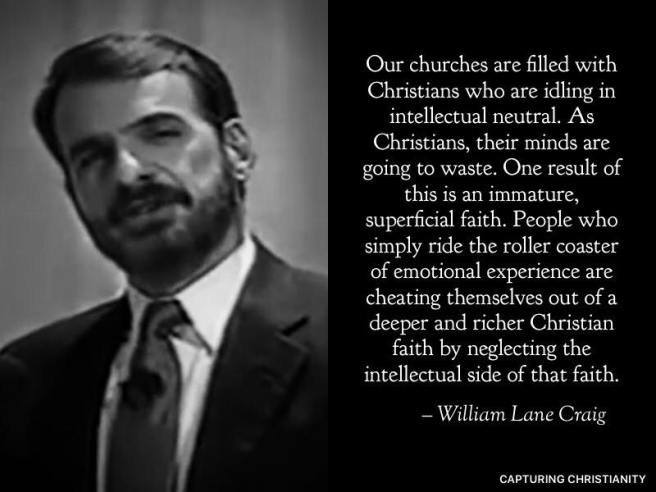
Dr. W. L. Craig: churches don’t prepare Christians to answer skeptics
Wife candidates ought to know apologetics
So, back to my original point about how some Christian feminists responded when I said that during courtship, I ask women questions about how much preparation they have done to answer objections from atheists, like the ones answered in this book. Am I joking?
Well, I think the problem is that Christian feminists don’t understand how Christian men view marriage. Christian men are interested in marriage because they think that their marriage will be an enterprise that produces a return for God. They like the idea of having a clean, comfortable home to host debate viewings and discussions over dessert with skeptics. They like the idea of raising children who will be effective and influential. Men don’t see marriage a means of making us feel better, or having fun, or getting our peers to approve of us. We see it as a way to promote Jesus’ agenda in the world. A Christian man loves his wife precisely because she is his partner in serving God.
So, some questions for all the Christian feminists out there. Are you aware of the actual objections that non-Christians have to the Christian worldview? Have you ever put in any effort to prepare to respond to these objections? Have you trained yourself to be calm and persuasive during discussions about Christianity?
Reading devotions or authors like Rachel Hollis, Beth Moore, and Jen Hatmaker won’t teach a Christian woman anything useful about defending the Christian worldview against atheist objections. And those books also won’t teach you how to evaluate a man to see whether he knows how to defend the Christian worldview, either. You have to study apologetics to know how to evaluate how much a candidate for husband and father roles knows about defending his faith. You have to protect yourself from men who lie about being Christians.
Having a rationally-grounded Christian worldview is essential to the roles of wife and mother. A Christian man cannot be confident about the trustworthiness of a Christian woman’s convictions unless she demonstrates her ability to defend those convictions to non-Christians in the ordinary way that she can surely defend other truth claims in areas where she does have the knowledge. If I ask a Christian nurse to defend the claim that germs are real, she will appeal to logic and evidence. I expect her to have put in as much work into defending the claims of Christianity, and to use the same methods: logic and evidence.
The Stream had an interesting article written by a motherwho explained what happened when she went to experts for help for her a daughter. Her daughter wanted everyone around her to treat her as if she were a boy. The experts didn’t much care what the mother had to say, they just assumed that the child was the authority, and the parents were expected to toe the lie… or else.
She writes:
If you take your child to a clinic to seek help, affirmative care means the therapist must follow the child’s lead. The professionals must accept a child’s professed gender identity. In fact, this is the law in many states.
Under “conversion therapy” bans, questioning a child’s professed gender identity is now illegal.
[…]Parents are encouraged to refer to him as their “daughter” and let him choose a feminine name. Teachers are told to let him use the girls’ bathroom at school. Therapists will reassure parents that social transition is harmless and reversible.
[…]The “experts” tell parents that it is harmful to question their children’s beliefs, that they must support their children’s medical transition, which includes a lifetime dependence on hormones, and that if parents do not comply, their children will be at higher risk of suicide.
The medical personnel prescribed hormone altering drugs to the child:
Once the teenage years begin, affirmative care means giving young people cross-sex hormones. Girls as young as 12 are prescribed testosterone for lifetime usage, while boys are given estrogen.
These are serious hormonal treatments that impact brain development, cardiovascular health, and may increase the risk of cancer.
And it’s not just drugs, it’s surgery, too:
For girls, one standard procedure is called “gender-affirming top surgery,” also known as a double mastectomy. They are performed on girls as young as 13 years old — otherwise healthy girls who believe they are transgender.
[…]There are also teenage girls undergoing radical hysterectomies in the name of gender identity.
Now, the first thing that occurred to me when reading this story was: what happens if the parents don’t want to go along with this? And also, how did these pro-transgender non-parent actors even find out about it?
Canada
In Canada, transgender children can approach teachers in the government-run public schools, and medical personnel in the government-run health care system. And then those government workers can take the parents to the government-run courts to get the will of the secular left state imposed on the parents.
The Federalist first reported on the story in the last week of February:
Clark* first found out that his 12-year-old daughter Maxine was being treated as a boy by her school when he saw her new name in her class’s grade seven yearbook. “Quinn” was the new name her counselor had helped her pick out, and Maxine’s school district in Delta, British Columbia, Canada, had decided that “Quinn” should be treated, for all intents and purposes, as a boy.
According to education policy, parents have no right to know their child’s “preferred sex, gender, or name” at school.
More:
Maxine’s counselors at school … referred Maxine and her mother, Sarah, to a “Dr.” Wallace Wong — a psychologist and LGBT activist who predictably decided that Maxine should be referred to a children’s hospital for testosterone injections when she was only 13. Not to be outdone, the children’s hospital asked Maxine’s parents for permission to begin injecting Maxine with testosterone on her very first visit. Clark said no and refused to sign.
From the middle of August until October, the hospital worked Clark over, trying to get his consent. When he finally refused, the hospital dropped a bombshell threat: simply put, they declared that they didn’t need Clark’s or Sarah’s permission for that matter.
The Federalist later reported that the courts had sided with the government-run school and the government-run health care personnel against the parents.
Ohio
You might wonder what happens in America, if parents choose to fight the experts on the secular left.
Here’s a recent example reported at the Daily Wire:
On Friday, Ohio parents were denied custody of their daughter for not being supportive enough of her alleged transgenderism.
The 17-year-old biologically female child identifies as a boy and claims she has suicidal thoughts over her parents’ lack of support for her transgenderism (they won’t, for example, call her by her new chosen male name). The parents were fighting for custody of their daughter back from the state in an effort to stop potential transgender hormone treatment.
The Hamilton County Judge, Sylvia Sieve Hendon, took the child away from the parents, so that the child could get transgender hormon replacement therapy.
I thought this part was very interesting:
The parents’ Christian faith was used against them in the case by Donald Clancy of the Hamilton County Prosecutor’s Office.
I looked at where Hamilton County is, thinking that it would be in a liberal city like Toledo or Cleveland, or even Columbus. But it’s actually a suburb of Cincinnati, close to Indiana. I assume that the judge, like all government workers, is paid out of the money taken from peope like the parents in taxes. They’re paying this judge to do this to them.
Be careful how you vote
In cases like this, I always like to remind Christians to remember how they vote. Many Christians think that a big secular government should be empowered to hand out welfare, stop global warming, provide free sex changes, free abortions and free contraceptives, etc. But they don’t understand that a big secular government does not care about religious liberty, parental autonomy, or conscience rights. They care about redistributing taxpayer money to buy the votes of people who depend on government.
When the secular leftists control so much of society (the schools, the hospitals, regulations on business, and even regulating free speech!), it’s harder and harder to be a Christian with integrity. Eventually, you’re going to conflict with the secular left, because they’re just everywhere. That’s why Christians should never vote for bigger government. It increases the area of conflict, while simultaneously draining away the money we would need to defend outselves. Because bigger government requires higher taxes, and that means less of what you earn can be used to fight back against the secular leftists.





 WINTERY KNIGHT