
Tag Archives: Marriage

My conversation about morality with an atheist millennial man

This is one of the memes from the Wintery Knight facebook page
A meme that was posted on the WK Facebook page, by the new meme admin

I spent some time talking to an atheist millennial recently. He considers himself a moral person, and he is very helpful to others. I asked him to define morality, and he said that morality was feeling good, and helping other people to feel good. I was trying to think of a way to punch a hole in his feelings-based utilitarianism. How could I show him that happy feelings are not a good basis for morality?

Now, you’re probably thinking that abortion is the most obvious example of something that is morally wrong – it’s just killing a baby because adults don’t want to take responsibility for their foolish pursuit of pleasure. But atheists typically don’t think of unborn children as people. They usually believe in naturalistic evolution, and they are committed to a view of reality where the universe is an accident, human beings are accidents, there are no objective human rights, and biological evolution progresses because the strong survive while the weak die. So you aren’t going to be able to generate a moral standard that includes compassion for weak unborn children on that scenario. If the rule is “let’s do what makes us happy”, and the unborn child can’t voice her opinion, then the selfish grown-ups win.

Instead, I decided to focus on fatherlessness. I asked him whether he thought that fatherlessness harmed children. Surprisingly, he said that it didn’t, and that he had a relative who was doing a great job raising fatherless kids. I asked him if he had ever looked at the research on what father absence does to children. He hadn’t. Then I asked him if a system of sexual rules based on “me feeling good, and other people around me feeling good”, was likely to protect children. He went silent.

Well, that was the end of that conversation. And I think it was a nice window into how millennials – who are absolutely clueless about what research says about sex, dating, marriage and parenting – think about relationships. They’re making decisions based on their feelings, then acting surprised when their “common sense” decisions based on happiness “in the moment” blow up in their faces, and destroy the lives of their children, including their unborn children.

Unfortunately, young people are having children outside of a marriage commitment more and more.
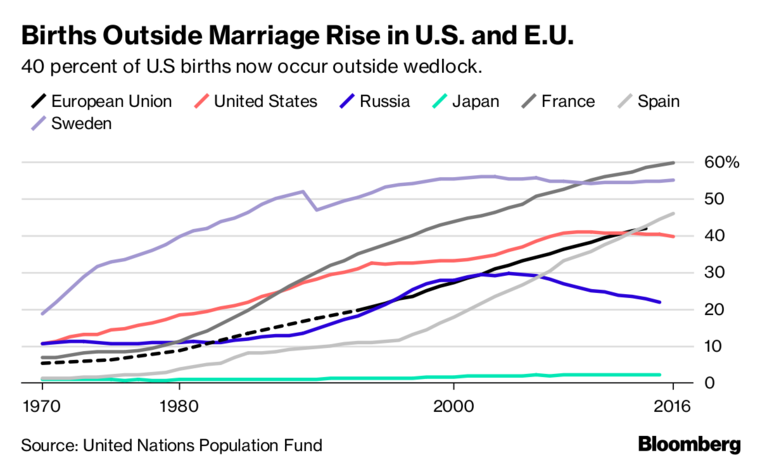
Out-of-wedlocks births rising as cohabitation replaces marriage

Far-left Bloomberg News reports:

Forty percent of all births in the U.S. now occur outside of wedlock, up from 10 percent in 1970, according to an annual report released on Wednesday by the United Nations Population Fund (UNFPA), the largest international provider of sexual and reproductive health services. That number is even higher in the European Union.

The EU has a higher rate of fatherless births because they have high taxes and big government to allow women to have children without having to commit to a husband:

The EU likely sees more births out of wedlock because many member countries have welfare systems that support gender-balanced child care, said Michael Hermann, UNFPA’s senior adviser on economics and demography, in an interview. Public health care systems, paid paternal leave, early education programs and tax incentives give unwed parents support beyond what a partner can provide.

More welfare and more government services make it easier for women to pursue relationships with men who aren’t interested in marriage. Hot bad boys who give them all the tingles. Big government makes those boring, predictable marriage-ready men dispensable. Big government also makes it much harder for a man who does marry to afford a stay-at-home mother for his kids, because he has to pay higher taxes for big government.

More:

The data show such births in the U.S. and EU are predominantly to unmarried couples living together rather than to single mothers, the report says.

[…]Jones also noted that the rise in births outside of marriage is closely correlated to delays in childbearing. “Women are claiming their ground professionally,” she said. “Delaying motherhood is a rational decision when you consider the impact it can have on your career, and that’s contributing to this trend.”

[….]The traditional progression of Western life “has been reversed,” said John Santelli, a professor in population, family health and pediatrics at Columbia’s Mailman School of Public Health. “Cohabiting partners are having children before getting married. That’s a long-term trend across developing nations.”

Regardless of marital status, more couples are choosing not to have kids at all. The U.S. fertility rate hit a historic 30-year low last year, according to the Centers for Disease Control and Prevention. Hermann said the rise in births outside of wedlock has actually mitigated the decline in fertility, which “would be much steeper if women weren’t having children outside marriage.”

What’s interesting about this anti-marriage article is that they have nothing to say about the research showing that cohabitation – and also marriages that occur after a period of cohabitation – are inferior to no-cohabitation marriages. People who are serious about self-control, and who are serious about committing through thick and thin, tend to have longer lasting marriages. But we don’t prioritize chastity, fidelity and self-sacrificial commitment anymore, because that relationships that require self-denial make us unhappy.

The article concludes: “We can’t go back to the ’50s”. Right. Because if feelings-based “morality” is assumed, then any choice between adult happiness and children’s happiness will favor the adults. Today’s young people carefully AVOID any evidence that contradicts their new “happiness-morality”. They act surprised when their unstable relationships dissolve, leaving children separated from their fathers. Marriage requires that both partners have a system of morality that puts the commitment above happy feelings. People have to be accustomed to doing things that feel bad, just because they are good and moral things to do according to an objective standard of morality. The new atheist morality of happy feelings doesn’t develop the character needed for commitment.

If you ask an atheist millennial, they think they are doing a great job of being “moral”. They don’t see the messes they are making for children as something that they are causing themselves, with their own foolish feelings-based decision-making. They think they know everything about relationships through their feelings. They think that they are exempt from the patterns of cause and effect in the peer-reviewed research.


Large-scale UK study confirms the importance of fathers to children

A family praying and reading the Bible

Dina sent me this article from the UK Daily Mail.

Excerpt:

A father’s love is as important to a child’s emotional development as a mother’s, a large-scale study has confirmed.

Examining the cases of more than 10,000 sons and daughters revealed how a cold or distant father can damage a child’s life, sometimes for decades to come.

The review of 36 studies from around the world concluded that his love is at least as important to youngsters as that of their mothers.

Researcher Professor Ronald Rohner said that fatherly love is key to  development and hopes his findings will motivate more men to become involved in caring for their offspring.

‘In the US, Great Britain and Europe, we have assumed for the past 300 years that all children need for normal healthy development is a loving relationship with their mother,’ he said.

‘And that dads are there as support for the mother and to support the  family financially but are not required for the healthy development of the children.

‘But that belief is fundamentally wrong. We have to start getting away from that idea and realise the dad’s influence is as great, and sometimes greater, than the mother’s.’

His conclusions came after he examined data from studies in which  children and adults were asked how loving their parents were.

Questions included if they were made to feel wanted or needed, if their  parents went out of their way to hurt their feelings and if they felt loved.

Those taking part also answered questions about their personality. These ranged from ‘I think about fighting or being mean’ to ‘I think the world is a good, happy place’.

Tallying the results showed that those rejected in childhood felt more anxious and insecure as well as hostile and aggressive.

Many of the problems carried over into adulthood, reported the study published in the journal Personality and Social Psychology Review.

Crucially, a father’s love was often just as important as a mother’s. In some cases, it was even more so. One reason for this may be that rejection is more painful when it comes from the parent the child regards as more powerful or respected.

You can read more about how fatherlessness damages children here.

I think the first question we should ask the people who want to redefine marriage is this: “which parent to do you think that a child can do without? the mother or the father?”. We must do everything we can as a society to keep both of a child’s natural parents in the home while the child grows up. If we really care about children, then we should prefer to meet their needs, even if the grown-ups have to be a bit more responsible in their decision making. if the conflict is between innocent children and selfish grown-ups, then the children should win.

We need laws and policies that promote traditional marriage, not laws and policies that break it down and destroy it. Repealing no-fault divorce, lowering subsidies for single motherhood, and making shared parenting the default position, would all help solve the problem. Policies like school choice and lower corporate tax rates helps men to be able to perform in their role as provider. We have to be practical and ask: “what makes men capable of marriage and parenting?” If we want strong fathers, then it makes sense to ask how to make fatherhood more reasonable: what do men need in order to do what we want them to do?

Christians should be especially concerned about the presence of fathers, given the evidence I blogged about before showing how the presence of quality fathers is essential for passing Christian beliefs on to children. Churches need to ask themselves tough questions: Are we teaching women how to choose men based on practical concerns and proven abilities in our churches? And are we doing a good job of attracting men to churches by promoting the masculine, practical aspects of Christianity that men like – like science, apologetics debates, economics and foreign policy?

Frequent denial of sex breaks the marriage covenant as much as adultery

Marriage and family
Marriage and family

Let’s start this post by quoting a passage from the Bible.

1 Corinthians 7:1-5:

Now concerning the things about which you wrote, it is good for a man not to touch a woman.

But because of immoralities, each man is to have his own wife, and each woman is to have her own husband.

The husband must fulfill his duty to his wife, and likewise also the wife to her husband.

The wife does not have authority over her own body, but the husband does; and likewise also the husband does not have authority over his own body, but the wife does.

Stop depriving one another, except by agreement for a time, so that you may devote yourselves to prayer, and come together again so that Satan will not tempt you because of your lack of self-control.

So with that in mind, I want to turn to a well-known Jewish talk show host named Dennis Prager, who is much loved and listened to by Christians. Dennis Prager features a lot of discussions about male-female relationships on his show, particularly during the male-female hour. In this two part series on male sexuality, he explains why women should not deprive their husbands of sex without a good reason.

Part 1 is here.

Excerpt:

It is an axiom of contemporary marital life that if a wife is not in the mood, she need not have sex with her husband. Here are some arguments why a woman who loves her husband might want to rethink this axiom.

First, women need to recognize how a man understands a wife’s refusal to have sex with him: A husband knows that his wife loves him first and foremost by her willingness to give her body to him. This is rarely the case for women. Few women know their husband loves them because he gives her his body (the idea sounds almost funny). This is, therefore, usually a revelation to a woman. Many women think men’s natures are similar to theirs, and this is so different from a woman’s nature, that few women know this about men unless told about it.

This is a major reason many husbands clam up. A man whose wife frequently denies him sex will first be hurt, then sad, then angry, then quiet. And most men will never tell their wives why they have become quiet and distant. They are afraid to tell their wives. They are often made to feel ashamed of their male sexual nature, and they are humiliated (indeed emasculated) by feeling that they are reduced to having to beg for sex.

When first told this about men, women generally react in one or more of five ways…

He then explains the 5 ways that women respond to this.

Here’s one:

1. You have to be kidding. That certainly isn’t my way of knowing if he loves me. There have to be deeper ways than sex for me to show my husband that I love him.

I think that this is a common mistake that liberal women make because they think that men are just hairy women. But men are not women, we are different and sex means something different to men than it does to women. In the past, most women understood how men are different than women, but younger women have been taught that there are no differences between the sexes. To think any different is “sexism”.

Here’s another from the list:

4. You have it backwards. If he truly loved me, he wouldn’t expect sex when I’m not in the mood.

Again, this is the common mistake that many younger women today make in thinking that love is a one-way street – flowing from men and children to the woman. If men and children DON’T do what the woman wants, or if they make demands on her, then they don’t “love” her and she is justified in ignoring them.

Liberal women have been taught to believe that they are always victims or some group of oppressors, such as men and children or corporations. It makes them rebel against having to do anything for anyone else, because they don’t want to be “oppressed”. That makes them unable to accept that relationships are give-and-take, Once a commitment to love another person permanently has been made, then each person has responsibilities to provide for the needs of the other.

I actually had a conversation with a Christian woman once who said that women should not be obligated to do things that they didn’t feel like doing. I asked her if men were obligated to go to work when they didn’t feel like going. She said yes, and acted as though I were crazy for asking. I just laughed, because she didn’t even see the inconsistency. The truth is that men often don’t feel like working, but they get up and go to work anyway, whether they like it or not (in most cases). Similarly, a women should feel obligated to have sex with her husband, even if she is not in a perfect mood for it (in most cases). Sometimes, a man stays home from work, and it’s OK. And sometimes a woman says no to sex, and it’s OK. But it’s not OK to stop doing it for months and months with no good reason.

Part 2 is here.

Excerpt:

Here are eight reasons for a woman not to allow not being in the mood for sex to determine whether she denies her husband sex.

He then explains the eight reasons.

Here’s one of them:

7. Many contemporary women have an almost exclusively romantic notion of sex: It should always be mutually desired and equally satisfying or one should not engage in it. Therefore, if a couple engages in sexual relations when he wants it and she does not, the act is “dehumanizing” and “mechanical.” Now, ideally, every time a husband and wife have sex, they would equally desire it and equally enjoy it. But, given the different sexual natures of men and women, this cannot always be the case. If it is romance a woman seeks — and she has every reason to seek it — it would help her to realize how much more romantic her husband and her marriage are likely to be if he is not regularly denied sex, even of the non-romantic variety.

Women have to engage their husbands if they expect their husbands to engage in the marriage as a husband and father. Men can’t do their protector, provider and spiritual leader roles forever unless their needs are met at some point. Performance of these male duties is not free. Wives have to love their husbands in the way that men expect to be loved. That’s what they vowed to do in the wedding, isn’t it?

At the end of the article, Prager makes a general point about women that I think needs to be emphasized over and over and over:

That solution is for a wife who loves her husband — if she doesn’t love him, mood is not the problem — to be guided by her mind, not her mood, in deciding whether to deny her husband sex.

This problem of sex-withholding is so widespread, that it really makes me (although I am a virgin) wonder what women think that marriage is about anyway. When a woman vows to love her husband, what do they think that word really means? Why do women think that men marry? What do men want that marriage provides for them? Which of those needs are the women’s responsibility to provide for? I think these are questions that men should ask women. I think women should be prepared to answer them. Men should expect that women be reading books on men and marriage, and that she has relationships with men where she is giving support, respect, affirmation, affection and approval. You can learn a lot about a woman by how she treats her father, for example.

Unfortunately, many men today haven’t thought through what they need from wives in a marriage. They spend their young years chasing women who are fun and sexually permissive. Every husband I asked about what they need has told me that respect, affirmation, affection and regular sex are more important than appearance and fun. Pre-marital sex, having fun, getting drunk, and going out, etc. are not the right foundation for marriage – which requires mutual self-sacrifice in order to work.

Another point: I have a friend who is very concerned that men are breaking sexual rules, but he seems oblivious to 1 Corinthians 7:1-5. I asked him privately what he thought about sex-withholding, and whether this might cause husbands to turn to pornography and even affairs, and I mentioned 1 Corinthians 7:1-5. He said: “no, it’s not something I take much interest in”. I was tempted to ask him if the Bible was something that he does not take much interest in.

I think he misreads 1 Corinthians 7:1-5 so that it could only be used to condemn men. If that were his view, then it actually worries me if well-meaning men are actually undermining marriage, by teaching women that they have no responsibilities to keep the marriage going, and helping them to feel like victims when their marriages fall apart. Sometimes even people who claim to be pro-marriage can undermine marriage practically-speaking, because of their unBiblical belief that women are “naturally good” and should not have any responsibilities in a marriage.

I thought this attitude was so interesting in view of what I read in the Proper Care and Feeding of Husbands. In that book, Dr. Laura urges women to be sensitive to their husbands’ different male natures in order to avoid them looking at pornography and having affairs. Withholding sex from a man is the equivalent of a man withholding conversation to a woman. Sex is how a man feels loved! What’s remarkable is how female callers on her show are shocked that men react badly to being deprived of sex.

I do think that some men will look at porn and cheat regardless of what their wife does sexually, but then it again falls to the woman to choose a man who has demonstrated that he has self-control – i.e., a virgin who has remained chaste with her throughout the courtship and protected her from doing sexual things outside of the covenant context. Chastity is hard, but it is how a man loves his wife self-sacrificially, before he even meets her. It should be a trait much sought after and respected by women. Basically, women need to be led by their minds, not by their feelings, when choosing a husband.

A man has to get up and go to work every day for his family, regardless of whether he feels like it or not. In fact, the many decisions he has made before getting married are also made not because they make him happy, but because he needs to be responsible to his future wife and children. The decision to study science? Loving obligation. The decision to go to grad school in science? Loving obligation. The decision to work in a demanding, risky career? Loving obligation. The decision to save money and eat instant oatmeal for dinner? Loving obligation. Men don’t do these things because we enjoy them. We do it because we love our wives and children self-sacrificially, before we ever even meet them. I think that women need to do the same.