Tag Archives: Marriage

Wage gap: are women paid less than men because of discrimination?

The pay gap is caused by women's own choices
The pay gap is caused by women’s preference for having children

Liberal feminist Hanna Rosin takes a look at this question in the far-left Slate, of all places.

Excerpt:

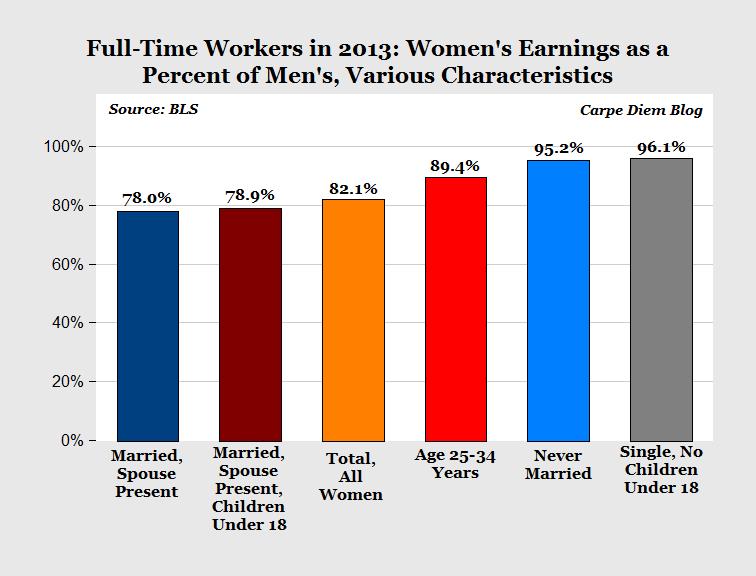
The official Bureau of Labor Department statistics show that the median earnings of full-time female workers is 77 percent of the median earnings of full-time male workers. But that is very different than “77 cents on the dollar for doing the same work as men.” The latter gives the impression that a man and a woman standing next to each other doing the same job for the same number of hours get paid different salaries. That’s not at all the case. “Full time” officially means 35 hours, but men work more hours than women. That’s the first problem: We could be comparing men working 40 hours to women working 35.

How to get a more accurate measure? First, instead of comparing annual wages, start by comparing average weekly wages. This is considered a slightly more accurate measure because it eliminates variables like time off during the year or annual bonuses (and yes, men get higher bonuses, but let’s shelve that for a moment in our quest for a pure wage gap number). By this measure, women earn 81 percent of what men earn, although it varies widely by race. African-American women, for example, earn 94 percent of what African-American men earn in a typical week. Then, when you restrict the comparison to men and women working 40 hours a week, the gap narrows to 87 percent.

But we’re still not close to measuring women “doing the same work as men.” For that, we’d have to adjust for many other factors that go into determining salary. Economists Francine Blau and Lawrence Kahn did that in a recent paper, “The Gender Pay Gap.”.”They first accounted for education and experience. That didn’t shift the gap very much, because women generally have at least as much and usually more education than men, and since the 1980s they have been gaining the experience. The fact that men are more likely to be in unions and have their salaries protected accounts for about 4 percent of the gap. The big differences are in occupation and industry. Women congregate in different professions than men do, and the largely male professions tend to be higher-paying. If you account for those differences, and then compare a woman and a man doing the same job, the pay gap narrows to 91 percent. So, you could accurately say in that Obama ad that, “women get paid 91 cents on the dollar for doing the same work as men.”

I believe that the remainder of the gap can be accounted for by looking at other voluntary factors that differentiate men and women.

The Heritage Foundation says that a recent study puts the number at 95 cents per dollar.

Excerpt:

Women are more likely than men to work in industries with more flexible schedules. Women are also more likely to spend time outside the labor force to care for children. These choices have benefits, but they also reduce pay—for both men and women. When economists control for such factors, they find the gender gap largely disappears.

A 2009 study commissioned by the Department of Labor found that after controlling for occupation, experience, and other choices, women earn 95 percent as much as men do. In 2005, June O’Neil, the former director of the Congressional Budget Office, found that “There is no gender gap in wages among men and women with similar family roles.” Different choices—not discrimination—account for different employment and wage outcomes.

A popular article by Carrie Lukas in the Wall Street Journal agrees.

Excerpt:

The Department of Labor’s Time Use survey shows that full-time working women spend an average of 8.01 hours per day on the job, compared to 8.75 hours for full-time working men. One would expect that someone who works 9% more would also earn more. This one fact alone accounts for more than a third of the wage gap.

[…]Recent studies have shown that the wage gap shrinks—or even reverses—when relevant factors are taken into account and comparisons are made between men and women in similar circumstances. In a 2010 study of single, childless urban workers between the ages of 22 and 30, the research firm Reach Advisors found that women earned an average of 8% more than their male counterparts. Given that women are outpacing men in educational attainment, and that our economy is increasingly geared toward knowledge-based jobs, it makes sense that women’s earnings are going up compared to men’s.

When women make different choices about education and labor that are more like what men choose, they earn just as much or more than men.


How parents and churches can make better women than the Bachelorette Hannah Brown

Do young women understand how to get to a stable marriage?

My friend Carla sent me a video from a TV show called the Bachelorette, in which a woman named Hannah Brown explains why she thinks that having recreational premarital sex is compatible with Christianity. In this post, I wanted to explain to Christian parents and churches why serious Christian men do not consider women like Hannah Brown to be appropriate candidates for marriage.

First, if you haven’t seen the clip, you can watch it here:

So I just wanted to go over what I think marriage is for, and then try to judge whether Hannah Brown’s view of men, sex and marriage offers me any value. I think this will be useful for parents and churches, because I think a lot of Christian men see marriage the same way as I do.

So, when I think of marriage, I’m looking for a partner who can help me to achieve goals that are consistent with the character of God revealed in the ministry of his son Jesus. So, what did Jesus do? Jesus demonstrated the existence of God by showing people evidence (miracles). Jesus taught people about what moral choices they should make and how to treat others. Jesus taught people that marriage is for one man and one woman, and that children should not be prevented from knowing God. And Jesus taught that people who sin can be forgiven, but that they should “sin no more”.

So, let’s take a look at what marriage-minded Christian men are looking for, and then decide whether Hannah Brown is doing a good job of preparing herself for marriage.

I’d like to model a successful, fruitful marriage to non-Christians, e.g. college students, neighbors, co-workers

A lot of people these days aspire to be married with children, and I want my marriage to be an advertisement to them for how Christianity provides a moral framework for that. So, a marriage candidate should demonstrate that she is good at making and keeping commitments, and investing in other people’s lives self-sacrificially, with a goal of making them grow in their knowledge and influence as Christians. She should also be good at tasks that are related to being a wife and mother, like cooking, cleaning, caring for children, managing money, and so on. She should be a virgin and demonstrate self-control when it comes to things like drinking alcohol, frivolous travel, and managing money. Regarding sex, men are aware of studies that show that the number of premarital sex partners that a woman has is related to her contentment in her future marriage. The more no-commitment hawt bad boys a woman has sex with before marriage, the less content she will be with the “loser” she has to “settle for” when she hits 30. Marriage-minded men understand that women who “settle” for them later on were never attracted to commitment skills. We don’t want to deal with sex-withholding, porn usage, emotional affairs, adultery, and divorce.

I’d like to facilitate discussions with students and faculty about whether the claims of Christian worldview are true

I would like my wife to be familiar with how to discuss and defend the claims of Christianity using evidence. For example, God’s existence, Jesus’ resurrection, etc. I do not mean that she should share her feelings and experiences with non-Christians. I do not mean that she should give her opinions or quote Bible verses to non-Christians. I mean that she should be able to appeal to mainstream scientific and historical evidence when making her case for the core claims of the Christian worldview. Being familiar with the work of people like William Lane Craig, Lee Strobel, Sean McDowell, J. Warner Wallace, etc. is sufficient. She should also be able to defend against objections to the Christian worldview, e.g. – suffering, hiddenness, pluralism, postmodernism, etc. I’m really looking for evidence that she is aware of areas where the culture is challenging Christianity, e.g. – abortion, natural marriage, socialism, border security, environmental stewardship, etc. and that she is able to be persuasive against the secular left with reasons and evidence.

I’d like to raise many effective and influential children who promote the Christian worldview and conditions that allow the practice of Christianity to flourish to society as a whole

In order to have many children, the woman has to be serious about making herself ready or marriage early, and pursuing marriage-ready men early. She should not be spending her late teens and 20s using her finite supply of youth and beauty trying pursuing temporary relationships with men who have superficial qualities. It eats into the “honeymoon period” that she could be giving her future husband, and it reduces the time available for making more children. Regular sex and emotional support are huge gifts that a woman gives to a man, and they should be reserved for a man who commits to love her, lead her, and provide for her and her children. Since she is busy in her 20s riding the carousel with not-her-husband men, she won’t have any effect on her husband’s early career, which means that her husband will have less money to support having more children later on. I’m also looking for evidence that she is investing in relationships with other people that causes them to be more competent and effective in their Christian lives. For example, she could be getting people to be better with money – leading them by example to study hard STEM subjects, get real jobs in the private sector, avoid student loans. Something that shows that she is able to navigate the real world successfully, and isn’t just wasting her time chasing fun and thrills.

I’d like to have an influence on the laws and policies in my community so that behaving as a consistent Christian is not subject to interference from the secular left

I’d like her to demonstrate that she’s going to keep the Christian worldview that she has in the face of pressures from the secular left culture. So, I’m looking for her to be aware of where Christian values are impacted by laws and policies. And I’m looking for her to have strong convictions herself and also to be persuasive to others in debates and discussions. It’s very easy for women to tell men what they want to hear when it comes to issues like abortion, gay rights, definition of marriage, socialism, environmentalism, border security, national debt, etc. Opinions are easy. What’s not easy is having conversations where arguments are made, and supported by factual evidence. I would definitely want to see her taking pro-marriage and pro-family views in her conversations, but also in her writings, and in her activism. A man needs support and understanding when he is engaged in providing for a family, being a spiritual and moral leader, and protecting his family from outside threats. Many of the laws and policies that young Christian women find attractive are incompatible with what a Christian man does as a father and husband.

Conclusion

So, I think it’s pretty clear when you look at Hannah Brown that she has none of these things. But she is a perfect example of what I see being produced by Christian parents and Christian pastors today. She really is not exceptional in any way, she is the normal Christian woman. On the one hand, she hollers Jesus, reads the Bible, sings praise hymns, attends church, and knows just enough about Christianity to satisfy parents and pastors that she is serious about her faith (until she throws the mask off on the first day of college). But to the Christian men who evaluate her for marriage, she has nothing at all that we want in a wife and mother.

Don’t dismiss best practices for Christian living as “legalism” and “denying grace”

Telling a woman how to make wise decisions protects her

On Sunday, I listened to a very interesting discussion between Sean McDowell and Jessica van der Wyngaard on Justin Brierley’s Unbelievable show. The topic was on the pros and cons of purity culture. I didn’t know a thing about “purity culture”, and had never read any books about it. I didn’t really disagree with anyone on the podcast, but I did want to say something about it in a blog post.

Description:

20 years ago Joshua Harris was the poster boy of the evangelical ‘purity movement’ having authored the bestselling book ‘I Kissed Dating Goodbye’. Today, Harris regrets writing the book, and has also recently changed his mind about Christianity.

Justin is joined by Jessica van der Wyngaard, director of the documentary film ‘I Survived I Kissed Dating Goodbye’, and Christian apologist Sean McDowell, to discuss purity culture, singleness and the Joshua Harris story.

The MP3 file is here.

First, here’s a brief summary of what everyone said on the podcast:

  • JW: the book urged people to give up dating in favor of courting and suggested other rules that would guarantee a successful marriage to your soul-mate
  • JW: some of the rules proposed by the book were not Biblical
  • JW: I’m not a virgin and I’m in early-30s, but I accept that we should teach what the Bible says about abstinence
  • SM: purity culture is the idea that if you remain sexually pure, God will give you a spouse and bless you in the future
  • SM: purity culture is the idea that if you have premarital sex, you will be tainted forever
  • SM: I’m afraid that those reacting against purity culture will build a sexual ethic solely based on their shame, their hurt, their concern about legalism, and this will not help the next generation
  • SM: let’s have a balanced Biblical approach to sexuality instead
  • SM: there is scientific data to back up the Bible’s teaching that marriages work better when sex occurs only within a marriage
  • SM: it’s a mistake to define your spiritual standing based on whether you are a virgin or not
  • SM: following the Bible’s rules for sexuality is an important part of discipleship
  • SM: the Bible is replete with examples of people restoring their standing before God through forgiveness and redemption

Right now, we are living in a secular culture where people are hooking up, having premarital sex, living together, and breaking up far more often than in the past. There is this pattern of choosing partners based on secular criteria: outward appearance and ability to entertain. And this approach to dating – choosing people for the wrong reasons, and trying to force a commitment using premarital sex – is now common practice, even among Christians.

I think people should have a plan to counter this trend that’s realistic and guided by studies and evidence. For example, studies show that people who have no sexual partners before marriage are more likely to still be married 10 years later. Studies show that cohabitation negatively impacts the stability of a future marriage. It’s difficult to accept that this is the way the world is, but if a stable marriage is a goal for you, then you should care about the best practices for having a stable marriage.

Take a different example. Suppose you have a lot of shame and bad feelings over having run up $90,000 of student loans. Now your retirement will be much more difficult. The answer to these feelings of shame is not to say that you can invoke “grace” and that will make everything OK. It won’t. It might help you to make better decisions going forward, but that debt is going to affect your future spouse, your future marriage and your future children.

There are real costs to these behaviors for your future, and being forgiven through Jesus’ atonement isn’t going to instantly make the effects of those choices disappear. It’s good to warn young people about these costs. It’s also good to help people who have made mistakes undo the damage by investing in them. I don’t want us to throw out evidence-based best practices as “legalism”, because they help us to reach the discipleship goals specified for us in the Bible.

The goals of the Bible (e.g. – not aborting, not divorcing) are good goals. If we find out from science that premarital promiscuity or cohabitation reduce our odds of achieving that goal, then it’s a mistake to dismiss that evidence because it make us feel bad about our past. It’s not legalism to investigate evidence and consult wise advisors in order to choose how best to achieve goals like marriage. That’s actually being wise.  Making good decisions doesn’t give you the right to be proud and compare yourself to others, but it is good to make good decisions for yourself, and to share your reasoning with those who ask you.

I agree with the speakers that purity culture is wrong to promise people a happy marriage if they only keep their virginity. That’s just the prosperity gospel, and it really is not a Biblical view of the Christian life.

People who choose to have premarital sex haven’t separated themselves from marriage. But studies indicate that they have damaged the stability of their future marriage if they do nothing to counteract the effects of their choices. And I think there is more to counteracting these bad effects than just stating to your partner “Jesus forgives me, so you can’t judge me”. The focus of the “no-rules because I feel ashamed” crowd doesn’t seem to be on taking the damage seriously and fixing it. Their focus seems to be on not being judged.

I don’t think that a cursory response (“don’t judge me!”) is adequate to undo the damage from premarital sex. But if a person is willing to be honest about their past, and put in the work to understand the effects of premarital sex on their future marriage, renew their minds, and re-establishing their bonding ability, then they should be able to fully counteract the damage. I have met people who have done this, and you can see in their choices and lifestyle that there’s been a complete turning against their former use of sex for fun and attention and self-esteem. It’s not “idolizing virginity and idolizing marriage” to look at the data, and make choices that are likely to lead to a stable marriage.