
Tag Archives: Marriage

First openly gay Episcopal bishop to divorce same-sex partner

This is an Associated Press article, so it is extremely liberal and sympathetic to the gay bishop. (H/T Tom)

Excerpt:

The first openly gay Episcopal bishop, who became a symbol for gay rights far beyond the church while deeply dividing the world’s Anglicans, plans to divorce his husband.

[…]Robinson, 66, had been married to a woman and had two children before he and his wife divorced. He and Andrew had been partners for more than a decade when Robinson was elected to lead the New Hampshire Diocese. The two men were joined in a 2008 civil union in New Hampshire, which became a legal marriage when the state recognized gay marriage two years later.

[…]Robinson was… widely celebrated as a pioneer for gay rights, became an advocate for gay marriage and was the subject of several books and a documentary about Christianity, the Bible and same-sex relationships. He delivered the benediction at the opening 2009 inaugural event for President Barack Obama and, after retirement, became a senior fellow at the Center for American Progress, a Democratic think tank with close ties to the White House.

The interesting thing about this is that although Americans have been fed a steady diet of propaganda from Hollywood to make us think that gay relationships are stable, the reality is that they are NOT stable.

Let’s take a look at the data

Consider this post from The Public Discourse which explains that there are few stable, long-lived gay relationships – even the ones with children.

Excerpt:

The [NFSS] study found that the children who were raised by a gay or lesbian parent as little as 15 years ago were usually conceived within a heterosexual marriage, which then underwent divorce or separation, leaving the child with a single parent. That parent then had at least one same-sex romantic relationship, sometimes outside of the child’s home, sometimes within it. To be more specific, among the respondents who said their mother had a same-sex romantic relationship, a minority, 23%, said they had spent at least three years living in the same household with both their mother and her romantic partner. Only 2 out of the 15,000 screened spent a span of 18 years with the same two mothers. Among those who said their father had had a same-sex relationship, 1.1% of children reported spending at least three years together with both men.

This strongly suggests that the parents’ same-sex relationships were often short-lived, a finding consistent with the broader research on elevated levels of instability among same-sex romantic partners. For example, a recent 2012 study of same-sex couples in Great Britain finds that gay and lesbian cohabiting couples are more likely to separate than heterosexual couples. A 2006 study of same sex marriages in Norway and Sweden found that “divorce risk levels are considerably higher in same-sex marriages” such that Swedish lesbian couples are more than three times as likely to divorce as heterosexual couples, and Swedish gay couples are 1.35 times more likely to divorce (net of controls). Timothy Biblarz and Judith Stacey, two of the most outspoken advocates for same-sex marriage in the U.S. academy, acknowledge that there is more instability among lesbian parents.

Therefore, while critics of the NFSS have faulted it for lacking comparisons between children of IBFs and the children of committed and intact gay or lesbian couples, this was attempted, but was not feasible. Despite drawing from a large, representative sample of the U.S. population, and despite using screening tactics designed to boost the number of respondents who reported having had a parent in a same-sex relationship, a very small segment reported having been parented by the same two women or two men for a minimum of three years. Although there is much speculation that today there are large numbers of same-sex couples in the U.S. who are providing a stable, long-term parenting relationship for their children, no studies based upon large, random samples of the U.S. population have been published that show this to be true, and the above-cited studies of different nations show that on average, same-sex couple relationships are more short-lived than those of opposite-sex couples.

I think this is an important point to make – and it’s consistent with the research from previous studies. The bottom line is that gay marriage is another step on the path towards making marriage about the needs and feelings of adults. In natural marriage, parents are concerned about how breaking up will affect their children – so thy have a reason to stay together and work conflicts out. The needs of the adults are secondary to the needs of the children. But in gay marriage, there is no such constraint. The children are not related biologically to both partners, and so that protection is not in place. Now that gay marriage is legalized, we should understand that children will be getting a lot less stability, and that’s in addition to being deprived of their biological mother and father.
New study: open relationships in the gay community

Story from the San Francisco Chronicle.

Excerpt:

A new study released this week by the Center for Research on Gender & Sexuality at San Francisco State University put statistics around what gay men already know: Many Bay Area boyfriends negotiate open relationships that allow for sex with outsiders.

[…]”I think it’s quite natural for men to want to continue to have an active and varied sex life,” said 50-year-old technology consultant Dean Allemang from Oakland, who just ended a 13-year-open relationship and has begun another with a new boyfriend.

“I don’t own my lover, and I don’t own his body,” he said. “I think it’s weird to ask someone you love to give up that part of their life. I would never do it.”

Hoff, who just received a $3.5 million grant from the National Institute of Mental Health to continue the study for five more years, initially started her research based on findings that HIV infection is on the rise among male couples.

“So much of the HIV prevention effort is aimed at a different set – men in dance clubs or bathhouses having anonymous sex,” she said. “HIV prevention might want to expand its message to address relationships; we have to look at risk in a greater context.”

In her study of gay couples, 47 percent reported open relationships. Forty-five percent were monogamous, and the remaining 8 percent disagreed about what they were.

Another researcher quoted in the story explains how same-sex marriage is compatible with an “open relationship”, and that this interpretation of marriage would be a redefinition of traditional marriage.

Related to that, there is this radio interview with a gay activist.

Excerpt:

“It’s a no-brainer that (homosexual activists) should have the right to marry, but I also think equally that it’s a no-brainer that the institution of marriage should not exist. …(F)ighting for gay marriage generally involves lying about what we are going to do with marriage when we get there — because we lie that the institution of marriage is not going to change, and that is a lie.

The institution of marriage is going to change, and it should change. And again, I don’t think it should exist. And I don’t like taking part in creating fictions about my life. That’s sort of not what I had in mind when I came out thirty years ago.

I have three kids who have five parents, more or less, and I don’t see why they shouldn’t have five parents legally… I met my new partner, and she had just had a baby, and that baby’s biological father is my brother, and my daughter’s biological father is a man who lives in Russia, and my adopted son also considers him his father. So the five parents break down into two groups of three… And really, I would like to live in a legal system that is capable of reflecting that reality, and I don’t think that’s compatible with the institution of marriage.”

The word marriage means, one man, one woman, for life. And both parents sacrifice to raise the children they create. And no frivolous divorce, either. And if you ask me, it should also mean no sex before marriage, formal courtship, approval of both sets of parents, and the wife stays home when the children under five.

ADF offers advice on SCOTUS marriage redefinition ruling

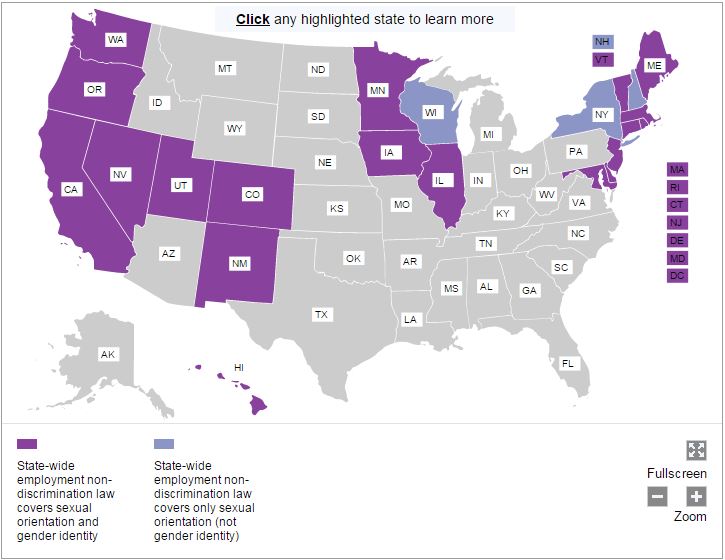
States with non-discrimination laws

(Source: ACLU)

Erik Stanley of the Alliance Defending Freedom offers advice to churches on how to respond to the Supreme Court’s decision to redefine marriage to remove the gender requirement.

He says:

[…][T]he greatest threat for churches lies in the application of the Court’s decision to believers who live in jurisdictions covered by so-called “non-discrimination” laws and ordinances. Everywhere that marriage has been redefined in the last several years has seen an awakening of non-discrimination laws that prohibit discrimination in employment, housing, or places of public accommodation on the basis of sexual orientation or gender identity. These laws are peppered throughout the states and local governments and are a linchpin of the sexual revolution’s broader legal and political strategy: to establish non-discrimination laws at all levels throughout the country and to to “ensure that religion is not used as an excuse to discriminate.”

In coming days, the threat from these non-discrimination laws will materialize in numerous ways as same-sex couples marry. But there are proactive steps your church can take to protect itself.

I put the map from the ACLU above. I think that’s what he is talking about when he says non-discrimination states. Keep in mind that the ACLU supported redefining marriage, and opposes religious liberty.

Erik’s article covers 3 areas:

  1. Church’s statement of faith
  2. Pastors officiating same-sex marriage ceremonies
  3. Church’s facility usage policy

Part 3) was the most interesting to me:

3. Churches should ensure their facilities usage policies are revised to allow only uses consistent with the church’s religious beliefs.

In the wake of the Supreme Court ruling, some churches may be approached by same-sex couples seeking to be married in the church facility. Churches should not feel as if they have to close their doors to the community just to prevent wedding ceremonies with which they disagree. Churches must continue to be a welcoming presence in the community and can do so through updating or revising their facility usage policy. The key point is to tie usage of the church’s facility to the statement of faith and religious beliefs of the church. And then to make clear that uses inconsistent with those religious beliefs will not be allowed. Alliance Defending Freedom has a sample facilities usage policy available in our Protecting Your Ministry manual.

So you update your statement of faith, and then tie usage of the the facility to that statement of faith. Simple.

I took a quick look at the booklet, and it also talked about tying employment within the church and church membership to the statement of faith.

Denny Burk summarizes those:

2. Religious Employment Criteria

Your church can best avail itself of the First Amendment’s protection in employee disputes if you create and faithfully enforce religious employment criteria for every employee. That requires churches to do at least two things: (1) require all employees and volunteers to sign a statement affirming the church’s statement of faith and standards of conduct, and (2) create written job descriptions for every employee and volunteer position.


4. Formal Membership Policy

If your church does not have a membership policy, you need to change that. Biblically, this should already be a priority for your church. You need to specify what the requirements for membership are, how one joins, how one resigns, and the procedures for church discipline. If all of this isn’t spelled out up front, your church could be exposed (see ADF guide pp. 17-18).

So what to make of this? Well, the ADF is an organization that I admire and trust. I cannot abide Christians who do not want to understand the details of what is happening with religious liberty in their country. The ADF has first class lawyers from the top law schools, and they defend religious liberty at every level of our justice system, up to and including the Supreme Court. If you want to help your church protect itself from prosecution, then you must point them to the ADF booklet linked above.

And this is especially true if you are in one of those states in the map above. In looking over the map, I noticed that much of the trouble we have been having with Christian businesses getting sued are in states that have these laws… Oregon, Washington, New Mexico, New York, and so on. Pay attention to that map and make decisions about where to live accordingly.