
Tag Archives: Health

New study: fewer than one in ten women staying home with children

Dina sent me this article from the UK Daily Mail.

Excerpt:

Fewer than one in ten women stay at home to look after their children

  • Latest census figures show 300,000 fewer staying home than thought
  • Concerns for well-being of mothers and impact on toddlers in day care
  • Stay-at-home figures dropped from 17 per cent of women 20 years ago

The stay-at-home mother is fast becoming consigned to history, according to the latest census figures.

Returns showed there are 300,000 fewer than officials  had previously estimated, with those who devote their lives to bringing up families now reduced to a tiny minority.

Fewer than one in ten women of working age are stay-at-home mothers.

The collapse follows a decade in which governments urged mothers to take jobs on the grounds that working is the route to fulfilment for women and that families with two incomes are much less likely to fall into poverty.

Critics, however, are concerned for the well-being of mothers who might prefer to be with their families, and the impact on increasing numbers of toddlers who spend long hours in day care.

The 2011 census results found there are 1,598,000 women who do not work because they are looking after their home and family – 298,000 fewer than estimates from the Office for National Statistics.

Note that this is applauded by feminist groups, like the UK Labour Party:

The decline in numbers of stay-at-home mothers will be welcomed by ministers as the Labour drive to push mothers into work has continued under the Coalition.

Childcare minister Elizabeth Truss has made a priority of providing cheaper day care to help mothers into jobs.

In an article earlier this year  she said it was ‘vital’ for mothers to work, adding: ‘To power ahead Britain needs to look at best practice from overseas to discover how to increase women’s participation, especially for those who are parents.’

But critics say the sky-high level of house prices and the lack of help for two-parent families in the tax and benefit systems means most mothers have to work, whether they like it or not.

Earlier this week I blogged studies that showed the importance of fathers to children. But it’s important to remember that mothers are also important to children, especially in the first few years of the child’s life. And we have studies to back that up as well.
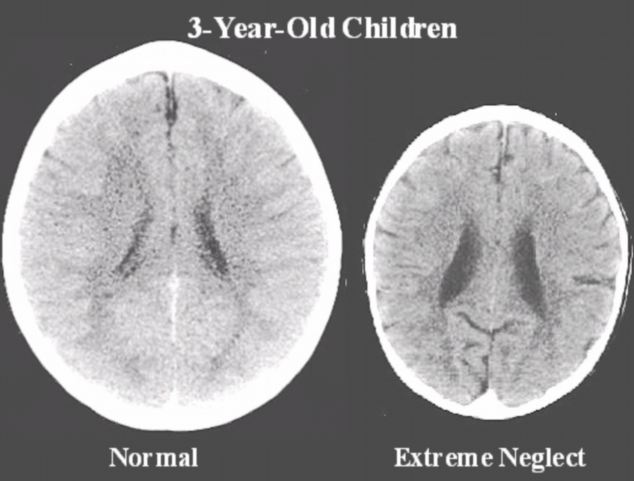
Brain scans of 3-year old children: normal vs neglected

This was discussed before in another article from the UK Daily Mail. (H/T Dina)

Excerpt:

Both of these images are brain scans of a two three-year-old children, but the brain on the left is considerably larger, has fewer spots and less dark areas, compared to the one on the right.

According to neurologists this sizeable difference has one primary cause – the way each child was treated by their mothers.

The child with the larger and more fully developed brain was looked after by its mother – she was constantly responsive to her baby, reported The Sunday Telegraph.

But the child with the shrunken brain was the victim of severe neglect and abuse.

According to research reported by the newspaper, the brain on the right worryingly lacks some of the most fundamental areas present in the image on the left.

The consequences of these deficits are pronounced – the child on the left with the larger brain will be more intelligent and more likely to develop the social ability to empathise with others.

But in contrast, the child with the shrunken brain will be more likely to become addicted to drugs and involved in violent crimes, much more likely to be unemployed and to be dependent on state benefits.

The child is also more likely to develop mental and other serious health problems.

Professor Allan Schore, of UCLA, told The Sunday Telegraph that if a baby is not treated properly in the first two years of life, it can have a fundamental impact on development.

He pointed out that the genes for several aspects of brain function, including intelligence, cannot function.

[…]The study correlates with research released earlier this year that found that children who are given love and affection from their mothers early in life are smarter with a better ability to learn.

The study by child psychiatrists and neuroscientists at Washington University School of Medicine in St. Louis, found school-aged children whose mothers nurtured them early in life have brains with a larger hippocampus, a key structure important to learning, memory and response to stress.

The research was the first to show that changes in this critical region of children’s brain anatomy are linked to a mother’s nurturing, Neurosciencenews.com reports.

The research is published online in the Proceedings of the National Academy of Sciences Early Edition.

Lead author Joan L. Luby, MD, professor of child psychiatry, said the study reinforces how important nurturing parents are to a child’s development.

If we are really interested in providing for the needs of young children, then we have to voluntarily limit the freedom of adults. Traditional marriage is the way that societies have provided for the needs of young children. Marriage puts boundaries on sexual activity (premarital chastity, post-marital fidelity) that are beneficial to children. Children need to have access to their parents over the course of their development.

We should be promoting behaviors and policies that strengthen marriage, like chastity and low tax rates. We should be opposing behaviors and policies that weaken marriages, like hooking-up and no-fault divorce. That’s what we would do if we really had the best interests of children at heart instead of the best interests of adults.

How would redefining marriage affect your marriage?

An interesting article by Ryan T. Anderson appeared on Ricochet.

First, a bit about the author.

Ryan T. Anderson researches and writes about justice and moral principles in economic thought, health care and education as the William E. Simon Fellow in Religion and a Free Society at The Heritage Foundation. He also has expertise in bioethics, marriage, religious liberty and natural law theory.

Anderson, who joined Heritage’s DeVos Center for Religion and Civil Society in 2012, also is the editor of Public Discourse, the online journal of the Witherspoon Institute of Princeton, N.J.

Anderson’s recent work focuses on the moral and constitutional questions surrounding same-sex “marriage.” He is the co-author with Princeton’s Robert P. George and Sherif Girgis of “What Is Marriage? Man and Woman: A Defense” (Encounter Books, December 2012). The three also co-wrote the article “What is Marriage?” in the winter 2011 issue of Harvard Journal of Law and Public Policy.

[…]Anderson received his bachelor of arts degree from Princeton University, graduatingPhi Beta Kappa and magna cum laude. He is a doctoral candidate in political philosophy at the University of Notre Dame, where he received his master’s degree.

The point I wanted to pull out his piece on Ricochet was that gay activists admit that one of the motives for redefining marriage is to destroy central aspects of traditional marriage, such as monogamy, sexual exclusivity and pledged permanence.

He writes:

Redefining marriage would abandon the norm of male-female sexual complementarity as an essential characteristic of marriage. Making that optional would also make other essential characteristics—like monogamy, exclusivity and permanency—optional, as my co-authors and I argue in our new book, What Is Marriage? Man and Woman: A Defense. We also show how it is increasingly confirmed by the rhetoric and arguments of those who would redefine marriage (“revisionists”) and by the policies that their more candid leaders increasingly embrace. Indeed, several commentators on Tuesday’s post explicitly jettisoned monogamy, sexual exclusivity and pledged permanence as demands of marriage.

Consider the norm of monogamy. In testifying before Congress against the Defense of Marriage Act (DOMA), prominent New York University professor Judith Stacey expressed hope that the revisionist view’s triumph would give marriage “varied, creative and adaptive contours . . . [leading some to] question the dyadic limitations of Western marriage and seek . . . small group marriages.”

In their statement “Beyond Same-Sex Marriage,” more than 300  self-styled LGBT and allied scholars and advocates—including prominent Ivy League professors—call for legally recognizing sexual relationships involving more than two partners. University of Calgary professor Elizabeth Brake argues in her book Minimizing Marriage that justice requires using legal recognition to “denormalize the ideal of heterosexual monogamy” and correct for “past discrimination against homosexuals, bisexuals, polygamists and care networks.”

And exclusivity? Andrew Sullivan, who has extolled the “spirituality” of “anonymous sex,” writes in his book Virtually Normal that the “openness” of same-sex relationships could enhance the bonds of husbands and wives:

Same-sex unions often incorporate the virtues of friendship more effectively than traditional marriages; and at times, among gay male relationships, the openness of the contract makes it more likely to survive than many heterosexual bonds. . . . [T]here is more likely to be greater understanding of the need for extramarital outlets between two men than between a man and a woman. . . . [S]omething of the gay relationship’s necessary honesty, its flexibility, and its equality could undoubtedly help strengthen and inform many heterosexual bonds.

Similarly, in a New York Times Magazine profile titled “Married, With Infidelities”, Dan Savage encourages spouses to adopt “a more flexible attitude” about allowing each other to seek sex outside their marriage. A piece titled “Monogamish” in The Advocate, a gay-interest newsmagazine, supports this point still more candidly:

Anti-equality right-wingers have long insisted that allowing gays to marry will destroy the sanctity of “traditional marriage,” and, of course, the logical, liberal party-line response has long been “No, it won’t.” But what if—for once—the sanctimonious crazies are right? Could the gay male tradition of open relationships actually alter marriage as we know it? And would that be such a bad thing?

As the article’s blurb reads: “We often protest when homophobes insist that same-sex marriage will change marriage for straight people too. But in some ways, they’re right.”

These are the words of leading supporters of same-sex marriage. If you believe in monogamy and exclusivity—and the benefits these bring to orderly procreation and child wellbeing—but would redefine civil marriage, take note.

I wrote before about how feminism debased marriage, and same-sex marriage should be viewed as phase two of the radical feminist enterprise. Surprise! These left-wing groups don’t like natural, traditional marriage.

Kevin DeYoung’s article opposing gay marriage has broad appeal

Marriage and family
Marriage and family

In my own secular case against gay marriage from last year, I argued for 3 points:

  • same-sex marriage is bad for liberty, especially religious liberty
  • same-sex marriage is bad for children
  • same-sex marriage is bad for public health

My hope when I wrote that was that pastors and other Christian leaders would learn to argue for what the Bible says by using evidence from outside the Bible, so that they would be able to appeal to more people instead of only appealing to the minority of people who accept the Bible. I think that Christians who argue for their views by citing the Bible only will only be convincing to people who already accept the Bible. But there is not a majority of people who do accept the Bible as an authority, so I think that pastors have to make another plan. They need to argue using the Bible to those who accept the Bible, and without the Bible to those who don’t accept it.

Now with that said, take a look at this article by pastor Kevin DeYoung that Dina sent me. It’s from earlier this week. The article makes the same exact three points as I made in my article last year. Let’s take a look at how Kevin does that.

My first point was liberty, especially religious liberty. He writes:

[I]n the long run, the triumph of gay marriage (should it triumph as a cultural and legal reality) will mean the restriction of freedoms for millions of Americans.

This will happen in obvious ways at first–by ostracizing those who disagree, by bullying with political correctness, and by trampling on religious liberty. Surely, Christians must realize that no matter how many caveats we issue, not matter how much we nuance our stance, no matter how much we encourage or show compassion for homosexuals, it will not be enough to ward off the charges of hatred and homophobia.

[G]ay marriage will challenge our freedoms in others way too. It’s not just Evangelicals, traditional Catholics, and Mormons who will be threatened. Once the government gains new powers, it rarely relinquishes them. There will be a soft tyranny that grows as the power of the state increases, a growth that is intrinsic to the  notion of gay marriage itself.

My second point was bad for children. He writes:

[T]he state has an interest in promoting the familial arrangement which has a mother and a father raising the children that came from their union. The state has been in the marriage business for the common good and for the well-being of the society it is supposed to protect. Kids do better with a mom and a dad. Communities do better when husbands and wives stay together. Hundreds of studies confirm both of these statements (though we all can think of individual exceptions I’m sure). Gay marriage assumes that marriage is re-definable and the moving parts replaceable.

My third point was bad for public health. He writes:

The unspoken secret, however, is that homosexual behavior is not harmless. Homosexuals are at a far greater risk for diseases like syphilis, HIV/AIDS, hepatitis, gonorrhea, HPV, and gay bowel syndrome. The high rate of these diseases is due both to widespread promiscuity in the gay community and the nature of anal and oral intercourse itself. Homosexual relationships are usually portrayed as a slight variation on the traditional “norm” of husband-wife monogamy. But monogamy is much less common among homosexual relationships, and even for those who value monogamy the definition of fidelity is much looser.

He also talks about the definition of marriage, and more.

I’ve criticized pastors before for dealing with social issues by only citing the Bible, like John Piper does. That approach won’t work on enough people to change society, because not enough people consider the Bible to be an authority in their decision-making. We have to use evidence from outside the Bible – like Wayne Grudem does in his “Politics According to the Bible”.

I think that pastor Kevin’s article is quality work, because it follows the pattern of taking an all-of-the-above approach to persuasion. He uses all means to persuade so that he might win some over to his side. I hope that many more pastors will do the same thing on this issue of marriage and other issues – even fiscal issues. Fiscal issues do have an impact on moral issues – think of how abortion subsidies and single mother welfare lower the penalties of recreational premarital sex. We can do this, we just have to do what works, instead of what makes us feel “holier-than-thou”.