

Tag Archives: Government

Ryan T. Anderson lectures on marriage and why it matters

Marriage and family
Marriage and family

Here’s the lecture:

About the speaker:

Ryan T. Anderson researches and writes about marriage and religious liberty as the William E. Simon Fellow at The Heritage Foundation. He also focuses on justice and moral principles in economic thought, health care and education, and has expertise in bioethics and natural law theory.

Anderson, who joined the leading Washington think tank’s DeVos Center for Religion and Civil Society in 2012, also is the editor of Public Discourse, the online journal of the Witherspoon Institute of Princeton, N.J.

Anderson’s recent work at Heritage focuses on the constitutional questions surrounding same-sex “marriage.” He is the co-author with Princeton’s Robert P. George and Sherif Girgis of the acclaimed book “What Is Marriage? Man and Woman: A Defense” (Encounter Books, December 2012).

The lecture starts at 7:20 in. The lecture ends at 49:35. There are 32 minutes of Q&A.

Introduction:

  • When talking about marriage in public, we should talk about philosophy, sociology and public policy
  • Gay marriage proponents need to be pressed to define what marriage is, on their view
  • Every definition of marriage is going to include some relationships, and exclude others
  • It’s meaningless to portray one side as nice and the other mean
  • Typically, marriage redefiners view marriage as a more intense emotional relationship
  • Marriage redefiners should be challenged in three ways:
  • 1) Does the redefined version of marriage have a public policy reason to prefer only two people?
  • 2) Does the redefined version of marriage have a reason to prefer permanence?
  • 3) Does the redefined version of marriage have a reason to prefer sexual exclusivity?
  • Also, if marriage is just about romance, then why is the state getting involved in recognizing it?
  • The talk: 1) What marriage is, 2) Why marriage matters, 3) What are the consequences of redefining marriage?

What marriage is:

  • Marriage unites spouses – hearts, minds and bodies
  • Marriage unites spouses to perform a good: creating a human being and raising that human being
  • Marriage is a commitment: permanent and exclusive
  • Male and female natures are distinct and complementary

The public purpose of marriage:

  • to attach men and women to each other
  • to attach mothers and fathers to their children
  • there is no such thing as parenting, there is only mothering and fathering
  • the evidence shows that children benefit from mothering and fathering
  • boys who grow up without fathers are more likely to commit crimes
  • girls who grow up without fathers are more likely to have sex earlier
  • Children benefit from having a mother and a father
  • can’t say that fathers are essential for children if we support gay marriage, which makes fathers optional
  • without marriage: child poverty increases, crime increases, social mobility decreases, welfare spending increases
  • when government encourages marriage, then government has less do to – stays smaller, spends less
  • if we promote marriage as an idea, we are not excluding gay relationships or even partner benefits
  • finally, gay marriage has shown itself to be hostile to religious liberty

Consequences redefining marriage:

  • it undermines the norm in public like that kids deserve a mom and a dad – moms and dads are interchangeable
  • it changes the institution of marriage away from the needs of children, and towards the needs of adults
  • it undermines the norm of permanence
  • we learned what happens when marriage is redefined before: with no-fault divorce
  • no-fault divorce: after this became law, divorce rates doubled – the law changed society
  • gay marriage would teach society that mothers and fathers are optional when raising children
  • if marriage is what people with intense feelings do, then how can you rationally limit marriage to only two people?
  • if marriage is what people with intense feelings do, then if other people cause intense feelings, there’s no fidelity
  • if marriage is what people with intense feelings do, then if the feelings go away, there is no permanence
  • the public policy consequences to undermining the norms of exclusivity and permanence = fatherless children and fragmented families
  • a final consequences is the decline and elimination of religious liberty – e.g. – adoption agencies closing, businesses being sued

We’re doing very well on abortion, but we need to get better at knowing how to discuss marriage. If you’re looking for something short to read, click here. If you want to read a long paper that his book is based on.
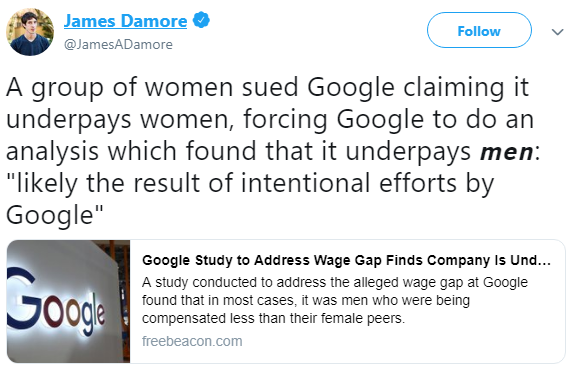

Wage gap: are women paid less than men because of discrimination?

Google pays men less than women
Far-left social media giant Google pays men less than women

Liberal feminist Hanna Rosin takes a look at this question in the far-left Slate, of all places.

Excerpt:

The official Bureau of Labor Department statistics show that the median earnings of full-time female workers is 77 percent of the median earnings of full-time male workers. But that is very different than “77 cents on the dollar for doing the same work as men.” The latter gives the impression that a man and a woman standing next to each other doing the same job for the same number of hours get paid different salaries. That’s not at all the case. “Full time” officially means 35 hours, but men work more hours than women. That’s the first problem: We could be comparing men working 40 hours to women working 35.

How to get a more accurate measure? First, instead of comparing annual wages, start by comparing average weekly wages. This is considered a slightly more accurate measure because it eliminates variables like time off during the year or annual bonuses (and yes, men get higher bonuses, but let’s shelve that for a moment in our quest for a pure wage gap number). By this measure, women earn 81 percent of what men earn, although it varies widely by race. African-American women, for example, earn 94 percent of what African-American men earn in a typical week. Then, when you restrict the comparison to men and women working 40 hours a week, the gap narrows to 87 percent.

But we’re still not close to measuring women “doing the same work as men.” For that, we’d have to adjust for many other factors that go into determining salary. Economists Francine Blau and Lawrence Kahn did that in a recent paper, “The Gender Pay Gap.”.”They first accounted for education and experience. That didn’t shift the gap very much, because women generally have at least as much and usually more education than men, and since the 1980s they have been gaining the experience. The fact that men are more likely to be in unions and have their salaries protected accounts for about 4 percent of the gap. The big differences are in occupation and industry. Women congregate in different professions than men do, and the largely male professions tend to be higher-paying. If you account for those differences, and then compare a woman and a man doing the same job, the pay gap narrows to 91 percent. So, you could accurately say in that Obama ad that, “women get paid 91 cents on the dollar for doing the same work as men.”

I believe that the remainder of the gap can be accounted for by looking at other voluntary factors that differentiate men and women.

The Heritage Foundation says that a recent study puts the number at 95 cents per dollar.

Excerpt:

Women are more likely than men to work in industries with more flexible schedules. Women are also more likely to spend time outside the labor force to care for children. These choices have benefits, but they also reduce pay—for both men and women. When economists control for such factors, they find the gender gap largely disappears.

A 2009 study commissioned by the Department of Labor found that after controlling for occupation, experience, and other choices, women earn 95 percent as much as men do. In 2005, June O’Neil, the former director of the Congressional Budget Office, found that “There is no gender gap in wages among men and women with similar family roles.” Different choices—not discrimination—account for different employment and wage outcomes.

A popular article by Carrie Lukas in the Wall Street Journal agrees.

Excerpt:

The Department of Labor’s Time Use survey shows that full-time working women spend an average of 8.01 hours per day on the job, compared to 8.75 hours for full-time working men. One would expect that someone who works 9% more would also earn more. This one fact alone accounts for more than a third of the wage gap.

[…]Recent studies have shown that the wage gap shrinks—or even reverses—when relevant factors are taken into account and comparisons are made between men and women in similar circumstances. In a 2010 study of single, childless urban workers between the ages of 22 and 30, the research firm Reach Advisors found that women earned an average of 8% more than their male counterparts. Given that women are outpacing men in educational attainment, and that our economy is increasingly geared toward knowledge-based jobs, it makes sense that women’s earnings are going up compared to men’s.

When women make different choices about education and labor that are more like what men choose, they earn just as much or more than men.

Should government get out of the marriage business?

Dr. Jennifer Roback Morse

Here are three articles by Jennifer Roback Morse posted at The Public Discourse. The articles answer the charge from social liberals and libertarians that government should “get the government out of marriage”.

Here’s the first article which talks about how government will still be involved in marriage, even if we get rid of the traditional definition of marriage, because of the need for dispute resolution in private marriage contracts. She uses no-fault divorce as an example showing how it was sold as a way to get government out of the divorce business. But by making divorce easier by making it require no reason, it increased the number of disputes and the need for more government intervention to resolve these disputes.

Here’s the second article which talks about how the government will have to expand to resolve conflicts over decisions about who counts as a parent and who gets parental rights. With traditional marriage, identifying who the parents are is easy. But with private marriage contracts where the parties are not the biological parents, there is a need for the state to step in and assign parental rights. Again, this will require an expansion of government to resolve the disputes.

Here’s the third article which talks about how marriage is necessary in order to defend the needs and rights of the child at a time when they cannot enter into contracts and be parties to legal disputes.

The third article was my favorite, so here is an excerpt from it:

The fact of childhood dependence raises a whole series of questions. How do we get from a position of helpless dependence and complete self-centeredness, to a position of independence and respect for others? Are our views of the child somehow related to the foundations of a free society? And, to ask a question that may sound like heresy to libertarian ears: Do the needs of children place legitimate demands and limitations on the behavior of adults?

I came to the conclusion that a free society needs adults who can control themselves, and who have consciences. A free society needs people who can use their freedom, without bothering other people too much. We need to respect the rights of others, keep our promises, and restrain ourselves from taking advantage of others.

We learn to do these things inside the family, by being in a relationship with our parents. We can see this by looking at attachment- disordered children and failure-to-thrive children from orphanages and foster care. These children have their material needs met, for food, clothing, and medical care. But they are not held, or loved, or looked at. They simply do not develop properly, without mothers and fathers taking personal care of them. Some of them never develop consciences. But a child without a conscience becomes a real problem: this is exactly the type of child who does whatever he can get away with. A free society can’t handle very many people like that, and still function.

In other words I asked, “Do the needs of society place constraints on how we treat children?” But even this analysis still views the child from society’s perspective. It is about time we look at it from the child’s point of view, and ask a different kind of question. What is owed to the child?

Children are entitled to a relationship with both of their parents. They are entitled to know who they are and where they came from. Therefore children have a legitimate interest in the stability of their parents’ union, since that is ordinarily how kids have relationships with both parents. If Mom and Dad are quarreling, or if they live on opposite sides of the country, the child’s connection with one or both of them is seriously impaired.

But children cannot defend their rights themselves. Nor is it adequate to intervene after the fact, after harm already has been done. Children’s relational and identity rights must be protected proactively.

Marriage is society’s institutional structure for protecting these legitimate rights and interests of children.

I recommend taking a look at all three articles and becoming familiar with the arguments in case you have to explain why marriage matters and why we should not change it. I think it is important to read these articles and to be clear that to be a libertarian doctrine does not protect the right of a child to have a relationship with both his or her parents.  Nor does libertarianism promote the idea that parents ought to stick together for their children. Libertarianism means that adults get to do what they want, and no one speaks for the kids.

The purpose of marriage is to make adults make careful commitments, and restrain their desires and feelings, so that children will have a stable environment with their biological parents nearby. We do make exceptions, but we should not celebrate exceptions and we should not subsidize exceptions. It’s not fair to children to have to grow up without a mother or father just so that adults can pursue fun and thrills.