
Tag Archives: Feminism

New study: children of working single mothers are 25% more likely to be obese

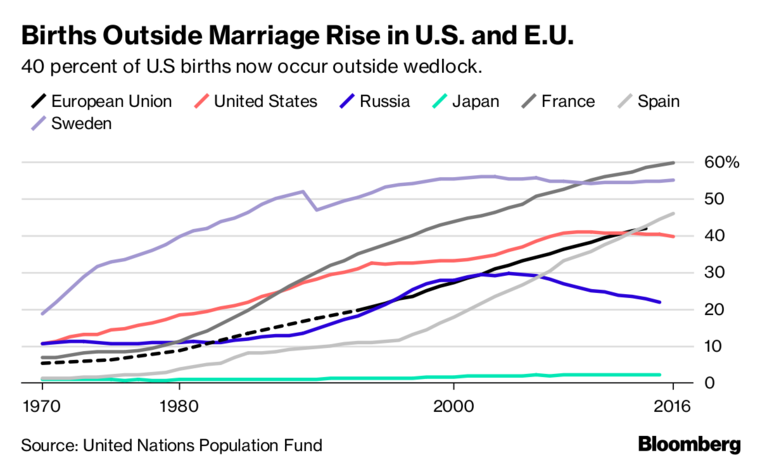
Out-of-wedlocks births rising as cohabitation replaces marriage

It’s getting to be very common for women to have children out of wedlock, especially since many countries increase welfare programs design to encourage single motherhood. That’s because of feminism, which encourages women to ignore the traditional male virtues, like commitment, and tradional commitment itself (because marriage is “sexist”). But do children do well in the fatherless homes created by feminism and welfare?

Here’s a recent study reported in the UK Sun. (H/T Thomas)

Excerpt:

SCIENTISTS have laid the blame for Britain’s childhood obesity epidemic at the door of working mothers, in a new study.

The shocking findings also claim the kids of mums who work are negatively affected – whereas the father’s employment appears to have no “significant effect”.

A study carried out by University College London looked at 20,000 families, and is the first to link mums who work to the weight of their children.

Professor Emla Fitzsimons told The Sunday Times: “We find that children whose mothers work are more likely to have increased sedentary behaviour and poorer dietary habits.”

Researchers said the bizarre findings were more obvious for single mums who work full-time, but also revealed a pattern with mums who work and have a partner.

But the study added it doesn’t matter if mums work full-time or part-time, their child is still more likely to be fatter than that of a non working mum.

It describes obesity as “the most common chronic disease of childhood and likely to persist into adulthood with far-reaching effects”.

And found teens and children have gained weight over the past four decades along with a rise in working mums – with kids of single working mothers 25 per cent more likely to be overweight.

It suggested kids of mums who work full time are 29 per cent less likely to eat a regular breakfast and 19 per cent more likely to watch TV for more than three hours a day.

The UK is one of the countries that most strongly embraced feminism, and sought to encourage fatherlessness with unfair divorce laws, unfair divorce courts, and generous benefits for women who divorced with kids or never bothered to even marry before having kids. It’s common now for UK single mothers to just have sex with the hottest guys they can find, knock out babies with all the different “fathers”, and sit back and collect welfare. Welfare funded by the ever-shrinking supply of working husbands, who typically earn the most, and therefore pay the most in taxes.

But’s not just working SINGLE mothers who have problems.

The UK Daily Mail (reporting on the same study) notes that the increase in obese children mirrors the growth in women working part-time or full-time outside the home:

[…][T]he dramatic increase in the numbers of obese children and teenagers over the past four decades had been accompanied by a similarly sharp rise in the employment of mothers.

In the UK, the proportion of working mothers with children under the age of five rose from 31 per cent in 1980 to 58 per cent in 2008.

The UK prioritized getting women out of the home and working, and handing children off to day cares and public schools. Even the conservative party refused to give women a tax incentive to raise their young children. They gave the tax credit to working mothers instead, encouraging more women to abandon their children for work.

The Root Cause of the Problem

We really need to discourage women from starting up relationships with men who aren’t interested in commitment. When women treat relationships as a source of “fun” instead of as an enterprise aimed at commitment and stability, they often end up raising fatherless kids. The problems begin with the woman’s choice of man, and her purpose for the relationship. If she expects the relationship to be about entertaining her, then she will choose an entertaining man. One who doesn’t expect her to do anything she doesn’t feel like doing, and has no particular plan for her, or raising children well.

Many women today, even Christian women, love to laugh and scorn the idea that there are any “best practices” for relationships. They know everything there is to know – without having to read any studies that might force them to control their desires and make plans to succeed that involve self-denial and wisdom. But if you ignore the studies, you can be certain that you and your children will pay the price. There’s no sense expect hunky fun bad boys to “man up” after you’ve already given them premarital sex. The time to get men to act like a man is when the woman chooses who to have a relationship with. If you choose a MAN, who protects, provides and leads on moral and spiritual issues, then you get a REAL MAN who is already MANNED UP.

The solution to problems like abortion and fatherless children is to encourage young women to make better decisions when choosing men for relationships – and to prioritize marriage as the goal of their relationships, too. It would be nice if pastors preached a little self-control, chastity and anti-feminism to women in churches. So far, though, I’ve never seen it. The Christian church approach to the problems caused by fatherlessness seems to be “let women make poor choices, then tell them it’s not their fault, then blame men”.
Wage gap: are women paid less than men because of discrimination?

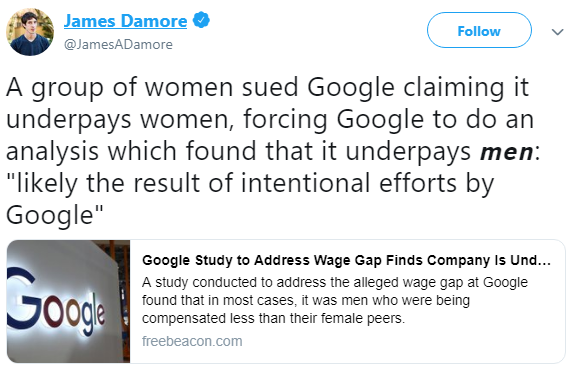
Google pays men less than women
Far-left social media giant Google pays men less than women

Liberal feminist Hanna Rosin takes a look at this question in the far-left Slate, of all places.

Excerpt:

The official Bureau of Labor Department statistics show that the median earnings of full-time female workers is 77 percent of the median earnings of full-time male workers. But that is very different than “77 cents on the dollar for doing the same work as men.” The latter gives the impression that a man and a woman standing next to each other doing the same job for the same number of hours get paid different salaries. That’s not at all the case. “Full time” officially means 35 hours, but men work more hours than women. That’s the first problem: We could be comparing men working 40 hours to women working 35.

How to get a more accurate measure? First, instead of comparing annual wages, start by comparing average weekly wages. This is considered a slightly more accurate measure because it eliminates variables like time off during the year or annual bonuses (and yes, men get higher bonuses, but let’s shelve that for a moment in our quest for a pure wage gap number). By this measure, women earn 81 percent of what men earn, although it varies widely by race. African-American women, for example, earn 94 percent of what African-American men earn in a typical week. Then, when you restrict the comparison to men and women working 40 hours a week, the gap narrows to 87 percent.

But we’re still not close to measuring women “doing the same work as men.” For that, we’d have to adjust for many other factors that go into determining salary. Economists Francine Blau and Lawrence Kahn did that in a recent paper, “The Gender Pay Gap.”.”They first accounted for education and experience. That didn’t shift the gap very much, because women generally have at least as much and usually more education than men, and since the 1980s they have been gaining the experience. The fact that men are more likely to be in unions and have their salaries protected accounts for about 4 percent of the gap. The big differences are in occupation and industry. Women congregate in different professions than men do, and the largely male professions tend to be higher-paying. If you account for those differences, and then compare a woman and a man doing the same job, the pay gap narrows to 91 percent. So, you could accurately say in that Obama ad that, “women get paid 91 cents on the dollar for doing the same work as men.”

I believe that the remainder of the gap can be accounted for by looking at other voluntary factors that differentiate men and women.

The Heritage Foundation says that a recent study puts the number at 95 cents per dollar.

Excerpt:

Women are more likely than men to work in industries with more flexible schedules. Women are also more likely to spend time outside the labor force to care for children. These choices have benefits, but they also reduce pay—for both men and women. When economists control for such factors, they find the gender gap largely disappears.

A 2009 study commissioned by the Department of Labor found that after controlling for occupation, experience, and other choices, women earn 95 percent as much as men do. In 2005, June O’Neil, the former director of the Congressional Budget Office, found that “There is no gender gap in wages among men and women with similar family roles.” Different choices—not discrimination—account for different employment and wage outcomes.

A popular article by Carrie Lukas in the Wall Street Journal agrees.

Excerpt:

The Department of Labor’s Time Use survey shows that full-time working women spend an average of 8.01 hours per day on the job, compared to 8.75 hours for full-time working men. One would expect that someone who works 9% more would also earn more. This one fact alone accounts for more than a third of the wage gap.

[…]Recent studies have shown that the wage gap shrinks—or even reverses—when relevant factors are taken into account and comparisons are made between men and women in similar circumstances. In a 2010 study of single, childless urban workers between the ages of 22 and 30, the research firm Reach Advisors found that women earned an average of 8% more than their male counterparts. Given that women are outpacing men in educational attainment, and that our economy is increasingly geared toward knowledge-based jobs, it makes sense that women’s earnings are going up compared to men’s.

When women make different choices about education and labor that are more like what men choose, they earn just as much or more than men.

Study: women seeking to have a child should start before age 32

Brain vs Heart, from: theawkwardyeti.com

Dina sent me this sobering piece of research from the New Scientist which is perfect for all the young feminists who have been taught in college that marriage should be put off, and women can easily get pregnant after age 40.

Excerpt:

It’s a question many people will ask themselves at some point in their lives: when should I start a family? If you know how many children you’d like, and whether or not you would consider, or could afford, IVF, a computer model can suggest when to start trying for your first child.

Happy with just one? The model recommends you get started by age 32 to have a 90 per cent chance of realising your dream without IVF. A brood of three would mean starting by age 23 to have the same chance of success. Wait until 35 and the odds are 50:50 (see “When to get started”).

The suggestions are based on averages pulled from a swathe of data so don’t give a personal prediction. And of course, things aren’t this simple in real life – if only family size and feelings about IVF were the only factors to consider when planning a family. But the idea behind the model is to help people make a decision by condensing all the information out there into an accessible form.

“We have tried to fill a missing link in the decision-making process,” says Dik Habbema at Erasmus University in Rotterdam, the Netherlands, one of the creators of the model. “My son is 35 and many of his friends have a problem deciding when to have children because there are so many things they want to do.”

It’s a scenario that will be familiar to many; the age at which people have their first child has been creeping up over the last 40 or so years. For example, the average age at which a woman has her first child is 28 in the UK and has reached 30 in Italy, Spain and Switzerland. In the US, the birth rate for women in their 20s has hit a record low, while the figures for those over 35 have increased over the last few decades.

The decision is more pressing for women thanks to their limited supply of eggs, which steadily drop in quantity and quality with age. Female fertility is thought to start declining at 30, with a more significant fall after the age of 35.

[…]The new model incorporates data from studies that assess how fertility naturally declines with age. The team took information on natural fertility from population data collected over 300 years up to the 1970s, which includes data on 58,000 women.

I have often tried to talk to young women about the need to get their lives in gear. I advise them to work summers during high school, obtain a STEM degree in university, minimize borrowing money by going to community college for the generic prerequisites, don’t have premarital sex, get a job related to their STEM field straight out of college, pay off their debts, move out of their parents’ house, start investing from the first paycheck, marry between age 25-30, and then start having children after the first two “stabilizing” years of marriage. This is sound advice, rooted in my careful reconnaissance of the things that human beings care about and need in their old age. This advice is not bullying, it comes from reading many, many relevant papers. It comes from putting the knowledge gained from reading the papers into practice, and seeing results where appropriate.

I am giving you the numbers. Straight out of a peer-reviewed study. Don’t follow your heart. Don’t listen to your friends. Follow the science. Make your decisions within the boundaries of reality. God will not save you from foolish decisions.

Related posts