Tag Archives: Economy

What happened to the economy after Democrats won the House and Senate in 2007?

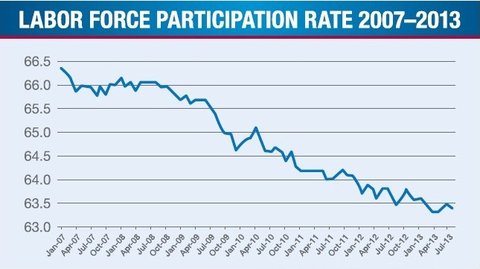
Labor Force Participation Rate from 2007 (Pelosi/Reid) to 2013

Three data points explain what happens when government gets bigger, and job creators get smaller.

First from Investors Business Daily, Obama’s failure to reduce health insurance premiums with his big government takeover of health care.

Excerpt:

The average employer-provided family health insurance premiums have climbed $2,976 since 2009, according to an annual Kaiser Family Foundation survey released this week. They’re up $3,671 compared with the year before President Obama took office. That’s despite Obama’s repeated promises that the health care reform law he championed would cut premiums by $2,500 in his first term.

And while annual premium increases have moderated over the past two years, that’s due to trends in the insurance market largely unrelated to ObamaCare, and trends the law could actually reverse.

The Kaiser survey found that the average family premium this year is $16,351, up 4% over last year, and up 22% since 2009. After adjusting for inflation, premiums climbed an average 3.2% a year in Obama’s first term, higher than the 2.7% average during President Bush’s last four years in office.

During his first campaign for president, Obama repeatedly claimed that his health reform plan would, as he said at a Virginia rally in 2008 “lower premiums by up to $2,500 for a typical family per year.”

Now, let’s take a look the second failure, as reported by the Weekly Standard.

Excerpt:

President Obama likes to talk about income inequality, but what matters far more is the actual income of the typical American.  And how has the typical American household income fared on Obama’s watch?  Well, the economic “recovery” has now spanned an Olympiad, and during that time the typical American household income has not only dropped—it has dropped more than twice as much as it did during the recession.

New estimates derived from the Census Bureau’s Current Population Survey by Sentier Research indicate that the real (inflation-adjusted) median annual household income in America has fallen by 4.4 percent during the “recovery,” after having fallen by 1.8 during the recession.  During the recession, the median American household income fell by $1,002 (from $55,480 to $54,478). During the recovery—that is, from the officially defined end of the recession (in June 2009) to the most recent month for which figures are available (June 2013)—the median American household income has fallen by $2,380 (from $54,478 to $52,098).  So the typical American household is making almost $2,400 less per year (in constant 2013 dollars) than it was four years ago, when the Obama “recovery” began.

Importantly, these income tallies include government payouts such as unemployment compensation and cash welfare. So Obama’s method of funneling ever-more money and power to Washington, and then selectively divvying some of it back out, clearly isn’t working for the typical American family.

And finally, the third example, from the Daily Caller.

Excerpt:

 In 35 states, welfare benefits pay more than a minimum wage job, according to a new study by the libertarian Cato Institute, and in 13 states welfare pays more than $15 per hour.

“One of the single best ways to climb out of poverty is taking a job, but as long as welfare provides a better standard of living than an entry-level job, recipients will continue to choose it over work,” said Michael Tanner, senior policy analyst and co-author of the study.

The study is an updated version of one Tanner put out in 1995 that estimated the full value of welfare benefits packages across the states. The 1995 study found that such tax-free welfare benefits greatly exceeded the poverty level and “their dollar value was greater than the amount of take-home income a worker would receive from an entry-level job.”

Despite efforts to curb welfare spending, many welfare programs and benefits have continued to outpace the income that many workers can receive for working an entry-level job, which disincentivizes work, according to the study.

“The current welfare system provides such a high level of benefits that it acts as a disincentive for work,” reads the study. “Welfare currently pays more than a minimum-wage job in 35 states, even after accounting for the Earned Income Tax Credit, and in 13 states it pays more than $15 per hour.”

According to the study, the federal government funds 126 separate programs designed to support low-income earners. Seventy-two of these programs provide cash or in-kind benefits to recipients. This is on top of additional welfare programs operated by state and local governments.

Welfare recipients in Hawaii get the most benefits, according to Tanner, at $29.13 per hour — or $60,590 pre-tax income annually. However, the state’s minimum wage is only $7.25 per hour, according to the Labor Department. Hawaiians on welfare also earn 167 percent of the median salary in the state, which is only $36,275.

What if a fireman showed up in front of your house on your birthday and claimed that he wanted to put out the candles on your birthday cake because they were a fire hazard? What if he read out a long, passionate, prepared speech about how much he wanted to put out fires? What if he then dumped a bucket of gasoline on your cake? What if your house caught fire and he claimed that you should let him keep throwing gas on the fire to put it out? What if you found out that this person was a lawyer and a community organizer, and knew nothing at all about putting fires out? Obama was not prepared to run the economy, and, as expected, he spent a ton of money without getting the results he said he was going to get. He gave speeches about jobs and poverty and everything he’s done has been to increase unemployment and increase poverty – and now we are $17 trillion dollars in debt. Speeches about achieving objective X during a campaign don’t necessarily translate into achieving objective X. You actually have to know what you are doing in order to achieve objectives, preferably because you’ve done it before in real life.

Wisconsin abortions decline again by 4.4% after Governor Walker’s pro-life laws

Wisconsin Governor Scott Walker

Life News reports.

Excerpt:

Abortion are on the decline in Wisconsin and they are poised to drop further thanks to new pro-life laws signed by Governor Scott Walker. Abortions dropped 7.4 percent in Wisconsin in the prior report.

Last year, Walker added to his pro-life list of accomplishments today by signing bills the pro-life movement supported, including measures to stop abortion funding in Obamacare and webcam abortions.

Wisconsin Right to Life officials told LifeNews Wisconsin abortions have decreased 68% from their all-time high in 1980 and 60% since Wisconsin began requiring abortion reporting in 1987.

[…]According to an AP report, abortions declined 4.4 percent from 2011-2012:

The Department of Health Services reported Monday that there were 6,927 abortions in 2012. That is down from 7,249 in 2011 for a drop of 4.4 percent.

It marks the third year in a row that abortions have gone down. Prior to an increase between 2008 and 2009, abortions had dropped for five straight years.

The rate of women aged 15-44 who had an abortion in 2012 was 6.1 per 1,000, down from 6.3 per 1,000 the year before. That is well below the national rate of 15.1 per 1,000 as of the most recent data available from 2009.

State law requires any facility that provides abortions to report statistics to the state.

In July, Walker signed Senate Bill 206 (Sonya’s Law) into law.  This important new law requires that women seeking abortions in Wisconsin be given the opportunity to see their unborn children through ultrasound.

Just hours before Walker signed the law, the Planned Parenthood abortion business announced it would file a lawsuit seeking to stop women from seeing these ultrasounds.

[…]After Walker signed the bill, the Planned Parenthood abortion business shut down one clinic in Appleton and another facility end abortions at another center in Green Bay.

But he’s not just a social conservative, but a fiscal conservative, too.

Excerpt:

Wisconsin is living proof that elections have consequences. The last 10 years of public policy in the state proves this, providing a sharp contrast between Republicans and Democrats and highlighting the positive results of Republican leadership.

The previous Governor left Wisconsin with a $3.6 billion budget deficit and a bleak economic outlook. In fact, during Governor Jim Doyle’s last term, Wisconsin lost over 133,000 jobs, and only 10% of employers thought our state was headed in the right direction.

At the polls in 2010, Wisconsinites elected Scott Walker and Republican majorities in the Assembly and Senate. Since taking office, Republicans have turned things around. Unlike the Democrats, who in 2009 were debating over $3 billion in tax hikes, State Republicans have been cutting taxes and eliminating regulations to foster a pro-growth environment in Wisconsin. In fact, the current budget provides nearly $1 billion in tax relief for hard-working middle class families.

In a stunning reversal of Doyle-era job loss, Wisconsin created over 14,000 jobs in June alone. The budget is balanced, and 94% of employers say our state is headed in the right direction. Furthermore, a leading economic indicator from the Federal Reserve Bank of Philadelphia just ranked Wisconsin second in the nation in jobs outlook for the next six months.

What if he were to run in 2016? Well, Scott Walker is a favorite of social conservatives, but remember that this is the same Scott Walker who took on the labor unions to limit collective bargaining and he won. His law, which has produced an economic boom in Wisconsin, is still standing. He’s showing leadership on social AND fiscal issues. It’s not just talk, it’s action. I think he should be considered in 2016, along with governors Bobby Jindal (LA), Rick Perry (TX), John Kasich (OH), and Mike Pence (IN).

Related posts

Ball State University sides with Darwinian Inquisition and against academic freedom

Evolution News reports:

In a blatant attack on academic freedom and the unfettered consideration of scientific viewpoints, the president of Ball State University (BSU) in Muncie, IN, has imposed a gag order on science faculty forbidding their discussion of the theory of intelligent design (ID) in science classrooms.

Ball State has been the focus of media attention since an extremist atheist group, the Freedom from Religion Foundation, demanded an investigation into whether Ball State physicist Dr. Eric Hedin had informed his students about the theory of ID. Dr. Hedin’s interdisciplinary honors course “Boundaries of Science” included a “Partial Bibliography” listing books favorable to, and others critical of, intelligent design.

Now BSU’s President Jo Ann Gora has declared that ID is a “religious” idea at variance with “the consensus of science scholars” and may not be discussed in science classes, since that would be a violation of “academic integrity.”

“Students and the public are owed a genuine evaluation of the merits of ID, touching as the theory does on ultimate questions of life’s origins,” responded Dr. Stephen Meyer, director of Discovery Institute’s Center for Science & Culture. “However, when scientific discussion is censored by a university, fair-minded evaluation becomes impossible.”

Dr. Meyer is the author of the recent New York Times bestseller Darwin’s Doubt, a rigorous summary of the current state of the argument for intelligent design.

“In the Orwellian world of Ball State’s president, academic freedom apparently means only the ‘freedom’ to support the majority’s view,” said Dr. John West, associate director of the Center for Science & Culture. “This is exactly how the academic ‘consensus’ against the theory of intelligent design is maintained — by intimidation, fiat, and legal threats.”

ID theorists hold that a variety of features observable and testable in living creatures and in the fossil record are best explained as the product an intelligent cause rather than an unguided process such as natural selection. Dr. Meyer’s book, for example, begins by examining the abrupt origin of complex, diverse animal life in the Cambrian era, 530 million years ago.

Not unexpected, given what we knew about the panel charged with evaluating Dr. Hedin’s course.

But I do have some good news today. Tune in at 2 PM to read my report on yet another new peer-reviewed paper hostile to Darwinism.

Related posts