
Tag Archives: Drug Abuse

Study explains why college women abandon courtship for hook-ups

This study is from the Institute for American Values. It was done by Elizabeth Marquardt.

The PDF of study is here.

If you download the 88 page PDF, the first few pages are an executive summary.

I’d been exposed to this research before when I read Dr. Miriam Grossmann’s book “Unprotected”. (Boundless review here) I just got Dr. Miriam Grossmann’s new book “You’re Teaching My Child What?” and I also got Elizabeth Marquardt’s new book “Between Two Worlds: The Inner Lives of Children of Divorce”. I don’t think either of them is conservative, but I like their research anyway.

There are a couple of things that really struck me about this IAV study on hooking-up.

First, this one from p. 15:

A notable feature of hook ups is that they almost always occur when both participants are drinking or drunk.

A Rutgers University student observed, “You always hear people say, oh my gosh, I was so drunk, I hooked up with so and so…” Perhaps not surprisingly, many noted that being drunk helped to loosen one’s inhibitions and make it easier to hook up. A number of students noted that being drunk could later serve as your excuse for the hook up. A Yale University student said, “Some people like hook up because they’re drunk or use being drunk as an excuse to hook up.” A New York University student observed, “[Alcohol is] just part of an excuse, so that you can say, oh, well, I was drinking.”

A Rutgers University student commented, “If you’re drinking a lot it’s easier to hook up with someone… [and] drugs, it’s kind of like a bonding thing… and then if you hook up with them and you don’t want to speak to them again, you can always blame it on the drinking or the drugs.”

Other women observed that being drunk gives a woman license to act sexually interested in public in ways that would not be tolerated if she were sober. For instance, a University of Michigan student said, “Girls are actually allowed to be a lot more sexual when they are drunk…”

A University of Chicago junior observed, “One of my best friends… sometimes that’s her goal when we go out. Like she wants to get drunk so I guess she doesn’t have to feel guilty about [hooking up].”

Some reported that drinking had led them to do things they later regretted. A University of Virginia student said, “My last random hook up was last October and it was bad. I was drunk and I just regretted it very much.”

And this one from p. 30 on the effects of hooking-up on their future commitments:

A few women did see an unambiguous connection between present relationships and future marriage.

[…]Many women either saw little or no connection between present and future relationships, or their understanding of this connection was curiously flat. A student at New York University said, “[The present and the future are] connected because I will still have the same values and principles that I have now, but I just won’t be single anymore.”A number of women said that the present and the future are connected because whatever heartache or confusion they experience now gives them lessons for the future.

A University of Michigan student said, “Early relationships prepare you for marriage because it’s like, oh, what type of person do I want to be with? Oh, I’ve had these bad experiences. Or, I’ve learned from this relationship that I should do this and I shouldn’t do this.”

A sophomore at Howard University said that “I am kind of learning from a lot of the mistakes that I have made.” At a further extreme, some women saw their future marriage as the reason to experiment widely in the present. A Rutgers University student said,“I think hooking up with different people and seeing what you like and don’t like is a good idea. Because eventually you’re going to have to… marry someone and I’d just like to know that I experienced everything.”

Although it is admirable to take risks and learn from one’s mistakes, these women would probably find it difficult to explain how having your heart broken a few or even many times in your early years — or trying to separate sex from feeling, as in hooking up — is good preparation for a trusting and happy marriage later on.

And on p. 42, we learn what women think marriage is and isn’t for:

For instance, in the on-campus interviews one student complained, “[With] marriage…you have to debate everything… Why do you need a piece of paper to bond a person to you? …But I know if I don’t get married I’ll probably feel like… [a] lonely old woman… If anything, I’d get married [because of] that.”

This student went on to say that she would be satisfied to live with a man, but added that, if the man was committed to her, he would offer to marry her, and that this was the kind of commitment that she wanted. A student at the University of Washington said,“I don’t want to get married right after I graduate from college. I just think that would stunt my growth in every way that there is. I would like to be in a very steady, committed relationship with a guy.”

And on p. 44, we learn that they like co-habitation, which increases the risk of divorce by about 50% (but they don’t know that):

In the national survey, 58 percent of the respondents agreed that “It is a good idea to live with someone before deciding to marry him.” This belief often coexists with a strong desire to marry, because it was embraced by 49 percent of the respondents who strongly agreed that marriage was a very important goal for them.

[…]Women we interviewed on campus reflected a similar range of attitudes about cohabitation. Some women thought that cohabitation was a good way to test whether one could spend a lifetime with a potential partner. In such cases, women often cited fears of divorce as the reason for trying cohabitation first. A senior at the University of Washington said, “I kind of don’t really see marriages work ever, so I want to make sure that everything’s all right before [we get married]. I don’t see how people can get married without living together because I know like I have a best friend and I live with her and we want to kill each other, like, every few months.”

Other women felt that, in an age of divorce, cohabitation was a preferable alternative to marriage. A student at New York University said, “You see so [many] people getting divorces… I just don’t see the necessity [of marriage].” She went on to say, “I think that I don’t have to be married to [the] person that I’m with…. You know like… Goldie Hawn [and Kurt Russell]? They’re not married.”

But let’s get back to the drinking and the hook-up sex…

Once a woman abandons femininity for feminism, then sex is all that she can use to get noticed by a man. Men are like hiring managers, and courting is like a job interview for the job of marriage and mothering. If a woman tries to get the job by having sex with the interviewer, he isn’t going to hire her since sex has nothing to do with the job. There are children involved, you know – he has to think of them when he makes the hiring decision. But women have been taught to think bad things about men (they’re rapists) and marriage (it’s slavery) by feminists – so they don’t even try to understand men, or to respect men, or prepare their character for being a wife and mother. Feminists just don’t understand that hard work is needed to understand men and prepare for marriage.

In a previous post, I explained how feminists wanted to get women to drink like men, have sex like men, and to abolish courtship and marriage. Under the influence of feminism and Hollywood celebrities, women began to choose men to have sex with without any consideration of morality, religion, marriage, etc. They thought that sex was an easy way to trick a man into committing to them without having to treat him like a real person, or to take the demands of marriage and parenting seriously. (They have been taught to value education and careers over husbands and children, you understand). This results in a cycle of binge-drinking, one-night-stands, cheating, co-habitating, breaking-up, stalking, aborting, etc., until the woman’s ability to trust and love anyone but herself is completely destroyed. And yet these college women somehow believe this is “adventurous”, that it makes them feel “sexy”, and that the experience of being selfish and seeing the worst kind of men acting in the worst possible ways, point blank, somehow prepares them for marriage and motherhood.

Often, a young unmarried woman’s biological father was NOT selected by her mother based on his ability to make commitments and moral judgments. Many feminists prefer men who do not judge women morally, nor impose his religion on her. But those very things that young unmarried  women today seem to dislike most about men, because they fear rejection on moral and religious grounds, are exactly the things that make men good husbands and fathers. They don’t want to be judged or led spiritually, so they choose immoral, non-religious men. Men who are not firm on morality and religion do cannot be counted on to act morally and self-sacrificially. And when they fail, and the marriages break up, the children grow up fatherless and may develop negative views of men.

Every young unmarried woman who chooses a bad man, and then has a bad experience with him is pushing away marriage with both hands. The more she destroys her ability to trust, love and care for others, the less she is able to be happy and effective in a marriage.
Read Theodore Dalrymple’s “Life at the Bottom” online for free

I want to recommend that you read a book that is available online for free.

The author  is a psychiatrist in a British hospital that deals with a lot of criminals and victims of crime. So he gets to see the worldview of the “underclass” up close, and to understand how the policies of the compassionate secular left are really working at the street level. The theme of the book is that the left advances policies in order to feel good about themselves, even though the policies actually hurt the poor and vulnerable far more than they help them. And the solution of the elites is more of the same.

The whole book is available ONLINE for free! From City Journal!

Table of Contents

The Knife Went In 5
Goodbye, Cruel World 15
Reader, She Married Him–Alas 26
Tough Love 36
It Hurts, Therefore I Am 48
Festivity, and Menace 58
We Don’t Want No Education 68
Uncouth Chic 78
The Heart of a Heartless World 89
There’s No Damned Merit in It 102
Choosing to Fail 114
Free to Choose 124
What Is Poverty? 134
Do Sties Make Pigs? 144
Lost in the Ghetto 155
And Dying Thus Around Us Every Day 167
The Rush from Judgment 181
What Causes Crime? 195
How Criminologists Foster Crime 208
Policemen in Wonderland 221
Zero Intolerance 233
Seeing Is Not Believing 244

Lots more essays are here, all from City Journal.

My favorite passage

The only bad thing about reading it online is that you miss one of the best quotes from the introduction. But I’ll type it out for you.

The disastrous pattern of human relationships that exists in the underclass is also becoming common higher up the social scale. With increasing frequency I am consulted by nurses, who for the most part come from and were themselves traditionally members of (at least after Florence Nightingale) the respectable lower middle class, who have illegitimate children by men who first abuse and then abandon them. This abuse and later abandonment is usually all too predictable from the man’s previous history and character; but the nurses who have been treated in this way say they refrained from making a judgment about him because it is wrong to make judgments. But if they do not make a judgment about the man with whom they are going to live and by whom they are going to have a child, about what are they ever going to make a judgment?

“It just didn’t work out,” they say, the “it” in question being the relationship that they conceive of having an existence independent of the two people who form it, and that exerts an influence on their on their lives rather like an astral projection. Life is fate.

This is something I run into myself. I think that young people today prefer moral relativists as mates, because they are afraid of being judged and rejected by people who are too serious about religion and morality. The problem is that if you choose someone who doesn’t take religion and morality seriously, then you can’t rely on them to behave morally and exercise spiritual leadership when raising children. And being sexually involved with someone who doesn’t take morality seriously causes a lot of damage.

An excerpt

Here’s one of my favorite passages from “Tough Love”, in which he describes how easily he can detect whether a particular man has violent tendencies on sight, whereas female victims of domestic violence – and even the hospital nurses – will not recognize the same signs.

All the more surprising is it to me, therefore, that the nurses perceive things differently. They do not see a man’s violence in his face, his gestures, his deportment, and his bodily adornments, even though they have the same experience of the patients as I. They hear the same stories, they see the same signs, but they do not make the same judgments. What’s more, they seem never to learn; for experience—like chance, in the famous dictum of Louis Pasteur—favors only the mind prepared. And when I guess at a glance that a man is an inveterate wife beater (I use the term “wife” loosely), they are appalled at the harshness of my judgment, even when it proves right once more.

This is not a matter of merely theoretical interest to the nurses, for many of them in their private lives have themselves been the compliant victims of violent men. For example, the lover of one of the senior nurses, an attractive and lively young woman, recently held her at gunpoint and threatened her with death, after having repeatedly blacked her eye during the previous months. I met him once when he came looking for her in the hospital: he was just the kind of ferocious young egotist to whom I would give a wide berth in the broadest daylight.

Why are the nurses so reluctant to come to the most inescapable of conclusions? Their training tells them, quite rightly, that it is their duty to care for everyone without regard for personal merit or deserts; but for them, there is no difference between suspending judgment for certain restricted purposes and making no judgment at all in any circumstances whatsoever. It is as if they were more afraid of passing an adverse verdict on someone than of getting a punch in the face—a likely enough consequence, incidentally, of their failure of discernment. Since it is scarcely possible to recognize a wife beater without inwardly condemning him, it is safer not to recognize him as one in the first place.

This failure of recognition is almost universal among my violently abused women patients, but its function for them is somewhat different from what it is for the nurses. The nurses need to retain a certain positive regard for their patients in order to do their job. But for the abused women, the failure to perceive in advance the violence of their chosen men serves to absolve them of all responsibility for whatever happens thereafter, allowing them to think of themselves as victims alone rather than the victims and accomplices they are. Moreover, it licenses them to obey their impulses and whims, allowing them to suppose that sexual attractiveness is the measure of all things and that prudence in the selection of a male companion is neither possible nor desirable.

Often, their imprudence would be laughable, were it not tragic: many times in my ward I’ve watched liaisons form between an abused female patient and an abusing male patient within half an hour of their striking up an acquaintance. By now, I can often predict the formation of such a liaison—and predict that it will as certainly end in violence as that the sun will rise tomorrow.

At first, of course, my female patients deny that the violence of their men was foreseeable. But when I ask them whether they think I would have recognized it in advance, the great majority—nine out of ten—reply, yes, of course. And when asked how they think I would have done so, they enumerate precisely the factors that would have led me to that conclusion. So their blindness is willful.

Go read the rest!

Book reviews

GAO: Green River Formation has more oil than the rest of the world combined

Remember when Obama said that we have “2 percent of the world’s oil reserves”?

This is an excerpt from his own speech:

As a country that has 2 percent of the world’s oil reserves, but uses 20 percent of the world’s oil — I’m going to repeat that — we’ve got 2 percent of the world oil reserves; we use 20 percent.  What that means is, as much as we’re doing to increase oil production, we’re not going to be able to just drill our way out of the problem of high gas prices.  Anybody who tells you otherwise either doesn’t know what they’re talking about or they aren’t telling you the truth.

Now let’s find out who doesn’t know what they’re talking about and who isn’t telling the truth.

The Government Accountability Office – a department of the federal government – tells us the facts.

Excerpt:

The Green River Formation, a largely vacant area of mostly federal land that covers the territory where Colorado, Utah and Wyoming come together, contains about as much recoverable oil as all the rest the world’s proven reserves combined, an auditor from the Government Accountability Office told Congress on Thursday.

The GAO testimony said that the federal government was in “a unique position to influence the development of oil shale” because the Green River deposits were mostly beneath federal land.

[…]It also noted that developing the oil would have an environmental impact and pose “socioeconomic challenges,” that included bringing “a sizable influx of workers who along with their families put additional stress on local infrastructure” and “making planning for growth difficult for local governments.”

“The Green River Formation–an assemblage of over 1,000 feet of sedimentary rocks that lie beneath parts of Colorado, Utah, and Wyoming–contains the world’s largest deposits of oil shale,”Anu K. Mittal, the GAO’s director of natural resources and environment said in written testimony submitted to the House Science Subcommittee on Energy and Environment.

“USGS estimates that the Green River Formation contains about 3 trillion barrels of oil, and about half of this may be recoverable, depending on available technology and economic conditions,” Mittal testified.

“The Rand Corporation, a nonprofit research organization, estimates that 30 to 60 percent of the oil shale in the Green River Formation can be recovered,” Mittal told the subcommittee. “At the midpoint of this estimate, almost half of the 3 trillion barrels of oil would be recoverable. This is an amount about equal to the entire world’s proven oil reserves.”

In her oral statement before the subcommittee, Mittal said that developing the shale oil would create wealth and jobs for the country, but also challenges for government.

“Being able to tap this vast amount of oil locked within this formation will go a long way to help to meet our future demands for oil. The U.S. Geological Survey, as you noted, estimates that the formation contains about 3 trillion barrels of oil of which half may be recoverable,” she said.

“As you can imagine having the technology to develop this vast energy resource will lead to a number of important socioeconomic benefits including the creation of jobs, increases in wealth and increases in tax and royalty payments for federal and state governments,” she said.

[…]In her written testimony, Mittal noted that three-fourths of the Green River shale oil is under federal land.

Is Barack Obama a good President? Does he know how to be President? Does he understand economics?

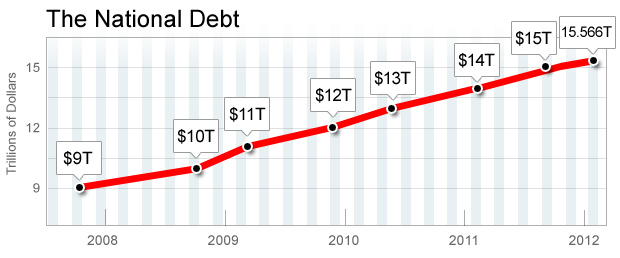
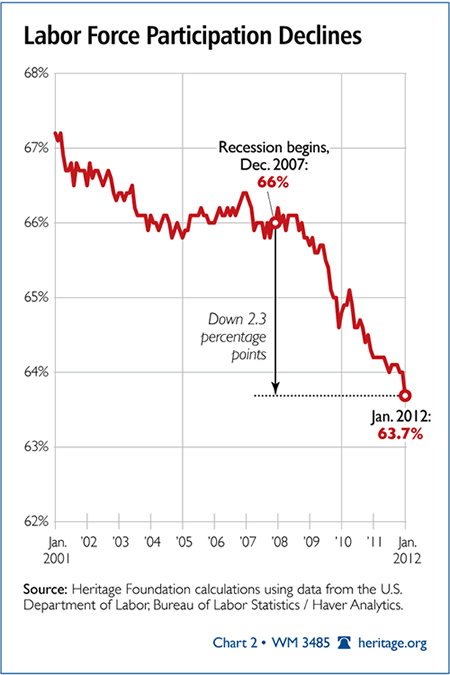
Let’s look at the national debt and the labor force participation rates in Obama’s first term. Recall that the Republicans lost the House and Senate in January of 2007. At the time of the Pelosi/Reid takeover, the national debt was $8 trillion. It is now almost double that at $16 trillion.

Obama added 5 trillion dollars to the debt since he took office
US Labor Force Participation down 4.9 million people

If these numbers seem bad to you, then I don’t think you should vote for Obama.