
Tag Archives: Day Care

New study by HHS: Head Start early childhood education programs don’t work

This story is from last month, but I wanted to post about a government study that evaluated the government’s own Head Start early childhood education programs.

Fox News reports on the study.

Excerpt:

Head Start is an $8 billion per year federal preschool program, designed to improve the kindergarten readiness of low-income children. Since its inception in1965, taxpayers have spent more than $180 billion on the program.

But HHS’ latest Head Start Impact Study found taxpayers aren’t getting a good return on this “investment.”  According to the congressionally-mandated report, Head Start has little to no impact on cognitive, social-emotional, health, or parenting practices of its participants. In fact, on a few measures, access to the program actually produced negative effects.

The HHS’ scientifically-rigorous study tracked 5,000 children who were randomly assigned to either a group receiving Head Start services or a group that did not participate in Head Start. It followed their progression from ages three or four through the end of third grade.  The third-grade evaluation is a continuation to HHS’ first-grade study, which followed children through the end of first grade.

The first-grade evaluation found that any benefits the children may have accrued while in the Head Start program had dissipated by the time they reached first grade.

The study also revealed that Head Start failed to improve the literacy, math and language skills of the four year-old cohort and had a negative impact on the teacher-assessed math ability of the three-year-old cohort.

More here from the Heritage Foundation:

In a newly released paper, Heritage’s Lindsey Burke and David Muhlhausen discuss the findings, summarized as follows:

  • Cognitive development. Of 11 measures of cognitive ability—including reading, language, and math ability—access to Head Start made no difference for either three- or four-year-old students on any outcomes.
  • Social-emotional development. Of 19 measures of social-emotional development—such as aggression, hyperactive behavior, and conduct problems—for the three-year-old cohort, access to Head Start was connected to a slight benefit in “social skills and positive approaches to learning,” as reported by parents, but it had no impact on any of the other outcomes. For four-year-olds, Head Start was associated with a small decrease in aggressive behavior but also appeared to be significantly linked to harmful impacts, including higher teacher reports of “an unfavorable impact on the incidence of children’s emotional symptoms,” as well as poorer peer relations.
  • Child health outcomes. Of five measures of health outcomes, Head Start made no difference for either group, including no impact on “receipt of dental care, health insurance coverage, and overall child health status being excellent or good.”
  • Parenting outcomes. Of the 10 measures of parental outcomes, Head Start appeared to have only one benefit for each group. Parents of the three-year-old cohort reported higher levels of authoritative parenting, and parents of the four-year-old cohort reported spending more time with their children.

After five decades, Head Start continues to default on its aim to boost school readiness. In addition to the program’s overall ineffectiveness, there are government reports of fraud in the program. Yet Head Start continues to receive billions of taxpayer dollars every year. Since Head Start began, more than $180 billion taxpayer dollars have been spent to fund it—and Congress is currently contemplating allocating millions of extra dollars to the program through the supplemental aid package for Hurricane Sandy victims.

The article also points out how the HHS sat on the report for 4 years – they finished their data collection in 2008. I found it interesting that Obama wants to spend MORE money on these programs, even though they don’t work.

New study: fewer than one in ten women staying home with children

Dina sent me this article from the UK Daily Mail.

Excerpt:

Fewer than one in ten women stay at home to look after their children

  • Latest census figures show 300,000 fewer staying home than thought
  • Concerns for well-being of mothers and impact on toddlers in day care
  • Stay-at-home figures dropped from 17 per cent of women 20 years ago

The stay-at-home mother is fast becoming consigned to history, according to the latest census figures.

Returns showed there are 300,000 fewer than officials  had previously estimated, with those who devote their lives to bringing up families now reduced to a tiny minority.

Fewer than one in ten women of working age are stay-at-home mothers.

The collapse follows a decade in which governments urged mothers to take jobs on the grounds that working is the route to fulfilment for women and that families with two incomes are much less likely to fall into poverty.

Critics, however, are concerned for the well-being of mothers who might prefer to be with their families, and the impact on increasing numbers of toddlers who spend long hours in day care.

The 2011 census results found there are 1,598,000 women who do not work because they are looking after their home and family – 298,000 fewer than estimates from the Office for National Statistics.

Note that this is applauded by feminist groups, like the UK Labour Party:

The decline in numbers of stay-at-home mothers will be welcomed by ministers as the Labour drive to push mothers into work has continued under the Coalition.

Childcare minister Elizabeth Truss has made a priority of providing cheaper day care to help mothers into jobs.

In an article earlier this year  she said it was ‘vital’ for mothers to work, adding: ‘To power ahead Britain needs to look at best practice from overseas to discover how to increase women’s participation, especially for those who are parents.’

But critics say the sky-high level of house prices and the lack of help for two-parent families in the tax and benefit systems means most mothers have to work, whether they like it or not.

Earlier this week I blogged studies that showed the importance of fathers to children. But it’s important to remember that mothers are also important to children, especially in the first few years of the child’s life. And we have studies to back that up as well.

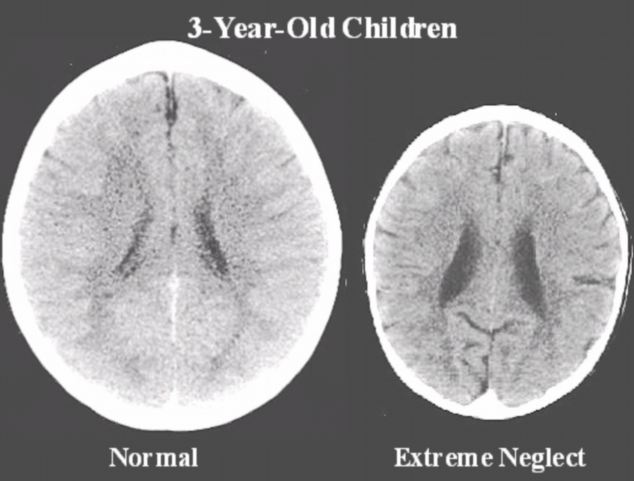
Brain scans of 3-year old children: normal vs neglected

This was discussed before in another article from the UK Daily Mail. (H/T Dina)

Excerpt:

Both of these images are brain scans of a two three-year-old children, but the brain on the left is considerably larger, has fewer spots and less dark areas, compared to the one on the right.

According to neurologists this sizeable difference has one primary cause – the way each child was treated by their mothers.

The child with the larger and more fully developed brain was looked after by its mother – she was constantly responsive to her baby, reported The Sunday Telegraph.

But the child with the shrunken brain was the victim of severe neglect and abuse.

According to research reported by the newspaper, the brain on the right worryingly lacks some of the most fundamental areas present in the image on the left.

The consequences of these deficits are pronounced – the child on the left with the larger brain will be more intelligent and more likely to develop the social ability to empathise with others.

But in contrast, the child with the shrunken brain will be more likely to become addicted to drugs and involved in violent crimes, much more likely to be unemployed and to be dependent on state benefits.

The child is also more likely to develop mental and other serious health problems.

Professor Allan Schore, of UCLA, told The Sunday Telegraph that if a baby is not treated properly in the first two years of life, it can have a fundamental impact on development.

He pointed out that the genes for several aspects of brain function, including intelligence, cannot function.

[…]The study correlates with research released earlier this year that found that children who are given love and affection from their mothers early in life are smarter with a better ability to learn.

The study by child psychiatrists and neuroscientists at Washington University School of Medicine in St. Louis, found school-aged children whose mothers nurtured them early in life have brains with a larger hippocampus, a key structure important to learning, memory and response to stress.

The research was the first to show that changes in this critical region of children’s brain anatomy are linked to a mother’s nurturing, Neurosciencenews.com reports.

The research is published online in the Proceedings of the National Academy of Sciences Early Edition.

Lead author Joan L. Luby, MD, professor of child psychiatry, said the study reinforces how important nurturing parents are to a child’s development.

If we are really interested in providing for the needs of young children, then we have to voluntarily limit the freedom of adults. Traditional marriage is the way that societies have provided for the needs of young children. Marriage puts boundaries on sexual activity (premarital chastity, post-marital fidelity) that are beneficial to children. Children need to have access to their parents over the course of their development.

We should be promoting behaviors and policies that strengthen marriage, like chastity and low tax rates. We should be opposing behaviors and policies that weaken marriages, like hooking-up and no-fault divorce. That’s what we would do if we really had the best interests of children at heart instead of the best interests of adults.

Single mothers are better off with a $29,000 job and welfare than with a $69,000 job

Socialism subsidizes single motherhood by choice

(click for larger image)

James Pethokoukis of the American Enterprise Institute explains how the welfare state discourages women from getting married before they have children.

Excerpt:

The U.S. welfare system sure creates some crazy disincentives to working your way up the ladder. Benefits stacked upon benefits can mean it is financially better, at least in the short term, to stay at a lower-paying jobs rather than taking a higher paying job and losing those benefits. This is called the “welfare cliff.”

Let’s take the example of a single mom with two kids, 1 and 4. She has a $29,000 a year job, putting the kids in daycare during the day while she works.

As the above chart  – via Gary Alexander, Pennsylvania’s secretary of Public Welfare — shows, the single mom is better off earning gross income of $29,000 with $57,327 in net income and benefits than to earn gross income of $69,000 with net income & benefits of $57,045.

It would sure be tempting for that mom to keep the status quo rather than take the new job, even though the new position might lead to further career advancement and a higher standard of living. I guess this is something the Obama White House forgot to mention in its “Life of Julia” cartoons extolling government assistance.

Fatherlessness is absolutely horrible for children across the board. Not just in terms of their development, but also their material well-being and their physical safety. Fatherlessness is a loss in three ways for children. The federal government should NOT be taking money from good married households and transferring it to women who decline to marry before choosing to have reckless, irresponsible recreational sex.